White Monkey Chronicles: Myth-busting in Eden BOOK REVIEW by BJ Austin

I binge-read White Monkey Chronicles The Complete Trilogy. The first time. It’s like Douglas Adams, Kurt Vonnegut, J.K. Rowling and Gloria Steinem got drunk one night and decided to write a book.  A second, slower read was even sweeter.

The first paragraph of the Prologue tipped me headfirst and wide-eyed into this mind-bending, myth-busting, topsy-turvy tale. Its innocuous, traditional “Once Upon” opening was immediately blown up by the explosive words “infant deity abandoned,”, “famous bachelor Jew,”, and “A-list Hindu”.  Wait. Whaaat? The stage was set for a rebellious, revolutionary saga destined to be voted “Most Popular” at a fundamentalist book burning!

A white monkey (part-time Plush toy, full-time guardian of an off-the-record baby boy deity) sets the book’s roller coaster ride in motion on a snowy night in Humbolt County, USA. There, at the withered and weathered Sisters of Immaculate Conceptions convent, we meet the three remaining Sister-resisters of The Great Church’s preening patriarchy. (Lets just say the clergy is strictly for the birds — in dress and demeanor.) Getting a whiff of the unauthorized deity’s arrival, a conclave of Cardinals swoop in to confirm (and possibly kidnap) the threatening newborn from the kind, caring, and radical hands of the rogue nuns. Not so fast. Continue reading “White Monkey Chronicles: Myth-busting in Eden BOOK REVIEW by BJ Austin”

Pro-Choice and Christian: Reconciling Faith, Politics, and Justice BOOK REVIEW by Katie M. Deaver

In 2015 Kira Schlesinger wrote piece for Ministry Matters about how her own pro-choice stance on abortion had become more complicated the more she explored the issue of abortion. The article was widely read and shared, as well as hotly debated by many. You can read this article and the many comments here. Out of the response to this article grew Schlesinger’s Pro-Choice and Christian: Reconciling Faith, Politics, and Justice.

The book does a great job of walking the fine line of being both academically engaging and an easy enough read to engage a book or Bible study group as well. Schlesinger uses the first couple of chapters to dig into the history of abortion, listing recorded examples of the process as early as 1300 BCE. From there she briefly walks the reader through the roughly 100 years (Comstock Act in 1873 until Roe v. Wade in 1973) during which abortion was illegal in the United States. Finally, she wraps up this beginning historical section with details about the generations after Roe v. Wade up to our current reality.

Continue reading “Pro-Choice and Christian: Reconciling Faith, Politics, and Justice BOOK REVIEW by Katie M. Deaver”

Temple Magdalen by Elizabeth Cunningham

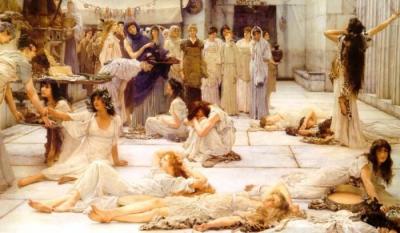
The Women of Amphissa, 1887, by Lawrence Alma-Tadema

Since I began writing for FAR in July 2012, I have written about Mary Magdalen, or excerpted a passage from one of my novels, near or on her July 22 Feast Day. For why I made the controversial choice to depict her as a prostitute, see last year’s post. The below excerpt is from The Passion of Mary Magdalen. I made this selection in remembrance of all the refugees in the world today. In this passage, Judith, a Jewish widow whose family was driven from the land by tax collectors, returns to the place where Maeve (my fictional Celtic Magdalen) and her friends have recently founded a Temple to Isis on the outskirts of Magdala. Maeve has just invited Judith to join them. (Edited for brevity.)

She stared at me, her eyes full of anger and longing.

“I will not be a slave and a whore where I was once a wife, the one who made the challah bread, who said the Sabbath prayers over it. This was our place, my husband’s and mine. We brought the best we had to the temple, the finest oil and wine, the unblemished kid—”

“Goats? You kept goats? You know how to make cheese?”

She sat quietly for a moment before she answered. “How can I live here with you?” she wondered. “I don’t understand.”

Continue reading “Temple Magdalen by Elizabeth Cunningham”

Beaches and Books by Esther Nelson

Even though I’ve traveled and lived throughout much of the world, I’ve never thought of any one place or geographic location as home.  I have always felt a little envious of people who claim to have a strong, visceral connection to a particular house, garden, village, landscape, or city in a specific, geographic area.

We often use the word home to indicate a space where we feel accepted, safe, nurtured, loved, and at peace.  Although I’ve never sunk deep roots anywhere I’ve lived—or even visited—I feel most grounded when standing on a sandy beach anywhere in the world, overlooking an expansive view of the ocean.  Perhaps the cowboys in American folklore and legend felt “home, home on the range where the deer and the antelope play,” but I don’t.  I am much more at ease with home, home on the beach where the wind swirls the water and sand.

I often hear the beach calling me.  Sometimes I listen and allow myself to fall under her spell and into her fluid embrace.

Continue reading “Beaches and Books by Esther Nelson”

Lessons Mothers Might Teach Their Daughters by Elisabeth Schilling

There might be lots of lessons to consider. These lessons might have holes, for I’m not a wise sage, and I’m not really even a mother. As I am a couple of years from 40, I think about what lessons I would teach my daughter if I had one, lessons to honor her physicality, lessons to create space for her soul. What do you think of these lessons? Would I be a bad mother?

  1. Be self-sufficient, and work hard and do it early.

I think there is much to say about a woman making her own money so that she can be in relationships that honor her tendencies and desires and contribute in those relationships financially. I’m not sure why it is, but I still feel that we are in a time where most men are more given the idea they should be self-sufficient and work hard and early to do it and many women, although perhaps a hint of this, would not have this as the core of who they are. A woman should have her own money so that she can be free.

  1. Find a spirituality and a community that allows you to be confident in your internal wisdom and body and support learning about life skills.

Continue reading “Lessons Mothers Might Teach Their Daughters by Elisabeth Schilling”

Advocating Respect for Goddess by Susan de Gaia

I served as general editor for the recently published Encyclopedia of Women in World Religions: Faith and Culture Across History (2018/19 ABC-CLIO). It was an honor and a pleasure to work with a hundred and thirty wonderful scholars, many with expertise in female divinities. In working with a publishing house on this project, I negotiated for the capitalization of Goddess and other terms for the Female Divine.  

‘I recommend not capitalizing “goddess”’ – was the first reply I got on this question. It came from Anne, the development editor assigned to the project. Negotiations ensued. Continue reading “Advocating Respect for Goddess by Susan de Gaia”

Marianne Williamson. . . I’m Sacredly Smitten by Elisabeth Schilling

I caution myself to be critical and nuanced. I’m sorry, folks. I just haven’t had such dazzling hope or remote interest in politics since. . . well, since I was a puppet junior high evangelist for an independent candidate my Dad liked, and I don’t want to try to remember who it was. But I was 13. And I’m 38 now. What hath made this cold, indifferent, anxious millennial’s soul to warm?

I am into mindfulness, contemplative studies, Eckhart Tolle, Don Miguel Ruiz, Nhat Thich Hanh, the kind of comparative religious studies scholar who has eastern spirituality leanings, so when I heard Marianne Williamson was a presidential candidate, I got curious. I’ve not read A Course in Miracles (although I think I’ve avoided it for the same assumptions Williamson says she initially made) or actually any of her books. Williamson is Jewish and has a pluralistic perspective when it comes to noting the basic underlying wisdom of all religious and spiritual beliefs (I realize we have discussed this before when I called them “wisdom traditions” – is any tradition actually wise/can you separate the violence, oppressions, and misogynies of them?).

She speaks in cool, rushing waters and has a platform that still sounds “political”/political (she breaks down what this word actually means in her latest CNN Town Hall) and is spiritual and based in a rhetoric of love. After the complete loss of hope in what [T . .] represents, and the not-yet healed wounds from [B. . .], she sounds like a reasonable adult, much like Obama did during his years. I wonder if they are friends? They should be.

Continue reading “Marianne Williamson. . . I’m Sacredly Smitten by Elisabeth Schilling”

Practical Lessons in Kindness from the Grasshopper and the Ant (With apologies to Jean de La Fontaine for significant changes to his fable) by Barbara Ardinger

Note: This story was originally posted early in 2016. I’m posting it again because, thanks to the state of UNkindness the Abuser-in-chief has pasted all over the semi-civilized Semi-United States, we need lessons in kindness more than ever before. I bet you agree with me!

“Curses on that grasshopper!” exclaimed the ever-busy Madame Fourmi. “All he ever does is play. He’ll be sorry when winter comes.”

And so it went. Every day, Mme. Fourmi spent the morning scrubbing her front steps. And Monsieur Cigale?

“Partaaaaayyyyy!” Every day, he sped by on his skateboard. “Hey, Auntie Ant, stop cleaning the concrete and come and play with us. We’re gonna start a band!”

“Not on your life,” muttered this grandmother, most of whose conversations with her many daughters and granddaughters consisted of instructions on how to properly clean their homes and hills and how to prepare and store food for the winter. “Life is serious business, it is, it is. We need to plan ahead.”

Continue reading “Practical Lessons in Kindness from the Grasshopper and the Ant (With apologies to Jean de La Fontaine for significant changes to his fable) by Barbara Ardinger”

I Celebrate Love by Elise M. Edwards

Happy Valentine’s Day!  I know, I know… so many of us do not like this holiday.  It’s too commercialized, we say.  We don’t need card-makers or florists to tell us how or when to show affection.  Some of us don’t like Valentine’s Day because it reminds us of loves we have lost or never found.  I get it.  This day can seem shallow, overhyped, and falsely sentimental.  It can be lonely.  And yet, I won’t let today pass without celebrating and honoring love.  Love is too important to concede to commercial interests.

Love, in its many forms, keep us alive and able to endure. Love is powerful because it is expansive, growing in unexpected places and ways.  We tend to separate our celebrations of romantic love, friendship, familial love, self-love, and religious devotion.  We make distinctions between our valentines and “galentines.”  Rarely do we shout for joy in ecstatic worship while also celebrating the passionate longings of our innermost desires.  But occasionally, in my religious tradition, we let our disparate loves come together.  We unite them on holy feast days, enjoying the sensual pleasures of good food and company to mark spiritual occasions.  So that’s my inspiration.  Today, I’m celebrating love by reflecting on various forms of love merged together and sharing insight from poets and mystics about the power and beauty experienced in love.

Continue reading “I Celebrate Love by Elise M. Edwards”

Ancient Dreamer by Elizabeth Cunningham

Raised view fallen autumn leaves deciduous trees

The poems below are excerpted from my new (I hope forthcoming) collection, Tell Me the Story Again. Ancient dreamer’s voice is one among many voices including sorrow singer, temple sweeper, sword woman, morose fool, merry drunk, grey cat and mouse, stone mountain, skeleton woman, mother rain and many more. The voices speak from a time perhaps just after (or long before) our time, in a real and magical world.

I chose to excerpt ancient dreamer’s poems because winter is the time, in Celtic lore, of the Cailleach, the old one, the divine hag.  When I began writing the poems in 2014, my mother-in-law, then age 101, was in the last stages of her life. She slept and dreamed most of the time, and I would sit and daydream with her. She died two months before her 102nd birthday. When I took up the collection again in 2018 to complete it, ancient dreamer remained a strong presence and has the last word.  

Continue reading “Ancient Dreamer by Elizabeth Cunningham”