Gas-lighting on Al Franken(stein)’s Street by Elisabeth Schilling

I will add my #metoo, but don’t feel like going into details. I will just say that in light of my past experience and Al Franken’s statement of apology, I’m realizing why some of us don’t tell at an even deeper level.

This is Al Franken’s statement:

“I’ve met tens of thousands of people and taken thousands of photographs, often in crowded and chaotic situations. I’m a warm person; I hug people. I’ve learned from recent stories that in some of those encounters, I crossed a line for some women — and I know that any number is too many. Some women have found my greetings or embraces for a hug or photo inappropriate, and I respect their feelings about that. I’ve thought a lot in recent days about how that could happen, and recognize that I need to be much more careful and sensitive in these situations. I feel terribly that I’ve made some women feel badly and for that I am so sorry, and I want to make sure that never happens again.”

Summary: It’s super hard to be a guy in this society.

Continue reading “Gas-lighting on Al Franken(stein)’s Street by Elisabeth Schilling”

After the First 100 Days—What Do We Do Now? by Marie Cartier

deb-and-i
Marie & Deb

I am sitting here again with my friend Deb—you can see our first conversation here,  where we were excited about the activism ensuing from the Women’s March. A photo essay of the Los Angeles Women’s March is here. However, like so many conversations we are all having still, we ask each other— “after the first 100 days…what do we do now?” We are speaking of the first 100 days of the 45th president. When we last got together, we gave a list of options for doing activism as a daily part of life. In this blog, we want to expand on that idea.

Let’s first take stock of where we have gone since the last blog that Deb and I collaborated on February 24th . . Among other things Trump accused President Obama of illegally wiretapping his phones. Here is a list of many other terrifying things he has done. As we write this, we have also recently bombed Syria, sent warships to Korea, and appointed an extremely conservative Supreme Court Justice, because the Republican Senate voted to remove the ability to filibuster, which allowed Gorsuch’s appointment to go through with only 54 votes (rather than the formally required 60). Continue reading “After the First 100 Days—What Do We Do Now? by Marie Cartier”

Remember by John Erickson

Remember the loss, because we’re going to need it for the tomorrows to come and for those that need our protection the most: the next generation. Remember, we are Orlando; now, tomorrow, and always.

WEHO CA (June 7, 2015)©2015 Rebecca Dru Photography All Rights Reserved http://www.rebeccadru.com

I want to tell you a short story about the small town of Ripon, WI. On May 19, the local newspaper, The Ripon Commonwealth, which has served as the town’s paper since 1864, published a story regarding the political right’s uproar concerning President Barack Obama’s executive order that all public schools must allow transgender individuals to use the bathroom which matches that of their gender identity. Angry and upset, the paper’s education reporter wrote an article expressing his clear disdain for the President and also expressing a clear lack of empathy, understanding and sheer bigotry towards the transgender community.

Growing up in Ripon, I always read the paper when it came out on Wednesday evenings. Those of you who grew up in a small town can attest to the luxury of seeing friends, family members, and even the smallest ongoings in one’s town in print for the entire town to see and talk about. However, one thing I never saw in the paper was the clear hate I read in Mr. Becker’s article (the author of said piece). Enraged, I immediately asked myself: what can I do? Having connections back in Wisconsin, I immediately turned to friends who owned businesses, a friend who is the Director of a vocal and important group in the town, and community organizations and friends to begin to write letters. Continue reading “Remember by John Erickson”

Mazel Tov Tzidkaniyot of the Wall by Ivy Helman

20151004_161012I have never understood the logic behind sexism. Why is half (or so) of the human race better than the other half? Of course, patriarchy and patriarchal religious traditions offer various seemingly logical reasons, sometimes even divine explanations for the inequality between the sexes. Still, the –isms of patriarchy, whatever their “reasons” or perhaps better excuses, puzzle me.

Even more puzzling are the steps patriarchy-orientated men and women take to preserve these distorted systems. Violence usually goes hand-in-hand attempting to control others in order to preserve the status quo. Obviously if you need to resort to violence to keep people in their place, there is something horribly wrong with society. That being said – one could say that almost no society, nation or culture in our modern times doesn’t have some form of patriarchal violence within it. One would be correct to attribute some measure of the increase of violence to globalization, capitalism, fear, past colonialism and/or neocolonialism. Nonetheless one is hard pressed to find a culture without sexism, without patriarchy and without the need to keep the system in place through violence. Continue reading “Mazel Tov Tzidkaniyot of the Wall by Ivy Helman”

Two Wrongs Don’t Make a Right by John Erickson

Kim Davis does need a lot of things but saying of suggesting that she needs a haircut, a makeover, or even to lose weight, makes you and those that continue to repeat it no better than she is; to state such statements doesn’t purport the ideal that #LoveWins, which took over social media just mere months ago, but changes the whole narrative to symbolize that sexism and hate are more important than love and equality.

John Erickson, sports, coming out.Kim Davis, the defiant county clerk, is currently sitting in isolation in a jail cell after refusing to issue marriage licenses to same-sex couples in Rowan County, Kentucky, even after she was ordered by a judge to comply with the Supreme Court’s ruling on same-sex marriage or be held in contempt of court.

Everywhere I turn on both social media or in person people are talking about Ms. Davis, her actions, personal history and for some weird reason her hair and looks.   I’m all for individuals taking a virulent stand against an individual who chooses to not uphold the law of the land as well as continually acting in an unjust discriminatory way but bringing her looks or anything else about her physical appearance into the narrative is not only just plain wrong it is sexism in its worst form. Continue reading “Two Wrongs Don’t Make a Right by John Erickson”

The Greek Crisis: Grandparents on the Table? by Laura Shannon

Laura Shannon In a previous article, I have described the devastating consequences of five years of austerity in Greece: soaring poverty, hunger, unemployment, infant mortality, pensioner deaths, malnourishment, sickness, and suicide.

Unemployment has exploded to over 25%, nearly 60% for young people. In contrast to other European nations, Greece provides virtually no unemployment benefits , and national healthcare is only available to those with a job.

The resulting humanitarian catastrophe, ruthlessly and knowingly imposed by Greece’s creditors, the IMF, EU and ECB, is unequaled by anything in European history in peacetime. People have only managed to survive thanks to the intrinsic values of Greek culture and civilisation: generosity, hospitality, connection, positivity, sustainability and mutual support.

These are the values which brought me to live in Greece; they are also the values of the traditional circle dances I have spent my life researching. And they are directly descended from the values of Old European culture as articulated by Marija Gimbutas, Carol P. Christ, and Riane Eisler.

When the economic crisis first struck in 2008, worsening every year since, I saw firsthand how deeply these values are embedded in Greek society.

Here, networks of families, neighbours and friends help one another, even when everyone is desperately struggling; this is how Greeks have managed to survive the terrible effects of the man-made ‘crisis’ until now. As family members have lost jobs, homes, businesses and prospects, often crucial support for the whole family is provided solely by one grandparent’s meager pension.

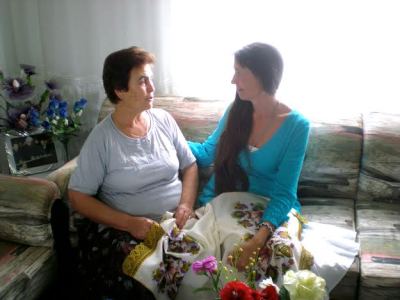
 Laura and Magdalina, in northern Greece. In the course of my research, I have been welcomed in countless homes by Greek rural women. Many families may be materially poor by contemporary standards, but are rich in values of community, hospitality and sustainability. Here Magdalina is showing me samples of her peerless embroidery (featuring ancient Goddess motifs, for those who have eyes to see).
Laura and Magdalina, in northern Greece. In the course of my research, I have been welcomed in countless homes by Greek rural women. Many families may be materially poor by contemporary standards, but are rich in values of community, hospitality and sustainability. Here Magdalina is showing me samples of her peerless embroidery (featuring ancient Goddess motifs, for those who have eyes to see).

This picture of grandparents helping support their children and grandchildren throughout their lives is quite alien to western and northern Europeans, and yet it is firmly at the heart of Greek society. Elders are almost universally cared for within the family; old-age homes are extremely few. Like the sacred hospitality offered to guests and strangers since ancient times, elder care is considered a sacred responsibility, and elders themselves are universally treated with great respect.

This respect for elders is at the heart of the Greek resistance to further cuts to pensions. For the same reason, Greece does not wish to consider raising VAT (sales tax) on medicines and electricity bills, two further measures on which the lenders continue to insist, which will of course hit these vulnerable elderly the hardest. Continue reading “The Greek Crisis: Grandparents on the Table? by Laura Shannon”

Caitlyn Jenner is a Friend of Mine

To speak ones truth is oftentimes a difficult and nearly impossible act. However, to live one’s truth, on a day-to-day basis, is an aspect of life that has become so foreign to individuals who have become so comfortable in their own skin that I fear the activist and social justice roots that we all claim to hail from have fallen at the wayside and been replaced by complacency and reductionism.

caitlyn-jenner-transformation-high-cost-surgery-clothes-house-5I’m deeply troubled by some of the anti-trans and anti-queer commentary that has been taking place on some of the comments on this blog in recent months. I’ll never forget when this project first began—talking with the founders about its original purpose: to bring the “F” word back into the mainstream religious discourse and more importantly, to be a place where scholars, young and old, senior or junior, could write, collaborate and eventually converse with across cyberspace.

However, in recent months, I’ve found myself being more of a watchdog rather than a frequent commentator on issues pertaining to feminist religious discourse. I’ve found myself reading comments about issues I may not frankly identify or agree with just to make sure that the cisgendering or anti-trans narratives do not become symbolic of what this blog is now rather than what was supposed to be at the beginning.

When I sat down to write my very first post I was scared. I was terrified that feminists from all communities would see me only as I appeared and not for whom I actually was. I was afraid that all I had worked for throughout my life would be moot with the first bad comment on one of my posts. While all of those fears were real and valid they quickly faded away as I was embraced by this community and many others for my passion rather than my gender; my life’s work rather than my privilege; and more importantly, the personal mission to make the world a safer and better place for women and girls everywhere.

To speak ones truth is oftentimes a difficult and nearly impossible act. However, to live one’s truth, on a day-to-day basis, is an aspect of life that has become so foreign to individuals who have become so comfortable in their own skin that I fear the activist and social justice roots that we all claim to hail from have fallen at the wayside and been replaced by complacency and reductionism.

Caitlyn Jenner’s story is one that many individuals, often not highlighted on this blog, know all too well. Caitlyn Jenner’s story and personal experiences are valid and for members of the feminist community to refer to her as not “feminist” or merely as a man “masquerading” as a woman while still utilizing his privilege from being biologically born as a man is troubling and the root of the problem facing many trans individuals today when they’re negotiating coming out as their true selves.

Trans individuals face a cadre of other horrible social, physical and mental statistics that oftentimes lead them to be more likely to self-harm.   However, as feminists, isn’t it our job to make sure that all groups have access to the same freedoms rather than working towards denying it for certain groups while trolling the comments sections of posts?

Shakespeare said: “To thine own self be true” and for those of us who identify with the Golden Rule, if we no longer treat others as we would like to treat ourselves, then we really have failed as feminists; and if the comments on recent blogs are any indication, we still have a long way to go before all voices can feel welcomed not only on FAR but also in the world at-large.

John Erickson is a Ph.D. Candidate in American Religious History at Claremont Graduate University. He holds a MA in Women’s Studies in Religion; an MA in Applied Women’s Studies; and a BA in Women’s Literature and Women’s Studies. He is a Permanent Contributor to the blog Feminism and Religion, a Non-Fiction Reviewer for Lambda Literary, the leader in LGBT reviews, author interviews, opinions and news since 1989 and the Co-Chair of the Queer Studies in Religion section of the American Academy of Religion’s Western Region, the only regional section of the American Academy of Religion that is dedicated to the exploration of queer studies in religion and other relevant fields in the nation and the President of the University of Wisconsin Oshkosh’s LGBTQA+ Alumni Association. When he is not working on his dissertation, he can be found at West Hollywood City Hall where he is the Community Events Technician and works on policies and special events relating to women, gender, sexuality, and human rights issues that are sponsored or co-sponsored by the City of West Hollywood. He is the author of the blog From Wisconsin, with Love and can be followed on Twitter @JErickson85

The Religiosity of Silence by John Erickson

In a repetitive culture of abuse and silence, is it really shocking to find out that an individual who preached such hate and discontent for others actually perpetuated other forms of heinous abuse against others?

John Erickson, sports, coming out.In 2013, I wrote an article about the then latest reality TV scandal featuring A&E’s Duck Dynasty’s Phil Robertson and his rampant foot-in-mouth disease that caused him to express, in the pages of GQ, his true distaste for the LGBT community and specifically for the sexual proclivities of gay men.

Now, two years later in another reality TV show, TLC’s ’19 Kids and Counting’, it isn’t star Josh Duggar’s anti-LGBT statements getting him into trouble but rather his sexual assault and molestation of 5 girls, including two of his sisters. However, while the Internet explodes with attacks against Josh Duggar and his Quiverfull background, it is vital to remember that the silence that he and his family inflicted upon his victims since 2006 has not only been ongoing since then but is also being reemphasized today with each keystroke focusing on the assailant rather than the victims. Continue reading “The Religiosity of Silence by John Erickson”

Justice for Mike Brown? by amina wadud

amina - featureI was born the year the Supreme Court of the United States of America began to hear Brown v. Board of Education of Topeka; a case that ought to be known to all as a matter of US history. Here is a precise, but telling history of how that case came into being. This historical account lacks hyperbole, perhaps because one feature of legal-eeze carries the technical title (and appropriately so) of being a brief.

In case blog readers don’t do background research or follow footnotes, I raise these salient points: The Declaration of Independence states “all men (sic) are created equal.” At the same time as it was written and signed into law, the legal enslavement of Africans was in full practice. This incongruence required further legal action to change that in the form of 13th Amendment to the US Constitution which made slavery illegal.

It should be no surprise that “equality” did not result from this and thus the 14th and 15th Amendments attempted to address inequities in more specific terminology. All of these Amendments were ratified the 19th century.

The last decade of the 19th century, Plessy v. Ferguson reached the Supreme Court. Plessy was an unsuccessful challenge, attempting to point out how manifest inequality– the “separate but equal” doctrine in practice across the United States– violated the constitutional notion of equality before the law. Judge Brown sums up the majority opinion which went against Plessy:

The object of the 14th Amendment was undoubtedly to enforce equality of the two races before the law, but in the nature of things it could not have been intended to abolish distinctions based upon color, or to endorse social as distinguished from political, equality..if one race be inferior to the other socially, the Constitution of the United States cannot put them upon the same plane

It would take more than half a century before Brown v. Board of Education brought out the many subtle ways, over the century since the legal end of slavery, that the racial divide had been enforced. It started very early in life, in the form of separate educational systems that only perpetuated the impossibility of constitutional consistency and equality before the law.

We still have a long way to go. Continue reading “Justice for Mike Brown? by amina wadud”

Choosing Well by Ivy Helman

pei headshotI’m moving to Prague in the Czech Republic at the end of August.  (In case anyone is concerned, I will still be a regular contributor to this blog.)  In part, moving to Europe feels like diving headfirst into the unknown.  At the same time, it also feels right.

A full-time teaching job still did not materialize again this year despite my best efforts.  I’m beginning to see the blessing in that since a full-time job would have made the decision to go that much harder.  Yet, the decision to move wasn’t easy either.

My plan in Prague is to teach English to local business people as well as feminism and ecology at Charles University.  Neither of these plans is solid.  I don’t have any job offers yet.  I could go there and everything could fall through or I could go there and decide to do something totally different.   In many ways, it’s up to me.  I’m not sure if I have ever placed myself into a situation in which I have so much freedom.  At the same time, I’m also quite nervous about the entire situation.  At least I’m not moving to Prague alone. Continue reading “Choosing Well by Ivy Helman”