In Light of Women by Mary Jane Miller

Why are so few women mentioned in the great feast days like Pentecost, the Last Supper, the Baptism of Christ, etc.? God made no commandment that they not be included.
Inquisitive women like myself have always been around Christ listening to His message. There they were, cooking and cleaning at the Last Supper, at the wedding at Canon and when He fed the five thousand. When Christ invited the children to come to him, you can be sure the mothers were there, too.
Beginning as early as the fourth century the dominant Christian leaders, all men, twisted and distorted Holy Scriptures to thwart the ascendant positions for women within the religious hierarchy and in christian societies in general. Yet, the underlying teachings of Jesus Christ, the Apostle Paul, Moses and the prophets, – all call for the proper and equitable treatment of God’s children. Without a doubt, God and Christ love all of humankind with no gender bias. When women listen to scripture we naturally fill in the gap, or adjust the gap knowing in our hearts and souls, we are not inferior to men.

Continue reading “In Light of Women by Mary Jane Miller”

Catholic Bishops: Corporate Executives or Prophets? by Dawn Morais Webster

Dawn Morais Webster, the Pope off to his summer palace, Castel Gandolfo. He tells the world he will now become just a “humble pilgrim.”

This is a moment to drive the merchants of hate out of the Temple, as Jesus did.  But will the United States Conference of Catholic Bishops (USCCB) bear prophetic witness? Do they have it in them to proclaim the Gospel?

I am a Catholic from Malaysia who has lived in the United States for nearly two decades. I became an American citizen two years ago.  Every day I look for two of the Big Ideas –Catholicism and American democracy—to which I am forever tethered, to be rearticulated by new, principled leaders. And they are: not by those who command the pulpit or political power but by those who live the Gospel through their faith-inspired service to the community.  People like Sister Erica Jordan who asked House Speaker, the conspicuously Catholic Paul Ryan to explain how he translates Church teaching into health care and tax policy. He could not.

Continue reading “Catholic Bishops: Corporate Executives or Prophets? by Dawn Morais Webster”

Sexuality and Spirituality: Convergence or Alienation? by Stephanie Arel

stephanie-arelI just finished reading for review The Bloomsbury Reader in Religion, Gender, and Sexualityedited by Donald L. Boisvert and Carly Daniel-Hughes. Targeting an undergraduate audience, the text explores ways that religion, gender, and sexuality intersect and interact in a variety of religious traditions.

The book’s essays traverse a wide sampling of religious inheritance including indigenous traditions, Christianity, Judaism, Islam, and various Asian religions. The topics examined range from the culture of male love in Japanese Buddhism to various themes of love in Haitian Voodoo, from sexual desire in Beguine communities to Gandhi’s experiments in sexual chastity, and from the passion of St. Pelagius to the transgender performance characteristic of the Hijra identity in India. Among other things, the book offers a wide array of interpretations regarding how sexuality emerges in particular traditions and contexts. One is left with a feeling that nearly anything goes depending on which set of rules or religious mores a particular group of people follow. The variations presented in each chapter related to the interpretation of sexuality’s embeddedness in spiritual expression problematize the notion of the “normal” emerging in sexual desire and expression. Continue reading “Sexuality and Spirituality: Convergence or Alienation? by Stephanie Arel”

Writing Through the Body: Betty Smith’s A TREE GROWS IN BROOKLYN by Joyce Zonana

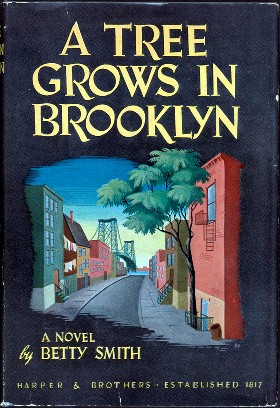
 TreeGrowsInBrooklynIn her 1975 manifesto, “The Laugh of the Medusa,” French feminist Hélène Cixous urges women to write: “Writing is for you, you are for you; your body is yours, take it. . . . Women must write through their bodies, they must invent the impregnable language that will wreck partitions, classes, and rhetorics, regulations and codes . . .”

“The Laugh of the Medusa” remains a thrilling essay, challenging and inspiring women to “return to the body” and to language.  “Woman must write woman,” Cixous insists, “for, with a few rare exceptions there has not yet been any writing that inscribes femininity.”

Although Cixous may not have been aware of it, Betty Smith’s beloved, perennially popular 1943 novel, A Tree Grows in Brooklyn is one of those “rare exceptions” that “inscribes femininity” in precisely the way she advocates. This autobiographical novel, so often dismissed as sentimental or as a children’s book, is actually written through the female body—which may explain its lasting popularity and power. Continue reading “Writing Through the Body: Betty Smith’s A TREE GROWS IN BROOKLYN by Joyce Zonana”

Remembering Sor Juana Inés de la Cruz’s Life and Legacy: Champion of Universal, and Non-Human Rights November 12, 1648/51 – April 17, 1695 by Theresa A. Yugar

She studies, and disputes, and teaches,
and thus she serves her Faith;
for how could God, who gave her reason, want her ignorant?

—Sor Juana Inés de la Cruz, Villancico, or, “Carol”, in celebration of St. Catherine of Alexandria (1692)

05.Yugar 1The reason for this blog, and for writing it on this day, is to celebrate and remember the life and legacy of Sor Juana Inés de la Cruz.
In 1994, I was exposed, by chance, to the life and writings of 17th century Novohispana feminist Sor Juana Inés de la Cruz. I am the product of twelve years of Catholic education, eight years of which were in an all-women setting. Again, by chance, I learned about Sor Juana in a liberation theology class while studying feminist theology at Harvard Divinity School. In this class, I learned about Sor Juana’s bold advocacy of the right of women to be educated. This spurred me to learn more about this Catholic Latina theologian whom I would later discover was the last great author of El Siglo de Oro (Spain’s Golden Age), recognized in her era as an esteemed poet, mathematician, astronomer, and more. This was the beginning of my life-long passion to reclaim the legacy of Sor Juana and her-story within the Christian, non-Christian Western tradition, and in Spanish and Mexican history. Continue reading “Remembering Sor Juana Inés de la Cruz’s Life and Legacy: Champion of Universal, and Non-Human Rights November 12, 1648/51 – April 17, 1695 by Theresa A. Yugar”

Interreligious Friends after Nostra Aetate (Book Review) by Janice Poss

JaniceBook Title: Interreligious Friendship after Nostra Aetate
Editors: J. Fredericks and T. Tiemeier
Series Title: Interreligious Studies in Theory and Practice
Publisher: Palgrave Macmillan US, 2015

“… the Jew prayed words of blessing … over his Roman Catholic friend. …Willebrands could not find … words to say to Tanenbaum at that moment. Of course, as is usually the case in friendships, words are not really necessary to express one’s deepest emotions.” – James L. Fredericks, p. 5

Friendship

In 1965, at fifteen, I strategized to become a top women’s fashion designer.  I felt it accessible to me!  The Second Vatican Council’s documents had been published. Nostra Aetate was among them, I was clueless, I could have cared less about anything coming out of the Vatican –especially with a Latin title having no meaning for me — except a bejeweled embroidery that might have inspired a contemporary dress or jacket.  Nothing theological or churchy was in my purview as I exerted my independence from parental authority and had one foot out the door from being a practicing Catholic.  I had had enough of the disciplinary, androcentric, ‘Father’ God who was mean, hypercritical and presupposed that anyone practicing any religion other than Roman Catholicism was doomed forever to hell.  Salvation was not for everyone. Continue reading “Interreligious Friends after Nostra Aetate (Book Review) by Janice Poss”

Honoring St. Mary of Magdala by Gina Messina

Gina Messina-Dysert profileWhile I am joining the conversation a bit late, I find it necessary to comment on the significance of the “upgrading” of the celebration of  St. Mary of Magdala to a feast – on par with the male apostles.  While such a day that honors her is quite overdue, I am grateful to Pope Francis for acknowledging this incredible woman and her leadership in the Christian movement.
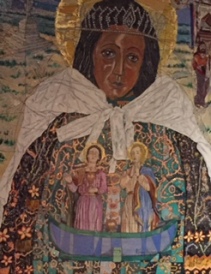
As we know from the Gospels, it was Mary Magdalene who stood at the foot of the cross with Mary the mother of Jesus, during his crucifixion.  When the male apostles ran in fear – and rightfully so – Mary of Magdala stood with Jesus refusing to disavow him and was a face of love for him to see during his darkest moment.

It was Mary of Magdala who was the first witness of Christ’s resurrection.  The very first Easter began with her and she was commissioned by Jesus to go and share the good news – to tell the other apostles – and that is why she is known as the apostle to the apostles. Continue reading “Honoring St. Mary of Magdala by Gina Messina”

Our Ladies of Sea, Earth, and Sky by Joyce Zonana

Sara and the Marys
Sainte Sara encompassing Sainte Marie-Salome and Sainte Marie-Jacobe

O Sainte Marie-Jacobe, priez pour nous.

O Sainte Marie-Salome, priez pour nous.

O gardeures de la Provence, priez pour nous.

The priest intoned the words in deep, liquid accents, his voice echoing from the ancient stone church in the remote village of Les Saintes-Maries-de-la-Mer, in the Camargue region of Southern France, where the waters of the Rhone River meet the Mediterranean Sea in a wild, wide, flat expanse populated by black bulls, pink flamingos, and white horses.

“O, Saint Mary-Jacobe, pray for us.”
“O, Saint Mary-Salome, pray for us.”
“O, guardians of the gates of Provence, pray for us.”

I could feel the words resonating through me, bringing sudden, hot tears. The people gathered in the small village square repeated the priest’s chant, their voices rising above the low, white-washed houses into the sunlit sky, out towards the shimmering sea where legend tells us the two Marys had drifted two thousand years ago in a boat without rudder or sail.

Continue reading “Our Ladies of Sea, Earth, and Sky by Joyce Zonana”

Wonder Bread by Natalie Weaver

Natalie Weaver editedIt is a difficult thing to wake up and realize you are living a life you do not recognize. This happens for all sorts of reasons. Sometimes, it happens dramatically as in the case of death, job loss, personal trauma, or illness. Other times it is a slow and insidious transition from what you knew to what you have become, as you find yourself looking at your workplace and recognizing no one or wondering who these people are in your home. Sometimes it is as simple as getting a haircut or a pair of contact lenses, when suddenly you see some wrinkle or skin mark you didn’t know had been forming while you slept. I find this experience shockingly regular now, and while I am no longer surprised that it happens, I am consistently surprised at what I discover.

For example, my son is now an altar server in the Roman Catholic Church. This has occurred concurrently with my very unexpected involvement in an annulment case, which has revealed an outrageous lack of pastoral sensitivity on the part of the Church. Witnessing the hurt this process causes, I could run from the Church. But then there is my son in the choir and serving at Mass, trying to understand this world that I both introduce him to and also roundly critique. I was chatting with a colleague at lunch over such matters and noticed her quieting after a time, eyes cast off into the distance. After a long pause, she murmured, “How did I get here again?” Continue reading “Wonder Bread by Natalie Weaver”

Moving Away from Normative Maternal Roles in the Catholic Church by Michele Stopera Freyhauf

FreyhaufEarlier this week, social media was all abuzz about the Pope’s investigation into restoring women to the diaconate. In the complete transcript of the Pope’s comments,  the traditional notion of women’s maternal role in the church is mentioned in relation to the Church.  Certainly this is nothing new.  Here the Pope describes important “maternal” work such as working with the marginalized, catechesis, and caring for the sick – once again, nothing new.

However, in the next sentence, a very subtle shift is seen when it comes to normative gender roles:

…. there are men who do the same [work as consecrated women], and it is good…..and this is important.

What does this mean – a change in language?  a laying of groundwork? or nothing at all?

imgres

It is no secret that cultural constructs of women as maternal and how a mother is defined as or even does has radically changed in today’s society; but, the Church continues to remain steadfast in normative roles between the priesthood and the “motherhood” of the Church (and therefore “motherhood” in general).

Continue reading “Moving Away from Normative Maternal Roles in the Catholic Church by Michele Stopera Freyhauf”