

 In 1965, the Council document Perfectae Caritatis, Decree on the Adaptation and Renewal of Religious Life, encouraged women religious to situate themselves and their vocations in the social milieu to which they belonged. Each religious community adjusted rules and customs to accommodate the needs and demands of particular ministerial vocations. For those communities that embraced Perfectae Caritatis entered into a complete paradigm shift in thinking that changed forever how they understood themselves and their chosen vocations. I recall vividly the morning, when, in 1968, Sister Mary DePatzie entered our classroom clad in a shorter habit and dress revealing the startling fact she 1) indeed had brilliant, beautiful red hair; and 2) rather shapely legs even in her sensible shoes. Continue reading “Presumed Guilty by the Sin of Silence: U.S. Nuns, Network, and The Congregation for the Doctrine of the Faith by Cynthia Garrity-Bond”
Category: Catholicism
Reflections on My Spiritual Journey: Claiming Judaism By Ivy Helman
 “Is Ivy Helman Jewish?” This question and knowing that eventually I’d have to respond one way or another to it has caused me many sleepless nights. At the same time my faith journey has become integral to who I am and I would like to spend some time today sharing it with you.
Why share this and why now? Well, first, I have not been ready until now. In addition, external forces which I will talk about in a minute are making my spiritual path an issue. So I share my story with a measure of concern about its possible effects but also with a great deal of joy about the ways in which my faith journey has challenged me to grow, reflect and change.
Margaret Farley emailed me about two weeks ago asking me how I identified religiously. Someone had emailed her asking if I was Jewish because this person had read one of my past blogs in which I wrote “my rabbi” on feminismandreligion.com. This same person is reviewing my book: Women and the Vatican: An Exploration of Official Documents. Here is how I answered Margaret: “Hi Margaret, I’m Catholic although I do attend services at a Jewish synagogue on occasion since I was raised in essentially a multi-faith home. On that blog, there really is no Jewish voice, so I try to comment on ideas from that tradition as much as I can. Ivy.” I felt unauthentic sending that email. But, I did.
Still troubled by that answer and rather than put my friends and colleagues in the middle of questions about my faith, I feel that this has now become a public issue that I must address. It is a question I have known I would have to answer at some point. Nevertheless, this is not a decision that came easily or quickly. I’ve literally agonized over it now for months. During the time, I’ve never questioned my resolve to be Jewish and to continue to follow that spiritual journey in my life; I’ve worried more about how other people will respond and how their responses will affect my career in academia. If I were allowed to rewrite that email to Margaret, then this is what I would say. Continue reading “Reflections on My Spiritual Journey: Claiming Judaism By Ivy Helman”
Life Must Always Be Protected by Bridget Ludwa
 Women’s dignity has often been unacknowledged and their prerogatives misrepresented; they have often been relegated to the margins of society and even reduced to servitude… Then too, when we look at one of the most sensitive aspects of the situation of women in the world, how can we not mention the long and degrading history, albeit often an “underground” history, of violence against women in the area of sexuality? At the threshold of the Third Millennium we cannot remain indifferent and resigned before this phenomenon. The time has come to condemn vigorously the types of sexual violence which frequently have women for their object and to pass laws which effectively defend them from such violence. Nor can we fail, in the name of the respect due to the human person, to condemn the widespread hedonistic and commercial culture which encourages the systematic exploitation of sexuality and corrupts even very young girls into letting their bodies be used for profit. – Pope John Paul II
If the Vatican desires an unambiguous message of concern for women, then it needs to address the acts of violence committed against women’s bodies. In focusing on the end result of sexual violence, aborted pregnancies, and not addressing the violence itself, Vatican leadership fails to communicate this concern for women’s bodies. Continue reading “Life Must Always Be Protected by Bridget Ludwa”
Do Man-Made Laws Trump the Authority of Jesus? Reflecting on the Meaning of Humility, Priestly Service, and the Issue of Women’s Ordination by Michele Stopera Freyhauf
 Maundy Thursday – the imitation of Jesus’ act of service and submission is re-created. Controversy surrounds the “disciples” – must they be all men? Are women allowed? Who steps into Jesus’ role? Men, women, or both? Why, when it comes to imitating the act of humility and priestly service (rooted in our baptismal call), does a distinction of gender need to made at all?
As I progressed towards the intersection, I looked up to witness a grand procession of men dressed in white albs with stoles that often contained subtle hints of gold, worn in a manner to distinguish their role as priests and deacons. They moved slowly down the sidewalk entering the Cathedral to begin their celebration of the Chrism Mass – a celebration of priesthood and priestly service within the Diocese where all priests and deacons gather to celebrate and re-affirm their commitment to ministry and service to the Church. It is also during this Mass that the oils used in sacramental celebrations, used by each church, are blessed by the Bishop.
As I continued to watch, I could not help but search the processional line for those with a hair color other than gray. I wanted to see how many young priests were in that processional line. What I found was no surprise – an aging group of men with the sporadic appearance of younger priests. The numbers stood as a staunch reminder that we, as a Church, may be faced with a severe shortage of priests in the future. Something already known and planned for by the Diocese in its campaign to consolidate and close parishes.
Another sad observation was put on public display – the absolute absence of women. Continue reading “Do Man-Made Laws Trump the Authority of Jesus? Reflecting on the Meaning of Humility, Priestly Service, and the Issue of Women’s Ordination by Michele Stopera Freyhauf”
Is Baptism a Male Birthing Ritual? By Michele Stopera Freyhauf
Quite a number of years ago I had a conversation with one of my professors, a feminist theologian, who posed the question “Why do I need a man to purify my baby with the waters of baptism? Is there something wrong or impure about the blood and water from a mother’s womb – my womb?” Before you jump and shout the words Sacrament or removal of original sin, this question bears merit in exploring, especially in today’s world where women are taking a serious beating religiously, politically, and socially. In today’s world, violations and rants are causing women to stand up and say STOP! This is MY Body. This outcry was provoked by chants of ethical slurs against women– Slut! Prostitute! Whore! The cry got  even louder when the issue of religion and government was raised in the fight of healthcare coverage of contraception. The cry got even louder with the enactment of the laws in Virginia and Texas (and many other states to follow suit) that forces women to undergo transvaginal ultrasounds in early stage abortions. The mandatory insertion of a wand into a woman’s vagina (mandated by the government, mind you), is a violation and has women crying RAPE!
The memory of this conversation did not re-appear by chance, it was prompted by a book I read for my History of Sexuality Class – Imperial Leather: Race, Gender, and Sexuality in the Colonial Context by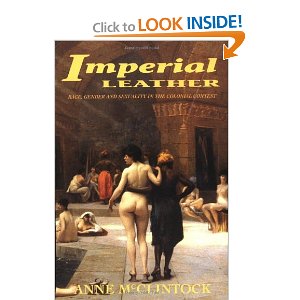 Anne McClintock who addresses the notion of baptism through origins, property, and power. So many things are currently being taken away from women and reading McClintock’s assertion regarding male baptism is perplexing. She believes that male baptism or baptism by a man takes women’s role in child bearing and diminishes it. These are the same men who historically treated and regarded women as vessels. She further asserts that this act is a proactive removal of creative agency with respect to a woman’s ability to have the power to name. That is, the last name of the child belongs to the husband. A point that supports the notion that patrimony marks the denial of women. Anyone doing genealogy encounters a perplexing struggle to identify mothers because their names are essentially erased from memory and rarely attached to a child’s name. Continue reading “Is Baptism a Male Birthing Ritual? By Michele Stopera Freyhauf”
Pink Smoke Over the Vatican: A Review by Kate Conmy
 Review: Pink Smoke Over the Vatican (2010)
Award-Winning Independent Documentary Film
 Directed by Jules Hart
By Kate Conmy, MA.
Membership Coordinator of the Women’s Ordination Conference.
Last weekend I had the honor of joining over eighty Women’s Ordination Conference members and supporters in Claremont, California for a screening of “Pink Smoke Over the Vatican” followed by a distinguished panel discussion. WOC board member Miriam Todoroff of Pilgrim Place hosted the event, along with Rev. Kathleen Jess, ECC, with local support from Theresa Yugar. “Pink Smoke Over the Vatican” has recently been made available for purchase, but for the past couple of years the film has starred in women’s ordination movement circles, drawing hundreds to cinemas, churches, universities, and homes for a peek at the controversial and moving film.
Fr. Roy Bourgeois has taken the show on the road, touring and speaking throughout the world (from Rhode Island to Rome) on women’s ordination and the important stories in the film. Fr. Roy’s involvement with women’s ordination is well documented, however, notably, “Pink Smoke Over the Vatican” is specifically mentioned in his First Canonical Warning from his Order, the Maryknoll Fathers and Brothers, insisting that his public support and promotion of the movie was a Holy Offense. More than just good press, this is a testament to the power contained within this film. Continue reading “Pink Smoke Over the Vatican: A Review by Kate Conmy”
Catholicism, Contraception, and Conscience: Church Imposed Teaching, God’s Gift of Free Will, and Political Rhetoric by Michele Stopera Freyhauf
Certainly one cannot turn on the news without seeing a story about the feud over the Catholic Church’s stance on forbidding the use of contraception and Obama’s Patient Protection and Affordable Care Act (PPACA) that mandates free contraception to women. In preparing this article, I took the time to review many articles from liberal and conservative news outlets, law professors who are experts on constitutional law, and statements from the USCCB and Bishops. Before asking questions, I want to outline the following points:
- In the literature reviewed, only two women, Sr. Carol Keehan and Sr. Mary Ann Walsh, made a statement against this policy stating that the government is interfering with the working of the Church. Most voices heard and shouting the loudest are members of the clergy.
- Hospitals considered “Catholic” hire people of all faiths and various beliefs. They also treat patients of all faiths. They are not exclusively “Catholic.”
- Catholic identified Colleges hire professors and staff that are not Catholic. Moreover, their student body is not totally Catholic.
- Catholic Charities, once again, hire non-Catholics.
- Insurance plans currently in place often offer contraception prescriptions at a zero to low co-pay price. These plans are in-force at many Catholic Institutions.
- Under HIPAA, healthcare of employees are protected and the Employer, even the Catholic Church cannot violate the privacy of the patient, even if it is an employee.
- Birth Control Pills are often prescribed for women with endome
 triosis or other “female” reproductive disorders and not birth control.
 - Women pregnant, carrying a dead baby, cannot have surgery due to risks are given medication to induce abortion are given. Continue reading “Catholicism, Contraception, and Conscience: Church Imposed Teaching, God’s Gift of Free Will, and Political Rhetoric by Michele Stopera Freyhauf”

Son of Man: An Updated Gospel Story of Jesus Set in South Africa by Michele Stopera Freyhauf
January 12, 2012

Son of Man is an updated story of the life of Jesus set in the fictional State of Judea that is modern day South Africa – complete with warlords and child soldiers. It could easily be mistaken for modern day Rwanda or Darfur with its modern issues and political overtones. Roger Ebert stated, “The secret of the movie is that it doesn’t strain to draw parallels with current world events – because it doesn’t have to.” The director draws parallels between the gospels and 21st century Africa. According to Dartford-May, “we wanted to look at the Gospels as if they were written by spin doctors and to strip that away and look at the truth.” The director “captures the rhythms of African life in both rural settings and sprawling townships.” “Feather-clad young angels offer an eerie echo and reminder of Africa’s lost generations.”
The movie also sticks with what Eric Snider calls “Traditional African trial music, dance, and costumes” as a type of worship or or allusion to Jesus’ godhood. Judea is in flux; warlords and corruption take center stage. Poverty, violence, and oppression affect the all of the people. The key idea is that Jesus is a freedom fighter – one that fights injustice and oppression. The director does not emphasize “Jesus’ divinity so much as his leadership, good sense and compassion.” Jesus is not violent and his followers, most of whom were former child soldiers, are encouraged to respond non-violently, which goes against their upbringing and training. Continue reading “Son of Man: An Updated Gospel Story of Jesus Set in South Africa by Michele Stopera Freyhauf”
The “Tenting” God and the Tenacity of Hope by Sheila E. McGinn, Ph.D.
 Easter Sunday 2010 marked the last Mass at Historic Saint Peter Church in Cleveland, Ohio. After over 150 years of continuous use, the oaken doors of this sacred space on 17th and Superior were closed and locked. In rich irony, the building that once had been the womb of a vibrant inner-city Catholic community closed like a tomb on the very day when the Christian church around the world celebrated the feast of Christ breaking the bonds of death and rising triumphant from the grave. The official ecclesiastical act of “suppression” that closed the church building was intended likewise to roll the stone across the grave of the vibrant parish community that inhabited that domus ecclesiae. But Christians know that Resurrection happens. Easter cannot be stopped, not even by bishops.
Almost before he set foot in the door of the Chancery in Cleveland, Bishop Richard Lennon announced his intention to close one-third of the 180+ parishes in the diocese. Sixty-three parishes were to be selected for elimination based on the criteria of declining membership and financial dependency. Not surprisingly, many of the faithful were quite disturbed at this announcement. The diocesan spokesman sought to reassure them: “We don’t close parishes; we close empty buildings.” “Alright,” I thought, “maybe this won’t be so bad as it sounds.” And at first, that looked to be the case. Continue reading “The “Tenting” God and the Tenacity of Hope by Sheila E. McGinn, Ph.D.”
Of Human Life* By Carol P. Christ
 Watching the last episode of the Australian series Brides of Christ in which Catherine leaves the sisterhood of the convent because of her disagreement with Humanae Vitae brought me right back to the Yale Roman Catholic chapel and the folk mass I attended regularly. In 1968 just after the publication of Humanae Vitae, priest and co-graduate student Bob Imbelli preached a sermon on the doctrine of conscience, arguing that though it was incumbent on Catholics to think carefully about the papal encyclical on birth control, it was also the responsibility of every Catholic to follow her or his conscience on the matter. In the episode, Sister Catherine encourages a Roman Catholic mother of six who has already self-induced more than one abortion to take the pill, but the woman decides she cannot go against the church’s teachings. Catherine allows an editorial against Humanae Vitae to be published in the school newspaper even though she knows it will probably lead to the expulsion of one of her favorite students.
I had forgotten that Pope Paul VI issued the prohibition on birth control against the clear majorities of the Roman Catholic commissions instructed to study the matter. In the episode, Sister Catherine, told by her bishop that she can no longer express her own opinions on birth control, tries to explain to her students that Roman Catholics cannot use birth control because it is against “natural law.” This provokes one of the students to ask if people are not supposed to use birth control because animals don’t use it. This question sparked an “ah-ha” moment for me. Hmm, I thought, while “man” has invented birth control, “women” cannot use it because we are meant to remain “like the animals.” This debate really is about the question of whether women are human! Continue reading “Of Human Life* By Carol P. Christ”

