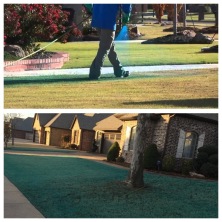
If Gaia is a living body, why are we painting her blue? Whether it is public parks or residential lawns, when there is that special odor in the air, I know to look down and there it is, an endless dye job on the grass indicating treatment. My city is concrete and blue dye for miles. Furthermore, I have sales people knocking at my door monthly asking if I want to spray pesticide around the house to decimate wasps, ants and spiders.
Many religious texts encourage us to mindfully consider the earth. The Jain Acaranga sutra, for instance, says, “a wise [person] should not act sinfully toward plants” (I.1.5.7). One way we sin against the earth so casually is by these mindless manipulations of our lawns, if we have them. (Technically, I do not have a lawn, but my roommate does, and I try to protect it). I do not think most people think about researching what they allow into the earth. Continue reading “The Blue No Gaia Wants: Protecting the Sacred through our Lawns by Elisabeth Schilling”
Tree and Goddess motifs on the ‘Wall of the Foremothers’ (Ahninnenwand), Bodensee, Germany, 4th Millenium BCE
Yes, times are tough. But a better understanding of our interconnectedness can help us move beyond the cynicism, frustration, and despair we may be feeling in the modern world. A closer look at trees, and at women’s traditional circle dances, can offer valuable lessons about friendship, community, and the interconnectedness of all life.
The sacred Tree is found in virtually all cultures, often identified with the life-giving figure of the Goddess. Both motifs appear abundantly in archaeological finds dating back to the early Neolithic era. Dance archaeologist Yosef Garfinkel affirms that humans have been dancing in circles since then and probably for far longer.
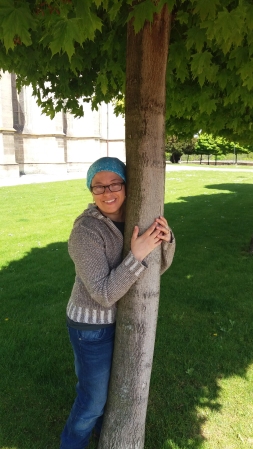
The Tree of Life is central to the women’s traditional circle dances of the Balkans and the Near East, which I have been researching for over thirty years. The pattern of the Tree of Life is encoded in the steps of dances, many dance songs refer to women as sacred or magical trees, people often dance around or under sacred trees, and Tree and Goddess motifs are featured on the textiles worn while dancing. Furthermore, each dancer resembles a tree, with her ‘trunk’ upright and centred, arms symmetrically extended like branches, and hands joined so that we support each other in the circle. Continue reading “The Tree of Life and the Forest of Friendship: Circle Dance to Restore our Hope by Laura Shannon”
Spring is here in the northern hemisphere and with it the return of light in the yearly round of seasons. Today is Earth Day. Flowers bloom, new seedlings emerge and birdsong fills the air.As the cold and dark of winter gives way once again to warmth and light, cultures across the world celebrate fertility and the rebirth of life and light.
Much of our lives lack the rich culture of ritual that I think would help us repair the relationships we have with our own bodies and with the earth. The Rg Veda is one of the oldest collection of hymns from India. In them, I find a playful and introspective expression of desires and fears that, at first, did not seem to me to hold much wisdom for a modern contemplative. But lately, I have been noticing how the speakers communicate to or about the earth, and how their lives seem centered around trying to take a part in creation. Mostly, these hymns are stories and supplications for rain, cows, victory in battle, and a long life. But there is a deep understanding of the power and divinity in the universe that is the very earth-based wisdom that our humanity-in- crisis needs. If the Qur’an is God calling for humanity to be grateful, the Rg Veda is a model of a humanity that could be nothing else.
I love one incantation, for instance, found in the tenth mandala, that seems to be from a compounding physician, praying to the healing herbs that might make her client well again. I imagine her alone, in a greenhouse pharmacy, on a damp late afternoon, fingering stems and leaves before crushing them with her mortar and pestle to make a bespoke tincture that holds a cure. She knows the plants intimately, and works as if she is on holy ground: Continue reading “Honoring the Earth in our Rituals of Well-Being by Elisabeth Schilling”
She studies, and disputes, and teaches,
and thus she serves her Faith;
for how could God, who gave her reason, want her ignorant?
—Sor Juana Inés de la Cruz, Villancico, or, “Carol”, in celebration of St. Catherine of Alexandria (1692)
The reason for this blog, and for writing it on this day, is to celebrate and remember the life and legacy of Sor Juana Inés de la Cruz.
In 1994, I was exposed, by chance, to the life and writings of 17th century Novohispana feminist Sor Juana Inés de la Cruz. I am the product of twelve years of Catholic education, eight years of which were in an all-women setting. Again, by chance, I learned about Sor Juana in a liberation theology class while studying feminist theology at Harvard Divinity School. In this class, I learned about Sor Juana’s bold advocacy of the right of women to be educated. This spurred me to learn more about this Catholic Latina theologian whom I would later discover was the last great author of El Siglo de Oro (Spain’s Golden Age), recognized in her era as an esteemed poet, mathematician, astronomer, and more. This was the beginning of my life-long passion to reclaim the legacy of Sor Juana and her-story within the Christian, non-Christian Western tradition, and in Spanish and Mexican history. Continue reading “Remembering Sor Juana Inés de la Cruz’s Life and Legacy: Champion of Universal, and Non-Human Rights November 12, 1648/51 – April 17, 1695 by Theresa A. Yugar”
“Let the beauty we love Be what we do
There are hundreds of ways to kneel and kiss the Earth.”
–Rumi
Introductory note: At the end of 2016, my parents purchased a piece of land about one mile from where I already live (they live one mile further away than that). In addition to woodland and meadow, this land has two springs, three creeks, a cave, and ¼ mile of river access. While I have been deeply connected to the land of my birth, the Missouri Ozarks, for a long time, and have written about that connection in multiple past posts for FAR, this new-to-us land has offered a new opportunity: the chance to get to know another section of land “from scratch,” deeply, wildly and well, and to become wise stewards of it for the time in which it is in our care. It is also the first time I have been able to so closely and intimately observe the origin source of a body of water. Previously not giving it much thought, I now have the daily privilege of observing the source of the flow as I watch water emerge directly from the ground. First, there is simply none and then, suddenly, a deep blue pool constantly bubbling as water rises to the surface and flows away on its long, long journey to the sea. This essay is a series of three vignettes as I spend this year immersing myself in relationship with this land.
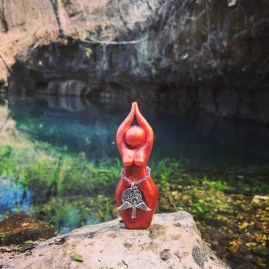
We walk along the nearly vertical hillside hanging onto small trees for support. Finally, though we almost miss it, we spy the opening to the cave nestled behind several mossy stones. The sun is still on the rise above the tree line and the rays filter through the trees so one ray is pointing directly at the cave entrance. We crawl inside, bumping our heads and scraping our backs as we wiggle into this womb in the earth. Once inside, the chamber enlarges so we can stand up. Unlike other caves we have experienced in this area, the only human signs we find are a single bottle cap, a glass bottle, and two sets of initials carved into a rock. In the dark silence we hear the sound of water dripping steadily. I make my way further into the cave, acutely aware that this is living cave and being careful not to step on the fresh, wet, cervix-shaped beginnings of new stalagmites on the floor. At the back of the cave, I find her. A Madonna-like stone column, glistening with water. In the silence of the cave, I quietly sing Ancient Mother to her, as tears well in my own eyes.
I am of this earth for this earth and by this earth.
We skirt carefully along the bank of the creek, making our way to the largest spring. Over three million gallons of water a day flow effortlessly from this small, deep pool nestled quietly in the middle of the woods. I am stunned by the magnitude of this flow as I stand there with my husband, my head resting on his shoulder, hawks wheeling overhead, redbud trees in full bloom. It has never seemed more clear to me how very “small” we are, but a blink of an eye to this spring and its countless years and countless gallons of water, not caring whether it is witnessed in its work or not, but simply, continually, creating and producing. I try to explain this feeling aloud, but words fail me. It is a humbling sensation, not a depressing one. The actual emergence of the water at this origin point of the river is nearly invisible, the continuous gentle, small popping of bubbles on its surface, the only sign that something significant is happening here that distinguishes this body of water from a pond or pool. Yet, those never-ending bubbles rapidly expand to a wide, swift-moving creek, which joins the river and another smaller spring-fed creek to continue to make their way southward across the state. We smell something sharp and see a dead armadillo by the roots of a giant sycamore. We hear a shrill cry and look up to see two bald eagles riding the currents of air high above us. We are so small. So many thousands of years of water have passed, but we are here right now.
Unfathomable eons
Glacier time
I am just a blink of an eye
But I can sit, and watch, and wonder.
We scramble along the uneven terrain on the rocky and wooded hillside, slipping, laughing, and looking. I am exhilarated by the simple thrill of exploring the world right here in front of me. We find tiny flowers. I kneel by the roots of fallen trees. We stop to admire moss on stones. We find gigantic black snake napping in the sun. A complete turtle shell. A shed antler. Each moment feels like a new opportunity to “kiss the earth.” I sing Reclaiming’s song-version of the Rumi quote over and over and as I kneel in each spot to see what it has to show me, in each, I kiss my fingers and press them to the earth. I see all the kissing going on around me…the sun filtering through branches, the fiddlehead ferns kneeling to kiss the earth, the roots wound through rocks, the trillium and bloodroot blooms pushing up between leaves, the water seeping out of the ground and flowing down the hill, the dogwood blossoms opening to the sun, the moss covering stones, the fallen trees stretched along the slope.
“And that is just the point…how the world, moist and beautiful, calls to each of us to make a new and serious response. That’s the big question, the one the world throws at you every morning. ‘Here you are, alive. Would you like to make a comment?’”
–Mary Oliver
We emerge from our walk to find morels growing alongside the path (morels are wild, edible mushrooms found for about two weeks in Missouri each spring and considered a delicacy by many). The afternoon suddenly becomes even more rewarding and we stoop and peer through fallen oak, sycamore, and elm leaves looking for the telltale conical form of these forest treats. We quickly discover that we must tune in and “listen” for the mushrooms, so to speak, or we’ll walk right by them, none the wiser. The moment I start thinking about anything else, I stop finding any. Once I settle into my body and the moment and really look at the world again, there another morel will be.
“I think this is how we’re supposed to be in the world … present and in awe.”
–Anne Lamott, Bird by Bird: Some Instructions on Writing and Life
Molly has been “gathering the women” to circle, sing, celebrate, and share since 2008. She plans and facilitates women’s circles, seasonal retreats and rituals, mother-daughter circles, family ceremonies, and red tent circles in rural Missouri and teaches online courses in Red Tent facilitation and Practical Priestessing. She is a priestess who holds MSW, M.Div, and D.Min degrees and finished her dissertation about contemporary priestessing in the U.S. Molly and her husband Mark co-create Story Goddesses, original goddess sculptures, ceremony kits, and jewelry at Brigid’s Grove. Molly is the author of Womanrunes, Earthprayer, and The Red Tent Resource Kit and she writes about thealogy, nature, practical priestessing, and the goddess at Brigid’s Grove.
I have written segments of a novel before for the FAR community several times—starting here. What follows are the beginning pages of a new novel (not the one I’ve published segments with FAR before—that one is on hold). I’m sharing this story—of the last surviving mermaid and her fight to save the planet– in honor of spring. You may see more pages in the future—but for now– happy spring equinox and blessings on you and our planet as the wheel turns.Continue reading “In Honor of Spring: A Novel about our Blue Planet by Marie Cartier”
One of the concerns of ecofeminism is the modern materialistic mindset of capitalism. Materialism in capitalism instills not just owning many possessions, but it also inculcates the “need” to own the newest innovation. In addition, materialism advocates a throw-it-away mentality. In other words, it is often cheaper to buy a new shirt or computer than to have them repaired. Similarly, it is not enough to have a cell phone. Rather, one must have the newest and best one! The environment pays the price.
One attempt to deny the hold of materialism is minimalism. The minimalist movement seems to run the spectrum. From the ideals of less is more, there seems to be some competition between mindful consumerism and extreme self-denial. Mindful consumerism suggests that minimalism is a journey of recycling, reusing and repairing combined with well-researched, well-considered, as-ethically-produced-as-possible purchases when necessary. Extreme self-denial advocates owning almost no material possessions. While I strive toward mindful consumerism, I have serious concerns about extreme minimalism. Continue reading “On Minimalism by Ivy Helman”
“You may not remember, but let me tell you this,
someone in some future time will think of us.”
—Sappho
I put on my boots and jeans, grab my priestess robe, pack a basket of ritual supplies, and meet four close friends in a nearby cave. We feel a little nervous about holding ritual on unfamiliar land, but we decide to push our boundaries and do it anyway. The land needs us, says my friend. The other people who come here are meth-heads and vandals.
We take our drums and climb to the top of the cave, singing as we find our way up the steep hillside. On top, looking out across the country, we sing: cauldron of changes, feather on the bone, arc of eternity, ring around the stone. We laugh and practice some more songs, some hearty, some tentative and new. We tie up small bundles of our symbolic burdens with stones and let them down over the edge using handspun wool yarn until the yarn releases, taking our burdens with them. Suddenly, we hear the sound of tires on the gravel. Slamming doors. The sound of loud men’s voices. The smell of cigarette smoke. A ripple of uncertainty passes through us. We are once again tentative and we feel a current of unease. What should we do? we whisper to one another. The voices draw nearer, there are calls and hoots. My friend looks at me and says: this is where we make our stand. We hold hands in a line at the edge of the cave roof, gazing out into the horizon. A hawk wheels overhead. We sing. The approaching voices quiet. We sing louder.
I am a strong woman, I am a story woman, I am a healer, my soul will never die.
We project our voices and yell: we are the witches, back from the dead!
The voices stop. We wait. We hear doors slamming. The sound of tires on gravel. We are alone once more.
We descend into the cave singing a song composed on the spot: Deeper, deeper. We’re going deeper. Deeper, deeper. Deeper still.
We strike a pose based on the carvings described in the classic book, When the Drummers were Women. Archaeologists described carvings of priestesses carrying drums as, “women carrying cakes to their husbands.”
We shout: “we’re not carrying cakes!”
I stand on a rock in the center of the cave and sing: she’s been waiting, waiting, she’s been waiting so long, she’s been waiting for her children to remember to return. My friends join the song and we move deep into the darkness where we face the “birth canal” at the back of the cave, listening to the small stream within trickle, laugh, and bubble as it emerges from the dark spaces deep within the heart of the earth. We begin to sing:
Ancient mother we hear you calling. Ancient mother, we hear your song. Ancient mother, we hear your laughter…
Just as we sing the words, ancient mother, we taste your tears, droplets of cave water fall on our faces, splashing our eyelids.
It might seem simple on the surface, but gathering the women and calling the circle is a radical and subversive act. A revolutionary act. In my work with women’s circles and priestessing, I am repeatedly reminded that gathering with other women in a circle for ritual and ceremony is deeply important even though it might just look like people having fun or even being frivolous, it is actually a microcosm of the macrocosm—a miniature version of the world we’d like to see and that we want to make possible.
In the book, Casting the Circle, Diane Stein observes that women’s rituals, “…create a microcosm, a ‘little universe’ within which women try out what they want the macrocosm, the ‘big universe’ or real world to be. Within the safety and protected space of the cast circle, women create their idea of what the world would be like to live in under matriarchal/Goddess women’s values…The woman who in the safety of the cast circle designs the world as she would like it to be takes that memory of creation and success out into daily life…By empowering women through the microcosm of the ritual’s cast circle, change becomes possible in the macrocosm real world.” (p. 2-3)
It starts with these private ritual and personal connections and then, as Stein explains, “A group of five such like-minded women will then set out to clean up a stream bed or park in their neighborhood; a group of twenty-five will join a protest march for women’s reproductive rights; a group of a hundred will set up a peace encampment. The numbers grow, the women elect officials to government who speak for their values and concerns. Apartheid crumbles and totalitarian regimes in Eastern Europe end, disarmament begins, and laws to control polluters are enforced. Homes, foods, and jobs are opened to the world’s homeless, and often begins in the microcosm of the Women’s Spirituality ritual circle” (p. 3)
“Feminism catches fire when it draws upon its inherent spirituality. When it does not, it is just one more form of politics, and politics never fed our deepest hungers.”
–Carol Lee Flinders (in The Millionth Circle)
Molly has been “gathering the women” to circle, sing, celebrate, and share since 2008. She plans and facilitates
women’s circles, seasonal retreats and rituals, mother-daughter circles, family ceremonies, and red tent circles in rural Missouri and teaches online courses in Red Tent facilitation and Practical Priestessing. She is a priestess who holds MSW, M.Div, and D.Min degrees and finished her dissertation about contemporary priestessing in the U.S. Molly and her husband Mark co-create Story Goddesses, original goddess sculptures, ceremony kits, and jewelry at Brigid’s Grove. Molly is the author of Womanrunes, Earthprayer, and The Red Tent Resource Kit and she writes about thealogy, nature, practical priestessing, and the goddess at Brigid’s Grove.
“Why is religion important to ecofeminism?”A student, in the Master’s course I teach at Charles University, asked this as we began the class session dedicated to the topic.Given the overwhelming presence of atheism in the Czech Republic, I wasn’t too surprised by the inquiry.Nonetheless, the idea has been at the back of my mind ever since: what does religion have to do with ending patriarchy and bolstering the health of the planet?While I may take the connection as obvious, it is clearly not for many feminists out there.Here is how I understand it.
First, it is true: many of our inherited religious traditions have been and still are considerably patriarchal.Because of that, some feminists outright reject religion.In fact, some feminists even consider religion dangerous and threatening, as it is often utilized to contradict many feminist aims.Yet, there are many, many feminists who find, within their given or chosen tradition, non-patriarchal elements that can be recovered, remembered and/or (re)created.Religious feminists work tirelessly to transform religions in life-sustaining and post-patriarchal ways not just for themselves but also for those women and men who belong to the same communities.Continue reading “The Importance of Religion for Eco-Feminism by Ivy Helman”


 If Gaia is a living body, why are we painting her blue? Whether it is public parks or residential lawns, when there is that special odor in the air, I know to look down and there it is, an endless dye job on the grass indicating treatment. My city is concrete and blue dye for miles. Furthermore, I have sales people knocking at my door monthly asking if I want to spray pesticide around the house to decimate wasps, ants and spiders.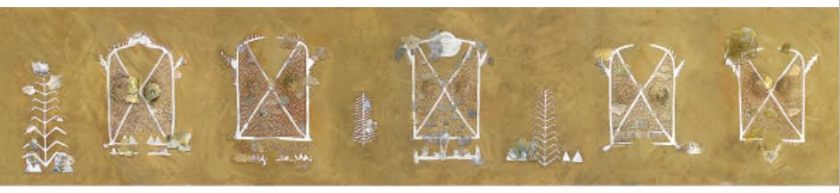
 Spring is here in the northern hemisphere and with it the return of light in the yearly round of seasons.
  Much of our lives lack the rich culture of ritual that I think would help us repair the relationships we have with our own bodies and with the earth. The Rg Veda is one of the oldest collection of hymns from India. In them, I find a playful and introspective expression of desires and fears that, at first, did not seem to me to hold much wisdom for a modern contemplative. But lately, I have been noticing how the speakers communicate to or about the earth, and how their lives seem centered around trying to take a part in creation. Mostly, these hymns are stories and supplications for rain, cows, victory in battle, and a long life. But there is a deep understanding of the power and divinity in the universe that is the very earth-based wisdom that our humanity-in- crisis needs. If the Qur’an is God calling for humanity to be grateful, the Rg Veda is a model of a humanity that could be nothing else.
 The reason for this blog, and for writing it on this day, is to celebrate and remember the life and legacy of Sor Juana Inés de la Cruz.
 live (they live one mile further away than that). In addition to woodland and meadow, this land has two springs, three creeks, a cave, and ¼ mile of river access. While I have been deeply connected to the land of my birth, the Missouri Ozarks, for a long time, and have written about that connection in multiple
 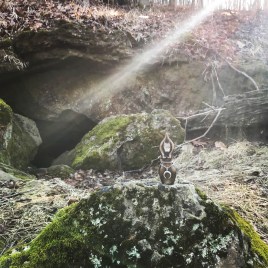 spy the opening to the cave nestled behind several mossy stones. The sun is still on the rise above the tree line and the rays filter through the trees so one ray is pointing directly at the cave entrance. We crawl inside, bumping our heads and scraping our backs as we wiggle into this womb in the earth. Once inside, the chamber enlarges so we can stand up. Unlike other caves we have experienced in this area, the only human signs we find are a single bottle cap, a glass bottle, and two sets of initials carved into a rock. In the dark silence we hear the sound of water dripping steadily. I make my way further into the cave, acutely aware that this is living cave and being careful not to step on the fresh, wet, cervix-shaped beginnings of new stalagmites on the floor. At the back of the cave, I find her. A Madonna-like stone column, glistening with water. In the silence of the cave, I quietly sing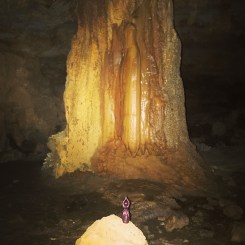
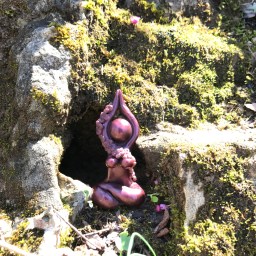
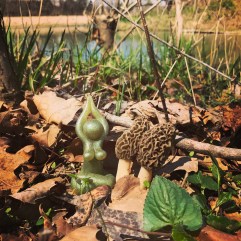 about two weeks in Missouri each spring and considered a delicacy by many). The afternoon suddenly becomes even more rewarding and we stoop and peer through fallen oak, sycamore, and elm leaves looking for the telltale conical form of these forest treats. We quickly discover that we must tune in and “listen” for the mushrooms, so to speak, or we’ll walk right by them, none the wiser. The moment I start thinking about anything else, I stop finding any. Once I settle into my body and the moment and really look at the world again, there another morel will be.
 Molly has been “gathering the women” to circle, sing, celebrate, and share since 2008. She plans and facilitates women’s circles, seasonal retreats and rituals, mother-daughter circles, family ceremonies, and red tent circles in rural Missouri and teaches online courses in
  I have written segments of a novel before for the FAR community several times—starting
  One of the concerns of ecofeminism is the modern materialistic mindset of capitalism. Materialism in capitalism instills not just owning many possessions, but it also inculcates the “need” to own the newest innovation. In addition, materialism advocates a throw-it-away mentality. In other words, it is often cheaper to buy a new shirt or computer than to have them repaired. Similarly, it is not enough to have a cell phone. Rather, one must have the newest and best one! The environment pays the price.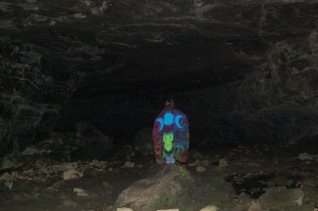
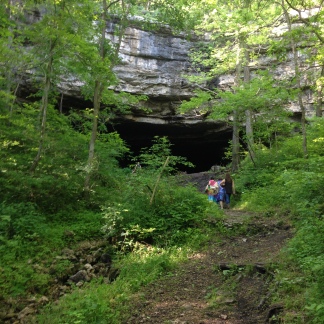 using handspun wool yarn until the yarn releases, taking our burdens with them. Suddenly, we hear the sound of tires on the gravel. Slamming doors. The sound of loud men’s voices. The smell of cigarette smoke. A ripple of uncertainty passes through us. We are once again tentative and we feel a current of unease. What should we do? we whisper to one another. The voices draw nearer, there are calls and hoots. My friend looks at me and says: this is where we make our stand. We hold hands in a line at the edge of the cave roof, gazing out into the horizon. A hawk wheels overhead. We sing. The approaching voices quiet. We sing louder.
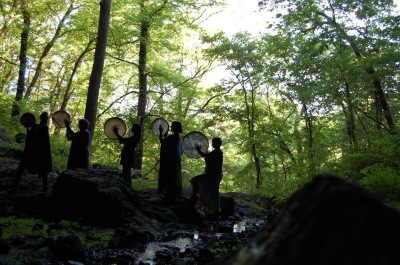 carvings of priestesses carrying drums as, “women carrying cakes to their husbands.”
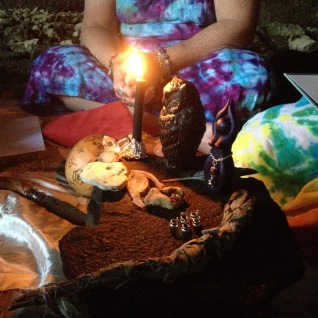 within which women try out what they want the macrocosm, the ‘big universe’ or real world to be. Within the safety and protected space of the cast circle, women create their idea of what the world would be like to live in under matriarchal/Goddess women’s values…The woman who in the safety of the cast circle designs the world as she would like it to be takes that memory of creation and success out into daily life…By empowering women through the microcosm of the ritual’s cast circle, change becomes possible in the macrocosm real world.” (p. 2-3)
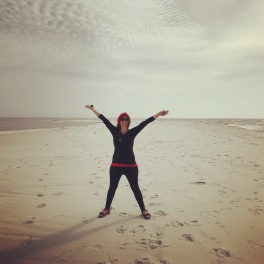 Molly has been “gathering the women” to circle, sing, celebrate, and share since 2008. She plans and facilitates
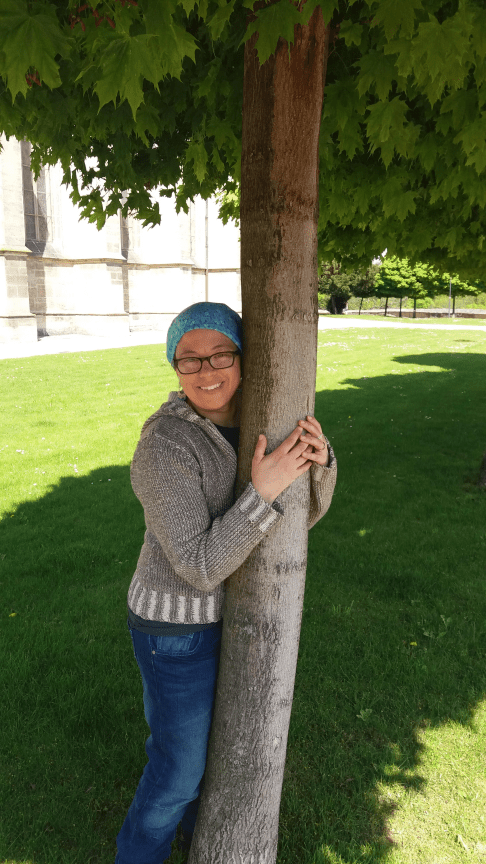 “Why is religion important to ecofeminism?”
 Feminism and Religion