

 Roughly 3 ½ years ago my FAR post was about the struggle that the Hawaiian people were facing with the proposed building of a Thirty Meter Telescope on the most sacred mountain in the Hawaiian Islands, Mauna Kea. When that post was published, there was a large social media presence and protests that helped cease construction of the telescope and sent the issue to the Hawaiian Courts. I am writing this post because Mauna Kea is again under threat. The Courts ruled in the favor of the telescope and for the last two months, large scale protests have gone under way on the road up to Mauna Kea.
Category: Ecojustice
Fish Tails: A Grandmother’s Legacy by Sara Wright
 When the two year old pulled the silvery gold fish out of the pond to the cheers of her five and seven year old siblings, parents, and grandmother, I shuddered involuntarily.
The young perch impaled by sharp hook was gasping for oxygen as the adults allowed the fish to hang helplessly while pictures were taken. Afterwards the group watched the fish flounder, still gasping, on the bottom of the boat. The toddler was applauded for her catch, while the terrified fish flipped over and over attempting to escape back into the water. It takes a while for a beached fish to die a death of asphyxiation. Continue reading ” Fish Tails: A Grandmother’s Legacy by Sara Wright”
Climate Change as a Socio-Spiritual Feminist Issue (Or 10 ways to be a leader in the era of climate change) by Nurete Brenner
 Authorities have observed that climate change is a feminist issue because it disproportionately affects women. Among these, the United Nations has gone further to acknowledge that climate change is a feminist issue because women are on the forefront of adopting climate-change mitigating techniques and technologies. A recent UN report states that “women are key actors in building resilience and responding to climate-related disasters…” But overarching these admittedly important issues is the greater understanding – not mentioned by the UN report – that climate change is a feminist issue on the socio-spiritual level. This side of the issue is often overlooked because the institutions who compile reports are immersed in a masculine way of thinking.
What do I mean by a masculine way of thinking and why do I label it in this seemingly gendered way? Masculine values are those of winning, achieving, proving, succeeding, counting, controlling. pursuit of achievement and status; individual self-reliance; strength and aggression. The UN climate report cited above goes on to say that “Enacting good policies requires quality data, so that we can quantify the issue and measure improvement…” Reports such as this make their points by tabulating numbers and citing statistics, not seeing that these are already masculine ways of expressions and that numbers can only ever tell part of the story. These masculine traits and values are social constructs and not necessarily to be associated with the male biological sex. Both men and women and other-gendered can display masculine values and attributes but they are labeled masculine because society typically associates them with the male gender. Continue reading “Climate Change as a Socio-Spiritual Feminist Issue (Or 10 ways to be a leader in the era of climate change) by Nurete Brenner”
Lise Weil – Requiem by Sara Wright
 For the Visionaries of the Women’s Movement and Beyond.
“I glimpse lines crazing my face in the windowglass,
crone’s bones emerging. My eyes are growing larger;
soon they will perch on stalks and swivel, crustacean.
The better to see how others do it:
this last chance at living…The message is we’re too fatigued to change the myths
of ourselves at this stage, preferring to die, unmake
the world, in the familiar. Understandable. Yet I persist
in lusting to be seamless with the universe while still aware
of it—so I suspect a future darkly bright, kaleidoscopic
as symmetries glittering beneath eyelids rubbed dry of tears.”Italics are my own.
Robin Morgan “Reading the Bones,” from her latest book of poems, Dark Matter: New Poems, published by Spinifex Press.
Yesterday I attended a reading for the memoir In Search of Pure Lust written by my friend and former professor Lise Weil, a woman who has dedicated her life to visionary thinking and teaching by inviting anyone to enter who has ears to listen and an open heart.
When I first encountered Lise’s radical feminist ideas my hair caught fire; and the flames between us continued to rise higher and higher. Our friendship remains as tempestuous as the fire that binds us still – fire and air are the two mediums of communication that flow between us – one a lover of women, a lesbian, internationally known translator, editor, writer, lifetime visionary activist and teacher, the other, a dedicated Earth centered heterosexual woman, a naturalist and mystic whose lifetime of writing had been confined to her journals up until that point, a woman who returned to school only after her children were grown. Continue reading “Lise Weil – Requiem by Sara Wright”
Befriending our Dragons by Sara Wright
“We are an overflowing river.
We are a hurricane.
We are an earthquake.
We are a volcano, a tsunami, a forest fire…”
These words written by Judith Shaw speak to the underlying merging of woman’s anger with Earth’s natural disasters, suggesting to me that women use “natural” violence in order to create change.
Violence, not the values of compassion and cooperation.
Violence and power over are the primary tools that Patriarchy uses to control women and the Earth.
Engaging in more violence will not solve the problems we face.
So many women including me are struggling like never before to survive on the edge of a culture that continues to sanction the vicious ongoing rape of both women and the Earth.
I use the death of trees as a primary example of the latter. By logging trees by the billions or killing them in “controlled burns” we are literally destroying human and non – human species. Without trees/plants we lose the oxygen we need to breathe.
We need “woman – centered” women to say NO!!! WE WON’T TOLERATE LIVING IN A DEATH DESTROYING CULTURE PREDICATED ON RAPE OF WOMEN AND THE EARTH.
We need women who are willing support other women – Women who refuse to remain neutral – Women who don’t wait until their mothers, daughters, sisters, nieces, granddaughters are assaulted to take a stand with other women – Women who refuse to stand behind their men when those men continue to support individuals (males or male identified women – the latter are often “Father’s Daughters” in Jungian parlance) – Women who refuse to support a Patriarchal system that is destroying us all.
A Letter to Senator Feinstein by Sarah Robinson-Bertoni
Dear Senator Feinstein,
I distinctly remember celebrating the 1992 historic victory when you and Barbara Boxer were elected as the first female Senatorial duo from any state in the union. My father brought my sister and me to an election party that evening at Gaia bookstore in Berkeley to watch the results trickle in. We literally jumped for joy, proud that California could lead the nation in recognizing the full capacity of women to legislate effectively and to send you to Washington. I never doubted that you would endeavor to represent me even though I was too young at that time to cast my own vote.
I am troubled by the recent media splash that showed your response to young people, who are rightly concerned about their own ability to have a future, represented in their intent to convince you to support the Green New Deal. At a certain level, it doesn’t matter what name is on the legislation, but what does matter is the content. Empirical reality, though undeniable in nearly the rest of the world, has been stymied here in the U.S. by those who profit from doubt and confusion. It is time for more active leadership in government and business to steer away from the shore before the ship of civilization runs aground.
Continue reading “A Letter to Senator Feinstein by Sarah Robinson-Bertoni”
Tree of Life: The Festival of the Trees in an Age of Treefall by Jill Hammer
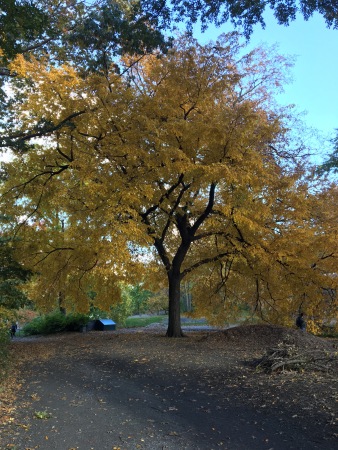
Almost every day, I walk in Central Park. There are certain trees there I’ve come to know: the gnarled cherry trees by the reservoir, the bending willows and tall bald cypress by the pond, the sycamores that drop their bark each summer, the hawthorn not far from Central Park West. Lately I’ve been taking photos of the trees to try to capture their essence, their posture in the world. The trees around me feel like friends, which is what an ancient midrash (interpretation/legend) called Genesis Rabbah says about trees: that they are friends to humankind. To me, they’ve always been a central manifestation of Mother Earth.
Currently, the national parks in the United States have no staff because of the government shutdown. Some people have taken the opportunity to cut down the rare and endangered Joshua trees in the Joshua Tree National Park—just for fun, I guess, or as a trophy of some kind. Meanwhile, President Bolsonaro of Brazil recently has indicted that he wants to remove protection for the rainforest, in order to allow development. It appears that my friends the trees have enemies. Sometimes the enmity is for personal/corporate gain, and sometimes the enmity seems to have no reason at all.
Continue reading “Tree of Life: The Festival of the Trees in an Age of Treefall by Jill Hammer”
We Have 12 Years. Luckily, Climate Lovers Are Usually Feminist by Tallessyn Grenfell-Lee
 Climate scientists have been screaming the alarm for literally decades. Despite global efforts, they now say we have 12 years left to contain the damage: the difference between 1.5°C and 2°C warming means tens of millions of lives lost, not to mention the death of all coral reefs and half the world’s plants and insects. In the USA, our oligarchic, oil-funded government seems determined to drive our country off a cliff and take the rest of the world with us. What on this good, green Earth are we to do?
I have been thinking about this a while. Below is a seven-fold strategy that I pray may bring help, comfort, and inspiration to those who, like me, can feel utterly overwhelmed.
Face Reality
It astonishes me to have to include this, but so much money has poured into distractions and strategies to discredit climatology that we must still spread the word. We now know which approaches actually bring people along; a little bit of doom and gloom goes a very long way. Focus on empowerment, action, and most importantly, connection: how do climate issues affect people directly? How do they intersect with issues people already care about? (Hint: the climate affects all life and every place on Earth!) Continue reading “We Have 12 Years. Luckily, Climate Lovers Are Usually Feminist by Tallessyn Grenfell-Lee”
Pachamama – August 1st – A day to Honour the Great Mother Goddess
 In Andean traditions the entire month of August is devoted to Pachamama.
Pachamama is the Supreme Goddess honored by the indigenous people of the Andes including Peru, Argentina and Bolivia. She is referred to as both the physical planet Earth as well as the universal Feminine Energy in time and space. Her name literally translates as Pacha – meaning world, land, earth, universe; and Mama, meaning Mother. She is the Mother of the World.
In Incan mythology Pachamama is also celebrated as a fertility Goddess who oversees planting and harvesting. She is responsible for the well-being of plants and animals and is often depicted as a Dragon or serpent representative of the Andean Mountains. When Pachamama feels disrespected it is thought that she causes earthquakes. Andean people believe that recent earthquakes in the region are a result of humanity’s destruction, disregard and disrespect for the planet. Continue reading “Pachamama – August 1st – A day to Honour the Great Mother Goddess”
A Feminist Retelling of Noah’s Ark by Trelawney Grenfell-Muir

My daughters came to me after Sunday School one day, concerned about a story they had heard in which God drowned almost everyone on Earth. So I sat down and thought about why a community might want to tell that story, and what valuable wisdom might be lifted from it for my children. Here is what I told them:
God/ess has many faces, which help us understand different things we need to know at different times. Sometimes we think of God/ess as Crone, an old, old woman crowned with silver hair as an emblem of her wisdom, who helps us learn to let go of anything that is holding back the wellness of our community and ourselves. Continue reading “A Feminist Retelling of Noah’s Ark by Trelawney Grenfell-Muir”
 Feminism and Religion