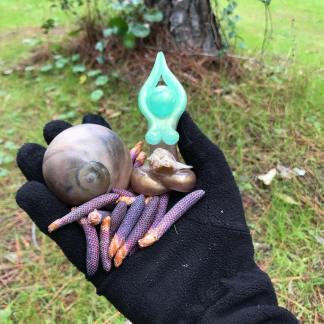
When the Cranes Come by Sara Wright

Departure.

I stood deep
in a toad hole
slinging mud
at twilight
when the sky
turned lemon
and gold.
They arced
over
my head
in pairs,
loose aggregations –
it seemed like thousands
crying out,
crossing
the river.
Ensouled.
Spirits defying
image or word.

A Mighty Migration begins…

I shivered.
Tears rose unbidden
Who calls them North?
I call out “I love you” –
Believing they know.
A crescent moon listens
cradled by nightfall.

To witness
a sky full
of Sandhill
Cranes
dark red heads
ebony eyes
long graceful necks
curved gray wings
dripping black legs
descending out of the blue
to roost
along this
winding Red
Willow River,
gracing fields
of depleted grain
is a Gift
given
at midnight;
the moment
before
departure.
This turning
of the wheel
births
days full of light
and an empty
sky bowl.

Haunting cries
in my ears
ring in the silence
of beloved crane absence
for another year.
Continue reading “When the Cranes Come by Sara Wright”

Leading by Mandala by Nurete Brenner and Elizabeth Meacham

Liz and Nurete (L to R)

Lake Erie Institute

The old myths and images that sustained us in earlier periods are no longer serving us during this time of breakdown of the old and the uncertainty about the future. The lone wolf, the frontiersman, the all-powerful superhero – these tropes fade into irrelevance as it becomes clear that no messianic figure is going to step forward and part the sea for us. We need to find new stories to accompany us and new images to illuminate the path as we shift from a patriarchal-hierarchical structure to a collective, relational, participatory one born in partnership rather than domination.  Women’s leadership is the emergent idea that leadership is about co-creating a new story for the world during a time of radical transformation in Earth history.

The word “leadership” stems from the Indo-European root leith which means to cross a threshold. How does a society cross the threshold from the myth of the strong leader to a new story of collective leadership? One answer is by telling new stories. Traditionally women have been the storytellers of our culture, relaying and relating the fairy tales, the bedtime stories, the family-history narratives and cultural myths. The men who share in this story-telling role are those who are at one with their feminine aspect and we recognize that this activity is not at all new for Indigenous cultures which have maintained an ongoing tradition of participatory story-telling leadership. Continue reading “Leading by Mandala by Nurete Brenner and Elizabeth Meacham”

I Celebrate Love by Elise M. Edwards

Happy Valentine’s Day!  I know, I know… so many of us do not like this holiday.  It’s too commercialized, we say.  We don’t need card-makers or florists to tell us how or when to show affection.  Some of us don’t like Valentine’s Day because it reminds us of loves we have lost or never found.  I get it.  This day can seem shallow, overhyped, and falsely sentimental.  It can be lonely.  And yet, I won’t let today pass without celebrating and honoring love.  Love is too important to concede to commercial interests.

Love, in its many forms, keep us alive and able to endure. Love is powerful because it is expansive, growing in unexpected places and ways.  We tend to separate our celebrations of romantic love, friendship, familial love, self-love, and religious devotion.  We make distinctions between our valentines and “galentines.”  Rarely do we shout for joy in ecstatic worship while also celebrating the passionate longings of our innermost desires.  But occasionally, in my religious tradition, we let our disparate loves come together.  We unite them on holy feast days, enjoying the sensual pleasures of good food and company to mark spiritual occasions.  So that’s my inspiration.  Today, I’m celebrating love by reflecting on various forms of love merged together and sharing insight from poets and mystics about the power and beauty experienced in love.

Continue reading “I Celebrate Love by Elise M. Edwards”

Devotion by Molly Remer

There are things that ask
50237778_2257311164481093_3090053013251817472_oto be remembered
or, is it that I ask to remember?
The everyday enchantments
of our living
words forming slices of
memory.
A white squirrel watching
from a sycamore tree
the sounds of black
crows calling
from within the secret
passages
between oak tree
and neighborhood
footprints of a shy orange
coastal fox in the sand.
Rays of sunlight
forming individual white rainbows
stretching from cloud
to water.
I no longer feel like I have anything
to teach
I just want to tell you about the
shell I found today
the sandy pink color
of its wave-shaped spiral
the way the pine needles
form a canopy under
which orange monarchs dance
the surprising softness and bright
green hue of thin fingers of grass
the pretty purple pollen cones
of a longleaf pine.
The colors of a morning woven
into a tapestry of devotion.
That is the word for this feeling
in my chest.
Devotion
to noticing.

Devotion is not a word that I have previously felt particularly inspired by or connected to. Perhaps it is too heavy, too responsible, or even “too religious”—carrying connotations of dogma or roteness. However, in the last month or so, something has opened up for me to consider the word, and the process, in a different way. Continue reading “Devotion by Molly Remer”

When Violence is Normal and Normalized by Carol P. Christ

Warning: this blog discusses spanking and bodily violence

“No Whips, No Punishments, No Threats: Women’s Control of Social Life” is the title of one of the chapters in Iroquoian Women, Barbara Alice Mann’s stunning reconstruction of female power in a matrilineal society. According to Mann, the European settlers were “unsettled” by the lack of strict punishment systems for children in Indian societies. “Spare the rod and spoil the child” was the backbone of European child-rearing practices. The settlers viewed Indian children as naughty, disobedient, disrespectful, and horror of horrors: self-possessed.

It is perhaps no coincidence that after reading this chapter, bodily memories of violence inflicted on me as a child began to resurface. My strongest bodily memory is of being hit repeatedly on my left upper arm by my younger brother’s fist. It is as if my arm is still stinging in that particular place. My mother wanted us to play together, but when we did, we usually ended up fighting. My brother, who was two and a half years younger, was later diagnosed with dyslexia and given “little red pills” to help him control his temper. I was a quiet child (there must have been reasons for that too), and though I soon realized that if I hit back I would only be hurt more, I learned to use my tongue against my brother. This too was a form of violence and my brother remembers my cruelty to this day. Once when I asked my mother what she wanted for her birthday, she responded, “Two children who do not fight.” I didn’t even try to give her that because I didn’t know another way. Continue reading “When Violence is Normal and Normalized by Carol P. Christ”

Eulogy for My Father by Natalie Weaver

Fourteen years ago, I was pregnant with William Valentine.  I had no idea what to expect.  I knew only that I was in a body, and it was pregnant.  Things happened to me, to my body, that seemed extrinsic to my person, so much so that for most of those forty weeks, I felt as though the doctor’s office was having the baby, and I was a mere observer.  But, when the time came to deliver the baby, I realized it was my body that was trying to make passage for another’s.  The particularities of myself and the baby’s self seemed to fade away into something more vital and primordial in the process of the transmission of life.  After a safe delivery, I felt a deep and curious gratitude that was beyond the gratitude I had for my child or for our health.  This strange gratitude was born of the passage I had been so fortunate to experience, that is, this novel yet ancient, essential yet unparalleled dimension of human being-ness.  I had given live birth, and I was grateful to know what that was like.  In that experience, I was more connected to my human brothers and sisters than I had ever been before, including to this new baby, who I knew in my deepest self was more fundamentally a brother human than even he was my own child.  I knew that in this transmission, I had helped a fellow traveler, and that transmitting life was simple even while it was giant in scope.  The experience was and would always be about walking with each other, from the cradle to the grave, in our vulnerability, in our fragility, in our humility, and in that walk, to find our strength, our dignity, and our luminescence, as persons, as creatures that think and speak and love.  To have been a party to another’s coming to be, this was an occasion of the greatest gratitude I had known.

In accompanying my father in this final stage of his life during these challenging and difficult months as he journeyed toward his death, I felt that same vital and primordial passage of being that I had in giving birth.  While it was not my body that this time labored and worked, I was party to his experience.  I witnessed his courage and another kind of transmission of life.  For, I saw a man go from self-concern to other-concern; from hope of getting well to hope to of making things better for others; I witnessed a man move from verbal complaint to silent focus; and I heard his relocation of worry for himself to concern for me because he knew I was hurting as I was watching him, mostly powerless to do anything but sit next to him. I saw a man graduate from a regular man to an elder and then to naked spirt in God’s care, and I was honored to be one of his midwives on that journey.  In his final hours, he became full of grace, and he fulfilled the trajectory of becoming the father and man he always intended to be.  It was an honor to behold, and I am grateful.

Continue reading “Eulogy for My Father by Natalie Weaver”

Seeking Happiness, According to Paulo Coelho by Elisabeth Schilling

Lately I’ve been reading a few Paulo Coelho books. I won’t say they are beyond feminist criticism, but it’s not what I’m going to focus on this post; but as always, feel free to say in the comments why/if you find them problematic. I expect and welcome it because it might be another layer of this conversation that I don’t have time or am not yet emotionally ready for myself.

What I want to focus on is the solution the author seems to advance in each of his books, at least those I’ve read, to our perpetual unhappiness despite the evidence that everything is fine, better than might otherwise be.

Adultery: I never finished this one, actually. I had to take it back to the library the last time I had to leave Ireland, but I’m sure I will find it again and read the rest of it soon. So I can’t say what the ending revealed, but what sticks in my mind was the predicament of the main character. She, from her perspective, had it all: wealth, an interesting career she liked, an attractive husband who was attentive and kind, a family, health. This was why she was so confused that she was unhappy. This is the premise of many of his books: the person who doesn’t know why they are unhappy. Also, the observation that no one is really happy.

Continue reading “Seeking Happiness, According to Paulo Coelho by Elisabeth Schilling”

Virgins with Pregnancy Scares: Feminist Reflections on the Annunciation by Lauren D. Sawyer

There I was in the bathroom, peeing on a stick. “It’s a rite of passage,” my friend Kelsey told me. She was the one wishing me luck from the other side of the door; she was the one who brought me the pregnancy test—and a pound of chocolate—after my panicked tears suggested I could not buy one on my own.
I came from a world of virgins with pregnancy scares. Growing up a girl in a conservative evangelical church, I was taught that all sexual sins—from kissing in the dark, to “petting” (whatever that was), to oral sex, to intercourse—were equally bad, were just as likely to risk my salvation. So many of us began imagining that the consequences were all the same too, that we might become pregnant by unconventional means. Lying naked together. Making out. Continue reading “Virgins with Pregnancy Scares: Feminist Reflections on the Annunciation by Lauren D. Sawyer”

Let Us Proclaim the God Who Bleeds Now by Carol P. Christ

we need a god who bleeds now

we need a god who bleeds now
a god whose wounds are not
some small male vengeance
some pitiful concession to humility
a desert swept with dryin marrow in honor of the lord

we need a god who bleeds
spreads her lunar vulva & showers us in shades of scarlet
thick & warm like the breath of her
our mothers tearing to let us in
this place breaks open
like our mothers bleeding
the planet is heaving mourning our ignorance
the moon tugs the seas
to hold her/to hold her
embrace swelling hills/i am
not wounded i am bleeding to life

we need a god who bleeds now
whose wounds are not the end of anything

–Ntozake Shange

Continue reading “Let Us Proclaim the God Who Bleeds Now by Carol P. Christ”

Lei by Elisabeth Schilling

Mauro Drudi’s installation of LEI (SHE/HER/YOU – formal) in the Chiesa de San Cristoforo on the Sicilian island of Ortigia where I usually take a bus to daily has become the shrine of women I’ve been searching for. Each time I cry, I am glad I can feel something: those tears are a mixture of communion, comfort, and recognition.

When one enters the church, there are two converging walls. On either side, a woman’s face is painted in shadow and light, gazing off toward the light, is reproduced over and over so that the number of women looks almost countless. They are the same face, a reproduction of Antonello da Messina’s “Annunziata” in the mode of pop art. The difference is not in expression. They all wear the same thoughtful, complicated, neutral countenance, holding deep thoughts and experiences of suffering and wise knowing, both acceptance and maybe resistance; they have lived and might be any age, although I see in our connection my own. The difference is between glossy, unblemished surfaces of wood vs. surfaces weathered, slightly ragged, sometimes scribbled on with ink. The former, found on the right when one enters supposedly represents the “positive” woman, the “western woman [. . . representing someone] happy, gorgeous, well-kept.” On the left, about these representations, Drudi says, “Which artist can paint the skin of a woman who has been abused, beaten, exploited, captivated or disfigured with acid? In my opinion, nobody, and so I let the material speak: the wall of a beach hut destroyed by a storm; woods and materials used and abused [. . .]; exhausted panels deriving from carrying tons of goods, tables, packagings, production wastes.”

Continue reading “Lei by Elisabeth Schilling”