On the ‘Naturalness’ of Inequality by Ivy Helman

29662350_10155723099993089_8391051315166448776_oIn some regards, life on Earth seems to depend on some basic inequalities.  For example, differences in size, height, strength, speed and endurance advantages some and disadvantages others.  Depending on another for survival is another type of inequality. Being able to adapt to change increases one’s likelihood of survival as well.  

In this regard, inequality is natural, a normal part of existence.  In fact, the exploitation of such inequalities supports and perpetuates life on this planet.   Darwin said as much. Evolutionary theory does as well. At one point, we, homo sapiens, replaced our Neanderthal cousins.  Lions kill and eat gazelles. Some iguanas in the Galapagos Islands were able to become great underwater swimmers in order to reach edibles; those who couldn’t died. Continue reading “On the ‘Naturalness’ of Inequality by Ivy Helman”

To Love the Earth and Fear the Forest: My Paradox as an Ecofeminist by Tallessyn Zawn Grenfell-Lee

I am privileged to live near a wood where I can walk with my family, my dog, or alone – when I have the courage. I fear the woods, see; not because of physical danger from humans or wild animals, at least, not really. I fear the woods because time in the wilderness forces me to think and feel things I normally can distract myself from.

It took me years to figure out why I resist going to the woods alone. I’m not really alone, of course – there are other people and their dogs on the trails, not to mention all the wild animals and plants whose homes I am visiting. But without a walking companion, sometimes, something rushes in, something that crushes me, so that I can’t breathe. Is it Nature’s Wall of Grief, as nature connection mentor Jon Young posits – the stark reality of the ecological crisis and my own disconnect with my earthly roots? Is it the summation of all my past grief and trauma, or a fear inherited from my ancestors? Is it whatever feelings of fear, inadequacy, or pain that I usually process in smaller, more manageable quantities? All of the above? No, no… it’s much safer to wait until someone wants to go with me. Continue reading “To Love the Earth and Fear the Forest: My Paradox as an Ecofeminist by Tallessyn Zawn Grenfell-Lee”

Considering Our Spaces in the Pursuit of Justice by Elise M. Edwards

This past summer, my friend and I were perusing the exhibits at the National Museum of African-American History and Culture when she urgently called for my attention.  “Psst… Isn’t this where you are from?” she asked, pointing at a placard titled African American Life in Montgomery County.  Yes!  I grew up, I was educated, and I was churched in Montgomery County, Maryland.  So I eagerly read the exhibit’s description:

By 1900 there were at least eight African American communities in Montgomery County, Maryland. Unlike many rural African Americans, the residents were not tenant farmers—they owned their property and homes.  This gave them greater control over the land and the crops they produced.  They also directly benefited from improvements to their homes, which was an incentive to make additions and to stay in place.  Descendants of these early settlers still live in these communities today. Continue reading “Considering Our Spaces in the Pursuit of Justice by Elise M. Edwards”

Sheep, Goats, and a Donkey Named Balthazar by Joyce Zonana

JZ HEADSHOTA few days ago, at the New York State Sheep and Wool Festival in Rhinebeck, NY, I purchased a six-ounce skein of fine, reddish-pink mohair bouclé, directly from the woman who’d dyed it using the natural pigments cochineal and logwood. My plan is to make a soft, long winter scarf with it.

I recently started knitting again, lured by some thick, heathered purple wool yarn I’d glimpsed in a farm store in upstate New York. “Is this wool from your sheep?” I asked the farmer. “No, but it’s from a farm down the road,” she assured me. “Her sheep and mine are related, and I know those sheep well.”

I was delighted to be knitting an afghan with wool carded and spun from the fleece of Continue reading “Sheep, Goats, and a Donkey Named Balthazar by Joyce Zonana”

Musings On My Recent Road Trip by Esther Nelson

I love a road trip.  It’s exciting to get behind the wheel of a car, get out on the highway (or bi-way), and just go.  The road seems to stretch out forever in front of me, full of possibilities, adventure, and fun.  Again, this summer I drove two thirds of the way across the United States from Virginia to New Mexico and back again.  I varied my route because why not?  The country is vast and diverse.  I want to see as much of it as I can.  The broad, open, colorful skies of Texas and New Mexico.  The wheat fields in Kansas.  The green, rolling hills of Kentucky and Tennessee.  On this particular trip back to Virginia, though, one of the sights disturbed me deeply.

The second day of my journey eastward, I drove from Amarillo, Texas, to Springfield, Missouri.  All along the panhandle of Texas and into Oklahoma, I encountered feedlots.  These are places where cattle live for several months in order to fatten up before slaughter.  The animals are fed grain (mainly corn), growth hormones, and antibiotics.  They live in crowded spaces and in the feedlots I saw, the cattle had difficulty walking due to the layers of muck, mire, and manure all over the ground.  I could smell a feedlot long before I saw one.  The stench nauseated me.

Continue reading “Musings On My Recent Road Trip by Esther Nelson”

Learning Compassion from Inmate Number 74799 by Cynthia Garrity-Bond

Technically I was employed as a lab assistant at our community hospital. This position entailed multiple responsibilities, from receptionist to actual bench work within the laboratory. The task I dreaded most was my assistance at autopsies. Beyond a strong constitution, it required no measurable skill set. This job was not the high-tech, immaculate setting of any of the CSI programs of today; instead the morgue was a stark, condensed room with two pullout refrigerators for the deceased, a stainless steel table the autopsy was performed on, and the necessary instruments and accouterments, some suspended from what appeared thin air. These tools of the trade ranged from the expected scalpels and retractors to saws and garden-like shears.

Fast-forward fifteen years. It is the morning of July 11, 1991. Prisoner number 74799 has just been transferred from the Department of Corrections, Arizona State Prison in Florence to Tucson County General Hospital in critical condition. Eight months prior to his admittance to the prison hospital, Prisoner 74799 was diagnosed with metastatic lung cancer. While considered inoperable, he was administered the customary chemotherapy treatments until four months later when the cancer spread to his brain, taking most if not all of his cognitive abilities away. Within one hour of his transport, Prisoner 74799, my brother, Michael Paul, died at the age of thirty-nine.

Continue reading “Learning Compassion from Inmate Number 74799 by Cynthia Garrity-Bond”

The Trees and We Breathe Bombs Long Gone by Elisabeth Schilling

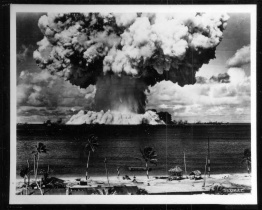
bikini atoll bombI wish that in our pursuit of finding cures for illnesses we would do more as a collective species to prevent the causes, sometimes environmental ones. Why do we vote for people to make decisions that represent us but that we would never in a million years agree to? Bombs and the consequences of them raise questions of health and power. In the Yoga Sutras, 2.30, we read that “Yama consists of non-violence, non-lying, non-stealing, appropriate use of vital energy, and non-possessiveness.” The yamas are our social restraints. They are a negation of behaviors we might usually partake in.

Ahimsā, or non-violence, is listed first. It is the first element of the first limb of yoga; it is the basis for every other ethical aspect of our lives. Bombs are an example of a common and frequent behavior of violence that make the land, water, and sky increasingly uninhabitable. According to Micah Zenko of the Council on Foreign Relations, in 2016 alone, the U.S. is estimated to have dropped 26,172 bombs. Zenko says that this estimate is “undoubtedly low.” (1) This is one year and the bombs from one nation. (2) What is the environmental impact of all of the bombs dropped from every nation since the beginning of bombing history?

When a bomb is detonated, there is not only harm to the immediate life in that vicinity but life in the future and far away. According to the International Campaign to Abolish Weapons (ICAN) website, “the International Physicians for the Prevention of Nuclear War has estimated that roughly 2.4 million people will eventually die as a result of the atmospheric nuclear tests conducted between 1945 and 1980, which were equal in force to 29,000 Hiroshima bombs.” (5)

According to a statistic updated March 2016 on the Ploughshares Fund website, nine countries in the world have a total of 14,900 nuclear weapons, the U.S. and Russia holding 93% of them. (3) They have been used twice, both times by the United States, in war, but additionally they have been used in tests over 2,000 times in more than 60 locations over the globe, according to ICAN. (4) There are already unavoidable consequences to the earth and humans because of this irresponsible behavior that is ongoing.  These tests occur in the atmosphere, under the earth, and under water. (6) Continue reading “The Trees and We Breathe Bombs Long Gone by Elisabeth Schilling”

The Universe Is on Your Side by Elisabeth Schilling

IMG_0617While I am sure this articulation is on an “inspirational” meme somewhere, my thoughts coalesced to form it while I was looking at the mid-afternoon blue sky in a moment of rare optimism. Too often can I become confused and despondent about the situation of our earth and humanity, myself. “We want healing too,” it whispered. If we are for the sustainable restoration and support of our earth, then we have a whole universe on our side that moves toward this direction as well. Our bodies, one with the universe, join in this want of healing.

Matthew Sanford is a yoga instructor whom I heard speak during an NPR interview. He explained how any reference to “our bodies failing us” does not feel true to him. He explained: Continue reading “The Universe Is on Your Side by Elisabeth Schilling”

The Blue No Gaia Wants: Protecting the Sacred through our Lawns by Elisabeth Schilling

blue lawnIf Gaia is a living body, why are we painting her blue? Whether it is public parks or residential lawns, when there is that special odor in the air, I know to look down and there it is, an endless dye job on the grass indicating treatment. My city is concrete and blue dye for miles. Furthermore, I have sales people knocking at my door monthly asking if I want to spray pesticide around the house to decimate wasps, ants and spiders.  

Many religious texts encourage us to mindfully consider the earth. The Jain Acaranga sutra, for instance, says, “a wise [person] should not act sinfully toward plants” (I.1.5.7). One way we sin against the earth so casually is by these mindless manipulations of our lawns, if we have them. (Technically, I do not have a lawn, but my roommate does, and I try to protect it). I do not think most people think about researching what they allow into the earth. Continue reading “The Blue No Gaia Wants: Protecting the Sacred through our Lawns by Elisabeth Schilling”

Leadership in the Kali Yuga by Elisabeth Schilling


green pathSince the U.S. has elected a reality TV show billionaire to represent our nation, we should be no longer be able to shy away from the ignorance, violence, and frivolity that is within us. Happiness and peace in humanity seem to be in short supply. How many of us experience continuing bliss, or do we only fantasize and find brief reprieves in our suffering? Even the more extreme privileged among us most likely share the same emotional landscape.

In Indian cosmology, Hinduism specifically, there are four stages (yugas) of humanity that occur in a cycle. They represent the ascending and declining spiritual, psychological, and physical well-being of humanity. The Satya Yuga is first (descending) and last (ascending) era, where people are without strife, disease, or fear. Satya means “truth.” Life increasingly deteriorates through out the Treta Yuga to the Dvapara Yuga to the Kali Yuga.

Continue reading “Leadership in the Kali Yuga by Elisabeth Schilling”