

 I am privileged to live near a wood where I can walk with my family, my dog, or alone – when I have the courage. I fear the woods, see; not because of physical danger from humans or wild animals, at least, not really. I fear the woods because time in the wilderness forces me to think and feel things I normally can distract myself from.
It took me years to figure out why I resist going to the woods alone. I’m not really alone, of course – there are other people and their dogs on the trails, not to mention all the wild animals and plants whose homes I am visiting. But without a walking companion, sometimes, something rushes in, something that crushes me, so that I can’t breathe. Is it Nature’s Wall of Grief, as nature connection mentor Jon Young posits – the stark reality of the ecological crisis and my own disconnect with my earthly roots? Is it the summation of all my past grief and trauma, or a fear inherited from my ancestors? Is it whatever feelings of fear, inadequacy, or pain that I usually process in smaller, more manageable quantities? All of the above? No, no… it’s much safer to wait until someone wants to go with me. Continue reading “To Love the Earth and Fear the Forest: My Paradox as an Ecofeminist by Tallessyn Zawn Grenfell-Lee”
 This past summer, my friend and I were perusing the exhibits at the
  A few days ago, at the

 I wish that in our pursuit of finding cures for illnesses we would do more as a collective species to prevent the causes, sometimes environmental ones. Why do we vote for people to make decisions that represent us but that we would never in a million years agree to? Bombs and the consequences of them raise questions of health and power. In the Yoga Sutras, 2.30, we read that “Yama consists of non-violence, non-lying, non-stealing, appropriate use of vital energy, and non-possessiveness.” The yamas are our social restraints. They are a negation of behaviors we might usually partake in.
 While I am sure this articulation is on an “inspirational” meme somewhere, my thoughts coalesced to form it while I was looking at the mid-afternoon blue sky in a moment of rare optimism. Too often can I become confused and despondent about the situation of our earth and humanity, myself. “We want healing too,” it whispered. If we are for the sustainable restoration and support of our earth, then we have a whole universe on our side that moves toward this direction as well. Our bodies, one with the universe, join in this want of healing.
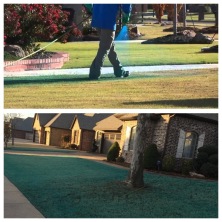 If Gaia is a living body, why are we painting her blue? Whether it is public parks or residential lawns, when there is that special odor in the air, I know to look down and there it is, an endless dye job on the grass indicating treatment. My city is concrete and blue dye for miles. Furthermore, I have sales people knocking at my door monthly asking if I want to spray pesticide around the house to decimate wasps, ants and spiders.
  Since the U.S. has elected a reality TV show billionaire to represent our nation, we should be no longer be able to shy away from the ignorance, violence, and frivolity that is within us. Happiness and peace in humanity seem to be in short supply. How many of us experience continuing bliss, or do we only fantasize and find brief reprieves in our suffering? Even the more extreme privileged among us most likely share the same emotional landscape.
 Much of our lives lack the rich culture of ritual that I think would help us repair the relationships we have with our own bodies and with the earth. The Rg Veda is one of the oldest collection of hymns from India. In them, I find a playful and introspective expression of desires and fears that, at first, did not seem to me to hold much wisdom for a modern contemplative. But lately, I have been noticing how the speakers communicate to or about the earth, and how their lives seem centered around trying to take a part in creation. Mostly, these hymns are stories and supplications for rain, cows, victory in battle, and a long life. But there is a deep understanding of the power and divinity in the universe that is the very earth-based wisdom that our humanity-in- crisis needs. If the Qur’an is God calling for humanity to be grateful, the Rg Veda is a model of a humanity that could be nothing else.
