A link to a talk called “Moral Behavior in Animals” by Franz de Waal recently found its way into my email inbox. I am a big fan of Franz de Waal because his findings confirm what I always believed—that animals are intelligent. I followed the link and other suggested links and spent most of the evening listening to de Waal.
De Waal began his studies of animal behavior at a time when instinctual behaviorism was academic orthodoxy: the idea that animals can think and feel was “poo-pooed” by “scientists.” As de Waal observed ironically, everyone who has a pet knows better than that. But academic researchers continued down this path, expressing contempt for ordinary people who thought their pets were intelligent and the likes of de Waal who suggested that scientists might be colossally wrong.
Well, the fall semester of the school year has begun. I’m teaching undergraduate classes in Christian Ethics and Bioethics this fall. I’ve designed my classes so that they are much more discussion-based than they have been in previous semesters and as a result, I’m noticing the things that challenge and confuse my students fairly early. I have readings from feminist, womanist, and mujerista thinkers in these courses, and unsurprisingly, some of my students don’t know what to do with the arguments feminists make about how we arrive at moral decisions and live them out. I hope that as we work through the essays together, my students and I learn from each other.
I assigned an essay called “Theology’s Role in Public Bioethics” by Lisa Sowle Cahill that was included in the Handbook of Bioethics and Religion edited by David E. Guinn (2006). Cahill, a feminist thinker, asserts that theology can be a conversation partner in public debate about bioethics and also an advocate for just, compassionate, and inclusive health care practices. Citing the work of another feminist, Maura Ryan, Cahill argues that ethical questions about reproductive technologies should be examined not only as individual dilemmas but as issues that exist within a social justice context. In the conclusion of the essay, she states, ”Specifically, one of [theology’s] most important and distinctive contributions to public discourse is a critique of the ways in which modern biomedicine and biotechnology have become luxury items marketed to economically privileged classes, while the world’s poor majority lacks basic health needs.” (55).
I suppose because I’ve been reading feminist thought, theology, and social ethics for years, some of the claims that my students see as radical and new are commonplace and go unquestioned by me. I expected some of my students to disagree with Cahill and Ryan’s particular positions about assisted reproduction. But I was surprised by students’ rejection of the idea that debates about reproductive technologies include MORE than individual considerations.
I’ve blogged on this site about reproductive rights before, and let me be clear that I do not think that the church, state, or any institution should have more governance over a person’s body than that person herself. But while respecting individuals’ rights to make health decisions for themselves, I also acknowledge that these “individual” decisions have broader social implications and meanings. This is one reason second-wave feminists have insisted that “the personal is political.”
Feminists routinely relate individual, “personal” acts and beliefs to larger constructs and the too-often asymmetrical power dynamics at work within them. This is why we are disturbed by video of a man who knocks his fiancée out and drags her unconscious body from an elevator and pop stars who gain commercial success by graphic displays and descriptions of sexuality that is objectifying or exploitative. And, in response to one of my students who wondered if feminist interpreters of religious texts go too far, that is why they point to patriarchy in a story that seems to be about devotion (referring to the Book of Ruth).
I’m grateful to my students for prompting me to explain some of these convictions that feminists hold. Certainly feminism is not monolithic. We feminists disagree on many issues including the scope of individual rights, the role of religion in public debate, and the extent of harm (or lack thereof) in media portrayals of female sexuality. But I believe we tend to agree that our personal decisions as well as our societal issues should be addressed with a consciousness that as humans we are beings-in-relation. Our conviction that we are connected and affected by each other lies behind our motivation to make the world a better place for women and girls and others who suffer from patterns of dominance.
What do you think?
Elise M. Edwards, PhD is a Lecturer in Christian Ethics at Baylor University and a graduate of Claremont Graduate University. She is also a registered architect in the State of Florida. Her interdisciplinary work examines issues of civic engagement and how beliefs and commitments are expressed publicly. As a black feminist, she primarily focuses on cultural expressions by, for, and about women and marginalized communities. Follow her on twitter, google+ or academia.edu.
I had an entire blog ready to go for posting this week, but as news broke of Jennifer Lawrence’s stolen pictures, I couldn’t bring myself not to speak up.
If you have not heard yet, hackers broke into Jennifer Lawrence’s personal accounts and uploaded quite a stash of private photos on to the internet. They are currently threatening to upload stolen videos as well. You can find the story chronicled here. I’ve decided to link to a feminist website that is withholding the photos because, trust me, you do NOT want to wade the waters of what is out there in regards to this story. It is rage inducing. Continue reading “We Are All Jennifer Lawrence by Martha Cecilia Ovadia”
In a space that has been flooded with negativity and scenes of war and violence, I find my Facebook newsfeed lit up with people from all walks of life engaging in this challenge. For those that may not be aware of how this works, you are invited to take the challenge by either donating $100 to ALS research or dumping a bucket of ice water over your head. Those with means seem to be doing both, even exceeding the minimum donation amount. However, despite millions of dollars raised for important research, there are critics of this challenge. They vary widely from diverting donations from the ALS Association because foetal stem cells are used in their research, a violation of Catholic Social Teaching, to objections to a display of privilege; watching those with means wasting precious resources to perform this challenge.
For me, I have been torn over this debate. I think today, more than ever, we are in desperate need of levity. More than that, we need to rebuild our sense of community and can do so while raising awareness about ALS, amyotrophic lateral sclerosis, also known as Lou Gehrig’s Disease, an incurable, progressive degenerative neurological disorder. I think that this challenge has accomplished all of these goals. From former presidents to billionaires, CEOs of Fortune 500 companies to professional sports stars (even teams), movie stars and musicians, to my neighbours, friends, and family members – there is something about this that ties everyone together – a common bond, if you will, forged by this challenge. Not to mention, over $90 million has been raised to support research so far, with a record breaking $10 million raised in one day alone. To put this in perspective, the annual average annual donations received by the ALS Association is usually around $2.1 million. Continue reading “#IceBucketChallenge – Raising Awareness While Being Good Stewards by Michele Stopera Freyhauf”
No doubt about it, the news of late has been dismal, heart breaking, soul crunching. Pick a place or theme and see where you end up: Ebola in parts of Africa, Israel and Hamas; Ferguson, Missouri; Ukraine, U.S., and Russia; unaccompanied minors from the south crossing over into U.S. borders; the assault of the Islamic State of Iraq and Levant (ISIS) on Christians, Kurds, Yazidis, Shi’ahs and journalists. This list could (should) be augmented by many other conflicts and areas of strife which have been on-going for longer than the last several weeks.
I don’t know about you, but I draw my weary attention to the latest news each morning with knots in my stomach and a heavy weight on my shoulders. Meanwhile, even if I am not directing my attention to the news per se, the same events are all over social media and I confess I check into facebook and twitter each day even when I try to maintain a casual posture over usage and to keep upbeat attitude in how I engage (or ignore) the latest hash tag or hot button issues.
For weeks I have been thinking I should blog about an important lesson I have learned as best articulated in the book by Sharon Welch: A Feminist Ethic of Risk. In a world riddled with problems of proportions greater than can be solved by any one person, one group, one country or over one life time, how does one continue to be ethically engaged, avoid crippling despair and pointless cynicism, or just plain fall into apathy? Continue reading “Good Muslim, Bad Muslim by amina wadud”
The Atheist Alliance of America National Convention 2014 held earlier this month in Seattle, Washington granted me the opportunity to interview, converse with, and listen to renowned speakers, comedians, and influential figures in the atheist movement including the likes of David Fitzgerald, Dr. Steven Pinker, Dr. Rebecca Goldstein, Richard Haynes, and Dr. Richard Carrier.
This year’s convention drew in approximately 100 attendees throughout the weekend, according to Amy Monsky, Executive Director of Atheist Alliance of America (AAA). Monsky states that the AAA National Convention has several primary goals including: to bring atheists together; to hear great speakers; to network and socialize; and to raise awareness through education.
The family-friendly event was comprised of educational and activist-oriented sessions, debate, a comedy show, VIP non-prayer breakfast, film by Jeremiah Camara, “2014 Richard Dawkins Award” banquet, and a Sunday outing to Snoqualmie Falls and Chateau Ste. Michelle Winery.
I’m moving to Prague in the Czech Republic at the end of August. (In case anyone is concerned, I will still be a regular contributor to this blog.) In part, moving to Europe feels like diving headfirst into the unknown. At the same time, it also feels right.
A full-time teaching job still did not materialize again this year despite my best efforts. I’m beginning to see the blessing in that since a full-time job would have made the decision to go that much harder. Yet, the decision to move wasn’t easy either.
My plan in Prague is to teach English to local business people as well as feminism and ecology at Charles University. Neither of these plans is solid. I don’t have any job offers yet. I could go there and everything could fall through or I could go there and decide to do something totally different. In many ways, it’s up to me. I’m not sure if I have ever placed myself into a situation in which I have so much freedom. At the same time, I’m also quite nervous about the entire situation. At least I’m not moving to Prague alone. Continue reading “Choosing Well by Ivy Helman”
A few days ago I had the pleasure of giving a talk at the Secular Student Alliance Conference on how non-believing persons can work with Churches. Amidst the chaos of conferences–managing your time, deciding which talks to attend, and making sure you have enough water (it was a Burning Ring of Fire outside in Tempe, AZ)–I got to meet some pretty incredible secular women.
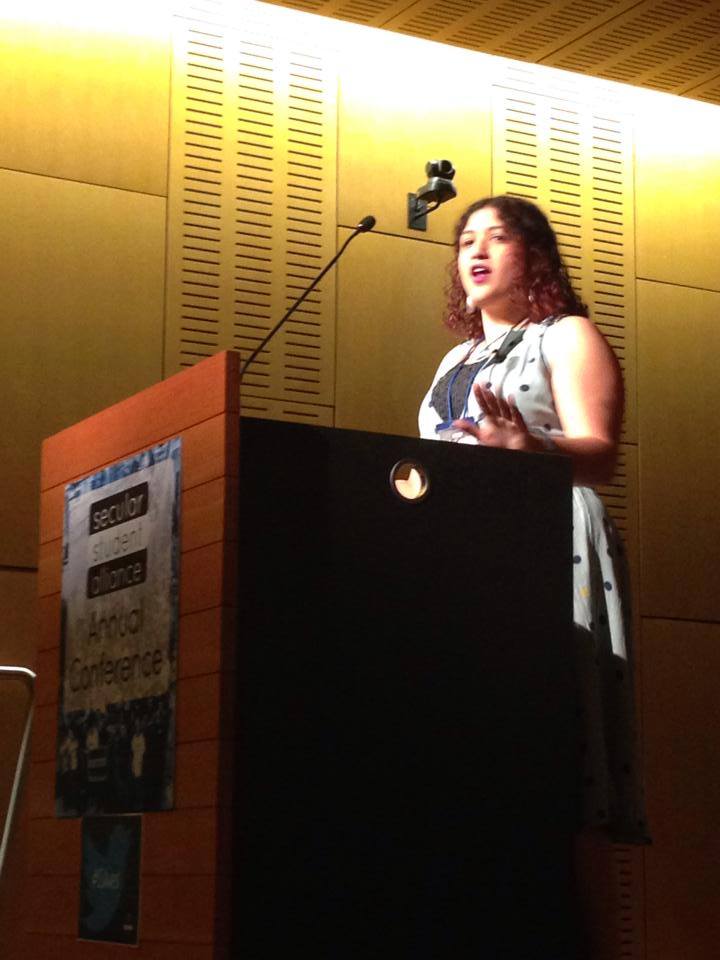
One of them was Heina Dadabhoy.
Heina speaking at SSA.
Former Muslim, blogger at Freethought Blogs, and overall bad-ass, Heina spoke about ways in which secular groups can create a more welcoming environment for ex-Muslims and Muslims beginning to doubt. Her talk, “Of Murtids and Muslims,” (a “murtid” is a public apostate) was not only about her experiences coming out as a secular humanist, but considered some of the absurd questions people ask her (and other ex-Muslims) about leaving Islam. “So did your parents try to honor kill you?” “Have you gone through FGM?” It was disturbingly humorous.
What I considered to be Heina’s main point, was that we should respect each others’ individual differences and not generalize and caricature all Muslims with the depictions of some. “Just because you read Ayaan Hirsi Ali’s book,” Heina notes, “does not make you an expert on Islam.” Heina made sure to emphasize the radical diversity that exists in Islam. She also spoke of the some of the issues that people go through when they leave Islam: How do I create a new identity when my old one was intricately tied up in my Muslim community, family, and culture? How do I navigate popular culture when I have missed a bunch of it? How do I find myself in this new secular world? Heina’s answers were refreshingly honest and insightful.
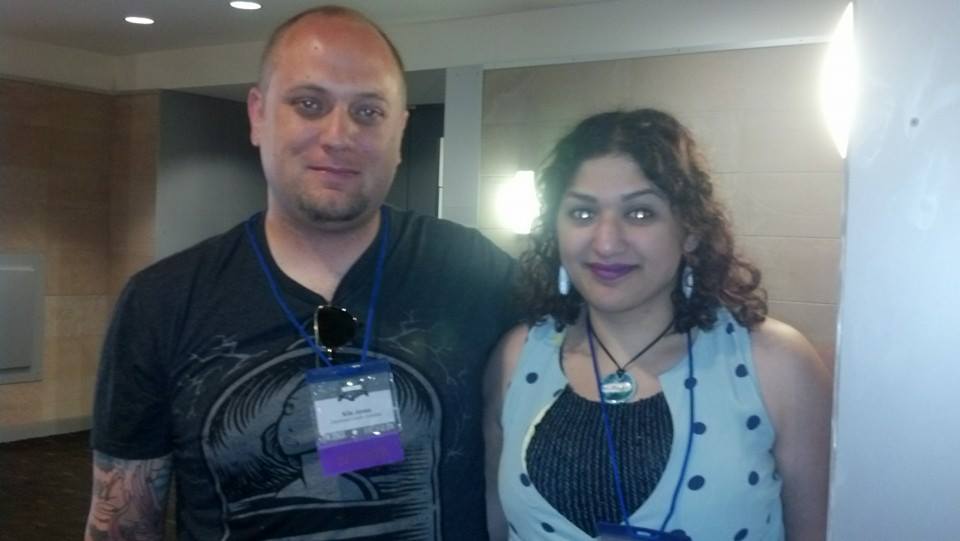
P.S. Aisha (one of Muhammed’s wives) should not simply be reduced to the young person Muhammed married; she was also a war leader, influential Muslim thinker, and someone who contributed greatly to early Islam. This is, of course, Heina’s insight.
Me and Heina at SSA
Another awesome secular woman I met, was Sarah Morehead.
Sarah. Photo from Apostacon.
Sarah is a former evangelical Southern Baptist, Executive Director of the “Recovering From Religion” project, and another overall bad-ass. She spoke on how to start up a Recovering From Religion group on your campus. Here is a blurb about Recovering From Religion,
“If you are one of the many people who have determined that religion no longer has a place in their life, but are still dealing with the after-effects in some way or another, Recovering From Religion (RR) may be just the right spot for you. Many people come to a point that they no longer accept the supernatural explanations for the world around them, or they realize just how much conflict religious belief creates. It can be difficult to leave religion because family and culture put so much pressure on us to stay and pretend to believe the unbelievable. If this is you, we want to help you find your way out. Don’t let people convince you that you just didn’t have ‘enough’ faith, or that you just haven’t found the “right” religion.”
Sarah and I chatted (and often laughed) about our old experiences as conservative Christians. We discussed some of the funny language (Christian-eze) we used to use, the various levels of guilt and shame that were cast upon us, and how science helps explain some of the interesting displays of piety often seen at Pentecostal services. Sarah’s jovial and welcoming demeanor was calming, and as an Executive Director for a project aimed at helping people “recover” from religion, I cannot think of a better person for the job.
Lyz. Photo by SSA.
The last woman I have in mind is Lyz Liddell.
Lyz is the Director of Campus Organizing for the Secular Student Alliance. I have an interview I did with her a while back, on this very blog! Besides running around with her headset on, standing on chairs for announcements, and generally keeping the world of SSA from not crumbling into oblivion, Lyz is a great motivation and example. If you are ever interested in starting a SSA group on your campus, talk to her.
To all those who attended this years SSA West, or who are involved with helping secular students: Unite!
Kile Jones holds a Bachelors of Theology (B.Th.) from Faith Seminary, a Masters of Theological Studies (M.T.S.) and a Masters of Sacred Theology (S.T.M.) from Boston University, and is a current Ph.D. in Religion student at Claremont Lincoln University. He also holds a Certificate in Science and Religion from the Boston Theological Institute. Mr. Jones has been published in Zygon: Journal of Religion and Science, Philosophy Now, Free Inquiry, World Futures, Human Affairs, and the Secular Web. He is the Founder/Editor-in-Chief of Claremont Journal of Religion (www.claremontjournal.com), and is the Founder/Director of Interview an Atheist at Church Day (interviewatheists.wordpress.com).
I am currently preparing to teach a course on bioethics in the fall. I plan on combining some common, secular materials on biomedical ethics with some theological material and some feminist readings. After all, in a course that centers around practices related to the body, birth, and death, there seems ample opportunity to introduce feminist themes. Some feminist perspective, of course, is typical, like when we will discuss abortion and contraception. (Or at least it is common in my courses where try to present multiple sides of an issue.) Anything related to conception, pregnancy, and birth is easily understood as a “women’s issue” and therefore something that feminists address. I’ve discussed abortion and contraception in previous posts on this forum.
However, I realized in going through readings for this course that I have not focused much on other practices related to the body in my scholarship or personal reflection. Specifically, I have not connected them to theological principles or feminist convictions. Perhaps not everything concerning the body is directly relevant to feminism. But I am sure if I thought about it, I would be able to make the connections. We are physical creatures and the feminist movement generally affirms recognizing our embodiment.
A good evangelist, especially in college ministries, acts as if there is no agenda to his or her evangelism. It’s very, “Do you want a cup of coffee? How are your classes going?” with a lot of understanding head nodding. The goal is to stay cool and not seem threatening (even though eternal damnation is at stake). A good evangelist then finds the opportunity to advance on whatever personal problem the interlocutor divulges, and the solution from the evangelist remains constant: “You need to accept Jesus Christ as your personal Lord and Savior.”


 A link to a talk called “Moral Behavior in Animals” by Franz de Waal recently found its way into my email inbox. I am a big fan of Franz de Waal because his findings confirm what I always believed—that animals are intelligent. I followed the link and other suggested links and spent most of the evening listening to de Waal.

 In a space that has been flooded with negativity and scenes of war and violence, I find my Facebook newsfeed lit up with people from all walks of life engaging in this challenge. For those that may not be aware of how this works, you are invited to take the challenge by either donating $100 to ALS research or dumping a bucket of ice water over your head. Those with means seem to be doing both, even exceeding the minimum donation amount. However, despite millions of dollars raised for important research, there are critics of this challenge. They vary widely from diverting donations from the ALS Association because foetal stem cells are used in their research, a violation of Catholic Social Teaching, to objections to a display of privilege; watching those with means wasting precious resources to perform this challenge.

 Feminism and Religion