Reproductive Justice by Gina Messina-Dysert

Following the testimony of Sandra Fluke on the lack of availability of contraception and the appalling remarks by Rush Limbaugh that took place in early March, 2012, much discussion around issues of reproductive justice has emerged.  Among these conversations, Mary Hunt recently shared her thoughts in “Contraceptive Controversies” on the issue on FSR-Inc., and graduate students Katie German and Linda Claros organized an event at Loyola Marymount University to invite faculty members, students, and interested persons to engage in dialogue on reproductive justice.  I was honored to have the opportunity to participate in that discussion and would like to share my thoughts here in an effort to continue that dialogue.

To begin, I understand reproductive justice as the call for the social, political and economic ability to make responsible and healthy decisions about gender, sexuality, and procreation for ourselves and our communities with the goal of transforming power inequities and bringing about systemic change.  The denial of reproductive justice in the Catholic Church is a symptom of the larger rape culture.  When I use this phrase I am referring to a culture that not only perpetrates rape, but all forms of sexualized violence against women and girls. Continue reading “Reproductive Justice by Gina Messina-Dysert”

A MEDITATION ON A MIDRASH: “ABRAHAM’S DAUGHTER” BY ARCADE FIRE by Sara Frykenberg

The wages of the sin of sacrificing our children is their death, whether the sacrifice is to some supposed higher order, to absolute obedience or to appear to be the “good Christians” we are “supposed to be”…

Maybe its because I enjoyed the books more, or because of my sister’s all too expectation-garnering reviews or even, because I’d seen this theme before, in an amazing yet gruesome Japanese movie, Battle Royal, I left the theater unsatisfied after watching The Hunger Games. I did however, LOVE the song that played at the end of the movie, which I downloaded before we left the theater.  I listened to it in the car on the way home.  I listened to it the next day, the day after that and for days after that… I listened and listened, and I found surprise, power, anger, sorrow and a channel for grieving that I had needed in the Midrash “Abraham’s Daughter” by Arcade Fire. 

Abraham took Isaac’s hand and led him to the lonesome hill

While his daughter hid and watched, she dare not breathe

She was so still.

I discovered the practice and potential power of Midrash from my teachers in graduate school.  The idea of an “extra-biblical” story that might help to expound upon Biblical passages that are all too often unexplained or unsatisfactory to (my) feminist consciousness was very appealing to me—and it is still appealing to me.  But I have to admit that the feminist Midrash I read in my classes seemed too positive and did not resonate with me.  The pieces were too much like a tender hug or a mother hen covering my wounds with her wings.  I wanted to hear a story of Bible that could help me make sense of the violence I’d discovered in my childhood religion.  I needed a story of Bible that honored my violent struggle to counter the abuse within it and within me.

Like Isaac, I was too intimate with my abuser: unable to avoid walking hand and hand with him when pushed to do so.  Asked to create a prayer or Midrash for a class once, I wrote about the way I would turn the radio in my car up when I started to hear ‘God’ speak to me.  I didn’t know how to listen and tune out the abusive maxims that played over and over again in my head (maxims that surfaced every time I even thought about the divine).  Continue reading “A MEDITATION ON A MIDRASH: “ABRAHAM’S DAUGHTER” BY ARCADE FIRE by Sara Frykenberg”

Life Must Always Be Protected by Bridget Ludwa

Women’s dignity has often been unacknowledged and their prerogatives misrepresented; they have often been relegated to the margins of society and even reduced to servitude… Then too, when we look at one of the most sensitive aspects of the situation of women in the world, how can we not mention the long and degrading history, albeit often an “underground” history, of violence against women in the area of sexuality? At the threshold of the Third Millennium we cannot remain indifferent and resigned before this phenomenon. The time has come to condemn vigorously the types of sexual violence which frequently have women for their object and to pass laws which effectively defend them from such violence. Nor can we fail, in the name of the respect due to the human person, to condemn the widespread hedonistic and commercial culture which encourages the systematic exploitation of sexuality and corrupts even very young girls into letting their bodies be used for profit. – Pope John Paul II

 If the Vatican desires an unambiguous message of concern for women, then it needs to address the acts of violence committed against women’s bodies.  In focusing on the end result of sexual violence, aborted pregnancies, and not addressing the violence itself, Vatican leadership fails to communicate this concern for women’s bodies. Continue reading “Life Must Always Be Protected by Bridget Ludwa”

The Feminist Toolbox by Marie Cartier

Photo of Marie Cartier by Lenn Keller

This spring I am teaching “Feminist Ethics” at California State University Northridge. For the students’ midterm and final we are doing an innovative project that we want to share with the “Feminism and Religion” blogging community. My students have been asked to find a problem in the public world, or their private world, that they wish to interact with and provide a solution for. The solution can solve the problem or a piece of the problem. They must deconstruct the problem and then construct the solution for the midterm. For their final they actually must *do* the solution.

In creating their solution, they must address and use the tools in what I call “the Feminist Ethical Toolbox.” These tools are ones we have been extracting from the class readings (so far we have read the anthologies Feminist Theological Ethics, and Feminist Ethics and Social Policy, and Carol Gilligan’s philosophical treatise on the patriarchy, In The Deepening Darkness, and the students have been using the toolbox and its accumulated (and accumulating) tools throughout the class, in their own lives, and interacting with the toolbox in the reading response journals in terms of looking at wider world issues.

The tools in what my students call “Cartier’s Toolbox” are as follows: Continue reading “The Feminist Toolbox by Marie Cartier”

My Feminist Perspective of Authority – Part 1 by Elise M. Edwards

I make a distinction between power and authority.  Authority is a personal characteristic based on a relationship of trust between me and a text, a person, or their work.  Power, on the other hand, is operative with or without trust.

This past weekend, I had the honor of participating in a workshop on Living Texts: Celebrating Feminist Perspective and Theo/alogy, Authority, and the Sacred in the Academy.  The workshop was organized for the Women’s Caucus of WECSOR, a regional association of national organizations who study religion.  I was delighted to connect with new friends, mentors and sisters interested in feminism and religion, including some of my co-contributors on this site –Theresa Yugar, Sara Frykenberg, and Corinna Guerrero .  There were two panels that shared our reflections about authority from either student perspectives or diverse professional perspectives.  I shared my experiences as a student.  This workshop was a gathering where women scholars in religion could discuss the challenges and promises of our voices in the academy.  Because our dialogue was so inspiring to me, I thought I’d continue the discussion here. Continue reading “My Feminist Perspective of Authority – Part 1 by Elise M. Edwards”

On Being in the Moment By Ivy Helman

Time.  We mark years, months, days, hours, minutes and seconds. We mark seasons.  We mark life events.  We live our lives in time: both circular and linear.  Time began before we did and time will continue after we cannot experience it any further.   Some say we repeat time with rebirth.  Others suggest that we only have one lifetime of which we should make the most.  Still others suggest there is existence outside of time with concepts like infinity and eternal life.  We sure do write, discuss and ponder time a lot, but do we ever really experience it?  Meaning: what would it be like to live in the moment, to be aware of and completely conscience within an instance of time, not thinking of the past, not worrying about the future, but being fully present in the here and now?

Sci-fi geek that I am, I often recall the Star Trek: The Next Generation movie entitled Insurrection when Captain Picard and Anij discuss experiencing a moment of time.  Anij explains to Captain Picard, “You stop reviewing what happened yesterday. Stop planning for tomorrow. Let me ask you a question. Have you ever experienced a perfect moment in time?”  A few lines of dialogue later, she picks up the topic again by describing what being present is like. ”We’ve discovered that a single moment in time can be a universe in itself. Full of powerful forces. Most people aren’t aware enough of the now to even notice.”  The visual effects show water stopping and a butterfly’s slow flight if I remember correctly.  Captain Picard is obviously caught up in these moments of time as well as being mesmerized by Anij herself.  The power of both the moments of time and Anij herself is palpable. Continue reading “On Being in the Moment By Ivy Helman”

Is Baptism a Male Birthing Ritual? By Michele Stopera Freyhauf

Quite a number of years ago I had a conversation with one of my professors, a feminist theologian, who posed the question “Why do I need a man to purify my baby with the waters of baptism?  Is there something wrong or impure about the blood and water from a mother’s womb – my womb?”  Before you jump and shout the words Sacrament or removal of original sin, this question bears merit in exploring, especially in today’s world where women are taking a serious beating religiously, politically, and socially.  In today’s world, violations and rants are causing women to stand up and say STOP!  This is MY Body.  This outcry was provoked by chants of ethical slurs against women– Slut! Prostitute! Whore!  The cry got even louder when the issue of religion and government was raised in the fight of healthcare coverage of contraception. The cry got even louder with the enactment of the laws in Virginia and Texas (and many other states to follow suit) that forces women to undergo transvaginal ultrasounds in early stage abortions.  The mandatory insertion of a wand into a woman’s vagina (mandated by the government, mind you), is a violation and has women crying RAPE!

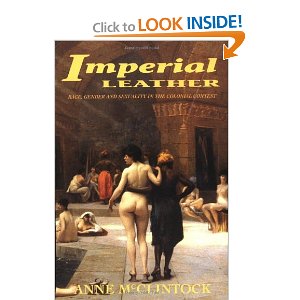
The memory of this conversation did not re-appear by chance, it was prompted by a book I read for my History of Sexuality Class – Imperial Leather: Race, Gender, and Sexuality in the Colonial Context by Anne McClintock who addresses the notion of baptism through origins, property, and power.  So many things are currently being taken away from women and reading McClintock’s assertion regarding male baptism is perplexing.  She believes that male baptism or baptism by a man takes women’s role in child bearing and diminishes it.  These are the same men who historically treated and regarded women as vessels.  She further asserts that this act is a proactive removal of creative agency with respect to a woman’s ability to have the power to name.  That is, the last name of the child belongs to the husband.  A point that supports the notion that patrimony marks the denial of women.  Anyone doing genealogy encounters a perplexing struggle to identify mothers because their names are essentially erased from memory and rarely attached to a child’s name. Continue reading “Is Baptism a Male Birthing Ritual? By Michele Stopera Freyhauf”

My First Experience at a Women-Only Conference by Grace Yia-Hei Kao

“This ain’t your daddy’s conference!”

I knew that I was going to be attending a totally different type of conference than I had ever been to before when I received the following instructions on additional items to pack: (1) my own mug with which to drink coffee or tea (“we will go green in this conference as much as possible”), (2) 3 oz. of water “from a source of nature near your home” to be offered during “opening worship,” and (3) a small, modest, pre-owned, homemade, or inexpensive “earth-honoring gift for exchange.”

Continue reading “My First Experience at a Women-Only Conference by Grace Yia-Hei Kao”

Beyond “Liberal” Female Piety or “Women Read the Qur’an Too” by Amy Levin

I’m a teacher’s assistant for an undergraduate course at New York University called, “What is Islam?” The other day in class, my professor asked the students whether or not the Qur’an is considered a “book”. Fraught with anxiety over inheriting such a problematic scholarly tradition of defining and delineating what “religion” is, I kept quiet. While my professor was aiming more for something sounding like, “a book is read, while the Qur’an is recited,” I kept thinking about the physicality and sacrality of the Qur’an (among other authoritative religious texts) and the way it is handled, revered, preserved, loved, an constantly under interpretation. It was about a week later when news broke out that U.S. soldiers in Afghanistan were guilty of burning several copies of the Qur’an on their military base, followed by an unfortunate slew of casualties including at least 30 Afghan deaths and five US soldiers. Continue reading “Beyond “Liberal” Female Piety or “Women Read the Qur’an Too” by Amy Levin”

“If You Allow Gay Marriage…” by John Erickson

“We need to start examining the underlying questions of counter-cultural relationships that view one man marrying many women to be hip because we begin to see that although a polygamist idea of marriage may be sexy from a popular culture standpoint, the thought of legally recognized gay marriage always then gets likened to bestiality.”

… you have to allow polygamy, bestiality, and everything else!” The title for my post this week is a quote from an individual I used to associate with.  This individual, haling from a conservative evangelical background, tried to explain to several others and myself the reasons why gay marriage would eventually lead to the repeal of anti-polygamy and bestiality laws across the United States.

The problems that I have with this particular argument are conflating gay marriage with religious freedom.  Activists and scholars can draw comparisons to anti-polygamy cases such as the 1878 U.S. Supreme Court case Reynolds v United States and the 1882 Edmunds Act and 1887 Edmunds-Tucker Act that disfranchised and led to the imprisonment of Mormon polygamists. But in the end, gay marriage is not about religious freedom but rather human rights.

I often feel that there is this need both within and outside religious communities to promulgate the idea that LGBTQ individuals want to get married within the sanctified walls of “the church” just as much as heterosexual couples do.  Although I do not want to disqualify those who desire to see LGBTQ equality within their faith based communities, buying into a heternormative ideal of what traditional marriage should look like needs to result in LGBTQ individuals asking why marriage should be performed in sacred spaces in the first place The normative traditions that have often defined marriage have also served as shackles keeping LGBTQ couples in the mindset that to achieve fully marriage equality with their heterosexual counterparts is to fully immerse themselves within the same traditions and practices. Continue reading ““If You Allow Gay Marriage…” by John Erickson”