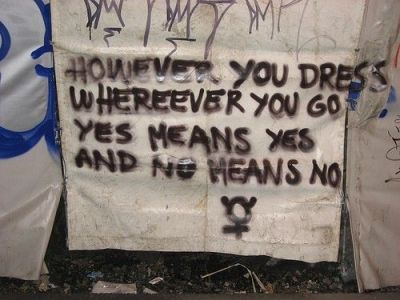
“It seems to me that calling oneself queer can be a way of affirming the parts (or all) of oneself that do not fit into the heteronormative paradigm. In my case, though I am white and straight, I am too tall, too smart, too assertive, too strong, too bold, too flashy, too unwilling to be controlled by men to fit the heteronormative paradigm of woman as in every way a little less than man–not as tall, not as smart, not disagreeing too much, not putting herself forward too much, not taking too many risks, not standing out in a crowd, and at least letting men think they are in charge. From this perspective, a whole lot of women are queer.”*
I wrote the above statement in response to a question posed to Vanessa de la Fuente after she called herself a gender queer Muslim feminist. Ivy Hellman asked if it is appropriation for a woman who does not herself identify as LGBTI to identify herself as queer: “where have you left room for queer individuals in their specificity and with their concerns? As a queer person (who happens to be Jewish and not Muslim), I have a problem with this because you end up losing what is particular about a certain group of people and their contributions as well as their particular gifts, struggles and perspectives within Islam (in your case) and Judaism (in mine).”
Vanessa responded that she claimed the term gender queer to describe herself as a feminist Muslim convert with dark skin who along with the “the women who participated in the mosque of women project” was about to “march along with feminist collectives, women theologians, trans women, lesbians, immigrant women, rural women, sex workers women, indigenous women, housemaids unions, all together to call for the early adoption and passing of the bill that legalizing abortion and ask on behalf of all women of Chile that our government hears each of our particular demands .”
I agree with Ivy that it is wrong for others to claim lesbian, gay, Jewish, or Muslim identities as a way of supporting struggles to end discrimination against particular groups. But am not so sure about the term “gender queer.” Though queer theory originally called attention to the ways in which butch lesbians and drag queens challenge gender stereotypes, the word “queer” has broader connotations, including “strange” or “different.”
*
Not long ago my friend Cristina called me “eccentric,” and I cringed. When I was very young, very tall, and very thin, my mother used to say to me, “You should be careful never to gain weight because then you will not only be taller than the other girls, you will be bigger too.” While recognizing that in many ways I do not fit the “norms” that define the ideal female, I have spent a lifetime trying to pretend that I am “normal.” The idea I might be able to affirm that I am not normal but that I am nonetheless fine just as I am was an idea that my mother and I simply were not able to consider.
When I asked Cristina please not to call me “eccentric,” she responded that for her eccentric is a positive term because the last thing she would want to be is normal. Cristina’s embrace of her eccentricity caused me to wonder why I was still expending so much energy trying to claim my normality.
These questions were in my mind when in a ritual at the Skoteino Cave on the recent Goddess Pilgrimage to Crete, I dropped a stone down a deep hole affirming my desire to let go of my fear of being different. While sitting in meditation in darkness of the cave, I was surprised to hear the words from a Sesame Street song my little brother used to sing form in my mind: “One of these things is not like the others. One of these things just isn’t the same. If you can tell me which thing is not like the others, then we’ll finish our game.”**
As the words from the song swirled in my mind, I found myself physically raising my hand like a school child and while answering silently, “I am. I am the one who is not like the others.” This meditation was powerful because being taunted, excluded, or categorized because of my difference had caused me to spend a life time wanting to be like the others.
*
Before I posted my response to Ivy and Vanessa, I asked my theological pal Judith Plaskow (who like Ivy identifies as lesbian) if she would categorize me as gender queer because I am so much taller than women are supposed to be. She said yes. She went on to say that she gets tired of insisting that a woman can be as smart as she is and still be a woman. Sometimes, she mused, it is easier just to acknowledge that she is gender queer.
I was reminded that identity theories and politics name the experiences of excluded groups in order to call attention to injustice and to offer more inclusive theories. My work on women’s experiences is situated in this framework. While it can be exhausting to explain that women are, can be, and have been different than gender norms have dictated, I (along with Judith) continue to insist that our theories and our politics take account of and value all of women’s multifaceted and intersectional experiences.
Queer theory challenges identity theory by asking whether there are any fixed identities at all. Vanessa speaks to this point when she writes, “I think the beauty of being human is being able to flow, to mutate, to be free of categories and asserting oneself to embrace our quirks and our dark areas and our sorrows and doubts, without wanting to be anyone but myself and without wishing to be anywhere else than in the present moment . . . I am a queer person for many reasons . . . I surrender to the possibilities of life, of my body, of my mind, of my soul.”
As Vanessa states so eloquently, identifying as queer means no longer having to try to fit in, to be like the others, to be normal. Identifying as queer means that it is fine to be different, eccentric, not like the others. It means telling the gender police to “go jump in a lake and swallow a snake and come out with a belly ache.”***
*
Before beginning to write this piece, I watched the most recent episode of Grey’s Anatomy. I was delighted to see the camera focus on the way the character played by Geena Davis (who is six feet tall) “towered over” Arizona, Amelia, and Bailey. I hope Davis’s character will survive her brain surgery because it is such a rare treat for me to see a woman who is different in the way I am different have a part on television program. Thanks to Shonda Rhimes for creating a series where women who are not like the others are celebrated in their difference.
*The quote is edited slightly from the way it appears in the responses to Vanessa’s post.
**The Sesame Street game taught children to identify difference: for example, colors or apples and oranges.
***A children’s rhyme used to respond to being taunted.
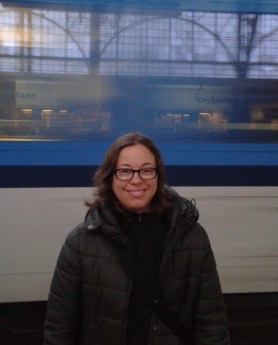
Carol leads the life-transforming Goddess Pilgrimage to Crete (facebook and twitter)–space available on the spring and fall 2015 tours. Carol’s books include She Who Changes and and Rebirth of the Goddess; with Judith Plaskow, the widely-used anthologies Womanspirit Rising and Weaving the Visions; and forthcoming next year, Goddess and God in the World: Conversations in Embodied Theology. Photo of Carol by Michael Bakas.
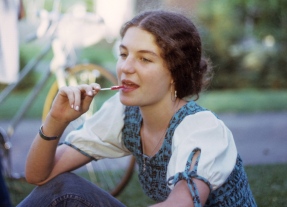 As you read this, dear FAR community, it will be my 59th birthday. I was born February 27, 1956. I have one year to go before I turn 60. For this last year I desperately wanted to dye my hair blue, purple and green and let the roots go gray.
 live with my brown, black and burgundy hair until I am ready to go completely gray and watch it grow out (my hairdresser tells me it will take three years). Or I will decide to live with the choice I made to dye my hair since I was 35 or so and let it be and keep dying it – and have that be the choice I made.
  No matter what you call it abuse is abuse. This is highlighted in the popular book and now movie Fifty Shades of Grey. Because of the stir this book caused, I delved into the first book and my initial reaction was that of repulsion and wonderment. How could a woman let a man control her like that? Why would she let him do things like that to her and continue to come back to him? Why is this book so popular?

 Ok. I’ll admit it. We all have our secret indulgences, don’t we? It is Valentine’s Day, after all. Shouldn’t we indulge a moment? After years of having my mind mired in the esoteric quandaries of the academy and the heart-yearnings of ministry, I needed an outlet, an escape. And when I couldn’t literally escape to some beautiful far-flung land via travel, I found my freedom nestled up with a good travel memoir. Travel essays, memoirs of finding oneself in another land, became my way of wandering, wondering, and learning about the world. A shelf full of dusty travel essays became my secret indulgence.