Violent Virtue by Esther Nelson

esther-nelsonI just got home from the first yoga class I’ve attended since the recent (11/8/16) U.S. presidential election.  I cried for the entire 75 minutes—through forward folds, downward facing dogs, exalted warriors, and especially shavasana (corpse pose).  The young man (probably in his thirties) doing his yoga practice next to me asked after the closing Namaste, “Are you all right?”  “No, not really. I’m very upset.”  He nodded his head as if to say he understood.

Ever since the nation’s president-elect declared victory, I’ve felt a huge sense of angst.  Why?  A huge percentage (81%) of white evangelical voters propelled him to that victory. I grew up in a branch of the evangelical church.  The church, to a large degree, is all about translating a particular understanding of God’s will as “revealed” in Scripture into public policy and law, keen on imposing that interpretation on our pluralistic society. Continue reading “Violent Virtue by Esther Nelson”

Voting for Hillary & the Real Meaning of Sanctity of Life by Marie Cartier

I just don’t trust Hillary,” a friend said. “Give me one good reason why I should vote for her—other than that, you know, she’s a woman—since I know you teach Women’s Studies.

OK. Here goes.

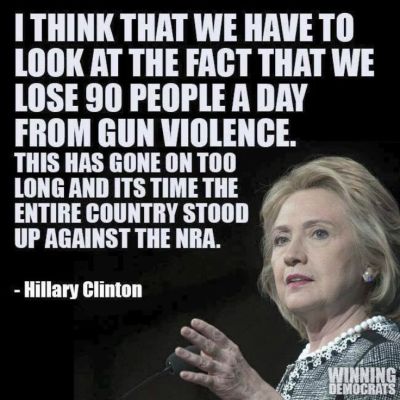
hillary-and-gunsI recently got a request for support from Gabby Giffords, who was shot on January 8, 2011. This U.S. Representative and eighteen others were shot during a constituent meeting held in a supermarket parking lot in Casas Adobes, Arizona, in the Tucson metropolitan area. Six people died, including federal District Court Chief Judge John Roll; Gabe Zimmerman, one of Rep. Giffords’ staffers; and a nine-year-old girl, Christina-Taylor Green. Giffords was holding the meeting, called “Congress on Your Corner” in the parking lot of a Safeway store when Jared Lee Loughner drew a pistol and shot her in the head before proceeding to fire on other people.

In her recent request for support, Rep. Giffords pondered why she didn’t die and six others had.  There is no answer—save for that, if there is God’s hand in this, she is the one who went on to fight against the all-powerful Gun Lobby who, for years on end continue to use big money to influence Congress.

On November 8th, we, the American people, will decide, for better or worse who is the next leader of the most powerful country in the free world. An important question to ask ourselves as we consider the candidates is: What does it mean to believe in the sanctity of life? Continue reading “Voting for Hillary & the Real Meaning of Sanctity of Life by Marie Cartier”

What My Mothers and Mentors Taught Me about Self-Care by Elise M. Edwards

Elise EdwardsDuring another week of killings, war, protests, and debates about whether Black Lives Matter or Blue Lives Matter, I’m concerned about the toll it takes on those who are witnessing the violence and fighting for justice.

I’m not on the front lines of these battles, but I can feel my energy draining, nonetheless. Over the past few days, while I’ve stayed informed about the latest tragedies and conflicts, I’ve intentionally limited my exposure to most news and social media outlets. I’ve begun preparing for a contemplative retreat with other women who also care about justice.  For me to continue to participate in any effort of transforming society, culture, or the church, I must nurture my mind, spirit, and body.

Audre Lorde put it like this:

“Caring for myself Is not self-indulgence.  It is self-preservation, and that is an act of political warfare.”

Self-care is a radical practice of self-love. It is absolutely necessary when engaged in conflict against those who do not show love to you, or worse, those who seek to destroy you.  Your survival and your flourishing are defiantly brave.  Self-care honors the God who created you, the One who loves you, and the Spirit who sustains you. Continue reading “What My Mothers and Mentors Taught Me about Self-Care by Elise M. Edwards”

What Traci West Taught Me about Dominant and Excluded Voices by Elise M. Edwards

Elise EdwardsIn my previous post, I mentioned a book I am writing about how theological and ethical considerations in architectural design can define good architecture.  In that post and in ones to follow, I am acknowledging the feminists and womanists and mujeristas who have influenced me while also opening up the dialogue to the feminists in this community who continue to inspire and guide me to do my best work.

But today, instead of talking about creativity or architecture, I want to discuss how I arrived at the conviction that community decisions about how we ought to live—whether those are decisions about laws, institutional policies, religious practices or architectural buildings—need to include the voices of the diverse people they directly and indirectly influence. Continue reading “What Traci West Taught Me about Dominant and Excluded Voices by Elise M. Edwards”

What Dorothee Soelle Taught Me about Creativity by Elise M. Edwards

Elise EdwardsI’m currently developing a book that considers how theological and ethical considerations in architectural design can define good architecture.  My book discusses five virtues related to the architectural design process that promote human participation in bringing out God’s intention of flourishing for humanity and creation.  Those five virtues (or values) are: empathy, creativity, discernment, beauty, and sustainability.  In the book, I’ll explain how these virtues orient design tasks to the social and ethical aims of architecture.

In this virtual space, I want to have a discussion about what these virtues mean from a feminist standpoint.  In my writing, I draw from theological ethics, architectural theory, and feminist theory to emphasize community discernment and participation.  It’s fitting, then, to claim opportunities in my work to acknowledge the feminists who have influenced me while also opening up the dialogue to the feminists in this community who continue to inspire and guide me to do my best work. Continue reading “What Dorothee Soelle Taught Me about Creativity by Elise M. Edwards”

From Competition to Collaboration: Reflections on Humility, Self-Promotion, and Gender

photo-1422190441165-ec2956dc9ecc

“Is self-promotion sinful?” Author Marlena Graves asked this question on Christianity Today’s Her.Meneutics blog back in 2010. Reflecting on her experience of having a manuscript rejected by publishers for being a “no name” and not having a big enough platform, she wrestles with questions like “how much of what we do as Christians and churches is about promoting ourselves?” and “are we using the church as a vehicle to make a name for ourselves?”

Graves never directly answers the question  but she imples that most of the time self-promotion is sinful. She concludes that when we are presented with platform-building opportunities, most of the time the most righteous path is to for us to take a step back in order to revaluate and humble ourselves. But, other than turning down opportunities to grow our professional presence, what does humbling ourselves mean? Continue reading “From Competition to Collaboration: Reflections on Humility, Self-Promotion, and Gender”

HUSBAND, MAY I? by Esther Nelson

esther-nelsonFor several weeks now, I’ve been going through and disposing of stuff that has accumulated in my house over the past three or four decades.  One of the more interesting finds was the following letter, written by my husband, when we lived in Saudi Arabia from 2000 – 2004:

May 1, 2001

Travel Letter

To Whom It May Concern:

My wife, Esther Ruth Nelson, has my permission to travel to Bahrain, Iran and other countries on May 1 – 30, 2001.

Dr. Theodore P. Nelson, P.E.
c/o Saudi Aramco
P.O. Box 8239
Dhahran 31311
Saudi Arabia Continue reading “HUSBAND, MAY I? by Esther Nelson”

#HillYes by John Erickson

I’m going to do something I’d never thought I’d do: fill your newsfeed with yet another article pertaining to the 2016 United States Presidential election and yes, I’m going to talk about former Secretary of State Hillary Clinton (hint: I’m emphatically supporting her and I’m unapologetic about it.)

John Erickson, sports, coming out.I’m going to do something I’d never thought I’d do: fill your newsfeed with yet another article pertaining to the 2016 United States Presidential election and yes, I’m going to talk about former Secretary of State Hillary Clinton (hint: I’m emphatically supporting her and I’m unapologetic about it.)

Let me start off with my central point: a vote for Hillary is a vote to change history and the world. No, not because she’ll hail in some type of new economic stimulus (although I’m sure she’ll do just fine with our economy #ThanksObama) or because she’ll save us all from the evils of the GOP (looking at you Trump/Cruz/and the “moderate” Kasich) but because she’ll do one thing that’s never been done before: become the first female President of the United States, ever.

While I have tried not to get into “it” (read: online trysts with my friends on social networks who are #FeelingtheBern) the question I beg to ask is: what’s so wrong with wanting the right woman to be the President? This is one, but not my only reason, I will cast my vote for her both in the Democratic Primary in California in June as well as in November (and, if you haven’t guessed, I do not believe or promulgate the reasoning or rhetoric that Bernie Sanders will come from behind and win the Democratic Party’s nomination because I passed 5th grade level Math.)

Hillary Clinton

Continue reading “#HillYes by John Erickson”

A Place for Everyone at the Table by Carolyn Lee Boyd

carolynlboydWinter’s bone-chilling, relentless cold makes it the most treacherous season in the north when you don’t have a warm place to sleep or enough to eat. Poverty may look different in the city and the country, in various countries and continents, but it can be devastating to body, mind, and soul anywhere.

When I lived in New York City, no day went by that I wasn’t aware that people near me were hungry and homeless. When I moved to a more rural community, I found that, while small groups of volunteers ran food pantries and emergency assistance programs, many in my generally well-off town did not know that they had neighbors who were in need. While contributing to organizations that assist people around the globe is essential, clearly we must also consider what we, as human beings and especially as feminists with a focus on religion and spirituality, must do to support those who live within a few miles of us. Continue reading “A Place for Everyone at the Table by Carolyn Lee Boyd”

Declaring a Theological State of Emergency: Trump’s Ignorance Must Not Be Ours by Mary E. Hunt

Mary HuntOn CNN’s State of the Union, Donald Trump reiterated his call to bar Muslim immigration to the U.S. and predicted that his fellow presidential candidates would soon come around to his position.

This prompts me to  declare a theological state of emergency. And I urge religious first responders to step forward.

His anti-Muslim rhetoric has caused Muslims to fear for their lives and well being—and it runs counter to the American Constitution on matters religious, although that does not seem to deter its adherents.

Because the content of these statements is focused on a specific world religion, I believe that scholars and activists of many religions need to step forward in concrete, educational ways.

Theologians must be among the first responders on this one. And we need to start at the beginning since Mr. Trump’s ignorance of the Muslim faith mirrors that of many Americans. “Islam” has become a code word for terrorism. In fact, it is the name of a monotheistic faith tradition based on the Qur’an which is practiced by more than 1.6 billion people, nearly a quarter of the world. Its practitioners are referred to as Muslims.

So our popular pedagogy must begin in order to right the wrongs of misinformation and demagoguery. Just as Christianity and Judaism have many expressions, so too with Islam. It is for Muslims to sort out their internal matters—but it is incumbent on global citizens to inform ourselves so as not to be cowed by the likes of Trump.

For example, a group of Muslims, including feminist journalist Asra Nomani, is calling for a new movement:

“We are Muslims who live in the 21st century. We stand for a respectful, merciful and inclusive interpretation of Islam. We are in a battle for the soul of Islam, and an Islamic renewal must defeat the ideology of Islamism, or politicized Islam, which seeks to create Islamic states, as well as an Islamic caliphate. We seek to reclaim the progressive spirit with which Islam was born in the 7th century to fast forward it into the 21st century. We support the Universal Declaration of Human Rights, which was adopted by United Nations member states in 1948.

We reject interpretations of Islam that call for any violence, social injustice and politicized Islam. Facing the threat of terrorism, intolerance, and social injustice in the name of Islam, we have reflected on how we can transform our communities based on three principles: peace, human rights and secular governance. We are announcing today the formation of an international initiative: the Muslim Reform Movement.”

Do Mr. Trump and the sector of the American public that agrees with him have any such information? I doubt it. Nor do they apparently have much experience with Muslim neighbors who live and work peacefully in virtually every part of the country.

Ignorance of religion is an acute problem in the United States. We have a lack of basic education about religion. Few school districts venture into the topic with their students. So it is not until tertiary education that most American young people have any formal instruction, if then, about religions other than their own. There must be a better way.

I propose that religious professionals, whether educators, pastoral people, or activists, become part of the solution by engaging in a massive, differentiated educational campaign to counter the negative narratives about Islam. This does not mean that anyone need convert to Islam. It is simply that in a democracy we owe one another a fair rendering of our faith traditions. That Mr. Trump’s remarks about Islam have caused such damage already, and could give license for more violence, add urgency to this task.

It is time for community forums where the basics of Islam can be explained in every part of the country. Radio shows, teleconferences, videos, social media posts, religious education classes, community group meetings might usefully focus on the basics of Islam. Simply to demystify the terms and show how ordinary Muslims go about their ordinary law-abiding lives would go a long way toward stemming the current tide.

I do not expect Muslims to educate the rest of us. But those who want to collaborate with other religious first responders are more than welcome. Among feminist colleagues, plans are afoot to launch some modest efforts, but we recognize and respect the need for safety and security for those who have been put in harm’s way by ignorant rhetoric and unconstitutional proposals.

It is non-Muslims who must bear the burden of this education about religion.

Not since the Nazi period has the specter of religiously-based oppression taken on such a heightened profile, with the potential for such devastating results. I believe it is a true emergency for which strong and constructive countermeasures are necessary.

The following is reprinted with permission from Religion Dispatches. Follow RD on Facebook or Twitter for daily updates.”

Mary E. Hunt, Ph.D., is a feminist theologian who is co-founder and co-director of the Women’s Alliance for Theology, Ethics and Ritual (WATER) in Silver Spring, Maryland, USA. A Roman Catholic active in the women-church movement, she lectures and writes on theology and ethics with particular attention to liberation issues.