Terry Pratchett’s Discworld, Feminist Theology, and Finitude by Linn Tonstad

Linn Marie TonstadIn David Kelsey’s theological anthropology, Eccentric Existence, he emphasizes that finitude renders creation vulnerable, but he still insists on the goodness of what he terms the “quotidian proximate contexts” in which human life is lived: our ordinary, everyday lives. Terry Pratchett’s Discworld novels bring together a multitude of characters – ethnically, religiously, and otherwise diverse – in the chaotic yet lively city of Ankh-Morpork (a fictionalized London). The Discworld offers what I see as a theology of everyday flourishing that fits with both Kelsey’s analysis of finitude and with significant feminist theological claims.

The books focus on the men and not-men (women, werewolves, vampires, trolls, a six-foot tall dwarf named Carrot, and a Nobby Nobbs) who populate the city and bring it to life. The characters of Pratchett’s city offer a vivid imaginative rendering of the vulnerabilities and possibilities of life in everyday finite contexts that bring together diverse creatures in the service of the goal of common flourishing. Although all theologies outline a social imaginary, whether implicitly or explicitly, the dry and technical character of much theological reflection can make it difficult for the reader to imagine what life would be or could be like given the proposals advanced by a particular author. Pratchett is a consummate observer of the everyday, and his world brings to life what a theology of the everyday would look like. Continue reading “Terry Pratchett’s Discworld, Feminist Theology, and Finitude by Linn Tonstad”

Gendered Imagery of God (Part 1) by Elise M. Edwards

Elise Edwards

I have been doing a lot of thinking about gendered imagery and language for God over the past few months. Honestly, a lot of this reflection was provoked by hostile comments I got from my college students at the end of the fall semester because I require gender-neutral language for God and gender-inclusive language when referring to people. The policy in my syllabus is this:

For academic discourse, spoken and written, students are expected to use gender-inclusive language for human beings, and gender-neutral language for God. (e.g. “God” instead of “He;” “God’s” instead of “His;” etc.) This is to prepare students to communicate to the world beyond the Christian university setting. I want to equip you to succeed in graduate school, in the corporate world, and in public communication, all settings in which gender inclusive language for is increasingly expected.

I provide links to websites that discuss the issue, and we talk about it more when we discuss 20th century feminist issues in my course on the Christian Heritage and when we discuss prejudice and sexism in my ethics class.  Some students have thanked me for the policy. But many students are perplexed by it, and I’m perplexed by their confusion. It shocks my system when I hear people refer to “man” for all people; I first became aware of the issue when I was in 2nd or 3rd grade and the Girl Scouts changed their pledge because it referred to “mankind.” That was over 30 years ago!

While I’m confused as to why replacing “man” with “people” is such a difficult task, I am more empathetic to the reorientation required to replace “He” with “God.”  (And I also acknowledge that the term “God” is not completely genderless either.) I recognize that for many of my students, I might be the first one to challenge their gendered conceptions of God.  So I am empathetic, but insistent.

The way discussions about the “gender” of God and Savior are often dismissed as irrelevant, unimportant, silly, or the remote concern of “those feminists” bothers me. Traditional Christian theology asserts that God is a different kind of being than humans are.  Therefore, God (the first person of the Trinity) and the Holy Spirit do not have a sex or gender, as sex is a characteristic associated with physical creature-ness and gender is (to simplify) a social construction related to sex. The second person of the Trinity, Jesus, is thought to be male.  In the Incarnation, the eternal God became human while also divine, and therefore has a sex and gender in the person of Jesus.  But the Trinity as a whole is without sex and has characteristics that we would associate with femininity, masculinity, and genders in between.  According to this logic, references to the maleness of God should only be understood metaphoricall,y not literally, and therefore replacing that language with genderless/sexless language should not be inherently problematic.

I’m not saying that the use of any language in reference to God is appropriate or acceptable within the bounds of traditional theology.  We (traditionals and non-traditionals alike) should be concerned with how we refer to God, because as Sallie McFague and others remind us, these metaphors/models of God have consequences in the world beyond language.  Maleness becomes deified or closer to godliness than femaleness, maleness becomes the model for the priesthood, maleness is the true form of authority, etc.  I believe that many of the concerns about feminine imagery for God are based in this same concern: that by associating God with one sex or gender, we claim God’s preference for that sex or gender.  In a patriarchal system, this correlation between God and the feminine simply will not do.  Feminists who assert feminine qualities of God are merely making projections of themselves, critics claim.

How we conceptualize the being we worship matters. It matters to me, at least. While I acknowledge that there is a danger of simply projecting an image of myself as a deity that I worship, I also think there is great harm in loving and worshiping the divine imaged as those who are at times hostile to me, and historically have been so to my ancestors and kin. So although I know and have good relationships with older, white males, I see no reason why I should image and worship God “the Father” who looks like an old white man. How would that benefit my spiritual practice?

Thank you Carol Christ, for asking me to state my views about this in the comments to my last post. I look forward to more discussions with you and the members of this community.  When I read your work years ago, I was convinced about the validity and rightness of affirming feminine forms of divinity. Although the Christian (patriarchal) tradition does not have much room for Goddess language, I am comfortable with it, at least for the first and third persons of the Trinity. In my next post, I’ll talk more about the ways I am considering the gender of the Christ.

Elise M. Edwards, PhD is a Lecturer in Christian Ethics at Baylor University and a graduate of Claremont Graduate University. She is also a registered architect in the State of Florida. Her interdisciplinary work examines issues of civic engagement and how beliefs and commitments are expressed publicly. As a black feminist, she primarily focuses on cultural expressions by, for, and about women and marginalized communities. Follow her on twitter, google+ or academia.edu.

“Immanent Inclusive Monotheism” with a Multiplicity of Symbols Affirming All the Diversity and Difference in the World by Carol P. Christ

carol-christIn recent years monotheism has been attacked as a “totalizing discourse” that justifies the domination of others in the name of a universal truth. In addition, from the Bible to the present day some have used their own definitions of “exclusive monotheism” to disparage the religions of others. Moreover, feminists have come to recognize that monotheism as we know it has been a “male monotheism” that for the most part excludes female symbols and metaphors for God.  With all of this going against monotheism, who would want to affirm it?

In response to some or all of the above critiques, many modern pagans define themselves as polytheists, affirming at minimum, the Goddess and the God, and at maximum a vast pantheon of individual deities, both female and male, from a single culture or from many, including divinities with animal characteristics.  Other pagans define themselves as animists, affirming a plurality of spirits in the natural world. A group of Christian feminists have argued that the Christian Trinity, the notion of God Three-in-One, provides a multiple and relational understanding of divinity.

While also rejecting exclusive monotheism and male monotheism, Jewish poet, ritualist, and theologian Marcia Falk provided a definition of inclusive monotheism that I find compelling.

Monotheism means that, with all our differences, I am more like you than unlike you. It means that we all share the same source, and that one principle of justice must govern us equally.  . . Continue reading ““Immanent Inclusive Monotheism” with a Multiplicity of Symbols Affirming All the Diversity and Difference in the World by Carol P. Christ”

IS GODDESS “WITH US” OR “IN CONTROL” OF EVERYTHING? THE “THEOLOGICAL MISTAKE” OF DIVINE OMNIPOTENCE by Carol P. Christ

carol-christHow do we make sense of loss, great loss, and everyday disappointment? Some would tell us that “everything has a purpose” or that whatever happens “must be the will of God.”  I have found that these answers to questions raised by life as we know it often do more harm than good.  Yet they have a sticking power–we hear them all the time, sometimes even from other feminist seekers.

From the beginning feminists in religion rejected “the God out there” who rules the world from a throne in heaven. Most of us have insisted that “God” is more “in” the world than “beyond” or “outside it.” However we have not always been consistent in our convictions. When feminists are confronted with untimely death or great evil or just not getting what we think we want, we can sometimes be overheard to wonder, “Why did God (or Goddess) let that happen?” This question is based in the assumption that God or Goddess is omnipotent and rules the world from outside it. This is the theological idea I intend to question today.

The “zero fallacy” is a term philosopher Charles Hartshorne used to explain the “theological mistake” known as divine omnipotence.  Hartshorne pointed out that if God is omnipotent, then God has “all” or “100%” of the power. If this is so, then human beings and all other beings have “zero” power.  But if we have zero power, then do we even exist?  Continue reading “IS GODDESS “WITH US” OR “IN CONTROL” OF EVERYTHING? THE “THEOLOGICAL MISTAKE” OF DIVINE OMNIPOTENCE by Carol P. Christ”

Why I Don’t Believe in Female Pastors by Andreea Nica

Andreea Nica, pentecostalismIt may come as a surprise to those who identify as both feminists and religious practitioners that I don’t believe women should be pastors of any dominant religious congregation. This includes most religions which, I assert, are rooted in and structured by the tenets of patriarchy. Does that mean I think women should be congregants of a patriarchal-originated religious system? You guessed it – no. While this may seem like a radical notion to some, it took me quite some time to come to terms with my own conflict in being both feminist and a believer.

My transition from the Pentecostal sect was a long, intricate process that involved life-altering decisions. The notion of leaving the church was driven by my immersion in women’s studies during my undergraduate degree. There were many difficult questions I simply didn’t have an answer for, as the church didn’t provide me with them.

One of them being: Can women instruct an entire congregation of believers?

For those who are female pastors, I’m sure you’ve heard this one a million times, but somehow it never fades from religious and secular discourse. Whether it’s the Islamic, Jewish, Christian, or Mormon faith, women have had to constantly fight for their right to preach religious doctrine. In the beginning of my transition, I was on the side of: Preach it ladies! Continue reading “Why I Don’t Believe in Female Pastors by Andreea Nica”

“Talking Taboo”: Register for WATER’s Feminist Conversations in Religion Teleconference

Talking-Taboo-Part-TwoWATER’s Feminist Conversations in Religion Series

Presents

“Talking Taboo”
Part Two

An hour long teleconference with

Grace Biskie
Gina Messina-Dysert
Tara Woodard-Lehman
Katey Zeh

Wednesday, February 5, 2014 1-2PM EST

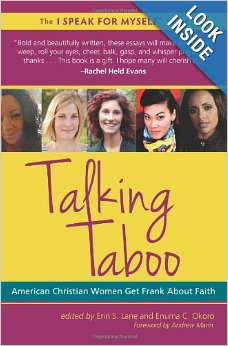
The book, Talking Taboo: American Christian Get Frank About Faith edited by Erin Lane and Enuma Okoro, is creating lots of conversation. WATER is excited to feature two teleconferences to start 2014 by looking at the issues many people consider taboo. Join authors Grace Biskie, Gina Messina-Dysert, Tara Woodard-Lehman, Katey Zeh, and let’s “talk taboo.”

Grace Biskie is a passionate, big-dreaming, extroverted communicator. She holds a bachelor of arts in speech communications and is half way through a Masters of Divinity from Western Theological Seminary. She has served high school and college students in the nonprofit sector for over fifteen years. She blogs regularly at http://www.gabbingwithgrace.com. Currently, Grace is working on her first book entitled, Detroit’s Daughter, a memoir.

Gina Messina-Dysert, PhD, is Dean of the School of Graduate and Professional Studies at Ursuline College. Gina is also Co-founder and Co-director of Feminism and Religion, an international project that explores the “F-word” in religion and the intersection between scholarship, activism, and community. She is the author of the forthcoming book Rape Culture and Spiritual Violence, and coeditor (with Rosemary Radford Ruether) of the forthcoming anthology Feminism and Religion in the 21st Century.  Gina’s twitter is @FemTheologian and her website is http://ginamessinadysert.com.

Tara Woodard-Lehman is an ordained Presbyterian minister. Since 1998 she has ministered to and with young adults and university students. Over the past four years Tara has served as the executive director of Westminster Foundation and Presbyterian Chaplain at Princeton University. Tara also serves on the pastoral staff of Nassau Presbyterian Church in Princeton, New Jersey.

Katey Zeh is an advocate for reproductive justice in faith communities. She wrote her honors thesis on theology, ritual, and motherhood at Davidson College. In 2008, she graduated from Yale Divinity School with her Masters of Divinity. Currently, she directs a grassroots education and mobilization initiative focused on improving global maternal health for The United Methodist Church. Katey serves on the Board of Directors for the Religious Coalition for Reproductive Choice in Washington, DC.

TalkingTabooA recommended resource is the book Talking Taboo, in particular the following chapters:

  •      “A Woman Undone,” by Grace Biskie, pp. 191-198
  •      “No Women Need Apply,” by Gina Messina-Dysert, pp. 93-97
  •      “Broken in Body, Slain in the Spirit,” by Tara Woodard-Lehman, pp. 74-79
  •      “A Pregnant Silence,” by Katey Zeh, pp. 186-190

HOW TO REGISTER

Email “Register Me Teleconference” towaterstaff@hers.com by Tuesday, February 4, 2014 in order to receive dial-in information.

WATER, The Women’s Alliance for Theology, Ethics and Ritual
8121 Georgia Avenue, Suite 310 | Silver Spring, MD 20910
301.589.2509 | water@hers.com | www.waterwomensalliance.org

Please consider making a secure online donation to WATER. Thank you!

Rosemary Radford Ruether’s Quests for Hope and Meaning by Gina Messina-Dysert

Gina Messina-Dysert profileRosemary Radford Ruether is one of the most brilliant theologians of our time and her newly released autobiography, My Quest for Hope and Meaning, is a gift to those of us who have been so touched by her work.  In this intimate and beautiful piece, Ruether shares her personal journey in feminist scholarship and activism.  The autobiography opens with a profound forward by Renny Golden (that is also shared here on Feminism and Religion) and continues with an introduction and six chapters where Ruether guides us through an exploration of the influence of the matriarchs in her life, her interactions with Catholicism, her continued exploration of interfaith relations, her family’s struggle with mental illness, and her commitment to ecofeminist responses to the ecological crisis.

Ruether states that “Humans are hope and meaning creators” (xii), and her autobiography details her own quests for hope and meaning.  She reflects on the incredible impact made by the female-centered patterns in family and community in her life.  According to Ruether, these “matricentric enclaves” grounded and shaped her interest in feminist theory and women’s history.  She also describes the spiritually and intellectually serious Catholicism that she received from her mother and articulates her continued frustration with Vatican leadership that has undermined the efforts of Vatican II.   For Ruether, her ongoing affiliation with feminist theological circles is crucial as she continues to work toward shaping an ecumenical and interfaith Catholicism.

Continue reading “Rosemary Radford Ruether’s Quests for Hope and Meaning by Gina Messina-Dysert”

Painting Sappho by Angela Yarber

angela

“Someone, I say, will remember us in the future,” she once wrote.  To my knowledge, she was never dubbed a prophet.  A muse, yes.  A romantic, perhaps.  But never a prophet, rarely holy, and nary an icon.  Until now.   Hailed as one of the best Greek lyric poets, many have tried to forget her, or at least the more provocative elements of her life.  The passionate poet Sappho was born on the island of Lesbos around 620 BCE (sometime between 630-612 BCE).  The word lesbian stems from the place of her birth and her name is the origin of the word sapphic, though most scholars assert that little is known of her actual life and that the majority of her poetry is not autobiographical.  Yet her lyric poetry speaks of love for both sexes and myriad people.

What is more, the idea of homo and heterosexuality are not transhistorical essences, but instead are relatively recent socio-historical constructs. To say that there were strict sexual binaries in the ancient world in which Sappho lived would be an anachronism. Sexuality was much more fluid.  Not surprisingly, many scholars have tried to name and claim male lovers for Sappho, a heteronormative attempt to erase her fluid sexuality, her hope to be remembered in the future dashed, demeaned, forgotten.  In fact, during the Victorian Era, many asserted that Sappho was the headmistress of a girls’ school, another attempt to straighten out her memory, her poetry, her love. Continue reading “Painting Sappho by Angela Yarber”

Seeing Death and Resurrection by Linn Marie Tonstad

Linn Marie TonstadYesterday, I visited the Capuchin catacombs in Palermo, Sicily. In a grotto about a mile or so from the center of the modern city are found the preserved remains of about 2,000 people who paid the monks to preserve their bodies after death, dress them in their finest clothing, and put them on display. Each of them is placed in its own niche along the wall, held up by iron bands, and has a tag around its neck with its name and date of death. The bodies are not displayed in random order: they are sorted (to some extent) by sex, profession, and familial status. In one large recess, a number of children’s skeletons are on display, many of them in heartbreakingly tiny coffins. In another corridor, friar after friar hangs in his robes, some with cords around their necks signifying their adherence to a Franciscan order. Almost indistinguishable from the cords are the braids still hanging from the heads of some of the women’s bodies. Some families are arranged together; in another corridor doctors and lawyers are segregated and in yet another female virgins are gathered together. The oldest body I saw dated from 1599 – high on a wall hangs the body of a monk whose name was almost illegible but who hailed from the Umbrian hill town of Gubbio.

Some of the skeletons presented death’s heads; others had skin dried to a leathery tightness over remaining bony protuberances. Some of their outfits are well preserved; others have disintegrated under the relentless assault of the years. The practice became illegal around 1880, but until then, people chose – or perhaps their relatives chose for them – to be preserved in this seemingly macabre manner. Continue reading “Seeing Death and Resurrection by Linn Marie Tonstad”

A Reflection on Feminist Theology and the Real Woman by Vanessa Rivera de la Fuente

 Vanessa Rivera de la Fuente. Feminism and TheologyThe XVII Conference of Latin American Religious Alternatives is being held this week in Porto Alegre, Brazil. This event will bring together scholars and researchers from across the continent to talk together about religion, integration, and identity. I will be presenting three papers, all about Islamic feminism. I am pleased to have such a space to discuss new ways of understanding the phenomenon of religion in Latin America and the role of feminism in Latin American religion.  I want to share some of my personal reflections regarding gender, feminism and religion with you today.   

It is true that today all so-called ‘major’ religions—Islam, too—are patriarchal and male minded. It would be a fall into denial to say that abuses in the name of religion do not have a concrete impact on the lives of many women around the world. While it is possible to differentiate between what the Qur’an says and the discourse of patriarchy on Islam, the reality is that it is this patriarchy that dominates our understanding of religion

The revealed messages have been used to reinforce gender oppression in bans on “women’s issues” from therapeutic abortion to driving a car. But we know these bans do not come from the holy books themselves, as the revealed messages can support a reading of oppression or liberation. The problems are the historical authority of sexist readings as criteria of truth and the incorporation of androcentrism as the axis in relation to the divine. Sexist readings and androcentrism both give rise to oppression and violence in the name of God.

Feminists have denounced these abuses over and over again. Many feminists say religions are patriarchal, so let’s leave them without feminist intervention. I think this is not enough. We need to recognize that the religious world is patriarchal. We must name and draw attention to women and their contributions to the development of religion. We must also remove the legitimacy and authority of the androcentric understandings of the spiritual, which have caused much damage throughout history. Feminism in religion is essential.

It is often said that feminists want to undermine the foundations of the faith. Who says this? The same people who justify the exploitation of human beings, the degradation of women, and wars in the name of a God whose message is peace, mercy and social justice. But I ask—is it so dangerous that women and groups historically segregated from society want to own their spiritual experiences and live them autonomously?

What kind of God is adored by those who oppose our approaching the Divine from a feminist point of view? Just listening to their diatribes is to know that it is misogyny and not piety that motivates their messages. Misogyny also lies behind the violence against women. And behind the violence lurks the fear.

Beyond the Female Believer

Patriarchy has silenced its fear and built an “ideal believer” to legitimize the control of women in religion. But feminists no longer want to remain silent and obedient. We are seek to respond by creating our own theologies.

However, even in feminist theology, heteronormativity is still present. It is a bias that still sees gays, lesbians, trans and queer people as “abnormal” outsiders. This approach validates the patriarchal ideas of “minority” and “marginality” regarding the male-female heteronormative assumptions that dominate the religious world.

Dismantling the patriarchy in religion is not only about making the feminine more visible in the mystical, historical, and experiential approaches to religion. We must also demystify and dismantle the axis of androcentrism and heteronormativity and the hold it has in the academy and the “mainstream”.

For example, more than once, sisters who call themselves feminists, have called me “whore,” “deviant,” and “immoral” for my queer understanding of gender roles and my critique of marriage as “half the Deen” [the Islamic idea that for women marriage completes their faith, which in Arabic is ‘Deen’], a replica of the romantic patriarchal discourse of the “other half” that is so damaging to the autonomy and the self-esteem of women in the real world.

This is a problem. Feminism in religion is not landing in the everyday lives of women. Feminist theology still speaks to a woman who is cis-gendered and heterosexual, who wants to marry and have children. Feminist theology is still quoting patriarchy.

The master’s tools will never dismantle the master’s house

The reality is that not all women in religious communities are heterosexual, not all heterosexuals wish to get married, and not all married woman understand their position in marriage as subordinate and complementary to the male.

Along with eliminating the patriarchal “revelations,” feminists who theorize regarding faith must be decolonized from the need to build another “perfect believer.” We should not assume an archetype of woman, as this exercise gives authority to patriarchy’s model of the female believer that imprisons women in destructive and limited dimensions with labels like saint, mother, and whore.

I think we must remove from women the roles that are supposed to make them proper “believers.” In fact, I think we have to destroy once and for all both the concept of “believer” itself and the category of “woman” as we know it in religion. Assessing the degree of spiritual development and the agency of the religious woman according to the degree of her functionality as a “Model” is NOT emancipatory, but is both limited and sexist. If there are “role models,” someone will always be outside the norm.

Instead, let us take over the theologies and feminisms, regain power over ourselves, and raise awareness in communities that feminism is not only a field of study and analysis but also an outlook on life. We can legitimize the authority of the feminist perspectives of religion, and commit sacrilege against the exemplary women and models that are imposed on us.  Let us not talk anymore about “Muslim women” or “Christian women” or “Jewish women,” but about ourselves as women.

Above all, and essentially, we must act on behalf of women of everyday, on behalf of those women who do not want to be “perfect believers,” but who want to be happy and fulfill their goals in a world that belittles them in many ways on a daily basis. Reasonable, imperfect, diverse and ‘under-construction’ women were created by God to be in this world as an expression of life and humanity.

Vanessa Rivera de la Fuente is a Writer, Mentor and Community Educator in Capacity Building for Grass Roots Female Leaders and Advocates. A Muslim Feminist who is an Independent Researcher of Gender and Islam in Latin America on Feminist Hermeneutics, Muslim Women Representations, Queer Identities and Movement Building. She blogs in Spanish at Mezquita de Mujeres, a site dedicated to explore the links between Gender, Religion and Feminism as well to Women from the Global South as Change Makers in their communities.