Painting Lottie Moon, Redeeming Lottie Moon by Angela Yarber

angelaI never imagined I’d paint her. Though I was not raised in church, I have vivid memories of worshiping in Southern Baptist Churches, churches where women’s voices were not permitted behind the pulpit, churches where women could never dream of ordination, churches that damned LGBTQ folks to hell with a pound of a fiery fist on a well-worn bible perched atop an angry pulpit. Canonize a Southern Baptist woman into the sainthood of Holy Women Icons? No, thank you.
Though I am an ordained Baptist minister myself, it’s important to remember that there is a vast spectrum of belief and practice when it comes to the Baptist church. Because our polity is non-hierarchical and we are anti-creedal, one cannot easily say, “All Baptists believe ______ or all Baptists practice _______.” Whether you are as conservative as the Southern Baptist Convention or as liberal as the Association of Welcoming and Affirming Baptists, we all share some core Baptist distinctives: the separation of church and state, believer’s baptism, the autonomy of the local church, freedom of conscious, and the priesthood of all believers. Learning of these distinctives as a young feminist searching for a faith to call my own, I was immediately drawn to the core Baptist tradition. They reject hierarchy. All are supposed to be equal. It is up to the individual conscious to determine what one believes. And it is up to the individual church to determine how that particular community of faith will practice those beliefs. It is feminist to its core. Southern Baptists feel otherwise, which is why they refrain for ordaining women and claim that they should be submissive to their husbands.

Continue reading “Painting Lottie Moon, Redeeming Lottie Moon by Angela Yarber”

Dancing Daughters of the Living Goddess by Laura Shannon

Laura Shannon

A lifetime of research has convinced me that the women’s ritual dances and costumes of Greece are living remnants of ancient Old European Goddess traditions.  In previous posts on FAR I have written about these dances and embroideries, as well as the Midwives’ day rituals which honour the wise women, and the healing effects the women’s circle dances can have. All of these threads came together again in my most recent trip to Thrace.

Today trisected into Greek, Bulgarian and Turkish parts, Thrace is a wild landscape of mountains, forests, rivers and fertile fields. Less than one hundred years ago Greeks, Slavs, Turks, Pomaks, Gagaouzides and other ethnic groups lived and mingled freely throughout the whole area, and although the traumatic wars of the 20th century precipitated a huge upheaval of refugee movement and new settlement, Thrace is still home to a great variety of different peoples here who have kept their customs alive.

In Greece, Thrace is the most northeasterly region, and Evros is the very topmost bit of it, rising up like a thumb between Turkey and Bulgaria. I started visiting the villages of Evros some years ago and have  been back many times. When friends invited me to celebrate my birthday there recently I jumped at the chance. All the villages we went to are Greek Orthodox, with visible elements in costume and culture – such as the Goddess embroideries – which survive from pre-Christian times.

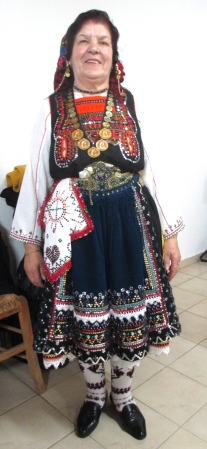
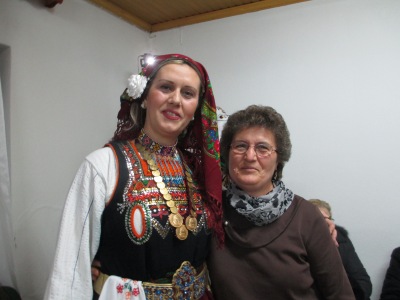
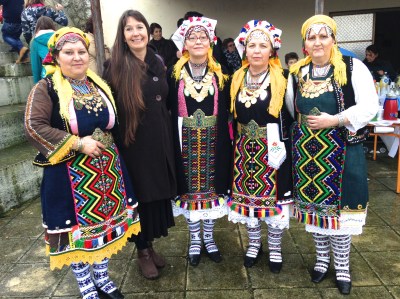
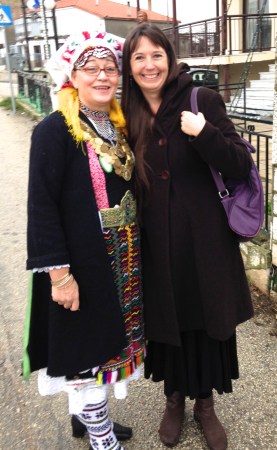
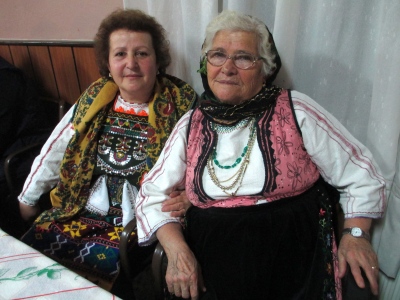
We started off in Pentalofos, my favourite village, with music, dance, song, feasting, and wonderful grandmothers in splendid traditional costumes. In this village they still spin, weave, sew and embroider their festive dress by hand. I have my own costume from Pentalofos like the one Kyria Koula is wearing (on the left), made for me by her, Kyria Loulouda and other women of the village.

photo 2

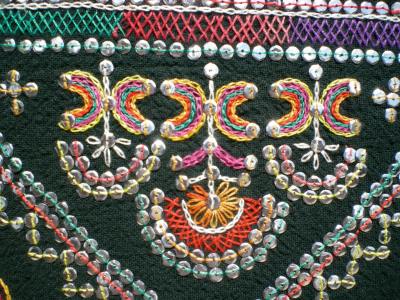
The bodice features a triple butterfly design, connected to the ancient labyris / double axe. It is also a symbol of transformation, not least the transformation of individual women – through dance, song and ritual dress – into manifestations of radiant feminine strength and beauty, moving beyond their personal identity and concerns in order to embody a larger power. This phenomenon is represented by the image of a woman with wings, easily discerned in the butterfly design here and in other villages.

Photo 1

Other villages have their own version of the Thracian women’s costume, as in Doxapara where we went next:

3_IMG_5562

4_IMG_5610
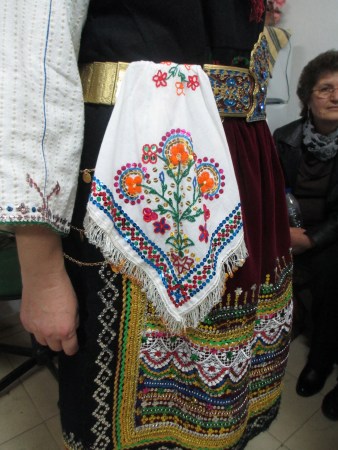
Chryssa, on the left, wears the costume made by her mother, on the right.

5_IMG_5609

Chryssa’s handkerchief is embroidered with a flamboyant sun-headed Goddess/flower motif.  An ancient V-shaped motif of spiral horns, or perhaps a pair of wings, appears on her sleeve in red. This motif is more discreet, but its central location affirms its importance. Women’s hands – which created all this and much more – were considered holy and worthy of protection. As on the handkerchief, Goddess figures are often depicted with radiant, extra-large or winglike hands.

6_IMG_5567
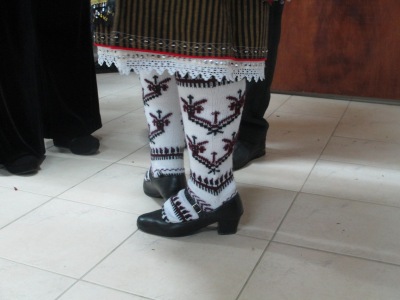
Knitted socks in Doxapara depict winged Goddess figures in red, black and white.

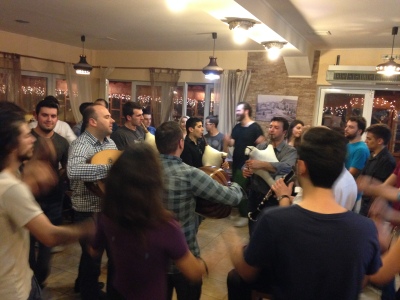
We celebrated my birthday eve in a little taverna in Oinoi, a village of Gagaouzides, Turkish-speaking Greek Christians from Bulgaria. Friends (and friends of friends) needed no persuading to dance up a storm.

7_IMG_1444

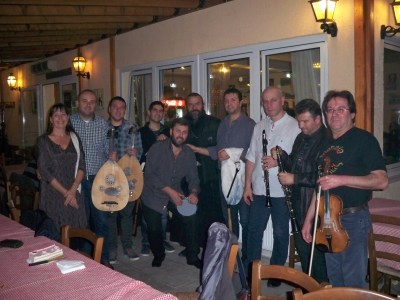
Music was provided by gaidas (bagpipes), laoutos (lutes), clarinets, violin and doumberleki, not to mention everyone singing along. The ‘Happy Birthday’ songs, both English and Greek versions, sounded fantastic with this orchestra.
8_100_0896

9_IMG_1436
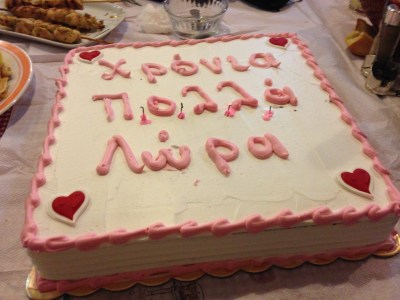
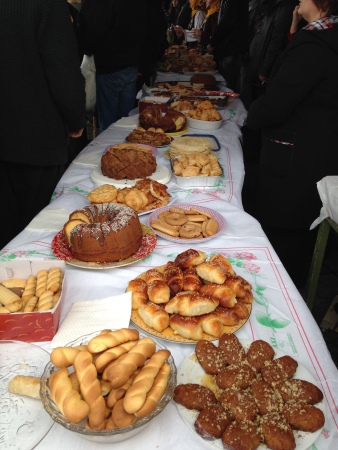
Hospitality is a sacred obligation in Greece, as in many parts of the Balkans, and dancing must be accompanied by feasting. My birthday cake weighed 3 kilos and fed 75 people. ‘Many years, Laura’!

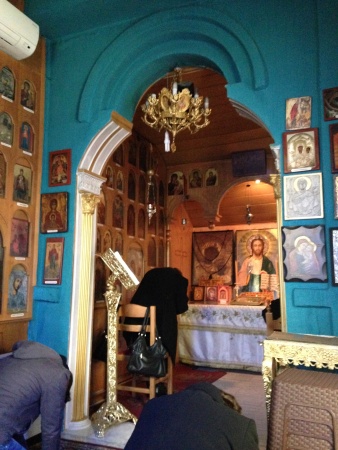
On the morning of my birthday, while everyone else was still asleep, I went to a favourite church in Kleissos, which has a little side chapel filled with 144 icons of the Virgin Mary, whom Greeks call the All-Holy One, the Panayia. As you see, people pray to her very fervently here. The images are copies of famous miraculous icons from other places like Tinos and Kythira. The Panayia of Kleissos is also believed to be a miracle-working icon; I can attest to its power from past experience.

10_IMG_1466

Later we proceeded to Ambelakia, a village I had not visited before.
11_IMG_1576

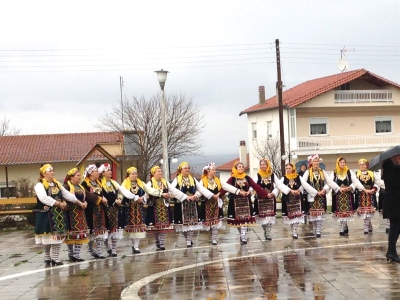
These women are Marides, an ancient Thracian tribe. Their costumes feature many Goddess embroideries and, on their socks, the recurring motif of the wild bee. Priestesses in Thrace and other areas were once known as bees (mélisses).

The women here told me about the ancient festival they keep, called ‘Gynaikokrateía’, Gynocracy or Women’s Rule. It is related to Thracian Midwives’ Day celebrations (described in a previous post) and falls on the same day, January 8th.  On this day, they told me, gender and power roles are reversed and women take over the town hall, village square, cafes and other male-dominated public spaces. They exact toll payments from passing vehicles, which they use to buy wine. The women’s unrestrained merriment and public drunkenness, unthinkable on the other days of the year, is combined with ribald and satirical skits lambasting men’s misbehaviour. This sharp commentary is remembered, laughed over and talked about for months afterwards, thus providing an apparently innocent, yet effective, social deterrent to abuses of power.

12_IMG_1593
Marides women’s costumes can be ‘read’ as a treasury of ancient women’s wisdom hidden in plain view, an open secret for those with eyes to see. Yellow headscarves with long fringes resemble both sun and rain, life-giving elements of agriculture both originally identified with the Goddess. Woven aprons illustrate flowing life force, womb energy and women’s awesome creative power, with Goddess/Tree of Life figures inside the central rhombs.

13_IMG_1617
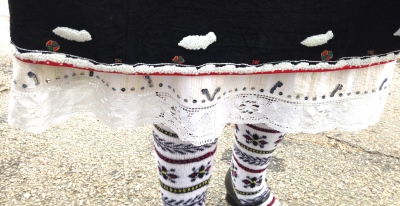
Spiral horns reappear on the hem of the underdress. Sacred symbols on this spot simultaneously pronounce and protect the power of what lies directly above. ‘Doves’ encircle the hem of the black overdress; ‘bees’ adorn the socks.

14_IMG_1614
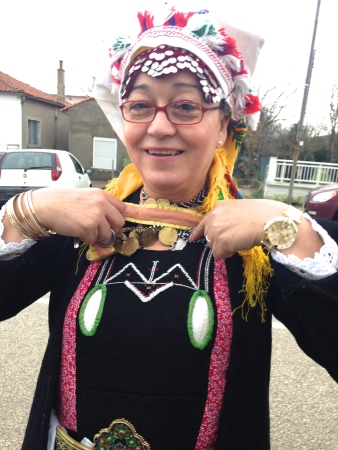
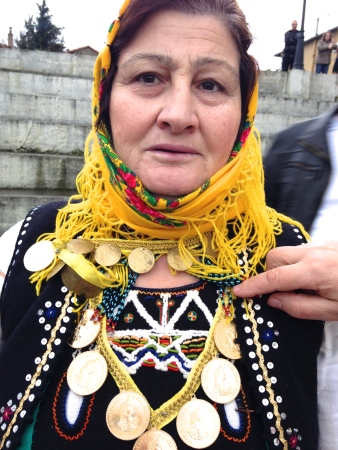
In the central place on the heart of the bodice: the winged Goddess motif, a sign of the dancing priestess and a key Thracian symbol for thousands of years. This powerful image is usually invisible, hidden under scarf fringes, beaded necklaces and garlands of gold coins, but the women revealed it to me because I knew it was there and asked to see it.

15_IMG_1648

16_IMG_1603
As much as I loved meeting them, they loved meeting me – as they would love to meet any woman who can recognise them for what they are and what they wear.

17_IMG_1571
And of course there was another feast.

It was a fabulous birthday. I even danced, managing to overcome lingering injuries from a bicycle accident I had had some months before. Giving myself to the healing energy of women sharing steps together, I felt radiantly joyful and truly alive, as if at a momentary crossroads of space and time, simultaneously fleeting and eternal.

In Thrace, I feel extremely privileged to witness the survival of motifs and ritual customs with roots in Neolithic Old Europe, as well as key values from the Old European worldview articulated by Gimbutas, Carol P Christ, and others: respect for nature, a sense of interdependence, the need for social justice and the importance of community celebration.

We are blessed to live in an age where these and other ancient treasures of women’s wisdom, are now returning, visibly and consciously, to our own culture. Patriarchal domination has not and will not manage to destroy these riches from the past. At this time of the winter Solstice, I wish us all the healing joy, connectedness, and love in abundance which these dances embody, to warm us and guide us all into the rebirth of the year.

Love & blessings,
Laura

Laura Shannon has been researching and teaching traditional women’s ritual dances since 1987. She is considered one of the ‘grandmothers’ of the worldwide Sacred / Circle Dance movement and gives workshops regularly in over twenty countries worldwide. Laura holds an honours degree in Intercultural Studies (1986) and a diploma in Dance Movement Therapy (1990).  She has also dedicated much time to primary research in Balkan and Greek villages, learning songs, dances, rituals and textile patterns which have been passed down for many generations, and which embody an age-old worldview of sustainability, community, and reverence for the earth. Laura’s essay ‘Women’s Ritual Dances: An Ancient Source of Healing in Our Times’,  was published in Dancing on the Earth

Casa Coatlicue by Erica Granados De La Rosa

Erica GDLR 2On a corner adjacent to a cantina, across the street from a home full of barefoot children running through open doorways, and a few houses down from a paleteria y fruteria in San Antonio, Texas, sits a bright white house dressed up in orange trimmings – Casa Coatlicue[1]. Before you walk through the gate you notice a raised bed of herbs, a garden, a large collection of potted succulents, and a metate[2] on the ground. Walking inside you can’t help but smell the sage, copal, and other herbs and incense that have left their smoky traces on the walls of the living room, the kitchen, and then the bedroom. As the house begins to introduce itself, you notice altars in corners and crevices of each room. Your curiosity begins to churn as you notice pictures and canvasses on the walls of ancient and present day cultural symbols, including one poster that reads “This land was Mexican once, and indigenous always,” and a large picture of Selena Quintanilla that captures her warm smile and beautiful black hair. As soon as you begin to take in the colors and ancient smells, the house is introduced to you by name, Casa Coatlicue, the home of four queer young healers, dreamers, lovers, artists, scholars, and spiritual activists who are reclaiming the life-giving traditions of their ancestors.
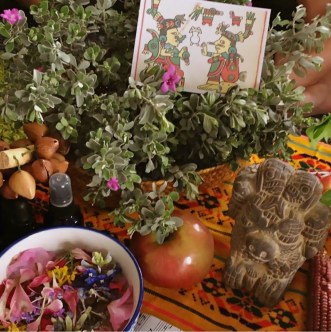
Community altar from  workshop
Community altar from workshop

Earlier this year, I was invited to a curanderismo workshop hosted at Casa Coatlicue. The word curanderismo had an air of secrecy, power, and nostalgia of home for me. I understood curanderismo as the medicine and magic of our grandmothers, and increasingly the forgotten inheritance of our communities. As I spoke with the residents of Casa Coatlicue, we began to identify the chronic erasure and appropriation of brown folks’ spiritual traditions, food, art, and customs by predominantly white, new age culture. Saddened by the loss and the historical disconnect of our people, we collectively affirmed the urgency and importance of relearning and reclaiming our own spiritual traditions not only to tap back into our cultural identity as native and mestizo people but also to tap into a powerful tool for the transformation of our current realities. In the midst of historic and present day manifestations of systemic violence against us – young brown bodies being gunned down in our streets, whole communities being persecuted, incarcerated, and displaced, as well as forced sterilization and assimilation- there is a critical need to tap into radical and sustainable ways to not only resist but to heal. Continue reading “Casa Coatlicue by Erica Granados De La Rosa”

Writing: Changing the World and Ourselves. By Ivy Helman

I still remember the first tim20140903_180423e I read Mary Daly’s Gyn/Ecology. It awoke something within me. Her use of language, the power of her writing and the ease with which she created new words taught me so much about the world around me and about the way the language, and subsequently its use in writing, shapes lives, choices, abilities and destinies. She also taught me about myself.

I was hooked, but not just on Mary Daly. Shortly after I finished her book, I moved onto other feminists writing about religion like Katie Cannon, Judith Plaskow, Alice Walker, Carol Christ, Rita Gross, Gloria Anzaldua, Audre Lorde, Adrienne Rich, Margaret Farley and Starhawk to name just a few. All of them, in fact every feminist I’ve ever read, has shown me the way in which words have power and how words speak truth to power. Ever since, I’ve wanted to be the kind of writer whose words carry a power that not only affects people but also inspires a more just, more equal, more compassionate and more humane world. In other words, I wanted to be a writer activist.

Yet, I’ve always carried around with me a sneaky suspicion that people don’t consider writers true activists. If you aren’t holding a sign, screaming or participating in some sort of public demonstration or civil disobedience, then you have no right to call yourself an activist. Is that really true? Continue reading “Writing: Changing the World and Ourselves. By Ivy Helman”

Fannie Lou Hamer’s Commitment to Life by Elise M. Edwards

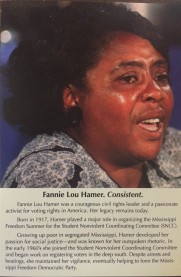
Elise EdwardsA few weeks ago, I came across a postcard that I was given at a conference last year. I got the postcard (advertisement?) because it has a picture of Fannie Lou Hamer on it, and in my home and office, I like to display images and quotes from inspirational women, especially black women. Hamer was a sharecropper from rural Mississippi who became a leader within the civil rights movement in the United States. I was happy to have something with her likeness on it. It was only later that I looked at the text on the front and back of the card, which read in part, ”Often called the ‘spirit of the Civil Rights Movement,” Hamer worked tirelessly on behalf of the rights of others—including the unborn. [She said,] ‘The methods used to take human lives such as abortion, the pill, the ring, etc. amounts to genocide. I believe that abortion is legal murder.’” I realized then that the card was distributed by an organization called Consistent Life, who, in support of a “consistent ethic of life,” is “committed to the protection of life threatened by war, abortion, poverty, racism, capital punishment and euthanasia.”

I was conflicted about the ushamere of Hamer’s image for this organization’s purposes. It is true, Hamer did have those views about abortion and birth control. But I did not know if her image and story was being manipulated for a particular political and religious agenda—one I do not align myself with. I put the card in a box of other images and quotes. I didn’t display it, but I didn’t throw it away, either, which is why I came across it again a couple weeks ago as I was cleaning and decorating my home office. I had the same misgivings about the image as before, and I set it aside again. Continue reading “Fannie Lou Hamer’s Commitment to Life by Elise M. Edwards”

Painting La Negrita by Angela Yarber

angelaOne week ago thousands of Costa Ricans made a pilgrimage to visit their patron saint on August 2. Some penitents walked the 22 kilometers on their knees from the capital of San José to the Nuestra Señora de los Angeles Basilica in Cartago where the small statue of La Negrita is now on display. Joining Virginia Woolf , the Shulamite, Mary Daly, Baby Suggs, Pachamama and Gaia, Frida Kahlo, Salome, Guadalupe and Mary, Fatima, Sojourner Truth, Saraswati, Jarena Lee, Isadora Duncan, Miriam, Lilith, Georgia O’Keeffe, Guanyin, Dorothy Day, Sappho, Jephthah’s daughter, Anna Julia Cooper, the Holy Woman Icon archetype, Maya Angelou, Martha Graham, Pauli Murray, and all my other Holy Women Icons with a folk feminist twist is this seemingly small saint who has done big and mighty things: La Negrita.

Also known as La Virgen de los Angeles, the Black Virgin is a very small representation of the Virgin Mary. She was originally discovered by an indigenous woman on August 2, 1635. When the poor indigenous woman tried to take the stone statuette, it miraculously reappeared. The people responded by building a shrine around her. Continue reading “Painting La Negrita by Angela Yarber”

Exhaustion and Inspiration by Ivy Helman

photo4
Wading in the waters of Prince Edward Island.

Change takes time.  If society takes years to change, religious institutions seem to take decades, maybe centuries.  That ubiquitous intersection of religion and feminism seems neck high in mud and muck.  Some religious institutions claim divine inspiration for keeping their chins down, jaws clenched and footings strongly moored in damaging sexist ideologies.  This is wrong.  But I’m tired.  I feel as if the feminist movement is draining too much out of me for not enough change.

Perhaps an example will clarify.  This Tuesday I taught the first session of a six-week long summer course entitled, “Theology through Women’s Eyes.”  An odd title that could mean many things, right?  It does not even imply a feminist approach to religion and the college’s course description did not either.  I learned from my department’s chair that the last professor to have taught the class shied away from the course having any specific reference to feminism as she was a practicing Catholic theologian and she worried about the effects of that association for her professional career at Catholic universities.

Are you kidding? We are stuck there?  Still?  I personally know a great number of Catholics in academia and outside of it who wear their feminism proudly like Margaret Farley, Lisa Sowle Cahill, and Rosemary Radford Ruether to name just a few.  Obviously, not everyone does.  Yet, when religious institutions threaten to and actually excommunicate those who dissent from their teachings, I can see genuine issues with being an “out,” so to speak, feminist.  At the same time, I’ve always thought that the minute someone censures me I’m finally doing something right.  I’m being heard by my intended audience.  Thank G-d, right?  Those are the people who need to listen anyway.  That is my measure of success. Continue reading “Exhaustion and Inspiration by Ivy Helman”

Queering Iconography, Painting Pauli Murray by Angela Yarber

angelaEven as my book, Holy Women Icons, is printed, bound, and available for purchase, filled with the stories of nearly fifty holy women, my project of painting these beloved saints continues. Joining all my other Holy Women Icons with a folk feminist twist is the brave, bold, and revolutionary Pauli Murray.

This month is a celebration of Murray’s life and witness is several meaningful ways. The first of July was her feast day, as she was deemed an Episcopal saint in 2012. LGBTQ author and activist, Kittredge Cherry, detailed Murray’s feast day, celebrating her as a “Human rights champion and queer saint…renowned civil rights pioneer, feminist, author, lawyer and the first black woman ordained as an Episcopal priest.” And the celebration of Pauli Murray’s radical witness continues as the icon bearing her image joins seventeen of my other Holy Women Icons at the North Star LGBTQ Center Gallery in Winston-Salem, NC for an exhibition entitled, “Queering Iconography: Holy Women Icons from Sappho to Pauli Murray.” Continue reading “Queering Iconography, Painting Pauli Murray by Angela Yarber”

Painting Martha Graham by Angela Yarber

angela

Joining Virginia Woolf , the Shulamite, Mary Daly, Baby Suggs, Pachamama and Gaia, Frida Kahlo, Salome, Guadalupe and Mary, Fatima, Sojourner Truth, Saraswati, Jarena Lee, Isadora Duncan, Miriam, Lilith, Georgia O’Keeffe, Guanyin, Dorothy Day, Sappho, Jephthah’s daughter, Anna Julia Cooper, the Holy Woman Icon archetype, Maya Angelou, and all my other Holy Women Icons with a folk feminist twist  is the dancing revolutionary Martha Graham. So, as the contemporary and modern dancers on So You Think You Can Dance continue to amaze us this summer, let us remember from whence they came.

Martha Graham’s contribution to the world of dance cannot be overestimated. She is regaled as the Picasso of the dance world, revolutionizing it by introducing an entirely new quality of movement known as modern dance. Not only did Graham revolutionize the dance world, like Isadora Duncan before her, she also made great contributions to feminist spirituality. One of her most famous statements may well have been “wherever a dancer stands is holy ground.” Like most dancers who are so in tune with their bodies, Graham new the holiness therein, the ways in which the body can express the ineffable when words alone simply cannot. “The body never lies,” she famously reminds us.

Martha Graham Continue reading “Painting Martha Graham by Angela Yarber”

A Message From My Mother by Mary Beth Mosèr

Recently I traveled to Texas to receive the Kore Award from the Association of Women in Mythology for my dissertation in Women’s Spirituality at the California Institute of Integral Studies, “The Everyday Spirituality of Women in the Italian Alps: A Trentino American Woman’s Search for Spiritual Agency, Folk Wisdom, and Ancestral Values.”

Shortly after I had arrived in San Antonio, and met my younger sister and her daughter who were in town, we received word that my Mother was not well.   Although Mom had been in precarious health throughout the last year, she had pulled through several times. That night in the hotel room, we hoped for the best.  The next morning as I lay in my dream state, I felt someone come and lay beside me in bed, compressing the covers, which I have come to understand as a visitation from my Mother. Then the phone rang with the news that Mom had died peacefully that morning.  It was comforting for me to be with my sister and niece, especially since we were away from home. Together, we made it through that long, rainy day.

Later that morning, my other siblings, who were gathered around my Mother’s kitchen table, called the hotel room where I was staying. They passed the phone around to each person, voicing their consensus that I should stay in Texas to attend the conference, give my presentation, and receive the award. There was nothing I could do in the next few days if I flew to Denver, they said.  All the arrangements had already been made; the funeral wasn’t until the next week. So, reluctantly, I surrendered to their decision. My heart wanted to be with them. However, I stayed, unsure. . . . Continue reading “A Message From My Mother by Mary Beth Mosèr”