“Suchness” of inequality vs. the “story” of patriarchy by Oxana Poberejnaia

oxanaIn the TV film about American suffragists “Iron Jawed Angels” Alice Paul (played by Hilary Swank) says to a psychiatrist who came to prison to assess her mental state during her hunger strike:

You asked me to explain myself. I just wonder what needs to be explained. Let me be very clear. Look into your own heart. I swear to you, mine’s no different. You want a place in the trades and professions where you can earn your bread? So do I. You want some means of self expression? Some way of satisfying your own personal ambitions? So do I. You want a voice in the government in which you live? So do I. What is there to explain? Continue reading ““Suchness” of inequality vs. the “story” of patriarchy by Oxana Poberejnaia”

What Dorothee Soelle Taught Me about Creativity by Elise M. Edwards

Elise EdwardsI’m currently developing a book that considers how theological and ethical considerations in architectural design can define good architecture.  My book discusses five virtues related to the architectural design process that promote human participation in bringing out God’s intention of flourishing for humanity and creation.  Those five virtues (or values) are: empathy, creativity, discernment, beauty, and sustainability.  In the book, I’ll explain how these virtues orient design tasks to the social and ethical aims of architecture.

In this virtual space, I want to have a discussion about what these virtues mean from a feminist standpoint.  In my writing, I draw from theological ethics, architectural theory, and feminist theory to emphasize community discernment and participation.  It’s fitting, then, to claim opportunities in my work to acknowledge the feminists who have influenced me while also opening up the dialogue to the feminists in this community who continue to inspire and guide me to do my best work. Continue reading “What Dorothee Soelle Taught Me about Creativity by Elise M. Edwards”

Dance of Persephone: The Trata of Megara by Laura Shannon 

Laura Shannon square cropIn a previous post on FAR I explored Greek Easter customs which interweave Christian and pre-Christian beliefs.  Today I would like to take a closer look at one of these customs, the women’s ritual dance known as Tráta, ceremonially performed on ‘Bright Tuesday,’ the Tuesday after Easter. Versions of Tráta survive in the towns of Mégara and Elefsina just west of Athens, on the island of Salamína directly across from them, and in the surrounding area as far as Thebes.

Elefsina, of course, is Eleusis, where for over 2,000 years the Eleusinian Mysteries enacted the story of Demeter and her daughter Persephone’s descent to the Underworld. Choral dance was a central part of the ceremonies at Eleusis – as at other sacred sites including Delphi, Knossos, Athens, and Vravrona – and the ‘Well of the Beautiful Dances’ can still be seen at the archaeological site. It is a a visible reminder of the circle dancing which was a part of the initiatory experience, bringing cosmic order – symbolised by the circle – into the human world. This is still one of the functions of the Tráta as performed today.

Eleusis
Eleusis
Eleusis – ‘Well of the Beautiful Dances’

Continue reading “Dance of Persephone: The Trata of Megara by Laura Shannon “

A New Covenant by Joyce Zonana

4
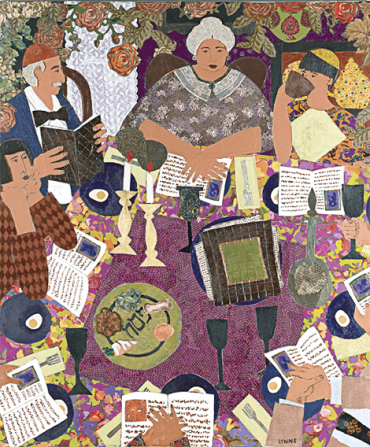
“The Seder Table” by Lynne Feldman

As the Jewish High Holiday of Passover draws to a close, I have been reflecting on this seasonal ritual so central to collective Jewish identity and so significant to me personally.

The Haggadah, the script for the Seder gathering, enjoins all Jews to experience the Exodus—the liberation of the ancient Hebrews from slavery in Egypt —as if it were happening to each of us in our own time.  Because I was born in Cairo to an Arab Jewish family that left Egypt when I was two, I always felt Passover to be mine.  No need for “as if”: our Exodus was all too real. Yet, from my parents’ accounts, life in Egypt had been delightful. I could not reconcile the Haggadah’s dreadful representation of ancient Egypt with my family’s treasured memories of contemporary Cairo: I could not understand why we celebrated deliverance from an Egypt we loved.

Continue reading “A New Covenant by Joyce Zonana”

An Illegitimate Child in Mecklenburg, 1850 by Carol P. Christ

Carol Molivos by Andrea Sarris 2I am Carol Patrice Christ, born in Pasadena, California, daughter of Janet Claire Bergman, born in El Paso, Texas in 1919, daughter of Lena Marie Searing, born in Lyons, Michigan in 1891, daughter of Dora Sophia Bahlke, born in Lyons, Michigan in 1858, daughter of Maria Sophia Catherina Hundt, born in Parum, Mecklenburg in 1827, daughter of Catherina Sophia Elisabeth Schoppenhauer, born in Pogress, Mecklenburg in 1798, daughter of Anna Sophia Seehasse, born in Zulow, Mecklenburg in 1756 in the clan of Tara. I come from a long line of women, known and unknown, stretching back to Africa.

In our ritual on the Goddess Pilgrimage to Crete this May, I will have two new names to add to my mother line. The name Sophia was passed down through the maternal line for at least four generations. I am sorry it was not handed down to my grandmother, my mother, and me.

When I left for Germany a little over a month ago, I knew that Dora Sophia Bahlke was the mother of my grandmother Lena Marie Searing and that Dora Sophia’s parents were Anton Bahlke and Maria Hundt, immigrants from the small towns of Parum and Dummerhutte, in Mecklenburg, Germany. I did not have their parents’ correct names, and I had very little information about their lives in Germany. I have now put some flesh on the bones. Continue reading “An Illegitimate Child in Mecklenburg, 1850 by Carol P. Christ”

#HillYes by John Erickson

I’m going to do something I’d never thought I’d do: fill your newsfeed with yet another article pertaining to the 2016 United States Presidential election and yes, I’m going to talk about former Secretary of State Hillary Clinton (hint: I’m emphatically supporting her and I’m unapologetic about it.)

John Erickson, sports, coming out.I’m going to do something I’d never thought I’d do: fill your newsfeed with yet another article pertaining to the 2016 United States Presidential election and yes, I’m going to talk about former Secretary of State Hillary Clinton (hint: I’m emphatically supporting her and I’m unapologetic about it.)

Let me start off with my central point: a vote for Hillary is a vote to change history and the world. No, not because she’ll hail in some type of new economic stimulus (although I’m sure she’ll do just fine with our economy #ThanksObama) or because she’ll save us all from the evils of the GOP (looking at you Trump/Cruz/and the “moderate” Kasich) but because she’ll do one thing that’s never been done before: become the first female President of the United States, ever.

While I have tried not to get into “it” (read: online trysts with my friends on social networks who are #FeelingtheBern) the question I beg to ask is: what’s so wrong with wanting the right woman to be the President? This is one, but not my only reason, I will cast my vote for her both in the Democratic Primary in California in June as well as in November (and, if you haven’t guessed, I do not believe or promulgate the reasoning or rhetoric that Bernie Sanders will come from behind and win the Democratic Party’s nomination because I passed 5th grade level Math.)

Hillary Clinton

Continue reading “#HillYes by John Erickson”

Reconstructions of the Past 6: Hafsa bint Sirin (My Story of Her Life 1) by Laury Silvers

silvers-bio-pic-frblog - Version 2In this sixth reflection on the life of Hafsa bint Sirin and in blogs to follow, I will be emphasizing that her much praised great piety was not incompatible with social engagement, or even sometimes a good dose of family drama.

Hafsa bint Sirin was the oldest child of freed slaves. Her parents had been taken as captives and most likely distributed as war spoils to the Prophet’s companions, Abu Bakr al-Siddiq and Anas b. Malik. Because her parents had been enslaved by such significant companions, and after their release became clients and treated like foster family, certain social advantages were open to her that might not have been for a free woman of no connection.

Let me pause here to say that there is no point in pretending, as some do, that slavery in Islam meant that the people they enslaved or clients were “like family,” in any way that makes sense to us now. The wealth of legal injunctions discussing the rights an owner had over those they enslaved makes the point. Likewise, innumerable calls to be good to enslaved people in piety literature demonstrates just how often the free had to be reminded to treat those they enslaved well. Furthermore, conversion to Islam did not mean that enslaved people were set free. I make this point because I do not want the successful story of Hafsa’s family to give the impression that Muslims who enslaved others were somehow less ethically culpable than slave owners in the Americas, nor do I want to minimize the Hafsa’s own purchase of a woman for household labour (who goes unnamed yet is also a transmitter of her story). I look at Hafsa’s story to demonstrate how women’s histories were transformed and worked for elite male purposes, this includes the histories of those who were enslaved. I address this aspect of pious women’s history in my piece on pious and mystic women in The Cambridge Companion to Sufism.

It is often said that with the coming of Islam Arab tribal social hierarchies were upended. While this is true to some degree, in practice, the social levelling that came with Islam was more of a redistribution of status than the elimination of it. Social status came in many modes and often hand in hand with great piety and great poverty. Those who sacrificed everything to join Muhammad early on and fought alongside him had the greatest rank. Those physically nearest to him or his companions had the greatest opportunity to learn about him and transmit his teachings. So even a slave of a household of one of the Prophet’s Companions would have been able to establish higher social connections based on mere proximity to these elites than a wealthy free man who lived in outside Medina.

First as enslaved servants and then clients of close companions of the Prophet, Hafsa’s parents, Sirin and Safiyya, were able to claim such connections and Sirin was eager to make use of them. Sirin had run a coppersmith business before his enslavement. He seems to have been eager to reclaim his lost status. Safiyya was the perfect wife in this regard. She was an appropriate match as a former slave, but she would also have raised him in status through her clientage relationship to the Prophet’s best friend and father-in-law, the first caliph of the Muslim community, Abu Bakr al-Siddiq. Throughout her life, Hafsa’s mother enjoyed relationships with the extended family of Abu Bakr as well as the Prophet’s wives. She was so well-esteemed, it is said that when she died three of Muhammad’s wives laid her out along with other notable companions.

The depiction of Sirin’s wedding to Safiyya bears the mark of a lavish and somewhat awkward event. He is said to have held a celebration (walima) for seven days, most likely paid for by Anas b. Malik, which would have been ostentatious by prophetic standards. Anas was a highly regarded companion, a transmitter of many hadith, but seems to have a sense of wealth that was out of keeping with some other companions of the Prophet. It is reported that Anas demanded 40,000 dirhams or more from Sirin for his freedom. Sirin could hardly afford this. He was forced to go to ʿUmar ibn al-Khattab, Muhammad’s close friend and the third caliph, for help facilitating his release. At the wedding party, the esteemed companion Ubayy b. Kaʿb stopped by, bringing other companions with him and praying for the couple. Ubayy b. Kaʿb was an early companion of the Prophet, one of his scribes and the possessor of a personal copy of the Qur’an. But notably Ubayy refused to eat at the celebration, saying he was fasting, which would have been considered a slight directed at Anas. 

Despite this implied criticism, Anas held great status and was able to give Sirin and his spiritually and intellectually precocious children the best opportunities for success. Through her father and mother’s connections, Hafsa, her two sisters Umm Sulaym and Karima, and her brothers Muhammad and Yahya–not to mention her half-siblings, some of whom also transmitted hadith–would have grown up in the deeply intertwined social, scholarly, and devotional circles of the Companions and Followers in Medina and Basra. Because her family had access to these elite social circles, Hafsa had the opportunity to memorize the Qur’an by the age of twelve as well as sit with companions such as Umm ʿAtiyya, Abu al-ʿAliya, and Salman b. ʿAmir from whom she transmits hadith. Ultimately, she became known as a reliable scholar and a woman of great piety and was taken seriously in influential circles (as we saw when she argued the legal status of women’s right to pray the ʿeid prayer at the mosque).

Later Anas contracted a second marriage for Sirin to one of his former slaves, then, again decades later, to one of his nieces as a third or fourth wife, thus elevating Sirin from client to family. Given Sirin’s multiple marriages, Hafsa grew up around many siblings in what was likely to have been a bustling compound of rooms. Her father tried to make space for his children’s devotional needs. It is said that he built separate prayer spaces of wooden planks for her, Muhammad, and Yahya. But such quiet spaces devoted to piety did not keep Hafsa from family drama arising from Sirin’s marriages.

When Anas offered Sirin his niece in marriage, Hafsa was supportive of the match despite her mother’s clear objection. Hafsa may very well have accepted the multiple marriages. She may have felt some advantage to them given her close relationships with her siblings and the social ties it further afforded them. Marriage was primarily a social arrangement for families, not solely a matter of legitimating desire or love. Or she may simply be portrayed this way to promote what male transmitters would consider a proper pious response highlighted against that of her mother. Whichever the case, it is reported that when given the news, she congratulated her father for a tie that would raise them from a clientage relationship to family with Anas. But when Hafsa delivered the news to her mother, Safiyyah insulted Hafsa for supporting her father and retorted, “Tell your father, ‘May you be distant from God!”’

To be continued…

(Accounts are taken from Ibn Saʿd’s Tabaqat al-kubra, her transmissions of hadith, and Ibn al-Jawzi’s Sifat al-safwa). Thanks goes to Yasmin Amin for clearing up a few matters, including the nature of Safiyya’s message to Hafsa’s father [literally, may God keep you young, but meaning, may you be delayed in meeting God and so distant from God]).

 Laury Silvers is a North American Muslim novelist, retired academic and activist. She is a visiting research fellow at the University of Toronto for the Department for the Study of Religion. Her historical mystery series, The Lover: A Sufi Mystery, is available on Amazon (and Ingram for bookstores). Her non-fiction work centres on Sufism in Early Islam, as well as women’s religious authority and theological concerns in North American Islam. See her website for more on her fiction and non-fiction work. 

 

Pause, Stop and Re-evaluate your place within patriarchy and capitalism by Oxana Poberejnaia

oxanaThere are three vicious circles: patriarchy, samsara and wanton destruction of environment. All three lead ultimately to annihilation of life. All three are incredibly difficult to escape. One of the reasons for this difficulty is that there are pay-offs. Someone or something benefits from keeping the cycles going.

Men and Mothers-in-Law seemingly benefit from patriarchy. However, the privileges granted by patriarchy are based on a pyramid scheme of tyranny. You get to bully people who are below you on the patriarchal pecking order: women, men of the lower status, daughters-in-law. Everyone at the higher level gets to bully you. The top man lives in constant fear of de-throning. Continue reading “Pause, Stop and Re-evaluate your place within patriarchy and capitalism by Oxana Poberejnaia”

Lucy Pick’s Pilgrimage by Mary Sharratt

mary sharrattIn medieval Europe, religious devotion provided an alternate narrative for women’s lives in a male-dominated culture. Defiant women who stood up for themselves in the face of rape, incest, and murder were hailed as virgin martyrs. Religious vocations, such as becoming a nun or a beguine, provided a viable and esteemed alternative to forced marriage.
Even women who were married with children could escape their domestic entanglements and conjugal duties by taking an oath of celibacy as 15th century English mystic Margery Kempe did, leaving behind her husband and 14 children to go on pilgrimage to Santiago de Compostela, Rome, and Jerusalem. Her Book of Margery Kempe, the tale of her travels, reads like a kind of late medieval Eat, Pray, Love and is the first autobiography written in the English language.

Though it might seem surprising to us today, women of the European Middle Ages possessed more rights and freedoms than their descendants in the Renaissance, Early Modern, and Victorian ages. Women worked as craftspeople and artisans and were members of the guilds, alongside men. Monarchs such as Eleanor of Aquitaine were global power brokers while religious leaders such as Hildegard von Bingen devoted their lives to intellectual and artistic pursuits, composing music and writing weighty philosophical and theological books that are still being discussed today.

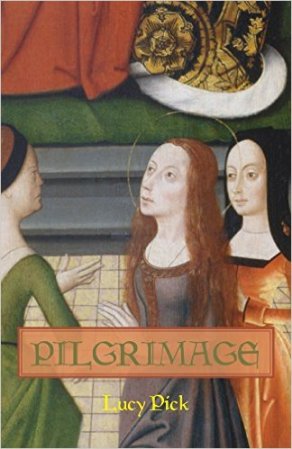
lucy pick pilgrimageThe cover of academic historian Lucy Pick’s novel Pilgrimage shows details from a painted altarpiece dedicated to Saint Godeleva. A victim of forced marriage who was strangled by order of her husband, this legendary saint was a patron of abused wives. Lucy Pick’s novel concerns the saint’s daughter, the blind Gebirga of Gistel in Flanders. What would it be like to be the daughter of a martyred saint whose miracles cured everyone except you?
Considered unmarriageable due to her blindness, Gebirga rejects life as a nun in an abbey dedicated to her sainted mother. Instead, in a bid for freedom, she embarks on a pilgrimage to Santiago de Compostela in faraway Iberia, an epic journey for that time. She serves as the companion to a highly strung teenage noblewoman and is charged with delivering the girl to the Spanish king she is contracted to marry. During their travels, Gebirga must use all her intelligence and resourcefulness to protect herself and her young charge from the considerable dangers and political intrigues they face on their way. Though they encounter hardship and heartbreak, this is a pilgrimage of miracles, healing, and redemption.

Lucy Pick, the Director of Undergraduate Studies and Senior Lecturer at the University of Chicago’s Divinity School, has infused her novel with impeccable research into the lives of medieval women. This novel is a medievalist’s delight and fans of the late Margaret Frazer will devour this book.

Mary Sharratt’s book Illuminations: A Novel of Hildegard von Bingen, won the 2013 Nautilus Gold Award, Better Books for a Better World. Her forthcoming novel, The Dark Lady’s Mask: A Novel of Shakespeare’s Muse, tells the tale of the groundbreaking Renaissance women poet Aemilia Bassano Lanier and will be published by Houghton Mifflin Harcourt in April 2016. Visit Mary’s website.


Was Mother Kalawati a Feminist? (Part 2) by Vibha Shetiya

VibahContinued from Part 1.

After leaving her home and her children in order to take refuge with her guru, in no time, Rukmabai won over hearts. Her guru, Siddharood Swami “with his divine sight” discerned that Rukmabai was no ordinary being. In fact, just before his death, upon realizing that his principle disciple had attained moksha (liberation from the cycle of death and rebirth), he left to her his mission of guiding others to salvation, directing his followers to now address her as Mother Kalawati.

And so it came to be that at the tender age of twenty-one, Rukmabai had a large following herself, and as an intense devotee of Krishna, she almost became synonymous with the god. As many like to point out, she had already internalized the attitude of non-attachment, whether towards individuals, possessions or food or drink; she was already enlightened.

Her disciples were both male and female, although she dedicated herself to the well-being of women. But while directing minds towards god, Kalawati Aai – a high class and high caste woman – also dedicated herself to uplifting the poor and backward Bohari community of Belgaum, Karnataka. It is said that the men used to wile away their time drinking and gambling leaving the womenfolk to run the household. Because of Kalawati Aai’s intervention, some order was brought to their lives; the men stopped drinking, which in turn put an end to the physical abuse they had heaped upon their wives, as well as the neglect their children had faced, who earlier had no choice but to turn to vagrancy. Stability in the homes through prayer and piety – in other words channeling their minds away from vice and towards god – in turn saw not just an economic change but also a change in the lives of these women and children, for the better.

But – and this is interesting – her message to women was not one of directing energy towards god in search of inner peace or salvation, but towards the family, of being a virtuous wife and mother. In fact, she urged women to put aside “just one hour a day of your life to the service of god”; the rest of the time should be aimed towards serving the family. And her advice to women unhappy on account of their domestic life would always be to look deep within themselves to remedy the situation, rather than to blame their husbands. Moreover, at no point should a woman ever neglect her duties towards family on account of her own well-being for that would be tantamount to selfishness. I find this most interesting because she herself broke norms in order to serve a personal calling. Continue reading “Was Mother Kalawati a Feminist? (Part 2) by Vibha Shetiya”