Sex, Religion, and Discourse: An Interview with Judith Butler

One of my academic joys is interviewing people I find particularly interesting (see most of my posts here). This time I am honored to present a recent interview I did with Judith Butler.

Image from The European Graduate School

Many wonder how gender performance relates to chromosomes, phenotypes, genitalia, and other scientific “evidence” for innate sexual differences. Continue reading “Sex, Religion, and Discourse: An Interview with Judith Butler”

Anti-sex feminism? by Linn Marie Tonstad

Linn Marie TonstadLori Gottlieb’s article in the February 9 New York Times magazine, “The Egalitarian-Marriage Conundrum,” was yet another tired entry in the New York Times’s annual clickbait misogyny Olympics. Who doesn’t remember the supposed opt-out revolution, and the sadness of the decade-later follow-up demonstrating every single consequence that any feminist could have predicted? Or the weekly gender terrorism spewed by Maureen Dowd, who somehow gets people to believe that constant belittling and feminizing male Democratic politicians counts as incisive, progressive political commentary? To name just a few of the most memorable, and most infuriating, examples.  

Gottlieb’s article rehashed the studies – I’ve lost count of how many times I’ve read about them in one version or another – that suggest that equality in household labor leads to decreased frequency of intercourse among married heterosexual couples. The most revolting lines in the article – among many contenders – start with a quote from Julie Brines, the author of the study in question: ‘”The less gender differentiation, the less sexual desire.’ In other words, in an attempt to be gender-neutral, we may have become gender-neutered.” It is possible that Brines may be quoted out of context, or that what she intended to say was something quite different, but as the quotation stands, it implicitly suggests that so-called “traditional” gender differentiation is necessary for sexually satisfying heterosexual relationships. (For, of course, there are plenty of other ways in which gender differentiation might be present in heterosexual relationships. Gender differentiation is here being equated with a very particular set of decisions about ‘housework’, a notion that arguably exists only to render some parts of women’s work invisible.) That’s before getting into the implications of the word “neutered” used in the second sentence. Why would egalitarian distribution of household labor be considered “gender-neutral” to begin with? Continue reading “Anti-sex feminism? by Linn Marie Tonstad”

Why I Don’t Believe in Female Pastors by Andreea Nica

Andreea Nica, pentecostalismIt may come as a surprise to those who identify as both feminists and religious practitioners that I don’t believe women should be pastors of any dominant religious congregation. This includes most religions which, I assert, are rooted in and structured by the tenets of patriarchy. Does that mean I think women should be congregants of a patriarchal-originated religious system? You guessed it – no. While this may seem like a radical notion to some, it took me quite some time to come to terms with my own conflict in being both feminist and a believer.

My transition from the Pentecostal sect was a long, intricate process that involved life-altering decisions. The notion of leaving the church was driven by my immersion in women’s studies during my undergraduate degree. There were many difficult questions I simply didn’t have an answer for, as the church didn’t provide me with them.

One of them being: Can women instruct an entire congregation of believers?

For those who are female pastors, I’m sure you’ve heard this one a million times, but somehow it never fades from religious and secular discourse. Whether it’s the Islamic, Jewish, Christian, or Mormon faith, women have had to constantly fight for their right to preach religious doctrine. In the beginning of my transition, I was on the side of: Preach it ladies! Continue reading “Why I Don’t Believe in Female Pastors by Andreea Nica”

Seriously?! Let’s Blame Feminism for the Creation of a “Wimpy” Nation by Michele Stopera Freyhauf

FreyhaufIt is so easy to blame feminism for the ills of the world – mainly because of continued misconceptions and misunderstandings about the definition or meaning of feminism. Feminism is responsible for poverty, bad leadership, wars, the polar vortex, the list goes on. Feminism is still considered a derogatory term that serves to incite prejudice against those who label themselves as one.  In fact, negative connotations surrounding feminism are exacerbated in today’s culture, especially in the media.  Fox News seems to be the poster child of “femiphobia” – a term coined by Stephen Ducat and defined as “wanting to repress every man’s feminine side and demonize the feminine and gay wherever we see them.” Elisabeth Hasselbeck and Nick Adams, in a recent interview, illustrate this femiphobic viewpoint by blaming feminism for raising a culture of “wimps” and “wussies” and thus compromising the U. S.’s national security and weakening its global presence.  In other words, feminism is to blame for the problems of the world.

According to Adams, men around the world are no longer allowed to be “manly” and that this phenomenon is a “dangerous” problem:

American men are of course very susceptible to it. It’s really important particularly in America given the leadership role that America has in the world that American men be allowed to be men.

What does in mean to be a man and how is Adams defining that stereotype? While I am aware of the discussion of gender identity and roles even gendered stereotypes, this post is not about what those roles mean.  Rather, for this point of discussion, I want to address the issue of masculinity, feminism, and what it means to be a “wimp” as portrayed by popular media.

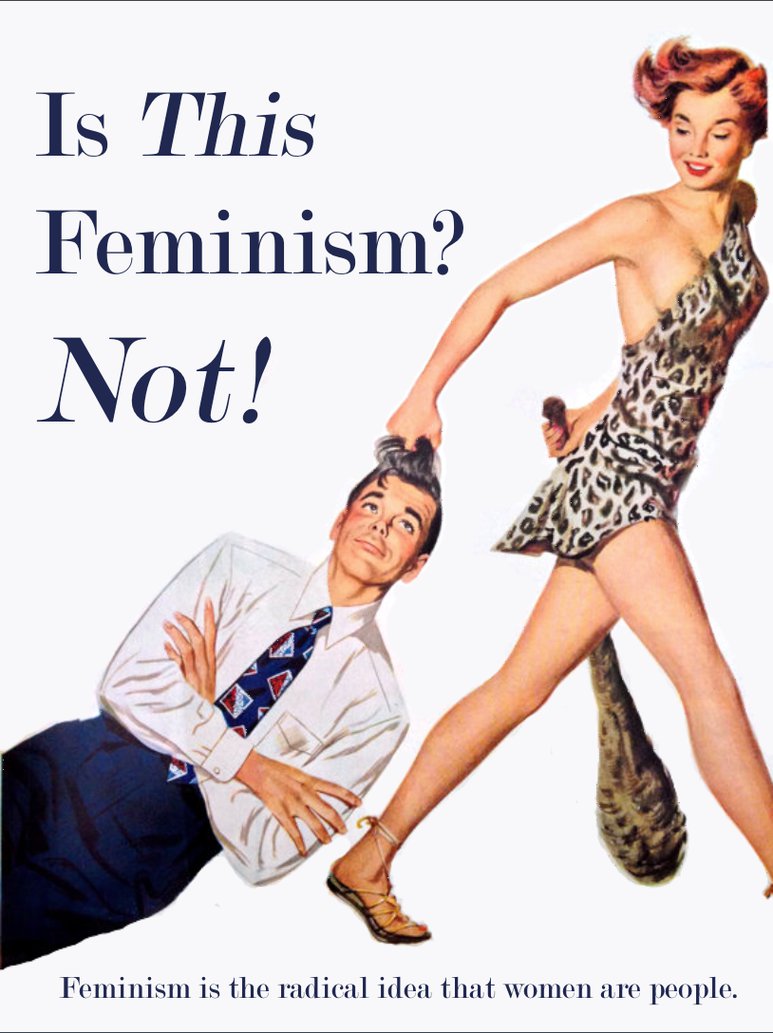
Original photo: http://poasterchild.deviantart.com/art/Feminism-Not-406854334

With that caveat in mind, I ask the following questions:

  • Is the author suggesting a move to a “hypermasculinity”?
  • Is Adams identifying masculinity with aggression and violence in a world where feminists and perhaps all women are demonized?

In a society dominated by the “alpha male” character trait,male  honor and pride are paramount. Is Fox News telling men to replace so-called passive behavior with pride, abrasiveness, authoritarianism, and arrogance–in such a world if where women are demonized, then assaultand rape will follow.  The call for “real men” or “hyper-masculinity” therefore provides a real potential to move us further towards a misogynistic rape culture of violence–in the direction of barbarianism.

Continue reading “Seriously?! Let’s Blame Feminism for the Creation of a “Wimpy” Nation by Michele Stopera Freyhauf”

Evangelical Missionaries Preach Death in Uganda by Andreea Nica

Andreea Nica, pentecostalismA former evangelical Christian friend of mine sent me information on the intriguing documentary God Loves Uganda. The newly released documentary addresses how the American evangelical movement has prompted a political and social shockwave in the country of Uganda. While missionaries are typically associated with delivering aid and improving the conditions of third world countries, the spreading of Christian values and ideals has inflicted suffering upon ethnic communities through evangelical indoctrination.

The intent of the film is to raise awareness of the political and social brutality that the evangelical missionaries are instigating; specifically through their teaching that homosexuality is a sin and should be dealt with accordingly. In Uganda this means death. Given the rise of globalization, transnational religious actors have been more enabled to engender other nations with their respective religious beliefs, often with minimal regard for the cultural and political landscape of the nation they wish to transform. Continue reading “Evangelical Missionaries Preach Death in Uganda by Andreea Nica”

Creating Space: Mosques Affirming All Bodies, Minds, and Hearts by Laury Silvers

Silvers, Bio Pic FRBlogIn my first blog for Feminism and Religion, I discussed the cognitive and embodied dissonance that some Muslims experience as a result of historically (not eternally) gendered ritual forms. I ended with a promise to share with readers the ways in which el-Tawhid Juma Circle mosques try to create space to break free of those forms. Our mosques affirm all human beings as spiritually, socially, and ritually equal and try to break down the social hierarchy of ritual and theological leadership by opening up a space for all bodies, minds, and hearts to lead and follow as equals among each other.

Continue reading “Creating Space: Mosques Affirming All Bodies, Minds, and Hearts by Laury Silvers”

Yes, You’re a Homophobe by John Erickson

Jesus loved sinners and Jesus would rather be dancing with me in West Hollywood on a Friday night than lugging through a swamp luring ducks into a trap with a duck caller made by a clan who think that my sexual actions are similar to that of an individual having sex with an animal.

John Erickson, sports, coming out.

To be able to walk down the street holding the hand of the one you love is a great feeling and an action that some of us aren’t able to perform without fear.

A line has been drawn in the sand between those who support gay rights and those who do not.  While some call it being on the “right side of history,” I simply now refer to it as not sounding and looking like a bigot in the halls of history and in the various books, Facebook posts, and Tweets that our children will one day read. Continue reading “Yes, You’re a Homophobe by John Erickson”

Who Am I Under Oppression? By Deanne Quarrie

Deanne QuarrieIn a class I am taking we were asked to journal with these questions: Ask yourself who are you in the inner voice that does not speak in the world around you or which you have worked tirelessly to bring into fruition in your life. Who are you that has felt suppressed and suffocated?

I sometimes think that I do not know who I am anymore.  Life teaches us that it is those outside of ourselves who determine our value to society.  We are given love and support (if we are lucky) by our parents as children.  Our value is determined by how much time and attention they give us.  If we get a lot, we grow up confident in ourselves trusting our way through life. When we attend school our value is determined by the effort we put into our studies, the grades we receive and the extracurricular activities we take part in and finally by the friends we choose. Continue reading “Who Am I Under Oppression? By Deanne Quarrie”

Can Secular Immigrant Assimilation Promote Equality? Pt. 2

Andreea Nica, pentecostalismI often wonder how my life would have been different if I had undergone a secular immigrant assimilation process. My former faith within Pentecostalism not only shaped my identity, but augmented my ability to assimilate into the American culture. Subsequently, this led me to explore how nonreligious narratives help immigrants better acculturate to western society. Despite my interests originating in personal exploration, emergent studies within religion and sociology show that there are many factors that come into play when considering social and cultural assimilation.

Following up on my most recent post, Liberations of Immigrant Women in Western Religious Conversion, I will draw on a comparative analysis to consider secular immigrant assimilation processes. Women’s experiences during their migration process contribute to their cultural and social identity formation. Many studies point to the established idea that religion is a key variable in influencing immigrant assimilation, particularly among the Latino community. “Faith plays an important role in their lives: 74 percent of Latinos say religion provides a ‘great deal’ or ‘quite a bit’ of guidance for them” (Philanthropy Roundtable). Continue reading “Can Secular Immigrant Assimilation Promote Equality? Pt. 2”

Theopoesis and the Interior Divine by Natalie Weaver

Natalie Weaver

Last week I traveled to Leuven, Belgium for the 9th Leuven Encounters in Systematic Theology conference.  I have been to this conference before, and I find that my perspective is generously enlarged by hearing voices that emerge from contexts and concerns that differ from my own in the USA.   This year, the conference theme was “Mediating Mysteries: Understanding Liturgies.”  The keynote speakers offered inspiring investigations into what “full, active, and conscious” participation of people in the Catholic liturgy means today (for, such were the goals for liturgy articulated at the Second Vatican Council).  Some provided critical evaluation of the newly revived Roman missal.  One speaker offered a searing critique of the distinction between true mystery and fabricated mystique in the Mass.  The breakout sessions were exceptionally well designed.  Here I noticed a common thread of people searching beyond the formal magisterial liturgies and studying the value of those mediated mysteries that are celebrated and communicated in culture, literature, and art. Continue reading “Theopoesis and the Interior Divine by Natalie Weaver”