What I’m Wearing to the Pool and What it Means, by Sara Frykenberg

Sara FrykenbergRecently a FAR colleague sent us writers an article entitled, “Toward a New Understanding of Modesty,” and asked if any of us would like to comment on it.  I dove at the chance, pun intended.  Not only did the article address the politics of swimwear (a kind of clothing I spent nearly a third of my life wearing everyday, swimming competitively for eight years), it also discussed the swimsuit designs of Jessica Rey – a former Power Ranger, the white-suited one to be specific.

The article’s author, Katelyn Beaty, explains that Rey believes, “that the now-ubiquitous bikini hurts women” because it encourages men to see women as objects to be used.  Beaty states, “Rey has a mission: to get as many women as possible in one-piece swimsuits.”  This mission immediately perked my attention.  As a Power Ranger, Alyssa  (Rey) is all too familiar with the utility of a shining, stretchy body suit.  Armored head to toe in white, pink and gold lycra and spandex, sporting a skirt over her leggings,[1] Alyssa defeats many monsters in the Power Ranger universe.

Sourced from: http://www.1up.com/do/blogEntry?bId=8982878
Source

But fantasy aside, the utilitarian nature of swimwear is often overlooked in deference to “sexiness” and fashion.  Bikinis are featured in most fashion magazines as the standard for bathing beauty, as is the ‘ability’ (or supposed ‘right kind of body’) to wear a bikini, aka the elusive “bikini body.”

Continue reading “What I’m Wearing to the Pool and What it Means, by Sara Frykenberg”
The Hot Seat by John Erickson

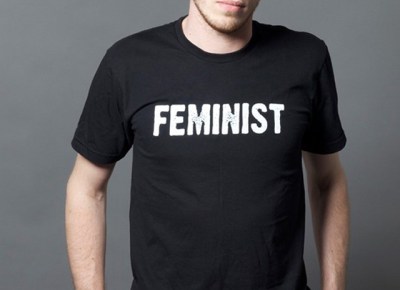
Being a man in feminism isn’t easy and that’s how it is supposed to be.

men_feminist_mainI’ve been thinking a lot about what it means to be a male feminist lately.  As the only man to be a permanent blogger on this very site until my colleague and friend Kile Jones came on board, I took my role, as a man in a traditional feminist (online) space very seriously.  Although the ongoing struggle to be a male feminist is one continually wrought with dialogues about power and positionality (amongst a host of many other topics), I am often conflicted when I see male feminists take advantage and destroy the hard work that many, specifically on this site and beyond, worked hard to build and defend.
Not wanting to reopen old wounds or start new online battles, men have been involved in feminism for quite some time.  From James Mott chairing the first women’s rights convention, to radical feminist Andrea Dworkin’s life partner John Stoltenberg, to Michael Kimmel and Michael Kaufman’s life long work to legitimize not only men in feminism but also what it means to be a man who works for gender equality, being a man in feminism isn’t easy and that’s how it is supposed to be. Continue reading “The Hot Seat by John Erickson”

Some Friendly Advice for Female Graduate Students by Grace Yia-Hei Kao

I’m officially in “back to school” mode, as I put the finishing touches on my syllabi, get my course websites ready, and prepare my 5-year old son for Kindergarten.

As I think about new graduate students studying theology or ministry, I’m reminded that while women make-up approximately 1/3 of all seminary students nationwide, at the place at which I work  (Claremont School of Theology), they comprise half of the student body.

In honor of all the new, especially female, matriculates (at my school or elsewhere), I’m reposting below one of my first entries on this blogsite. It was entitled “Undermining Our Own Authority.” The advice I gave then still captures what I’d say now.

Continue reading “Some Friendly Advice for Female Graduate Students by Grace Yia-Hei Kao”

Birth Warrior by Molly

editMollyNov 083“In this culture…a woman can be made to feel foolish for emphasizing the centrality of giving birth to her identity or her personal religiousness, her ‘womanspirit…’” –Stephanie Demetrakopoulos (Listening to Our Bodies)

After the birth of my daughter in 2011, I received a small package from a Birthing from Within mentor friend. In it was a sweet little t-shirt imprinted with the words, My Mama is a Birth Warrior. The words on the shirt surrounded a labyrinth image, which I love as a metaphor for birth and life

Written on the enclosed card was the following:

Imagine a tribe in which a woman is prepared for childbirth in the same way warriors are prepared for battle. Imagine a Ceremony for this woman before she gives birth, a grand send-off with holy songs and fire. Imagine a feast, prepared just for her.

Her tribe tells her, they say to her “Go to your journey, you have prepared. We have prepared you. If you fall from your horse once or a hundred times, it does not matter. All that matters is that you come back to us, that you come home.

Throughout your journey–your labyrinth of Great Love, Great Determination, Great Faith and Great Doubt—you rode on!

The Great Tribe of Mothers welcomes you back from your birth journey with honor.

Modeling her little t-shirt.

Imagine, indeed. After I read this note I reflected that I did feel I embarked on a mighty journey during my last pregnancy, I did pass through those Gates, and I did ride on. I AM a birth warrior!  Continue reading “Birth Warrior by Molly”

Women’s Christian Heritage by Elise M. Edwards

elise-edwardsIt is difficult to carve out time in a course that covers Christianity from the past 2000 years to address material beyond the standard textbooks.  But yet, I must because the visual and material culture, the worship practices, and the daily activities of women and men who have called themselves Christians or followers of Christ throughout history also comprise the story of the Christian heritage.

Over the past several weeks, I have been developing material for a historical and theological survey course called “The Christian Heritage.” In the multiple sections of this course taught at my university, and I imagine similarly at schools across the country, students are assigned a course reader.  The reader we use is a collection of texts that have shaped the Christian faith from the first century to the 21st.  It is a good collection, and I have no objection to using it.  However, for the way I would like to teach the course, I will need to supplement the reader with other material.  I have two interrelated concerns: the reliance on texts as a way of determining theological history and the absence of women in that history before the medieval period (and even then the number of women included is small). Continue reading “Women’s Christian Heritage by Elise M. Edwards”

5 Interesting Facts about Women and Religion by Kile Jones

Kile Jones, atheistPart of my research is focused on how the social sciences relate to “religion” and religious studies.  More specifically, I spend time examining the sociology of religion.  I look at stats, demographics, and polls.  I look at rates of attendance, frequency of prayer, levels of “religiosity,” apostates (or the less religiously-loaded term “exiters”), and political outlooks.  I also look at how bias this area of study is in favor of religion.  One facet of this work that has always interested me, is the differences in “gender” and “sex” as they relate to religious beliefs and observances.  Accepting the fact that there are spectrums of sex, gender, and identity, and the presence of difficult philosophical questions surrounding self-identification and the limits of labels, some really interesting facts and statistics crop up time and time again.  In what follows I will lay out a couple of these interesting facts, along with some thoughts on them: Continue reading “5 Interesting Facts about Women and Religion by Kile Jones”

Tug-of-Warring over the Female Body (Part 2 of 2) by Jameelah X. Medina

Cover up! No, get naked!

Haraam [Sin]; cover yourself! Be free; show some skin!

AstaghfirAllah [seeking forgiveness from God]; aren’t you ashamed?! Damn, aren’t you hot in that?!

The Muslim woman’s body feels like a battleground with essentialized feminism on one side (covered in Part I) and patriarchy on the other. Both sides have Muslim women on their team, but both sides also harm and silence them. This second part deals with “Team Haraaminator.”

The Haraaminators are kind of like “Daddy Longlegs” or “Momma Longreaches” who hold their wives, daughters, sisters, and even extended sisters in faith close to the chest with their long-legged grips. They come in the male and female variety. They believe that all women should be covered and wearing at least a headscarf. They speak with authority about the headscarf and how important it is for a woman in her pursuit of piety, virtue, modesty, chastity, and heaven. Some allow questioning the headscarf while others take it as a decree from Allah that should never be interrogated. Many use the Qur’an and ahadith (prophetic sayings and doings) to arrive at their opinions while other haraaminators just go by what their shaykh, imam, father, mother, friend or others have told them is the Islamic ruling on the headscarf. Continue reading “Tug-of-Warring over the Female Body (Part 2 of 2) by Jameelah X. Medina”

Blindness of the Gals by Oxana Poberejnaia

Oxana PoberejnaiaWomen (and men) are often blind to women’s inequality. I, as a Buddhist practitioner, have been blind to the reality of women’s second-class status in sacred texts of Buddhism and practice.

In her book “Buddhism After Patriarchy” Rita M. Gross describes how her fellow western Buddhist women completely overlooked the fact that women are not allowed into Rumtek Buddhist monastery in Sikkim, even after watching a video of a woman leaving an offering outside the gate and walking away.

Continue reading “Blindness of the Gals by Oxana Poberejnaia”

To Have and to Hold: Gay Marriage and the Religion Question

If a conservative religious traditions can’t give their mothers or sisters full equality, how can we expect them to give a GLBT individual the time of day?

John Erickson, sports, coming out.Outrage.  Anger.  Fear.  Hatred.  These are just a few of the words that flashed across my Twitter feed as I woke up on that fateful Wednesday, June 26 morning when the Supreme Court of the United States ruled that the Defense of Marriage Act (or DOMA) was unconstitutional and that supporters of Proposition 8, the hotly contested voter initiative in California that banned same-sex marriage, had no standing.   People were mad.  However, it wasn’t just the typical kind of mad that is associated with hatred, it was a type gay_marriage_81102178_620x350of mad that was met with impossible anguish because what I was reading and feeling was a result of one thing: there was nothing more they could do.

What does all this mean?  Questions from friends and family were filling up my inbox and although I wanted to take a moment to just hit “Reply All,” and input the words: Equality, I had to hold back and start to examine the notion that although equality may now be firmly on the proverbial table, there is still a lot of work to be done, specifically for gay marriage and those wanting to marrying inside the traditional church spaces they grew up in and not just the ones that have come out as open and affirming in recent years towards LGBT individuals. Continue reading “To Have and to Hold: Gay Marriage and the Religion Question”

What’s Your Super Power? (And Who’s Allowed to Have It?) by Sara Frykenberg

Sara FrykenbergI recently went to see Zack Snyder’s Man of Steel.  I saw it two times actually.  Readers familiar with my posts about cosplay and video gaming will not be surprised to learn that I am also a fan of comic book heroes and heroines; and Superman was my childhood favorite.

I was both attracted to and wanted to be like Superman, specifically, Christopher

Christopher Reeves as "Superman."
Christopher Reeves as “Superman.”

Reeves’ Superman.  One of my strongest childhood desires was also to fly like a bird.  I remember jumping off the end of my parent’s bed over and over again, convinced that if I flapped hard enough and kept on trying that I could fly.  The older I got, the more I realized that I also did not want to be “rescued” by Superman.  Rescue from the difficulties in my life was an unattainable fantasy.  So, I desperately wanted to be Superman.  Though I knew this too was impossible, perhaps I had only to try. Continue reading “What’s Your Super Power? (And Who’s Allowed to Have It?) by Sara Frykenberg”