Women as Stairways to Heaven by Jameelah X. Medina

In mainstream Islam, the ways and sayings of Prophet Muhammad are second in importance only to the Qur’an. There are two prophetic sayings pften quoted when speaking about the high status of women in Islam: 1) “Whoever has two daughters and treats them kindly, they will be a protection for him against the Fire;” and “Paradise lies beneath her [the mother’s] feet.”  These sayings influenced a growingly famous Islamic scholar who stated, “When she is a daughter, she opens a door to jannah [paradise/heaven] for her father. When she is a wife, she completes half of the deen [religion/way of life] of her husband. When she is a mother, jannah lies under her feet. If everyone knew the true status of a Muslim woman in Islam, even the men would want to be women.” This quote is being reposted all over social media sites by both Muslim men and women.

On the surface, the quote is lovely. It works to combat the stereotype of the lowly Muslim woman who has no standing in her religious community. It is posted as proof that women have great status in Islam. However, this quote and the prophetic sayings also have a problematic implication. When I read these quotes, I don’t see them talking about the status of Muslim women. The quotes are very specific and apply ONLY to women who are daughters, women who are wives, and women who are mothers. The implication is that, even though Muslim women and men are from a single soul and have the same essence (the Islamic perspective), women still are not sufficient enough for praise, reverence, and respect just by virtue of being women. They must be some man’s daughter, wife, or mother in order to enjoy elevated status. What does this say to women without fathers, women without husbands, and women without children? It tells them that they have not yet arrived; they are goals yet unrealized. Simply put, they are not enough. Continue reading “Women as Stairways to Heaven by Jameelah X. Medina”

The Roman Catholic Theology of Womanhood by Ivy Helman

The Vatican has creIvy Helmanated an entire theology of womanhood without the input of a single woman!  Searching the Vatican archives reveals a wide range of documents pertaining to women, some of which mention women tersely only in their capacity as workers needing protection (Rerum novarum, 1891) and others are fully dedicated to describing the status, role and mission of women in the family, society and the world (Mulieris dignitatem, 1988).  Within the documents, as time passes, women become their own category of theological importance.  This is due to the influence of feminism on the status and roles of women across the globe.  Yet, there is vehement anti-feminism in the documents as well.

I searched the documents myself, curious as to what the Vatican had to say about womanhood and wrote a book on the topic published by Orbis in Febrary 2012 entitled, Women and the Vatican: An Explanation of Official Documents.  I would like to lay out that theology now.  Continue reading “The Roman Catholic Theology of Womanhood by Ivy Helman”

Gender in Kabbalah by Judith Laura

Judith LauraI first started delving into both Jewish Kabbalah and Hermetic Qabalah in the 1990s, after friends told me these forms of mysticism included both female and male representations of divinity and therefore were gender equitable. They were right about the first part: Kabbalah/Qabalah contain both divine masculine and feminine imaging and male and female images.  But as far as gender equity goes, to use today’s slang, not so much!

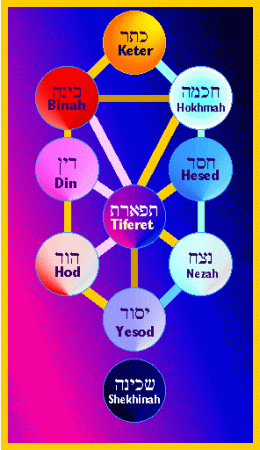
tree of life kabbalah

Though they are both transliterations of the same Hebrew word, as is common I use “Kabbalah” for the Jewish versions, and “Qabalah” for the Hermetic version, best known through its association with the British Hermetic Order of the Golden Dawn, which began in the 19th Century. The word means “that which is received,” with the understanding that it was “received” from ancient times. Though there is one tradition that says Adam was given Kabbalah in the Garden of Eden, the first written material for Kabbalah, Sefir Yetsirah (Book of Creation), is dated to between 200 and 500 C.E. Kabbalistic concepts changed over the centuries, with writings becoming more significant in the 13th century and even more popular in the 16th and 17th centuries.

Beginning with the Sefir Bahir (Bright Book) in late 12th century France, Kabbalah is represented by the Tree of Life, which has round areas transliterated sefirot (Heb. pl.; sing. sefirah) that I think of as fruit and others call “spheres,” but which in the Bahir, are more accurately translated “sapphires.”*  These “divine emanations,” as they are often called in English, are gendered. How equal is the gender representation? Continue reading “Gender in Kabbalah by Judith Laura”

Cosplay and Choice by Sara Frykenberg

Sara FrykenbergCosplay is often a deliberate, interpretive and self-chosen performance of gender and power.  Like drag performers, cosplayers put on a show of the characters they represent; and in my experience, they often do so within diverse, supportive and principally, inclusive communities. 

This week my husband sent me a great blog post he found about cosplay and one woman’s determination that she would no longer tolerate being demeaned, objectified or trivialized because of what she chooses to wear.  Blogger Megan Marie’s post, entitled “What would you do if you weren’t afraid,” inspires me.  She points out and refuses the trappings of rape culture: victim blaming, assumed male control over female sexuality and shame; and claims her right to be who she is.  I, as fellow (what is the female equivalent for fellow???) cosplayer, was also moved by her defense of this creative art.  I have been cosplaying a long time, but I have been too afraid to speak much about this or to directly protest the rejection of these fantasy images within some feminist communities.  So to answer Megan Marie’s question* in her own words, “What would you do if you weren’t afraid? My answer.  I’d write this blog.”

Coplay = costume + play!  It is the recreation of popular characters from video games, comic books, anime, scifi series, fantasy literature or the like.  Cosplayers do this for the fun of it, the craft involved, to express one’s fandom and sometimes, professionally, usually within an arena where fans can enjoy one another’s recreations.  The attempt to embody these characters involves a great deal of work and artistic expression.  Many conventions, like Fanime Con in San Jose, CA, host panels in which fans can learn cosplay skills, such as armor construction, wig making and costume design.  I have cosplayed the following characters: Sailor Star Healer, Eudial and Sailor Iron Mouse from the anime Sailor Moon, Misa

Death Note Cosplay: Misa and Light are in the center, flanked by their respective "Shinigami," or the death gods they are working with
Death Note Cosplay: Misa and Light are in the center, flanked by their respective “Shinigami,” or the death gods they are working with

from the manga Death Note, the Sorceress from He-man, a Star Fleet officer from Star Trek: The Original Series, and most recently, a giant “Angel,” Sachiel from Neon Genesis Evangelion.

Sachiel from Neon Genesis Evangelion: I am trying on my almost finished costume here!

I am currently planning a to make a Metroid out of an umbrella and to cosplay Nyan-kitty at the May conference that my husband (who will be playing Tac-nyan), my sister and many of my friends attend.

So, why the feminist-anxiety?  Continue reading “Cosplay and Choice by Sara Frykenberg”

Marriage as a Commodity (Satisfaction Guaranteed) by Michele Stopera Freyhauf

Freyhauf, Feminism, Religion, Durham, Old Testament, Blogger, Bible, Gender, Violence, Ursuline, John CarrollThis Saturday I will be presenting a paper about Cyberbrides at the United Nations Commission on the Status of Women.  While my focus for that paper is the impact on mothers and families, my research also revealed how some Cyberbrides (or Mail-Order Brides) are selected from internet catalogues with “satisfaction guaranteed” and how “International Marriage Broker” may be a cloak hiding the agencies’ involvement with human trafficking.

Cyberbrides are essentially mail-order brides, but like pen pals, they can chat and exchange pictures on the Internet and interact through video or instant chat.  There are almost 2.9 million website matches that turn up when Google-ing “Mail-Order Brides” within 19 seconds of pressing the “return” button. With the low cost of social media, a new venue to market and display this “commodity” is available.  Presently,  about 30 Facebook sites exist that advertise “Mail-OrderBrides. Continue reading “Marriage as a Commodity (Satisfaction Guaranteed) by Michele Stopera Freyhauf”

St. Thecla: Transvestite Saint and Woman Apostle by Michele Stopera Freyhauf

Freyhauf, Feminism, Religion, Durham, Old Testament, Blogger, BibleThe story of Thecla is an intriguing one – it is above all a story that demonstrates a woman in active ministry – a story that shows a woman as an Apostle.  The story found is found in the apocryphal literature called Acts of Thecla (sometimes found in “The Acts of St. Paul and Thecla) and seemed to attract the ire of Tertullian and the writers of the Pastoral Epistles.  In fact, some of the names in this story also appear in the New Testament writings. Thecla used to be a Saint in the Catholic Church, and is still a Saint in the Byzantine Rite.  Please note that what I say here is not my original work but a compilation of various interpretations of stories about St. Thecla

St. Paul was travelling in Iconium with his two companions, Demas and Hermogenes.  They were offered hospitality at the house of Onesiphorus.  Paul was giving a sermon praising virginity, stating that eternal reward awaits anyone who lives a chaste life.  Thecla overheard his sermon from her window and became enamoured by his teaching to the point that she was unable to move from her window for three days and three nights. Continue reading “St. Thecla: Transvestite Saint and Woman Apostle by Michele Stopera Freyhauf”

Living by an Ethic of Love by Elise M. Edwards

Elise EdwardsIf we base our love ethic in the love of God, we will be committed to the presuppositions that everyone has the right to be free and to live fully and well. We will not try to deny others access to safety, food, shelter, and companionship, nor prevent them from obtaining opportunities for growth and outlets for self-expression because of their gender, sexual orientation, race, ethnicity, class or cost to ourselves.

I enjoy Valentine’s Day, and this has been the case for many years, whether I have been in a relationship or not.  I think romantic love needs to be celebrated, even if it is at the urging of greeting card companies, chocolatiers, florists and jewelers.  Of course, those of us who are even the least bit critical of consumerism and media propaganda will acknowledge that these companies try to convince us that we need to buy luxury items to demonstrate our love to the important individuals in our lives.  When our consumption of these goods hurts other people in our world and our planet (as in the consumption of blood diamonds or flowers that have been flown around the world, and thus contributing to environmental ills), we must recognize that they are not true reflections of love.   This is not to say that the intent of the giver or recipient is untrue.  I do want to challenge the predominance of these kinds of images of love, and provoke us to reflect on another way – an ethic of love rooted in the love of God. Continue reading “Living by an Ethic of Love by Elise M. Edwards”

Second Class Rape Victims: Rape Hierarchy and Gender Conflict

Deconstructing masculinity isn’t the key to solving social, sexual, and domestic violence across the world but it is a step worth taking when attempting to engage men in affecting change to stop these violent actions since men, statistically are the perpetrators of such crimes that both cause such outcry as well as perpetual silence.

johnThe most disturbing part of the 2006 documentary Deliver Us from Evil isn’t the fact that Father Oliver O’Grady is rewarded by the Catholic Church with a new congregation in Ireland after his short stint in prison for the rape of dozens of children in the 1970s, but rather the hierarchy of gendered victimization which is often created throughout the various rape cases that are both reported and unreported throughout history.

I am often troubled by the ways in which rape cases are discussed and deconstructed via mediums such as blogs, online communities, social media networks, the news, and popular culture.  No series of events troubled me more than the Jerry Sandusky trial, but more importantly, the ways in which the young boys and adult men who were subjected to Sandusky’s abuse quickly overshadowed the other rape cases that are reported on a daily basis, specifically those involving young girls and women. Continue reading “Second Class Rape Victims: Rape Hierarchy and Gender Conflict”

On Pronouns and Liberation in the Classroom by Ivy Helman

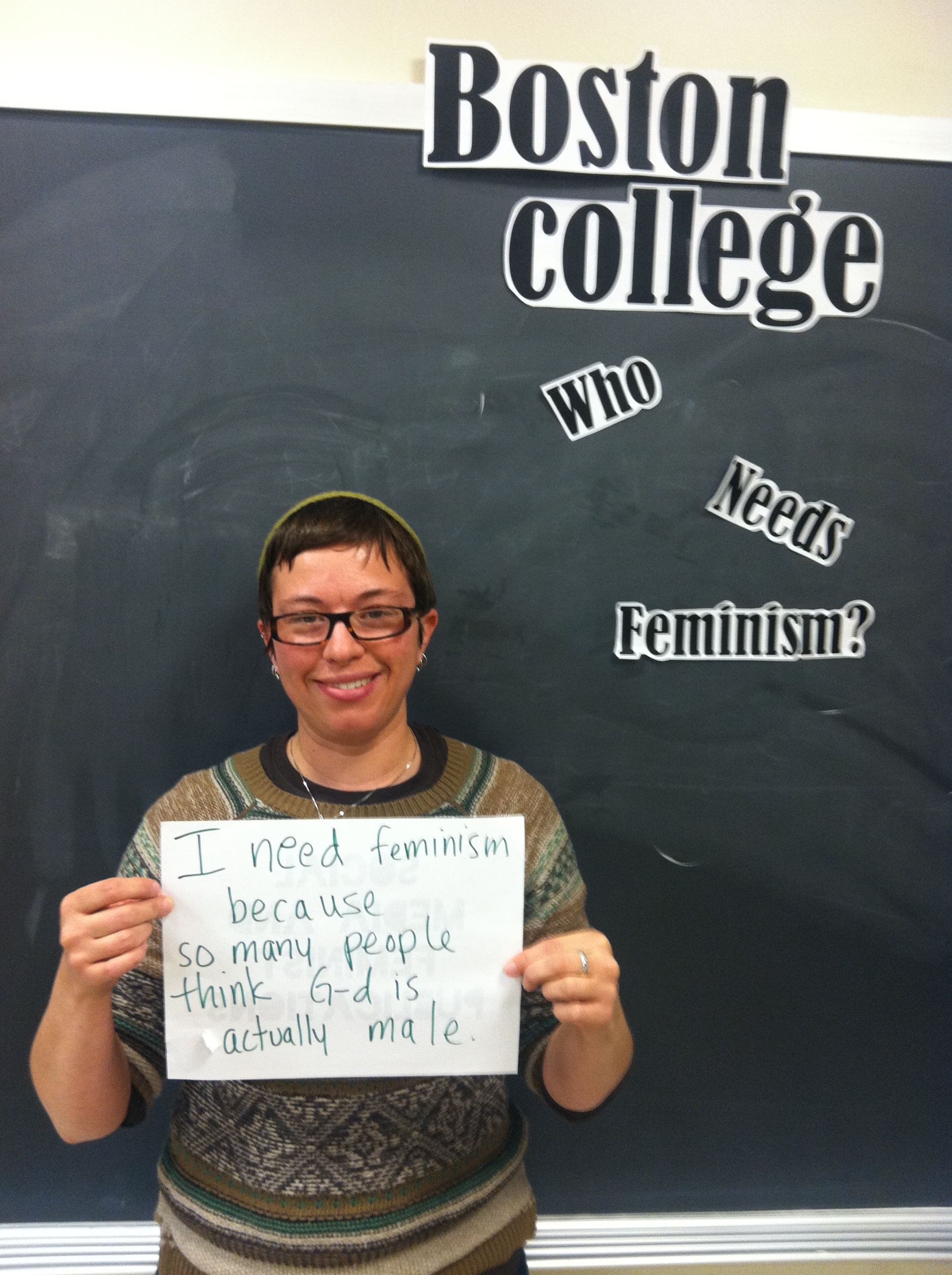
photoIn my introduction to Christianity class, almost every one of my students (who come from diverse religious backgrounds – primarily Roman Catholic, Protestant and Muslim), continues to believe that the best image if not the only appropriate image for G-d is male.  When probed they may speak generically about G-d as genderless, an entity or spiritual presence of some kind, yet conclude by affirming their belief that G-d is male often by adding something along the lines that G-d is best described as Father.  Some go so far in these affirmations that they articulate G-d’s maleness as fact.  It never fails that every semester I struggle with how to address this basic feminist issue within the classroom.

At least as early as 1973, Mary Daly, in Beyond G-d the Father: Towards a Philosophy of Women’s Liberation, articulated the problematic basis of the relationship between gender and divine imagery.  She argues that “If G-d in ‘his’ heaven is a father ruling ‘his’ people, then it is in the ‘nature’ of things and according to divine plan and the order of the universe that society be male-dominated.”  In other words, if maleness is associated with divinity, then the power, domination and running of society by men seems to be divinely ordained. Continue reading “On Pronouns and Liberation in the Classroom by Ivy Helman”

What It’s Like To Be A Woman In The Academy: Mentoring Edition by Linn Marie Tonstad

Linn Marie TonstadIn my first post, I promised to return to the topic of mentoring. Mentoring is a survival strategy for feminists inside hostile or difficult-to-navigate environments; in its best possibilities, mentoring is a strategy for flourishing, not just surviving. But when a mentoring relationship goes wrong, it is so destructive an experience that it may even be characterized as traumatic. Mentoring is also a practice rife with possibilities for abuse: the recent Yale study of gender bias in the sciences shows the extent to which gender alone serves as a significant variable for scientists assessing the possible rewards of mentoring a student.

I have given a lot of thought to mentoring in recent months – as I transition into new mentoring roles in a new institution, as I negotiate changing relationships with current and former mentors, as I reflect on successful and unsuccessful mentoring relationships I’ve been involved in, and as I seek to develop policies and practices that will serve me (and more importantly, my mentees) well.  Continue reading “What It’s Like To Be A Woman In The Academy: Mentoring Edition by Linn Marie Tonstad”