Dionysian Rites by Carol P. Christ

In today’s blog, I offer an excerpt from A Serpentine Path: Mysteries of the Goddess. The setting is Zaros, Crete, the time of year is mid-October.

We had a scrumptious dinner of fresh fish, salad, fried potatoes, local amber-colored wine, and tiny olives.  Later the two waiters, Themis and Nikos, bearing another pitcher of wine, sat down at our table.

They told us they were best friends and had just gotten out of the army. When they discovered that we were writers, the two young men were intrigued. “Our village has a very interesting history and many interesting customs,” they told us. “If you would like to come back and write about it, we will introduce you to all of the old people.” This conversation was in Greek, but I translated for Naomi. “This must indeed be a very interesting village,” I said to her, “because when they learn that I am a writer, most Greek men will say ‘write about me, I have a very interesting story.’ These men, in contrast, want us to write about their village.”

When we finished our wine, the young men offered to give us a lift back to our hotel on their motorbikes, suggesting we could have a coffee at the hotel bar. When we got to the hotel, they didn’t stop. “What happened?” I asked. “The bar wasn’t open at the hotel, so we’re looking for another place.” I wondered what Naomi, perched on the back of a motorbike and unable to speak Greek, must be thinking—especially since she was afraid of the unknown. We drove through the town and turned down a dirt road, arriving at the Zaros water factory. “We wanted to show you this,” they said sheepishly. “People drink our water all over Crete.” “O.K., “Naomi said, “but then you must take us back.” There were a few workers on the night shift, and the boys told us they had worked there too, before going into the army.

making rakiLeaving the factory, we continued down the dirt road heading away from the town. “Where are we going?” I asked, wondering what we had gotten ourselves into. “Just a minute,” Themis said, as he got off the bike in front of what looked like a small house in the middle of nowhere. “We need to go back,” Naomi said definitively. “Yes, I already said that,” I answered. “Come inside,” Themis beckoned. “We want to show you how they make the raki (the colorless alcoholic drink that had been offered to us in shot glasses us after meals). This is the still,” he continued, as he showed us into a small dark room with a glowing fire. “After the wine is pressed, they put the skins and stems into barrels like those you see in the corner. The mixture takes six weeks to ferment, and then they bring it to a still, where it is heated over a fire. The steam that rises is directed through long curved pipes, and comes out as raki,” he said, pointing to various parts of the mechanism. Continue reading “Dionysian Rites by Carol P. Christ”
Drawing the Four Together: Rosh Hashanah, Yom Kippur, Sukkot and Immigration.

10953174_10152933322533089_8073456879508513260_oLast Sunday, the Czech Republic’s Narodní Divadlo (National Theater) had its opening celebrations. The National Theater is a big thing here sort of like America’s Hollywood where actors, actresses and directors are household names. The opening celebration is even broadcast on television by Česká Televize (Czech TV, the national television company).

This year, Narodní Divadlo and Česká Televize have decided to dedicate all of the profits of the day’s long events to one organization: Organizace pro Pomoc Uprchlíkům (Organization for Aid to Refugees). It is the longest running and the most well-known NGO in the Czech Republic helping refugees, immigrants and asylum seekers. In addition, it also happens to be where my partner is a lawyer and Head of the Legal Department. So I have a personal connection.

As the High Holy Days begin tomorrow evening, I’ve been thinking a lot about their connection to immigration and Sukkot. My reflection starts with the fact that we too were once refugees. We too were once persecuted and forced into slavery. We too escaped and wandered in a foreign land even though sometimes we yearned for the comfort of the familiar. The sukkah is supposed to remind us of this history. At the same time, we have also been unwelcomed by many, been seen as suspicious and have even been expelled from the many lands we once called home. We have been murdered in mass numbers too many times to count. All of this is to say, that we know the situation of the down-and-out, because we have been there. Likewise, we have in many places overcome it and have a mission to help others in similar situations.

Continue reading “Drawing the Four Together: Rosh Hashanah, Yom Kippur, Sukkot and Immigration.”

Rosh Hashanah and the Goddess by Joyce Zonana

Joyce Zonana head shotWhen I was growing up in the 1950s in my Egyptian Jewish immigrant home, each of the High Holidays was imbued with sacredness, thanks largely to my mother’s commitment to a creating a harmonious and memorable gathering of family and friends.  Around a long table, covered with an embroidered white cloth and set with sparkling silver and delicately fluted china, she served at each season the festive meal that made manifest for us the presence of the Divine.

My father, an Orthodox man who prayed each morning and went regularly to the local Sephardic synagogue in Brooklyn, privately followed the tenets of his faith.  But it was my mother, unconsciously devout, who brought the public rituals of our religion to life.  As a child, I longed to be at prayer with my father and was envious of the men and boys who studied and recited the sonorous ancient Hebrew; I did not want to be confined to polishing the silver and setting the table.  But today, as an adult, I am grateful for the silent teachings bequeathed to me by my mother. Continue reading “Rosh Hashanah and the Goddess by Joyce Zonana”

Embracing Fierceness by Mary Sharratt

maenad dancing with snake

Maenad dancing with snake, ancient Greece, ca 450 BCE

This post is in part inspired by Donna Henes’s brilliant post, I am Mad. Too often as spiritual women, we are told we have to be nice all the time. Accomodating. Compromise our boundaries and principles.

Mainstream religions tell us we must forgive those who mistreat us. Too many women in very abusive situations literally turn the other cheek–to their extreme detriment. As Sherrie Campbell points out in her essay The 5 Faults of Forgiveness, the obligation of forgiveness oppresses survivors of abuse because it makes it all about the perpetrator and not about the healing, dignity, or boundaries of the survivor.

In my own Catholic upbringing I learned to swallow my anger and rage until it erupted in depression and burning bladder infections. My background did not teach me to skillfully dance with anger and it’s been a difficult learning curve for me. But I learned the hard way that owning my anger was crucial if I wanted to stand in my power and speak my truth.

Continue reading “Embracing Fierceness by Mary Sharratt”

Mysteries by Carol P. Christ

Savor an excerpt from A Serpentine Path: Mysteries of the Goddess:

Finding ourselves together in Crete after attending a conference, four friends and I set out to visit the caves of Eilitheia in Amnissos and Agia Paraskevi in Skoteino. As we drove along the coast toward Amnissos, I recalled that caves have been understood as sacred from the dawn of religion. When people knew the earth as their mother, the cave, the opening in the earth was her vagina and womb, the passageway to her deepest mysteries, the secrets of birth and rebirth.

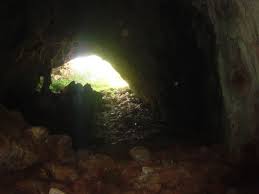
Eilitheia Cave entranceThe Eilitheia Cave is in the hills above the ancient port of Amnissos. We arrived in the morning, accompanied by the guard who came with us to unlock the gate. The cave has one large, long room, with a wide mouth, and a low ceiling. There is a belly stone near the entrance that women rubbed to insure conception. Near the center of the cave, in shadowy darkness, are two stalagmites, one squat and the other tall, surrounded by the remains of ancient walls that enclosed the sacred space. The guard told us that they were worshipped as the Mother, seated, and the Daughter, standing. Their heads were chopped off with the blow of an ax. In the back of the cave there are small pools of water, used for healing

Eilitheia Cave -- StalactitesAs our eyes adjusted to the darkness, we felt that we too had entered into the womb of the Mother. Naomi sat by the Daughter stalagmite, while I leaned against the Mother. We chanted to Her and sang, aware of the bemused but accepting presence of the guard, who retreated to the entrance of the cave. As we turned to leave, Mara crouched at the cave’s entrance to take a picture, her short, full body the image of the Mother Goddess, her wispy blonde hair capturing the light, crowning her like a halo. Slowly, we emerged from the cool depths, the place of ancient mysteries, into the light and warmth of the midday sun.

We visited the Skoteino Cave late in the day, after lunch and a refreshing swim in the sea. To reach the cave, we ascended into the mountains, passed through the small village of Skoteino, and turned right down a dirt road. Above the cave is a small church dedicated to Agia Paraskevi, the patron saint of eyesight. I had been to the cave eleven years earlier with my husband, Roger, on the saint’s name day, July 26th. That day the locals celebrated first in the church, where they decorated the icon of Agia Paraskevi with flowers and lit candles, and then in the cave, where they roasted lamb, sang, and danced. It is likely that this cave has a continuity of worship from ancient times to the present day.

The first time I visited the cave of Skoteino, which means dark, I thought it was a single, huge, high-ceilinged, cathedral-like room, adorned with stalagmites and stalactites. In the meantime, I had learned that beyond the first room, there are three more levels, the final one, totally dark. Mardy offered to lead the way. Two young German men, emerging from the depths, told us the way down was not easy, as there was no clear path.

Skoteino Cave EntranceMarie, unsure of her footing, stayed near the entrance. Naomi, afraid of the unknown, perched on a rock at the back of the first room holding her candle. Mara, Mardy, and I braved the descent. We did not know what awaited us in the dark. With candles and small flashlights, we climbed and slid, sensing a way down. The rocks were cool, damp in some places, but not slippery. There were no sharp edges because the rocks had been smoothed by water. Encouraging each other we reached a place where it looked like the next descent would be though a hole or narrow opening. We still had faint light from the mouth of the cave. The final passageway was unknown, frightening, inviting. We paused, eyes fixed on the dark opening. Mardy broke the silence saying that we should turn back because the sun was about to set.

I made the ascent more rapidly than the others, my body urging me on until I reached the first level. As I walked slowly up the path that meandered through the first large room, I could see two women before me with candles, and two behind me coming up from the depths. I could almost see Persephone coming up from the underworld, torch in hand. Surely it was in a place like this that the Eleusinian Mysteries began.


A Serpentine Path: Mysteries of the Goddess is available in kindle and paperback.  Carol P. Christ leads the life-transforming Goddess Pilgrimage to Crete. Her books include: Goddess and God in the World: Conversations in Embodied Theology, written with Judith Plaskow and She Who Changes and and Rebirth of the Goddess; also with Judith Plaskow, the widely-used anthologies Womanspirit Rising and Weaving the Visions.

Updated on December 26, 2016.

Two Wrongs Don’t Make a Right by John Erickson

Kim Davis does need a lot of things but saying of suggesting that she needs a haircut, a makeover, or even to lose weight, makes you and those that continue to repeat it no better than she is; to state such statements doesn’t purport the ideal that #LoveWins, which took over social media just mere months ago, but changes the whole narrative to symbolize that sexism and hate are more important than love and equality.

John Erickson, sports, coming out.Kim Davis, the defiant county clerk, is currently sitting in isolation in a jail cell after refusing to issue marriage licenses to same-sex couples in Rowan County, Kentucky, even after she was ordered by a judge to comply with the Supreme Court’s ruling on same-sex marriage or be held in contempt of court.

Everywhere I turn on both social media or in person people are talking about Ms. Davis, her actions, personal history and for some weird reason her hair and looks.   I’m all for individuals taking a virulent stand against an individual who chooses to not uphold the law of the land as well as continually acting in an unjust discriminatory way but bringing her looks or anything else about her physical appearance into the narrative is not only just plain wrong it is sexism in its worst form. Continue reading “Two Wrongs Don’t Make a Right by John Erickson”

I am mad by Mama Donna Henes

Donna Henes, Urban Shaman, Queen of my self, crones,

I am mad. So very mad. No, that doesn’t begin to describe it. I am pissed. I am angry. I am irate. I am incensed. I am outraged. I am enraged. I am livid. I am GODDESS DAMN FURIOUS.

“All men are created equal,” states the Declaration of Independence. From the very beginning, women were denied equality in this country. It has taken over two centuries for women to win the right to vote, to have alleged protection under the law, to earn as much as 68 and 77 cents on the dollar (depending on our skin color) that men are paid, and to gain control over our own bodies and destinies.

And now, nearly 250 years later, we are seeing our rights, our freedoms, our health care being stripped away, one by one, by mean spirited, misogynistic, right wing religious uber-conservatives. In 2015 there is still no Equal Rights Amendment. Women are still not equal under the law. Continue reading “I am mad by Mama Donna Henes”

Covenanting Justice. Covenanting Joy. by Margot Van Sluytman

MargotJustice as a lived and living experience is a poem. Is a song. And as a song it is filled with all manner of rhythm, of texture, and of sound via melody and lyric which affects us in an infinity of ways. The voice of poetry is the voice of The Song of Songs. It is a voice of invitation. Chapter Two of The Song of Songs is an invitation to strangers to Scripture. Strangers who want to feel a rhythm of joy, of loving embrace of tender and generous welcome. The gravity of the language is its graceful invitation to be seen, to be gazed at, to be heard.
My own vocation as a Sawbonna/Restorative Justice practitioner and a Therapeutic Writing facilitator, has blessed me with the opportunity to share words, via Word, in many different places and spaces around the Globe. The word that I use for justice as a lived and living experience is: Sawbonna. Sawbonna is a Zulu greeting that means I see you. You see me. I hear you. You hear me. Sawbonna contextualizes Restorative Justice in the crucible of our connectedness. Sawbonna, which is the essence of Chapter Two of The Song of Songs, clears the way for engagement, via words, with Word. Continue reading “Covenanting Justice. Covenanting Joy. by Margot Van Sluytman”

I Am A Woman’s Poet by Marie Cartier

MarieCartierforKCETa-thumb-300x448-72405This is the first poem I ever wrote and had published.
I wrote it in the early 80s at the height of the second wave of Women’s Liberation.

Having just returned from the final Michigan Womyn’s Music Festival, I publish it here with FAR today as an homage to that time period, to those women (myself among them), to many “womyn with a ‘y,’” and what we accomplished—battered women’s shelters, rape crisis centers, health clinics, women’s studies programs, bookstores, festivals, music and culture etc. etc.

Much of what we accomplished is because we learned to listen to each other’s repetition until, as Nelle Morton said, we “heard each other into speech.” Continue reading “I Am A Woman’s Poet by Marie Cartier”

Is There a Such Thing as a Code of Ethics in Academia?  by Michele Stopera Freyhauf


One of things that has dismayed me since I began graduate school and started focusing my study on the Bible, is how much sensationalism exists. We are told in the academy not to use Wikipedia or watch the History Channel. The first, as we know, is unreliable due to the fact that anyone can enter information and make changes. The other caters to the general public. What compounds this problem is the fact that scholars, many times – even reputable ones – appear on these shows. Sometimes creative licenses are exercised by the producer distorting or otherwise shifting the message of what the scholar was trying to explain. Other times, scholars will just give the producers and the public exactly what they want to hear and thus perpetuating myths rooted in literalism.

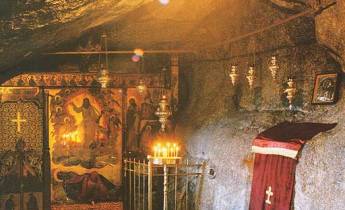
Alpocalypse_Cave
Cave in the Church of the Apocalypse in Patmos, Greece

This is not the only time this issues manifests.  The other time I encountered this is when I travel to sacred or holy sites in the Middle East.  The people in charge of sites may want raise money and increase tourism – so they give the people what they want.  What do I mean by this?  Walking into a place that has a story whether true or not provides pilgrims a sense of awe and wonder.

Certainly I am not saying that this experience should be diminished or should be taken away. What I am saying is that we should be a bit more truthful in our descriptions and remove the shroud of literalism that seems to fuel tourism and not faith. What was difficult for me when visiting Patmos is the rhetoric surrounding the island. It may or may not have been where John had his visions, but certainly the mystique surrounding the Church of the Apocalypse seems to perpetuate the literalism that surrounds the Book of Revelation as being prophetic in dealing with the end times.  Moreover, the vendors around the Church certainly focus their merchandise to support this myth.  However, while I study the Book of Revelation and teach that it is something other than prophetic, a person visits the island and the church, are told that it is prophetic – who is a person to believe?   Me or the religious order running the Church or the vendors living on the island?

This also happens at dig sites.  If a tourist is led by a guide or lead at a holy site being excavated and they tell them what they want to hear so they come back and tell their friends, who has more creditability – me or the person who guides on the site?  When scholars like myself, write about a topic that seems to gel with what the commonly held view of the academy, and goes against literalism or fundamentalist beliefs, we become heretics in relation to the information being fed by the sensationalism on the History Channel and the tourist industry.  So the popular view does not change and the academic view is left on the margins and Biblical literalism wins.

Continue reading “Is There a Such Thing as a Code of Ethics in Academia?  by Michele Stopera Freyhauf”