Staying In or Leaving the Religious Community of Your Birth: The Dialogue Continues by Carol P. Christ

carol p. christ 2002 colorThis blog is part of an on-going discussion between me and my friend Jewish feminist theologian Judith Plaskow about the differences in our choices to stay in and leave traditional religious communities, which is part of our forthcoming book Goddess and God since Feminism: Body, Nature, and Power.

When you (Judith) discuss the reasons I left Christianity while you stayed Jewish, I think you hit upon a crucial difference between us when you say that I am more “idealistic” than you are.  I agree that this does not mean that I am more ethical than you are.  When you say that I require more “purity of thought” or perhaps more accurately more “purity of ritual symbolism” than you, I think you have hit the nail on the head.  I simply cannot participate in a religious symbol system that I feel has done and continues to do great harm in the world.

I reiterate that for me this “problem” is not limited to the ways in which the maleness of God justifies male domination—including violence against and rape of women.  Equally important to me are the ways that religious symbolisms justify the violence of warfare and conquest.    I simply will not and cannot participate in religious rituals that justify domination and violence in the name of “God.”  If that makes me a “purist” or an “idealist,” I am willing to accept those terms.  Continue reading “Staying In or Leaving the Religious Community of Your Birth: The Dialogue Continues by Carol P. Christ”

Serving Spirit by Wendy Griffin

Wendy Griffin, Cherry Hill Seminary To me, it isn’t the belief that is meaningful, it is the feeling I get in those magical moments when I am connected to spirit.

When I was young, my mother owned a girls’ camp on the shores of a string of small lakes in Northern Wisconsin. From the age of 2 until I was 16, I spent every summer surrounded by silver birch trees and strong women. We lived in Army surplus tents and learned to ride horses and paddle canoes, build campfires and treasure the female spirit. Sunday evenings we would walk two by two singing through the forest down to the lake, where we would sit on pine logs on a little point of land between two shores and listen to the waves lap against sand as my mother read to us from Gilbran and her favorite poets. Those were our “Sunday vespers services.”

So I was raised on a Goddess path, although neither my mother nor I knew it then.

I had no interest in religion, which to me was Big Daddy in the Sky. It never occurred to me that what I felt in the forest had anything to do with religion, and I thought being spiritual meant that one prayed a lot and didn’t have any fun. When I left home at 18 and moved to Greenwich Village, I left the feelings I had those summers, what I know now was the spiritual part of me, behind. The world seemed full of wonderful adventures, and I wanted to have my share. Continue reading “Serving Spirit by Wendy Griffin”

Genetic Testing: The Ethical Implications of Expanded Newborn Testing – Who Benefits? (Part Two) by Michele Stopera Freyhauf

Freyhauf, Feminism, Religion, Durham, Old Testament, Blogger, Bible, Gender, Violence, Ursuline, John Carroll

With Angelina Jolie’s decision to have a double mastectomy due to a genetic test that revealed she carried the BRCa gene, the issue of genetic testing is in the forefront once again.  This is the second part of a three-part essay exploring genetic testing on newborns (part one and part two) and concludes with exploring personal choices and the psychological ramifications of genetic testing.

False Positives, Lack of Empirical Evidence, and Dangers in Expanded Newborn Screening

In the year 2000, most states only screened for about four conditions.   As of November 2008, most states adopted screening for the 29 recommended primary conditions and up to 25 secondary conditions (See President’s Council on Bioethics, “The Changing Moral Focus of Newborn Screening,” 36).    Since no federal mandate on newborn screening exists from state to state, this number varies due to the lack of understanding of the diseases or showing no proven benefit.   In fact, the twenty-five secondary conditions recommended  by the American College of Medical Genetics do not need urgent treatment in the newborn period or have no proven treatment (Also see Mary Ann Baily and Thomas J. Murray, “Ethics, Evidence. And Cost in Newborn Screening” Hastings Center Report (38, 2008), 28 ).

Then there is the multiplex technology of tandem mass spectrometry (MS/ MS) that can screen for over 40 “inborn errors of metabolism” from a single drop of blood (See President’s Council, “The Changing Moral Focus of Newborn Screening,” 9).  While this technology has reduced the numbers of false positives, it is still far from being reliable.  This is due to screening forBabySeq rare disorders on a population wide basis – about four million babies annually.  To illustrate this point, in 2007,  3,364,612 infants were screened for Maple Syrup Urine Disease (MSUD) in the United States and 1,249 tested positive. After retesting, only 18 cases confirmed a positive result (See President’s Council, “The Changing Moral Focus of Newborn Screening,” 14).  MSUD is a well-understood condition that shows some benefit for screening.  However, when we expand screening to add conditions that are not understood as well as mandate all newborns in the United States to be tested, false positives are likely to be in the tens of thousands (See also Beth Tarini, et al. “State Newborn  Screening in the Tandem Mass Spectrometry Era: More Tests, More False Positives” Pediatrics,  118 (2006), 448-456).

Continue reading “Genetic Testing: The Ethical Implications of Expanded Newborn Testing – Who Benefits? (Part Two) by Michele Stopera Freyhauf”

The Story of Juneteenth by Kelly Brown Douglas

Tomorrow is a special day for me. It is Juneteenth.  On June 19, 1865, news finally reached Galveston, Texas that slavery had been abolished. This was of course two and a half years after Lincoln issued the Emancipation Proclamation. While the actual impact of the emancipation for the enslaved remains a source of historical discussion if not debate, the fact of the matter  is that the proclamation of emancipation and the reality of freedom for black women and men did not necessarily coincide. To be sure, for a variety of reasons, the Emancipation Proclamation did not have an immediate impact on the daily lives of enslaved women, men and children.  While the “official” historical records marks   January 1, 1863 as a day of emancipation, the historical record for the descendants of enslaved men and women marks June 19, 1865 as the day of freedom. For, it was on this day that the last slaves were free.

While the celebrations of Juneteenth have waxed and waned over the years, it remains a day in which African Americans reflect upon the “mighty long way” we have come as well as the “mighty long way” we have left to go on the pathway toward freedom.  As I celebrate Juneteenth, in the words of a black gospel song, “My soul looks back and wonders how they got over.”  And so it is that my theological imagination is stirred, for it is clear that it was by faith that they (the enslaved) got over. And so I ask, what kind of faith was it that allowed them to get over, that is, to survive a life of bondage? This question is even more pressing to me each time that I am reminded that there were those who were born into slavery and died in slavery, and thus, as Toni Morrison once exclaimed, “never drew a free breath.” So, what kind of faith was it that carried these people through life? Continue reading “The Story of Juneteenth by Kelly Brown Douglas”

RAPE CULTURE IN THE MILITARY AND “TURNING BOYS INTO MEN” by Carol P. Christ

carol p. christ 2002 colorRape is not something that “just happens” in the military. It is an inevitable product of military training. Unless and until we understand this and change the way soldiers are trained, we will never be able to stop rape in the US military or any other military system.

The right to rape women of the enemy has been considered one of the “prerogatives” of warriors since the beginning of warfare.  Propaganda-Poster-MasculinityCould “military training” which “turns boys into men” by calling them “girls” or “women” or “gay” in order to break down their self-esteem and remold their “character” as soldiers be one of the reasons rape is such a pervasive problem in the military? Are “boys” being taught that the only way to “prove” their “manhood” is to replace “identification” with women—their mothers, sisters, girlfriends, wives—with a new “identity” as a “dominant male” who “dominates” women and weaker men?  I fear that if we fail to address the “core issue” of “military training,” we will never get to the root of the rape culture that pervades the military.

Unfortunately the model of training boys to be men by humiliating them with taunts that they are “girls” or “gay” is not limited to the military but is also a regular part of sports training.  In both the military and sports, terms like “sissy,” “wuss,” “pussy,” “faggot”–and worse–are regularly used by male authority figures in order to “spur” boys “on” to feats of “physical achievement” that require “punishing” their own bodies and the bodies of others.  The use of these epithets in the context of humiliation makes it clear that “a man” is not “a woman” or “a gay”:  “a man” is someone who has eradicated all of his “feminine” qualities while learning to dominate and humiliate women and effeminate men.

Is it any surprise that rape of women and effeminate or gay men is pervasive in the military and in sports culture? Continue reading “RAPE CULTURE IN THE MILITARY AND “TURNING BOYS INTO MEN” by Carol P. Christ”

A Divine Gift by Elise M. Edwards

Elise Edwards

I recently graduated with a PhD, and I have been fortunate enough to have many occasions to celebrate this milestone within the past month.  At the beginning of this month, I visited my parents in my hometown, and they threw a graduation party for me.  In addition to a great number of family members and friends who came to the party, several members of the Baptist church I attended in my 20s and early 30s came to celebrate as well.  I received many wonderful graduation gifts.  Surprisingly, some of the gifts led me to reflect on my faith convictions, namely some of the tensions I wrestle with.

A woman whom I had served on many committees with and worked closely with on plays and other artistic activities gave me an especially thoughtful gift.  It is a beautiful wooden plaque with the word “STRENGTH” at the top in capital letters and my name at the bottom in capital letters.  In between the two are decorative flourishes and these words from the New King James Bible: I can do all things through Christ who strengthens me. (Philippians 4:13) Continue reading “A Divine Gift by Elise M. Edwards”

God Doesn’t Live Here Anymore: Gay Bars and the Growing Divide Between Sexuality and Spirituality by John Erickson

oes God exist within the LGBTQ community anymore or has the community itself abandoned God for all-night raves, dance clubs, alcohol, and hypersexualized and over commoditized fetishized forms of femininity and masculinity? Oftentimes, I find myself answering yes to the above questions. After surviving hate crime after hate crime and endless batches of newly elected conservative politicians hell bent on ignoring medical and social epidemic plaguing the very country they were elected to serve and protect, why would a community, oftentimes linked to sin itself, believe in a holy entity?

John Erickson, sports, coming out.My good friend and fellow Feminism and Religion Contributor Marie Cartier’s forthcoming book, Baby You Are My Religion: Women, Gay Bars, and Theology Before Stonewall argues that American butch-femme bar culture of the mid-20th Century should be interpreted as a sacred space.  Specifically, gay bars served as both communal and spiritual gathering spaces where butch-femme women were able to discover and explore not only their sexuality but also their spirituality.  An opus of an academic accomplishment based off of the amount of in-depth interviews she conducted, Professor Cartier explores lived religion in an area that has become all too common within the LGBTQ community: the bar

The Palms, the last local and only lesbian bar to be found in city of West Hollywood, CA is closing its doors and I can’t help but wonder where its patrons or parishioners will now go? Continue reading “God Doesn’t Live Here Anymore: Gay Bars and the Growing Divide Between Sexuality and Spirituality by John Erickson”

Shekhinah by Rabbi Jill Hammer

Shekhinah  		Rabbi Jill Hammer, PhDI invite you to encounter Her as I encountered Her— with mystery, and with surprise.

The Sabbath night is the joy of the Queen with the King, and their uniting… Scholars who know this secret are intimate with their wives only on the Sabbath night.

This is a text from the Zohar, an important kabbalistic work.  We all know who the King is—the disembodied yet fatherly entity who creates the world by word— not by sex with a goddess— and who gives the Torah.  But who is the Queen?  Don’t Jews reject the idea of a divine queen?  Didn’t the prophet Jeremiah scold Israelite women for worshipping the Queen of Heaven?

There is a Jewish custom to recite the poem Lecha Dodi “Come, My Beloved”— on Friday night, as they turn to the door of the synagogue to greet the Sabbath.  What most Jews don’t know is that Jewish mystics regard the Sabbath as an embodiment of the immanent, feminine face of God.  The Sabbath’s entry into the synagogue, and the sexual coupling of lovers on Friday night, are embodiments of the divine union of the masculine face of God and the feminine face— dare we say— of Goddess. Continue reading “Shekhinah by Rabbi Jill Hammer”

Genetic Testing: The Ethical Implications of Expanded Newborn Testing – Who Benefits? (Part One) by Michele Stopera Freyhauf

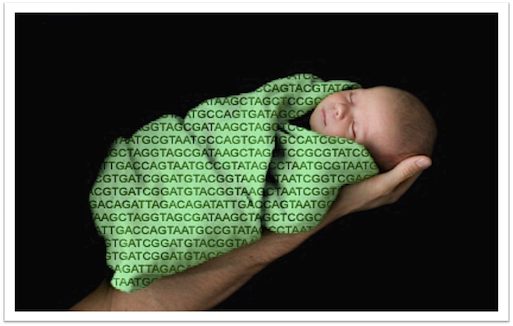
Freyhauf, Feminism, Religion, Durham, Old Testament, Blogger, Bible, Gender, Violence, Ursuline, John CarrollWith Angelina Jolie’s electing to have a double mastectomy because she carried the BRCa Gene, and her mother and aunt died at a very early age of the disease, the issue of genetic testing is in the forefront again.  This is a three-part essay explores genetic testing when it comes to newborn testing (part one and part two) and concludes with exploring personal choices, availability, and psychological ramifications of genetic testing.

BabySeq
Picture originally found at http://www.ngsleaders.org/blogs.aspx

After nine months of worrying and diligent pre-natal care, the day to meet your unborn child is here.  Labor is long and for hours you lie in the birthing suite riding out contraction after contraction.  The moment finally arrives and you discover you have a son; ten fingers, ten toes and seemingly healthylungs by the cry that you hear.  He is then quickly taken over to the nurse’s station and a drop of blood from his heel is placed into a machine that in seconds will decode his entire genome. Soon your son’s future will be written in stone; he has a life expectancy of 30.2 years and has a 99% chance of dying from heart failure.  In that instance, your son has been labeled as an in-valid and he is now doomed to exist within a lower class of society, one that will prohibit him from pursuing his dreams. Society has discriminated against your new baby boy based solely upon his DNA.  A new form of eugenics is born.

This was the opening scene of the 1997 science-fiction movie called “Gattaca.” Besides pushing the bounds of human imagination, science fiction can serve as a warning about a future caused by the abuses of humankind.  The opening birth scene in this movie is quickly becoming a potential reality.  Now, a person’s entire genome can be decoded and in an instant, a person knows whether he or she will be susceptible to Parkinson’s disease, Alzheimer’s disease, Cancer, or other life threatening conditions.  Proponents of genetic sequencing believe that this is the holy grail of medical care and tout phrases like “personalized medical care” and “significantly reduced costs of healthcare.”  There is a rapid movement towards this goal through the proposed expansion of newborn screening for eighty-four conditions, most of which are not understood or have no known treatment. Continue reading “Genetic Testing: The Ethical Implications of Expanded Newborn Testing – Who Benefits? (Part One) by Michele Stopera Freyhauf”

Unblocking Abundance: A Ritual by Sara Frykenberg

Sara Frykenberg

Rather than release the sadness, heartache and struggle we put into the bowl out into the world, we meditated …to transform what we could of this energy, re-membering the parts of ourselves that had helped to create these blocks and are responsible for transforming them.  We took the transformed energy back into ourselves.

As I have written about many times before, I believe that contemporary Western society operates within a largely abusive paradigm.  I often think of oppression in terms of an abusive cycle.  Theologians like Cater Heyward and Rita Nakashima Brock describe the impact of the theologies that generate such abusiveness, noting how we become smaller to ourselves and smaller to one another.  We do not believe that we are enough, nor are the people or the planet around us ‘enough’ to fill the vacuous alienation that substitutes itself for real relational need in an abusive context.  Judith Shaw wrote eloquently about the environmental impact of conflating need with greed in her Friday post, “Can We Honor Inanna and Her Gifts?”

Shaw writes, “At first glance we appear to be abundant with things, energy, experiences.  But in our mad desire for more and more and always more we neglect the balance of the very earth who provides us with all.”  Many people, particularly in industrialized nations, have been taught to fill the need for a sense of abundance, connection and ‘enough-ness’ with more stuff: more things, more money, more food, more land, etc.  And yet, ironically, this quest for ‘more’ can also prevent us from experiencing the very abundance we seek.  We can create blocks to abundance by trying to fill the vacuum instead of our actual needs: and difficultly, abusive patterns and cycles can prevent us from seeing the difference between the two.  Continue reading “Unblocking Abundance: A Ritual by Sara Frykenberg”