
To Death in Spring

‘Experts’
told me
you would
not rise
too old
they said
abandoned
purple and rose

Exploring the F-word in religion at the intersection of scholarship, activism, and community.

To Death in Spring
‘Experts’
told me
you would
not rise
too old
they said
abandoned
purple and rose
This was originally posted on May 21, 2012
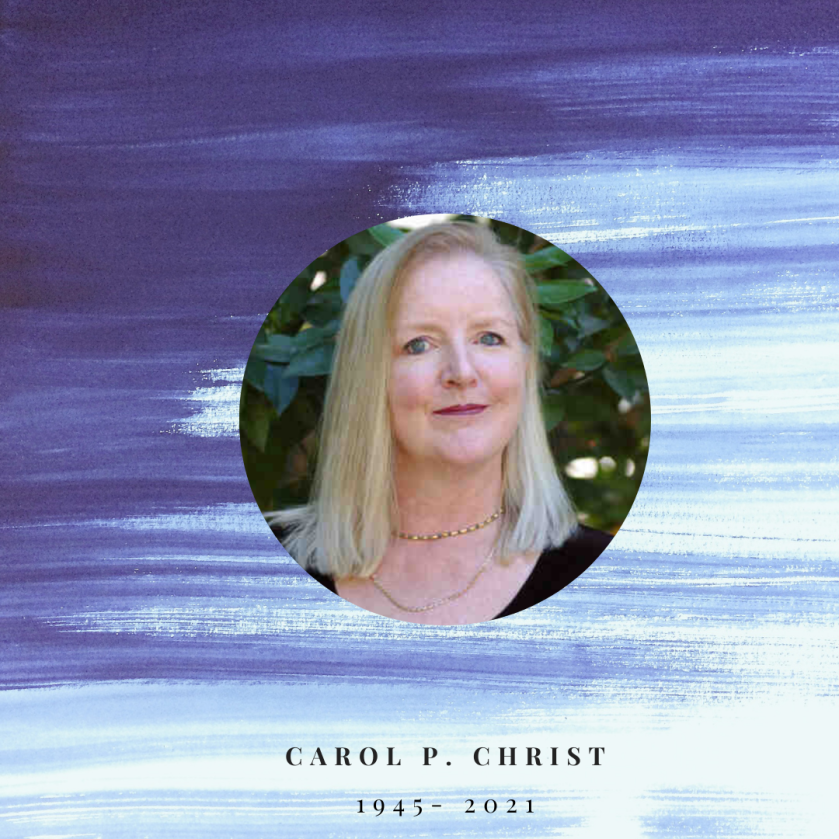
She changes everything She touches and everything She touches changes. The world is Her body. The world is in Her and She is in the world. She surrounds us like the air we breathe. She is as close to us as our own breath. She is energy, movement, life, and change. She is the ground of freedom, creativity, sympathy, understanding, and love. In Her we live, and move, and co-create our being. She is always there for each and every one of us, particles of atoms, cells, animals, and human animals. We are precious in Her sight. She understands and remembers us with unending sympathy. She inspires us to live creatively, joyfully, and in harmony with others in the web of life. Yet choice is ours. The world that is Her body is co-created. The choices of every individual particle of an atom, every individual cell, every individual animal, every individual human animal play a part. The adventure of life on planet earth and in the universe as a whole will be enhanced or diminished by the choices we make. She hears the cries of the world, sharing our sorrows with infinite compassion. In a still, small voice, She whispers the desire of Her heart: Life is meant to be enjoyed. She sets before us life and death. We can choose life. Change is. Touch is. Everything we touch can change.
Continue reading “Legacy of Carol P. Christ: SHE WHO CHANGES*”This was originally posted on June 15, 2012
I am less concerned with the legitimacy or morality of public breast-feeding . . . rather I am asking what contributes to this strange binary of, on the one hand, social acceptability of near-porn-like images of breast used in advertising, i.e. Victoria Secret, while on the other hand, internal conflicts some feel when viewing a baby/child feeding at the breast?


Beyond the “war on women” initiated by the Republican party on women’s reproductive rights, the issue of women’s breast, or more specifically, the nursing breast, has been making itself know in the media. The recent Time magazine cover of Jamie Lynne Grumet breast-feeding her three-year-old son produced a flood of controversy centering on “attachment parenting,” which promotes, among other things, breast-feeding beyond infancy. Parent magazine recently profiled two military mothers breastfeeding in public while in uniform. For some, this perceived breach in social decorum is akin to urinating and defecating openly while wearing your uniform. Responding to the outcry, Air Force spokesperson Captain Rose Richeson states, “Airmen (sic) should be mindful of their dress and appearance and present a professional image at all times while in uniform.” In other words, it is suggested nursing military mothers pump and bottle-feed their babies when wearing their uniform in public spaces. And finally, Hadley Barrows of Minnesota was asked to leave the library by a security guard because her nursing in public was a form of “indecent exposure.” In this post I am less concerned with the legitimacy or morality of public nursing (although I have no issue with it), instead I am asking what contributes to this strange binary of, on the one hand, social acceptability of near-porn-like images of breast used in advertising, i.e. Victoria Secret, while on the other hand, internal conflicts some feel when viewing a baby/child feeding at the breast? Drawing from the work of Margaret Miles and her text, A Complex Delight: The Secularization of the Breast, 1350-1750, social attitudes and the public display of women’s breast can best be understood when the breast is viewed as a coded symbol that informs, through artistic representation, complex patterns of discourse.
Continue reading “Archives from the FAR Founders: The Tale of Two Breast: From Religious Symbol to Secular Object by Cynthia Garrity Bond”
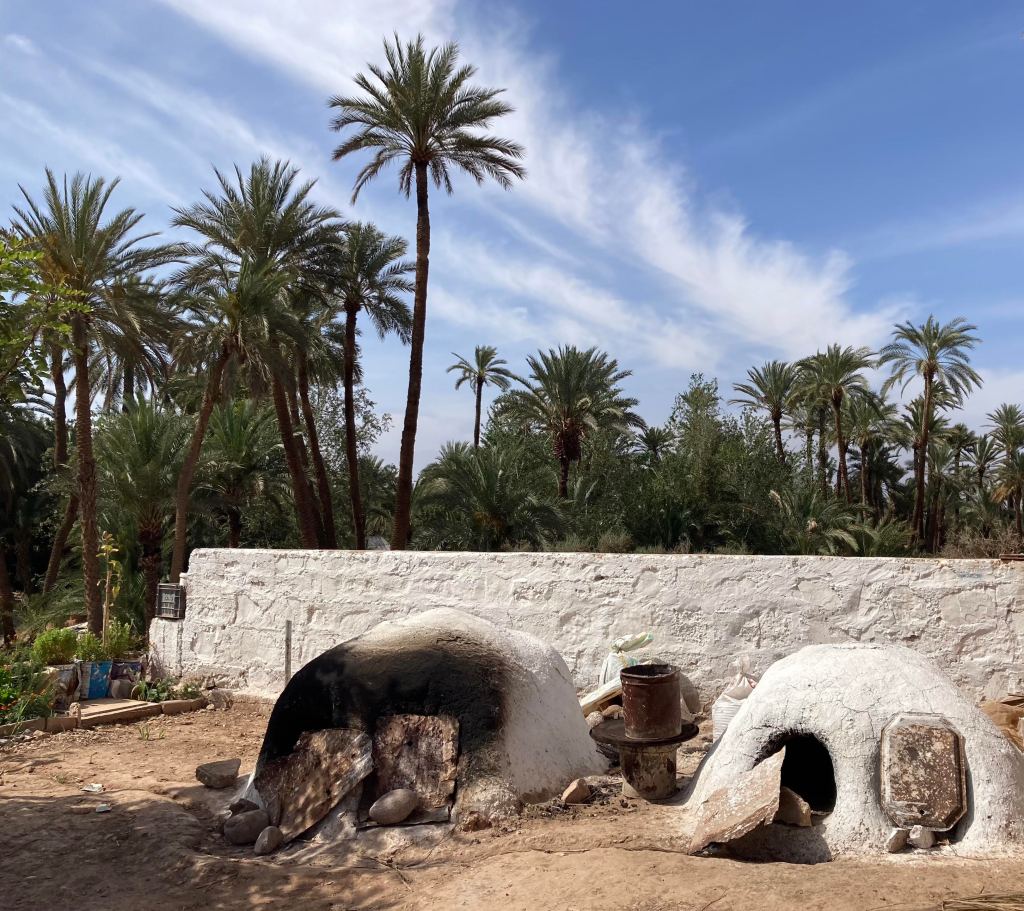
Last week, once again, I had the good fortune to bring a small group of dancing friends to southern Morocco. As always, our travels there unfolded in a blessed and beautiful way, rich in experiences of ancient Berber/Amazigh culture and encounters with local women.
At Tioute oasis in the foothills of the Anti-Atlas mountains, we bought unleavened flatbread baked in rounded clay ovens.
Part 1 was posted yesterday.
What are the conditions necessary to foster an environment in which we can truly listen to one another across differences? Gathering insights from many perspectives[i], Alison Jaggar outlined the essential conditions for what she called Feminist Practical Discourse or FPD. These include: 1) the creation of opportunities for participants to talk about their own lives, stressing the importance of first-person narratives and of others listening; 2) the equal importance of each person’s experience; 3) an openness to reevaluating one’s perspective; 4) the inclusion of people whose lives are different from our own and each other’s, especially those whose public voices have been most marginalized; 5) a nurturant, rather than an antagonistic environment, while still allowing for respectful disagreement; 6) participant qualities of self-discipline, responsibility, sensitivity, respect, and trust; and 7) the motivation of care and friendship.
Continue reading “Listening to One Another: Part Two by Beth Bartlett”“Listen is such a little, ordinary word that it is easily passed over. Yet we all know the pain of not being listened to, of not being heard.“[i]
“You heard me. You heard me all the way.” So goes the oft-quoted statement of one of the participants in a consciousness-raising (CR) group in which feminist theologian Nelle Morton participated. It is a testimony to the power of what happens in CR groups – of hearing each other into speech. “When we are listened to, it creates us, makes us unfold and expand. Ideas actually begin to grow with us and come to life,” wrote Brenda Ueland, the first female journalist in Minneapolis.[ii] This was the blossoming born of CR groups, where women began to discover truths long buried and watch them unfold and come to life.
Continue reading “Listening to One Another: Part One by Beth Bartlett”
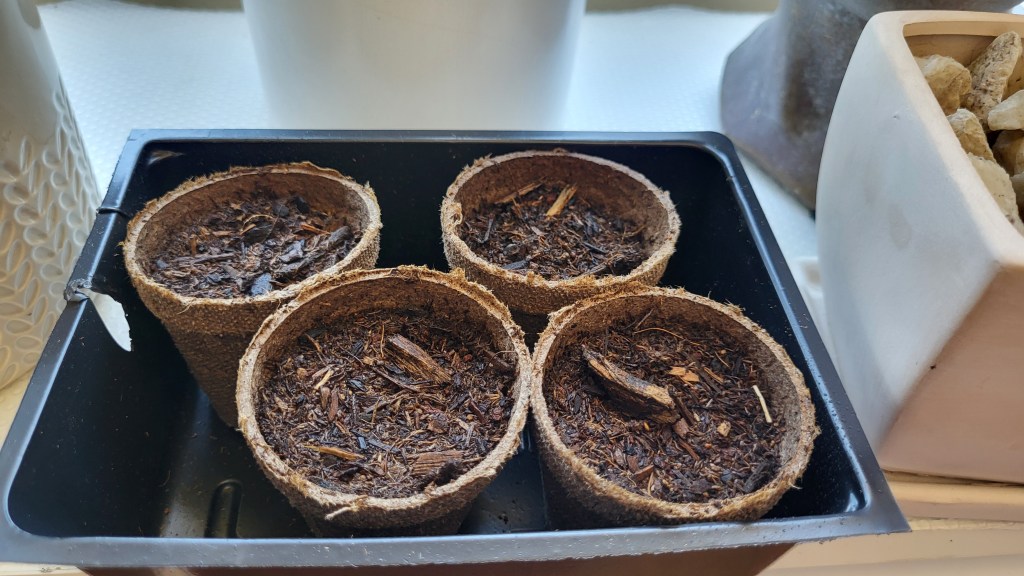
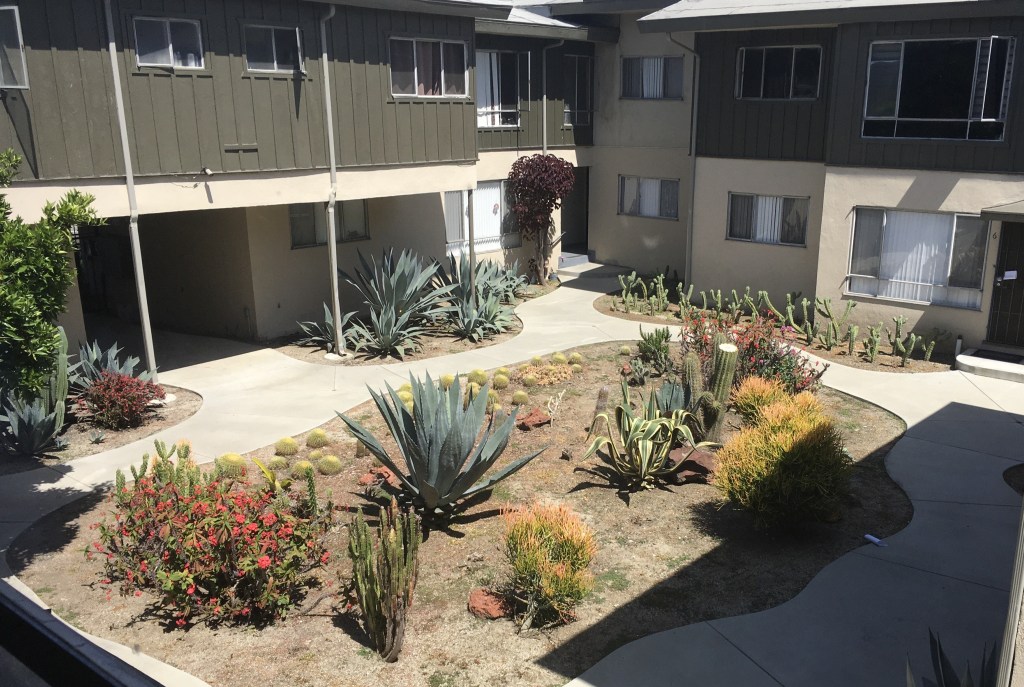
Last Monday on Earth Day I planted my little seeds (though I acknowledge Sara Wright’s point in her las post that every day is earth day!). I’m in a new apartment and don’t have the outdoor space I used to in my previous home. I live in a courtyard-facing apartment complex with a beautiful desert garden in the middle, but no outdoor space that the tenants are allowed to work in. I do, however, have a big, beautiful living room window that gets a lot of direct sunlight. For Earth Day, then, I started my little potted-plant garden. As I put together the tiny pots, pressed in the place for and placed the seeds, covered and watered them, I inevitably reflected on the magic of it all. The pots look empty except for the soil, and yet, I’m to expect lettuce from them in some weeks or months. A seeming impossibility, but it will happen—slow, but nonetheless, steady growth happens.

Yesterday my Vet and I created our version of the Indigenous Tewa Seed Ceremony, something I have not done since living in New Mexico (except to honor the Seed Moon). We didn’t plan to make an exchange of plants and seeds on earth day because neither of us believe or thought about it – (either do Indigenous peoples) – every day is earth day – so it just ‘happened’ on the day before the Seed Moon becomes full.
After giving Gary a very special heirloom scarlet runner bean sprout of mine (and seeds) along with the rest of ‘his’ plants that I had been nurturing for months, we also split up a sedum to share, one that he had given me in the hospital last fall, closing another circle of giving and receiving.
It wasn’t until after we parted that I was struck by lightning. Visceral memories surfaced as I relived the Tewa Sacred Seed Ceremonies I had attended in NM, gradually coming to the realization that we had unwittingly participated in an ancient ceremonial exchange that may have originally extended back to Neolithic times.
Continue reading “The Circle of Giving and Receiving by Sara Wright”This was originally posted May 14, 2012
Gina Messina-Dysert’s blog on sexual harassment by a Religious Studies professor brought up memories that have haunted me for years. It has taken me some months to find the courage to post this story.
When I was an undergraduate, I was very naive and barely dating. I was not as prepared for college work as most of the other students, and I devoted myself to my studies. I had a favorite professor, and I spent a lot of time in his office talking about books and about God. This professor encouraged me to go on for a Ph.D. in his field at a time when a woman with a Ph.D. was an oddity. His belief in my intelligence gave me the courage to overcome my parents’ opposition to the idea that I would pursue a doctorate. His recommendations helped me to win Danforth and Woodrow Wilson Fellowships. I naturally assumed that this professor respected me.
Continue reading “Legacy of Carol P. Christ: Somebody Almost Walked Off With All of My Stuff: And He Didn’t Even Know He Had a Thing of Value on the Open Market*”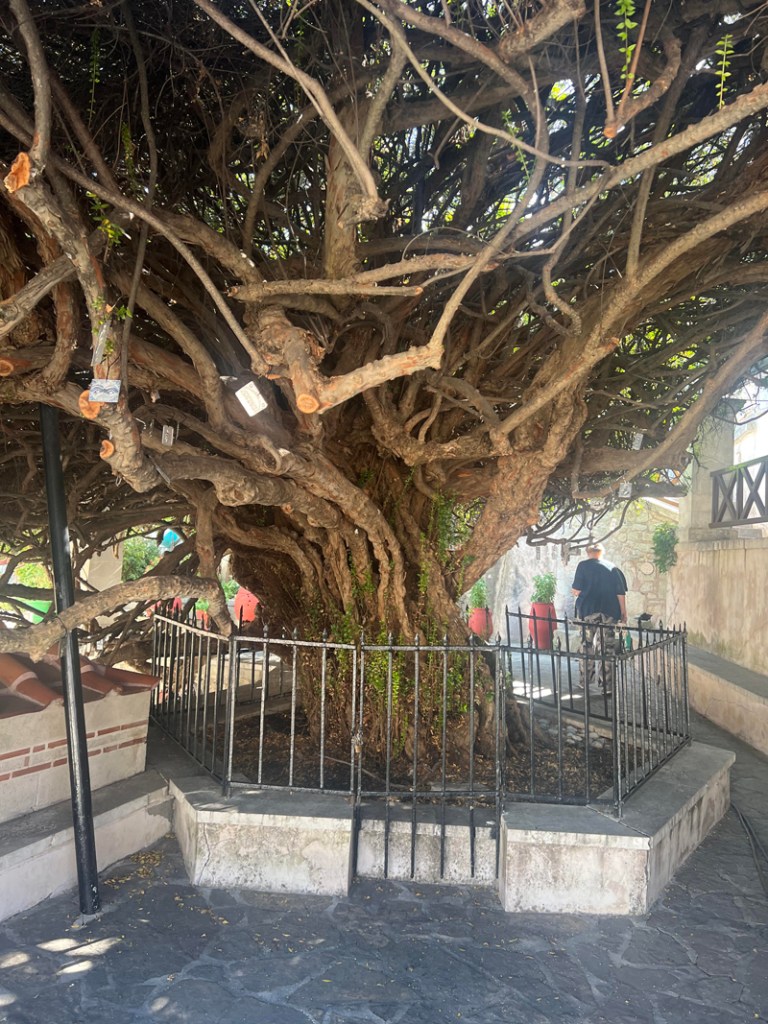
I went to Crete because I longed for some kind of communion with Ariadne. Each time I gathered in ritual with the women on my trip, I hoped She would speak to me, or that I would feel something and know that She was in me, or I within Her. At Paliani, I had these same wishes as I walked toward the over-1000-year-old sacred myrtle tree. Set back in the corner of the quiet convent, I was struck by the contrast between the tree’s black bark and surrounding black fence set against the hopeful flickering of silver ex-votos that filled each branch. I walked around the back of the tree on a slight upper landing and searched for a branch within reach. Finding a spot where I could rest my forearm, albeit awkwardly, I leaned in and waited for Her.
Continue reading “Ariadne and Me – Stumbling Toward the Divine by Arianne MacBean”
