

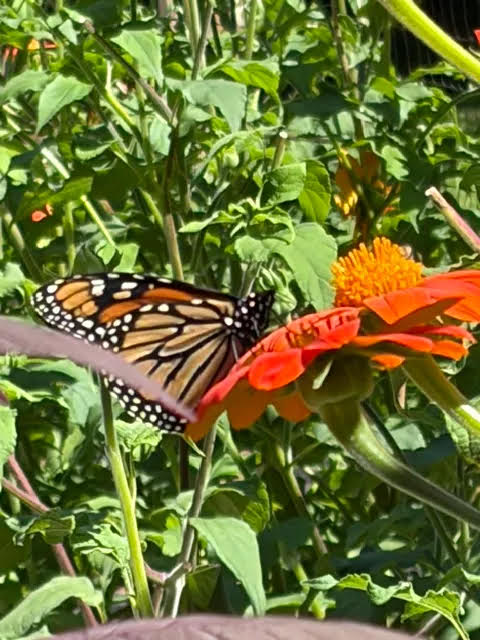
This summer marks the first year I have not had butterflies in my wildflower garden in August, a very troubling development. June and half of July were good months with some monarchs, many swallowtails and a multitude of fritillaries flying through the field. The latter two were as prevalent in my garden as last year, although painted ladies, pearly eyes, and admirals were scarce. No monarchs around the house this year. On July 15 I saw two up by the corner perching on the milkweed who were probably the same ones I saw just above me on the circle later that day. On July 17th out of state neighbors sprayed their property with pesticides. The wind was fierce. The monarchs disappeared. I have not seen a monarch or any other butterfly since (except one fritillary that appeared briefly last week).
Because I think the same monarchs return to the sparce milkweed patch on the corner before they come here, I immediately looked for eggs*. I kept looking day after day for the rest of the month, noting the bizarre leaf distortion on this small clump of milkweed that I had not seen anywhere else. Due to pesticidal drift from a few feet away? On August 6th I was walking by the distorted milkweed and spied two monarch caterpillars. Oh no!
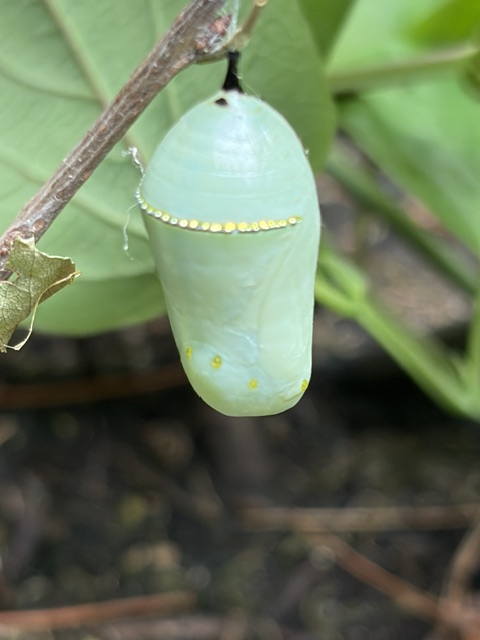
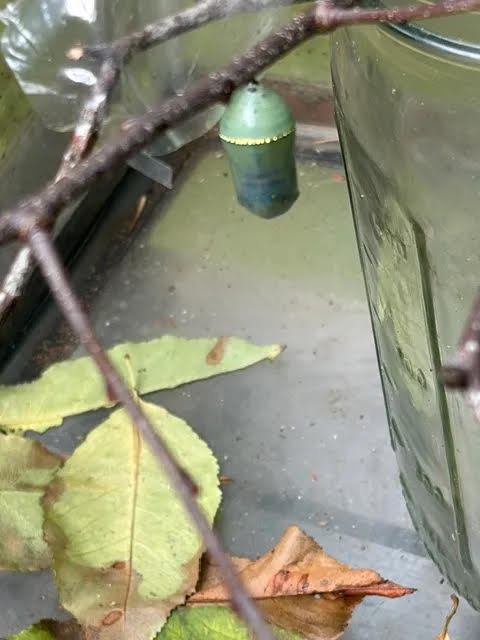
Anyone who reads this blog knows that I believe it is very important to leave monarch caterpillars alone because we don’t know how interfering might affect butterfly outcome, but spraying? My gut kicked in. Rightly or wrongly, I scooped the two up, detached them from their leaves, washed the caterpillars and gave them healthy new non -poisoned leaves. One pupated that first night, the second the next day. I situated the terrarium outdoors. On August 24th -eighteen days later- I noted two eyes appearing at the base of one capsule. For some reason that image broke my heart. Someone was trying to get out. Any transformation is a complex and dangerous process. Oh, I wanted this butterfly to emerge safely and in good health with wings that could fly….It is impossible not to get attached to outcomes while raising a monarch. Yesterday (August 26) one capsule was turning black although by nightfall was still a bit green at the top. Emergence is a process heavily influenced by the weather and who knows what else, so I must be vigilant because that chrysalis is in a terrarium. This morning (August 27th) the capsule is totally black at 9AM, and I can vaguely see the outline of the creature within… I will need to remove the chrysalis from the container if it doesn’t stay black for more than two more days. If it does then I have lost this one….the other has not yet turned but a bump is present on the lower part of the chrysalis….Oh how I hope I will be able to remove those capsules and place them on a tree branch for birth…
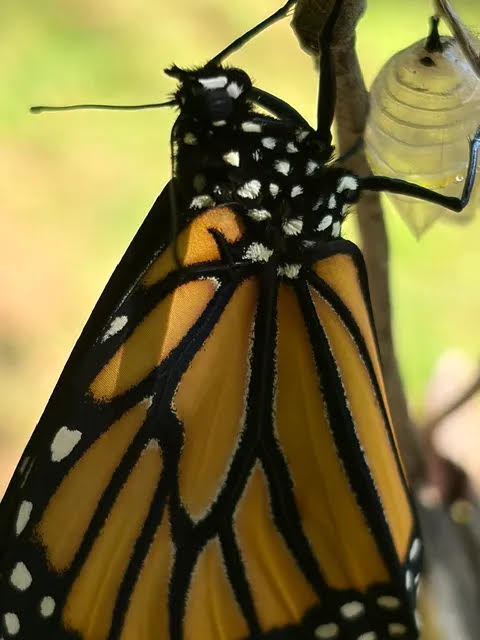
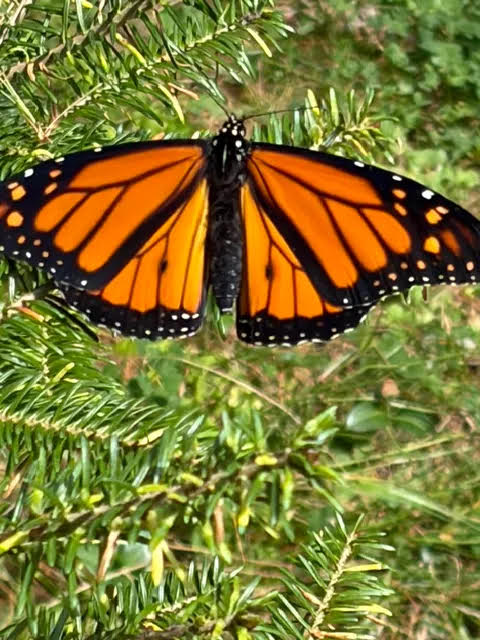
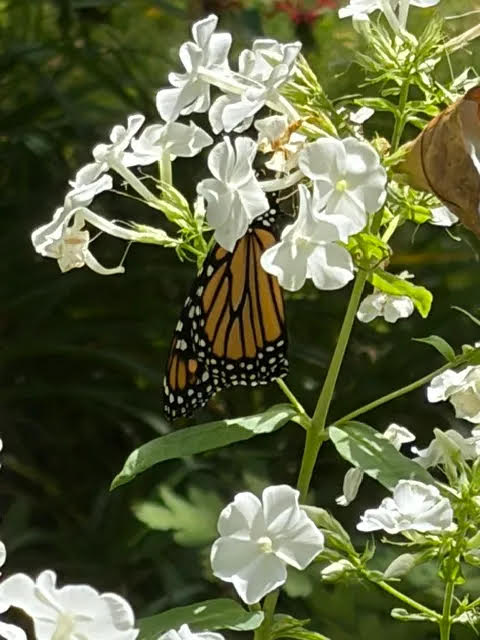
Interruption: Little did I know that as I was writing this personal essay the first caterpillar was in the last stages of transformation. When I went out to check at 11AM a butterfly had emerged! Immediately I removed the stick from which the butterfly was hanging and moved it to a tree while talking to this most beautiful creature in a loving way. Do not be afraid I whispered as monarch flapped a wing. Too shady a spot I realized in a few minutes as I watched the monarch pumping more fluid into his wings. I was just going to move him when he flapped and fell into the grass. Oh no, something was wrong I thought as I picked him up and placed him in the sun. Another mistake. Pinenes might be a problem if he stayed on the balsam. This time the monarch climbed onto and stayed on my finger as I was moving him while fluttering those bittersweet wings. Moments later he took his first real distance flight and landed on the sweetest phlox in the garden, positioning himself under the flower that would protect and feed him. There he stayed. In a few minutes he was sipping nectar. An hour later he spread his glorious wings to a warming sun and light breeze. Moving to the top of the cluster he suddenly took flight, soared into the trees and disappeared. Oh, he was gone. Gratitude for a chance for Life to continue overflowed…This monarch was on his way. Hopefully, the other chrysalis now turning black would make that final transition tomorrow. Perhaps that one might be a female? The two spots determine that this one was a male…
I return to my story….Conservation groups like the National Wildlife Federation recommend leaving a monarch chrysalis undisturbed because natural mortality is a normal part of the ecosystem, and most important human intervention does not address the broader threats facing the species (my italics).
This last sentence is key because people confuse the need to help with what they think they know and those that don’t use pesticides like me are painfully aware that making this choice is anything but universal. Without being able to deal with root causes like pesticides, habitat loss, and a rapidly changing climate all of which are pushing this species towards extinction raising one caterpillar to adulthood is NOT going to affect the survival of this species overall.
The other even more disturbing issue for a naturalist like me is that folks do not perceive these insects as being sentient living beings that experience trauma, stress, and fear like humans do. Imagine how you would feel being caught in a net and forcibly held by the wings while being tagged. Handling caterpillars is risky and so is feeding. Disturbing the chrysalises may result in disease, a butterfly with deformed wings, or one that does not hatch.
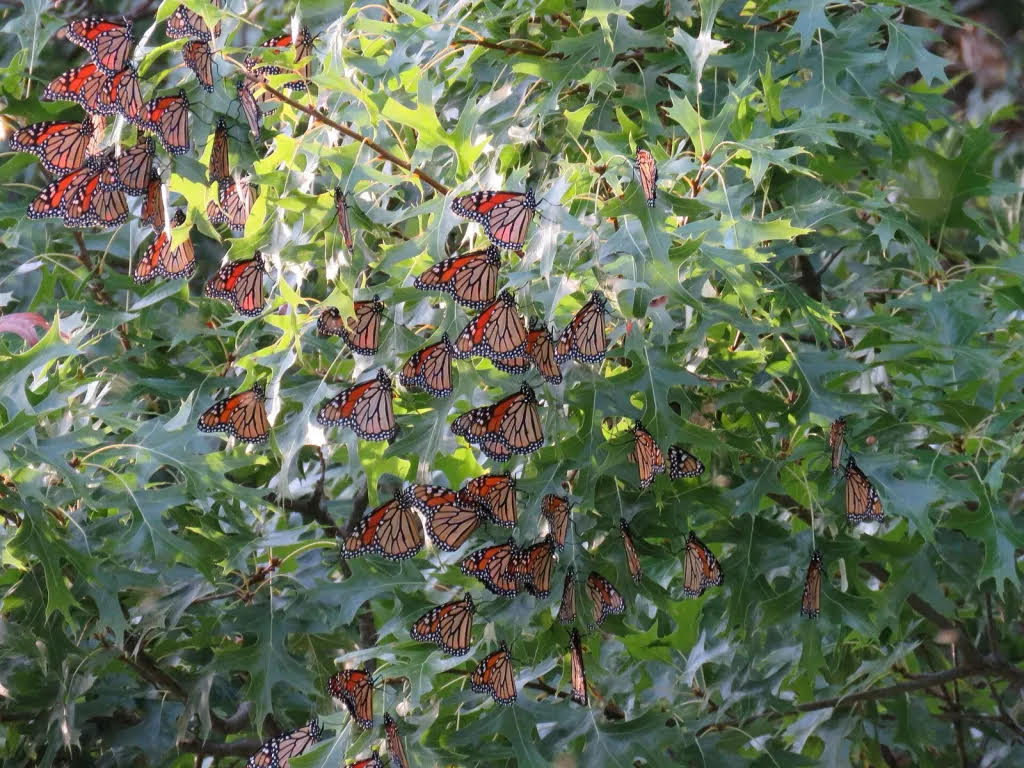
Organizations like the Xerces Society note that natural outdoor exposure allows for environmental cues to occur during the chrysalis stage. These cues (probably) help trigger proper migratory instincts in the adult butterfly. Overall, we know so little about butterfly transformation that drawing conclusions seems to be more about humans needing to have answers than what might be going on for the caterpillar or butterfly itself.
With pesticide use out of control all insects are under threat. Yet the average homeowner has a cabinet full of poisons like Round-Up that are used routinely. I just spoke to an ‘organic’ gardener who told me that she had to spray their potatoes with poison to deter the potato bugs (we are conservationists until it’s not convenient to be one). Another routinely uses pesticides to deter wasps and yellow jackets. Every hardware store has shelves full of poisons to use in the average backyard. Now we have companies like Pet Shield that assure folks that spraying whole properties is safe which is a bald faced lie that people believe. We are drenching the whole country with glyphosate. Poisoned air is concrete reality. With an Earth on fire, and habitat destruction legion, all beings are threatened, not just the iconic monarch butterfly.
At MLT, my local land trust, monarchs are tagged. A few days ago someone was feeding caterpillars in a beautiful outdoor container. While I was there this woman told me she tagged 200 monarchs last year, but that this year so far there were few. I understand that people want to feel like they are helping this butterfly survive even though the discovery of a tagged monarch means that the butterfly died in Mexico before completing (ki’s) life cycle. Tagging is collectively acceptable so at this point my opinion as a lifetime Naturalist and that of some scientists (that the press and public ignore) isn’t enough to stop this practice. Enough said.
(Anyone who reads this blog already knows how much I am against butterfly tagging so if interested in disturbing research that contradicts the collective acceptance of this practice, I direct the reader to other pieces I have written on the subject or to more academic articles that I have published).
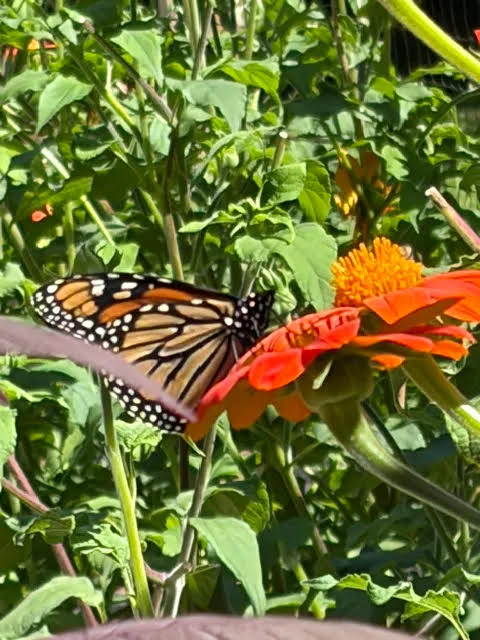
Ever since the land that abuts mine has been poisoned, I have been asking other neighbors and anyone else I meet if they have seen monarchs. I saw and photographed one last week at the land trust on my bi weekly visit to the garden. I have seen very few at the Community Forest. Monarchs do seem scarce at least around here. Maybe September will be better? No one I spoke to had spraying to deal with except MLT whose abutting property is sprayed for agricultural purposes.
The MLT Monarch Festival is a community event that draws thousands to the area. There are wonderful things for children to participate in (the pollinator garden is a child’s paradise – naturalists are born here – and the flowers are spectacular – some fascinating exotics), a multitude of vendors, food, and games complete the picture. This year I will be volunteering at the bird table as I have in previous years. Although I fervently wish tagging butterflies was not one of the things to do, I sadly accept that the practice continues to occur. Monarch tagging occurs in many other places too.
*I hypothesize that monarchs may return to the same milkweed plants every year to lay their eggs even though the ones that arrive each year have NOT been here before because they were only born this spring. In the field I do not keep track, but around the house I do because the wild milkweed in these areas is sparce and partially shaded. I learned from the monarchs that depending on when they arrive the first group use plants in full sun to feed on, while the next group chooses more shaded plants that come later and are easily monitored closely. Of course, this second group of monarchs may simply choose the plants that are available, but there is also a homing instinct present in the rest of nature that is not understood, and my animal senses tell me that the monarchs are choosing deliberately…
Discover more from Feminism and Religion
Subscribe to get the latest posts sent to your email.


