

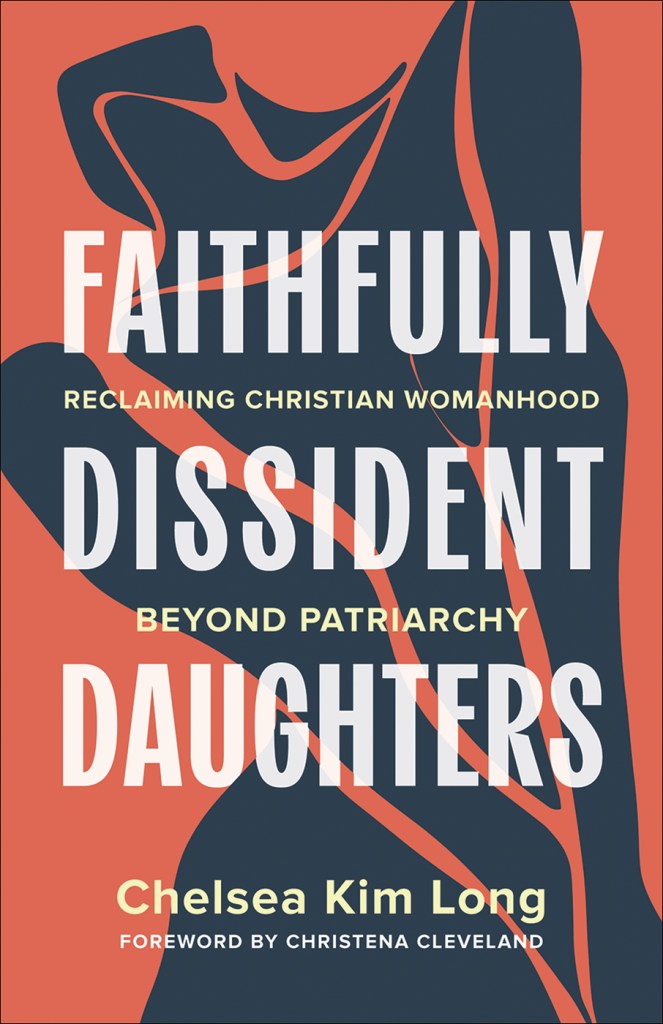
After a beautiful and insightful Foreword by Christena Cleveland, Chelsea begins her engaging book by telling us, “Up until the age of 26, I didn’t struggle to align my identity and my life experiences with the white, evangelical way of seeing the world.” Born in the late 1980s and raised in a nondenominational megachurch, she grew up with a strong sense of belonging. All was well as long as she matched her thinking and experiences with authoritarian expectations. “I was able to exist in those spaces just fine until, quite suddenly, I wasn’t.”
What changed? Pregnancy. “It was the first splinter in a crack that eventually ripped my whole worldview apart, forcing me into a crisis of theology where I felt I had to choose between myself and the church I loved.” Experiences surrounding pregnancy and childbirth opened Chelsea’s eyes to the realization that as a woman in a patriarchal structure, built by men, she didn’t fit. Interpretation of Biblical text empowered men. “I couldn’t see my femininity reflected in and affirmed by the God they made in their image.” She fled her home church.
“I walked through many lonely years trying to wrestle my way into a version of faith that reflected my reality and contained my life experience.” Chelsea, as a child, had memorized Jeremiah 17:9, “The heart is deceitful above all things, and desperately wicked: who can know it?” No room in her natal faith for “heart knowledge” since logic and reason superseded intuitive thought. She had learned to mistrust and silence any wisdom that came from within her own Being.
Eventually, Chelsea claimed her intuition, her body, and her own lived experience as “sacred tools, gifts from God,” enabling a more authentic faith to emerge. “Being dissident means standing against systems, teachings, and cultural practices within Christianity that seek to silence, marginalize, or erase.” I like to imagine a faith allowing each of us to own who we are—complex human beings created in God’s image—not beggars unworthy of gathering the crumbs under the Lord’s table!
Chelsea, raised in white, evangelical fundamentalism, eventually found a larger Christianity—from its millennia-long contemplative expression to feminist and womanist theologies. She also discovered “a strong thread of the Divine Feminine hidden in plain sight in the Scriptures I knew and loved.” The Divine Feminine, not just a phrase that refers to God as She, doesn’t “separate me from God but is reflected in and affirmed by God.” In the Hebrew Bible, El Shaddai (name for God) means “the breastfeeding God who imparts to us the sacred acts of growing, birthing, and feeding babies.”
In my church going days, using the name of God to indicate “acts of growing, birthing, and feeding babies,” never once surfaced—not even in the form of a homily on Mother’s Day! Nurturing children, a job most often thought of as “women’s work,” actually reflects a huge aspect of God’s nature. She/he/they sustains human beings. Jesus manifested this as well (according to a widely-accepted interpretation of biblical story) in his self-sacrifice—giving his body and blood.
Much of Chelsea’s work attempts to “shift the lens so we can see the Bible through the eyes of women.” The masculine lens, used for centuries to interpret sacred text, has obscured perspectives such as those of women, people of color, and LGBTQIA+ communities. That masculine lens empowers and promotes men and their experiences at the expense (diminishment—even erasure) of other viewpoints. Chelsea asserts, “From page one of the Bible, we see a God who encompasses every expression of gender while transcending gender entirely.”
All doctrine/theology is interpreted story. The story (experience) always comes first. The question then becomes: Whose story is informing the theology passed on to us? nd then: Why does a particular category of people (men) have (take?) power, enforcing patriarchal theology as Truth?
Stories define and shape us. Muriel Rukeyser (1913-1980, poet and political activist) asserts, “The universe is made of stories, not of atoms.” Most times we inherit stories and “live in them” before we realize we’ve accepted our life as something curated by others. Like Chelsea, we discover that reality when life feels out-of-kilter. Our belief system (often our inherited story) is not in alignment with our lived experience. Chelsea tells us that she “quite suddenly” realized her inherited stories didn’t fit anymore. They did not reflect her unique experiences which were different from what was considered “Truth” in her community. Subsequently, her life became unmoored.
“What would happen if one woman told the truth about her life? The world would split open” (Muriel Rukeyser).
I recall, in the heyday of the 2nd wave of feminism, conversation about the tension that feminists in faith traditions (mainly Christian) experienced. Was it possible to stay IN the church, a patriarchal institution, and live out one’s faith authentically? Those who said yes were referred to as Reformers—people (usually women) who believed change (inclusion) could (and would) come from within the institution. Get rid of sexist language, allow women in the governance of the church, and create woman-centered rituals. Others, referred to as Revolutionaries, said no—the patriarchal system had invaded and infected every nook and cranny of the church. Change had to come from creating things anew—outside the system. Both Reformers and Revolutionaries envisioned a church beyond patriarchy.
Carol Christ (1945-2021), one of the earliest supporters and contributors to FAR (Feminism and Religion), wrote, “The simple act of telling a woman’s story from a woman’s point of view is a revolutionary act.” Chelsea does this well—tells her own story—placing that narrative front and center. What I hear her saying is that there are other ways to understand “Truth.” The male-focused story has been front and center way too long. Move over. There are other voices. Yours is not the sole embodiment of “Truth.”
If everybody told their own story and wove that into the expression of regular worship, would that be enough (ultimately) to change the patriarchal structure of the institutional church? Will the model of being a “faithfully dissident daughter” suffice?
Chelsea writes, “I dream of an expansive view of faithful womanhood large enough to contain the experiences of anyone who wishes to claim that identity.” She does not give up on her “beloved community,” but envisions one that is inclusive of all people with their unique experiences.
Radically-inclusive spaces DO exist. I mention two here:
1, St. Andrew’s Presbyterian Church, Austin, Texas. I occasionally “zoom in” to the Sunday morning worship service. Not only is there a wide variety of people present, there are a myriad vehicles available to express one’s spirituality—art, music, books, round-table discussions, immigration assistance, visitation, food pantry, and caring for homeless people as the sanctuary morphs into a dormitory when needed. And so much more.
2. Unity Mosque (El-Tawhid Juma Circle), Toronto, Canada.
This mosque welcomes anyone feeling alienated from traditional Muslim circles. LGBTQIA+ affirming, mixed-gender prayers, and leadership by any gender.
Just before concluding her book, Chelsea offers practical suggestions on how to honor oneself while dissenting faithfully. Yoga, journaling, biblical meditation, etc. can all be used as grounding tools while experiencing the upheaval of change on the journey towards personal authenticity and wholeness.
Chelsea finishes her book with a short (1 page) “Manifesto for the Faithfully Dissident.” That text affirms the changes faithfully dissident people “stand on.” One poignant assertion follows:
“I will name patriarchy for what it is: a system of control, not God’s design. I reclaim Scripture through liberating eyes, recovering silenced voices and telling new stories that affirm the full humanity of all people. I make space for all marginalized bodies to see themselves in the divine story.”
You can purchase Faithfully Dissident Daughters on Amazon or through Bookshop. You can learn more about Chelsea’s work on her website: www.chelseakimlong.com and follow her on Instagram at @chelseakimlong
Discover more from Feminism and Religion
Subscribe to get the latest posts sent to your email.


wonderful words, a system of control, not God’s design.
LikeLiked by 1 person
Yes indeed, Yalda. Men have (for eons) used their entitlement to wreak havoc on those with lesser power.
LikeLiked by 1 person
Yes, Esther; unfortunately, for centuries, women have been kept away from the realm of power. It is as if a woman exists solely because of her gender and for procreation—as if she were a commodity. But we advocate for equal rights and human dignity for women.
LikeLiked by 1 person
Wow Esther, this is a excellent review and the subject matter is to my mind almost universal to feminists on some level …”She had learned to mistrust and silence any wisdom that came from within her own Being”. Don’t we ALL have to find ways to CRAWL out of this pit??? Men may need it even more.
LikeLiked by 1 person
Thanks, Sara. Yes, we all DO need to “crawl out of this pit.” Men, still, have more license to be at ease in a rapidly-changing world.
LikeLike
unfortunately, regarding men I reluctantly agree – so IRONIC men need it more
LikeLiked by 1 person