Crow and the Pornographic Gaze by Sara Wright

Once she believed that
it was her fault
they came on to her,
that she owed them
something
They owned her?
Secretly the
girl was pleased
because any kind of attention
was better than none,
or being so “different” –
stitched into an Indian skin.

She was a pretty shell,
an abandoned spiral
worn down by waves –
assaulted from within
by the pornographic gaze.
How she hated being young.

Continue reading “Crow and the Pornographic Gaze by Sara Wright”

Dancing for Forgiveness and Reconciliation – Part Two By Laura Shannon

In Part One of this article, I described dancing Jewish, Romani, and Armenian dances for forgiveness and reconciliation with groups in Germany and all over the world. I also offered danced rituals of remembrance at former concentration camps and other places scarred by the atrocities of war.
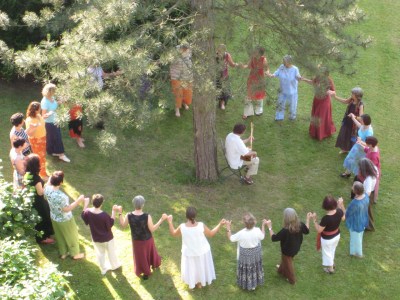
I went to camps including Dachau and Auschwitz, to genocide memorials and sites of massacre throughout Eastern Europe, in Australia, and the Americas. At first, my prayers were private: I brought flowers, lit candles, danced my grief, and spent time in meditation. I tried to visualise the prisoners in those places, sending them my deep sorrow and regret back through time. I wanted to let them know that they are remembered and mourned by people from their future. My prayers contained a fervent apology as well as a soul commitment to do my part in this lifetime to overcome prejudice and stand for peace.
In time I invited others to dance with me for healing and peace. We danced at former camps in Germany, including Bad Gandersheim, a subcamp of Buchenwald, and on many occasions in Steyerberg, a former prison camp and forced-labour munitions factory which is now the site of an intentional community called Lebensgarten (‘Garden of Life’), a centre for permaculture, non-violent communication, and other ecologically and spiritually oriented ways of living.

Continue reading “Dancing for Forgiveness and Reconciliation – Part Two By Laura Shannon”

Dancing for Forgiveness and Reconciliation – Part One By Laura Shannon

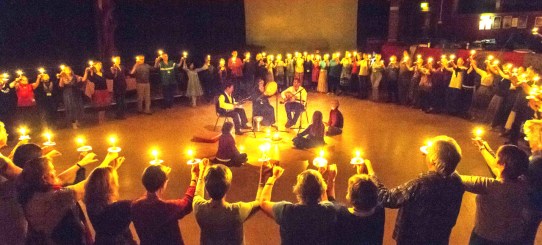
Armenian Candle Dance with Laura Shannon, Findhorn 2015 (photo: Hugo Klip)
When I first began researching traditional circle dances in the mid-1980s, I was amazed to find that the peoples who have suffered the worst of human experience – oppression, exile, genocide, war – also produce the most vibrant and joyful music and dance. Armenian, Jewish, Kurdish, and Romani (Gypsy) dances, in particular, were passionate affirmations of life, despite the horrors these peoples have gone through in their history. The dances seemed to hold clues to the mystery of moving on with life after trauma.
This was something I was desperate to learn how to do. Barely 20 at the time, I was struggling to keep my dignity and optimism while growing up female in a woman-hating world. The trauma of a violent rape on my 18th birthday had robbed me of my joy for life – but I could experience joy again in those dances.
Early on in my research and teaching, therefore, alongside the women’s dances which were always my main interest, I began to focus on the traditional dances of persecuted peoples, which I called Dances of Exile and Homecoming. These songs and dances seemed to have an inherently therapeutic potential, profoundly moving for people from any background and any culture.

Continue reading “Dancing for Forgiveness and Reconciliation – Part One By Laura Shannon”

Healing Uphill

These are trying times for all sentient beings. We are all carrying the intensity and stress in our bodies and spirits. I feel it. You feel it. In fact, we are feeling it together—sharing an experience even though interpreting and understanding it in our own unique ways. 

As a person of faith, I believe we are on a collective healing journey. As a feminist, I believe that journey continues to involve extended uphill challenges because of intersecting systems of oppression.  And that is how I understand this particular moment in time—a healing journey in a difficult uphill section on the path. As a human collective we are healing uphill. 

Healing uphill can feel like too much to bear sometimes. Healing uphill is the experience of having more and more challenges heaped on your back when you are already tired and struggling to keep going. Healing uphill is like trying to take care of yourself when you lose your job in a global pandemic and one of your kids gets sick and your landlord tells you that you are late on your rent and then your spouse comes home angry and blames you for all the stress and, well… you get the picture. Healing uphill is when you can’t seem to catch a break and things seem to just keep getting worse.  

Continue reading “Healing Uphill”

Mourning with the Goddesses, Now More than Ever by Carolyn Lee Boyd


Carolyn Lee Boyd

We may all remember 2020 as the year when we could no longer look away from death. Our western culture has hidden death away in hospitals and funeral homes for generations. However, in these past months we have all been inundated with daily images of COVID-19 patients dying alone in ICUs, terrified people and wildlife consumed by flames or flood, televised funerals of victims of racial violence, children starving due to droughts, the loss of icons of courage and compassion like Ruth Bader Ginsburg, Elijah Cummings, and John Lewis, and so much more.  Even as we seem to be surrounded by death, we risk being inured to its tragedy by the sheer numbers of dead from these and other causes.

How we survive this time as individuals and a society may depend in part on how we are able to answer the question “Were we able to mourn each life lost – human or non-human — as a sacred being, unique and irreplaceable? Did we ignore the suffering of others or did we find deeper compassion?” 

Continue reading “Mourning with the Goddesses, Now More than Ever by Carolyn Lee Boyd”

May Her Memory Be A Revolution by Anjeanette LeBoeuf

On the eve of the Jewish Sabbath and the start of Rosh Hashanah, Supreme Court Justice Ruth Bader Ginsburg breathed her last breath. She was 87. She fought so hard for so long. She is an American patriot, hero, champion for women’s rights, and for many she was the stalwart bastion of justice and ‘liberal’ rulings. She was a Supreme Court Justice for 27 years. Her life has been put into books, a movie, and the most notorious memes around. She became known for elaborate collars over her Justice robes. We mourn the lost of her, we celebrate her memory, and we must pull up our boots and continue the fight.

Continue reading “May Her Memory Be A Revolution by Anjeanette LeBoeuf”

ANNA’S DANCE: A BALKAN ODYSSEY by Michele Levy – Book Review by Joyce Zonana

Toward the end of her complex odyssey, Anna finds herself alone in an ancient Istanbul synagogue, where at long last she unreservedly “name[s] herself” a Jew and experiences connection with a God that “fuse[s] both male and female” and “from that wholeness birth[s] mercy and love.” Vowing to work to “help repair [the] world”–tikkun olam–she moves forward to face her life with a “sense of wholeness” that had eluded her for so long.

202002_Zonana_JoyceHow to come to terms with the most maligned or vulnerable aspect of ourselves—whether it be race, ethnicity, religion, gender, sexuality, physical ability, or any other trait—remains among the most pressing questions of our time. Should we try to “pass,” identifying with the oppressor and denying or rejecting who we are? Should we assume a militant, defiant stance, wreaking vengeance on those who have harmed us? Or can we find a way to embrace and affirm ourselves, neither denying nor reifying the pain of our individual and collective pasts? Can we love those who have harmed us?

These are among the questions faced by 23-year-old Anna Rossi, the central character in Michele Levy’s complex, lyrical new novel Anna’s Dance: A Balkan Odyssey (Black Rose Writing, $20.95), set in the turbulent summer of 1968. 

Raised in the U.S. as a non-observant Jew, Anna has nevertheless been seared by anti-Semitism—both the indignities experienced by her parents, and those she has encountered herself. Her mother, a brilliant mathematician, had been denied admission to Purdue’s engineering school— “You’re a woman and a Jew”—and rejected by her Irish-American mother-in-law as a “filthy immigrant Jew.” Growing up in a Northern Virginia suburb, Anna was branded “Miss Israel” in the ninth grade and given low marks by a teacher who insisted she was “not like us.” Later, in college, a professor called her a “Jewish bitch.”

Continue reading “ANNA’S DANCE: A BALKAN ODYSSEY by Michele Levy – Book Review by Joyce Zonana”

Women, like Goddesses, Come in All Colors, Shapes, and Sizes…by Vanessa Soriano


I wish I could have gotten this phrase tattooed on my arm when I started the serpentine journey into womanhood.  Like most of us, growing up, all I ever saw in media were thin female bodies with impossible proportions.  As one article put it:

Although body size and weight perception differ across race and ethnicity, women in western society are subject to images of women as not only thin, but also athletic and toned, with small waists, large buttocks, and large breasts, a body type that is largely unattainable.  Because of this ideal, all girls and women typically have weight concerns that ultimately shape body image, satisfaction, and appreciation. Continue reading “Women, like Goddesses, Come in All Colors, Shapes, and Sizes…by Vanessa Soriano”

I Don’t Mean to Brag, But I Cry a Lot by Trelawney Grenfell-Muir


It’s true. I don’t mean to make you jealous, but lately, I have at least one long session of really great crying most days. What I call the “lovely cry,” where my face gets all red and swollen and puffy, my nose runs, I drool, and I make all kinds of noises. I’m so proud of my crying, so proud of myself whenever I manage to accomplish a really good cry, and so relieved. I get a bit worried if a few days go by and I haven’t had a proper cry. I try to remind myself how important it is, and give myself time and space for a healthy crying session.

Again, not to blow my own horn, but it has taken some work—decades of practice and effort—to get good at frequent, healthy crying. Mostly, it takes two things: 1) the courage to feel your feelings, and 2) the strength to reject our culture’s toxic sexism.

I’m sorry I can’t provide you with a well researched summary of how our culture decided that tears are shameful, weak, and feminine. It’s been a damned hard time lately, trying to recover from long-term Covid. I could also go on about my past traumas, deaths I am grieving, and fears from this pandemic and the climate apocalypse, etc. I’m sure you could, too. Plenty to cry about! Continue reading “I Don’t Mean to Brag, But I Cry a Lot by Trelawney Grenfell-Muir”

Living with Uncertainty by Sara Wright

I was deeply moved by Carol’s willingness to share deeply personal feelings about how her visit to the hospital , enough so that I decided to write about how the Covid virus has impacted my life and the lives of those around me.

Here in my corner of the world summer is a time to be outdoors, and so returning to Maine in the early spring has allowed me to be emotionally present in a joyful way for Nature’s turnings, first from winter to spring, and then from spring to summer. But I am a naturalist and only too aware that my love for the wild is not shared by everyone.

Because I have no family, the longing to be with loved ones does not pierce my heart in the same way it does for others. Continue reading “Living with Uncertainty by Sara Wright”