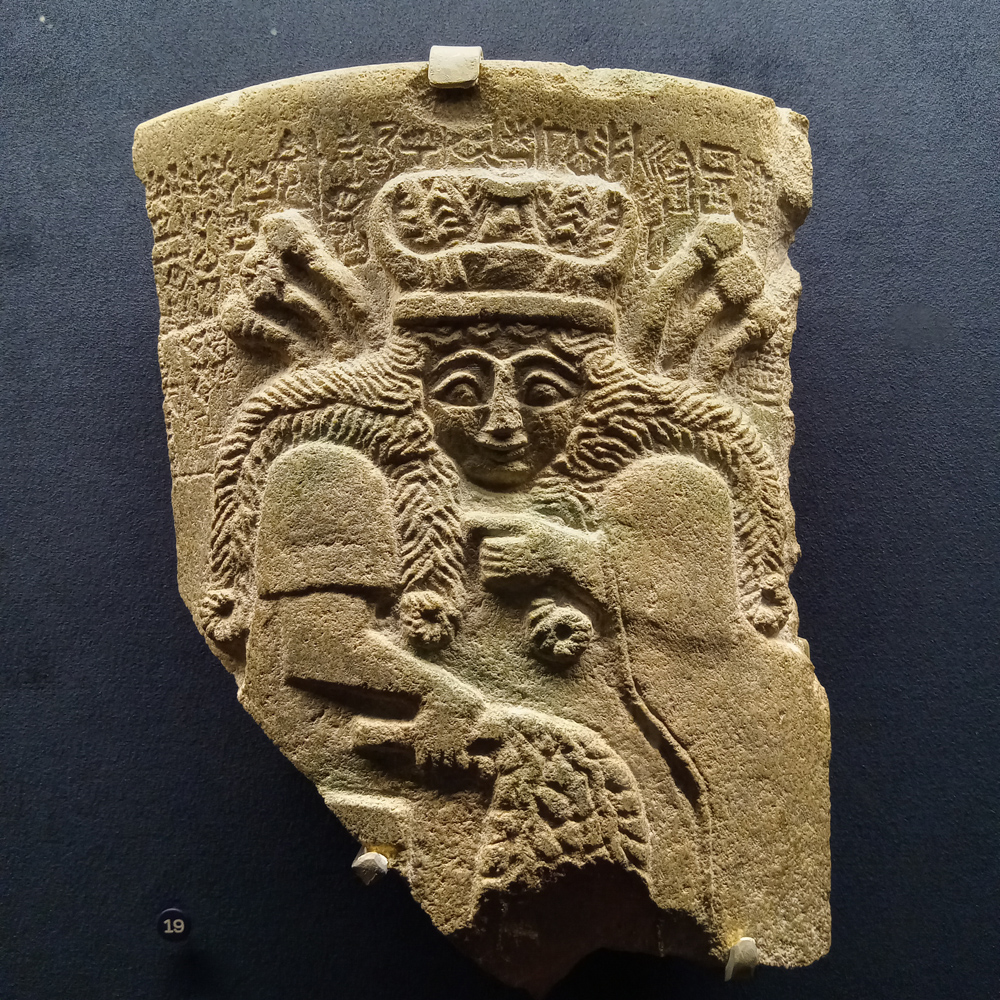
Image of a Goddess, maybe Inanna. Could she also be a Shaman and/or Queen? From 2400 BC, Sumeria. Photo by Rachel Thomas at the Morgan Library, on loan from the Vorderasiatisches Museum of Berlin.
Women’s History Month brings our attention to women of the present and the recent past. What about those women from our distant past? Those whose great stories go back thousands of years?
Scholars are discovering more and more evidence of powerful women in pre-history. Here is a snippet of the true herstory of my ancestral grandmothers.
Every day there is more research showing that women played leadership roles in the earliest large-scale civilizations of Western Asia, North Africa and Europe. We know that these areas had international trade and exchange of ideas going back at least 5,000 years. Maybe more.
I was in the process of writing this blogpost last week when the Arizona supreme court decided to turn abortion rights back to the civil war era (1864). This was a time when women had no rights at all and abortion from conception was illegal. But civil war era laws are downright quaint and modern compared the legal underpinnings of the supreme court’s Dobbs decision.
In his decision, Mr. Alito cited four “great” and “eminent” legal authorities, Henry de Bracton, Edward Coke, Matthew Hale, and William Blackstone. For perspective here are their dates.
Henry de Bracton c. 1210 – c. 1268 Edward Coke 1552 – 1634 Mathew Hale 1609-1676 William Blackstone 1723 –1780
To help me understand Alito’s logic, I read up on some conservative commentary. Here is what I learned: When the founding fathers needed to create legal documents, they didn’t create them out of thin air. They relied on the logic of the four men (and others) listed above. Yes, they did pick some enlightened aspects of these thinkers of the time, esp. in regard to the rights of the common people in relation to royalty. The thought of commoners having rights was revolutionary in its day. But as we have learned so painfully, our founding fathers limited who those rights applied to. They did not take into consideration the rights of anyone other than landowners, which at the time meant white men.
Moderator’s Note: Part 1 was posted yesterday. You can read it here.
Rejecting the notion of “comparative suffering” is critical for those who are committed to the work of social justice, human rights, and antiracism. There is no Guinness world record for “human suffering” for which groups or individuals need to vie to outrank one another. The human capacity to empathize with one people’s suffering does not diminish our capacity to empathize with another group’s suffering, even when those respective groups are at war with one another.
On March 26, I began my talk on a women’s panel titled, “Global Women Speak,” for Mount Saint Mary University with this reminder. Before I could speak about the humanitarian challenges facing Palestinian women in Gaza today, I felt compelled to make this argument due to my experience six days earlier at another women’s interfaith panel. In this previous panel, a co-panelist rudely cut me off four times within a span of one minute when I began to address Palestinian suffering, although she had already addressed Israel’s current challenges in response to a question that we were all asked. For several days following this jarring experience, I kept wondering, what felt so threatening to this co-panelist about the stories of Palestinian suffering that she felt compelled to shut it down?
Moderator’s Note: This is part 1 of a 2 part series. A version of this article first appeared in The Charlotte Post on March 25
In her paradigm-shifting book, Why I am No Longer a Feminist: A Feminist Manifesto, Jessa Crispin reminds us that having token “female representation” does not solve the problem of systemic oppression or marginalization. I was recently reminded of this truth when a female co-panelist attempted to silence me twice, when I shared my perspective on women’s challenges in Gaza.
On March 20, I joined an all-female interfaith panel for an elite retirement community center in Charlotte, NC in honor of Women’s History Month. As three female panelists, we were invited to represent our respective faiths, Judaism, Islam, and Christianity. After we each responded to the scripted questions posed to us, community members began to ask us questions. One man stood up and said, “I have visited Jordan, Egypt, and Israel. Will it be safe to travel to Israel again given the current situation?”
Two young kids and an Airline Pilot husband who got caught in the 911 lay-offs, a first divorce, struggling, a second marriage and struggling again. Moving around the country with no ties and not knowing many people. I remember after my first marriage having to move to a less expensive neighborhood, I had the thought “Match.com? I don’t need a Match.com, I need a Friend.com!”
Only “Friend.Com” doesn’t work. It is awkward to go out to lunch “Do you want to be my friend?”
And so I remained isolated and strugglingalone.
I drank daily in order to quell my anxiety and fall asleep.
Dreaming of and working toward creating an earth- and female-centered future is proving to be my best strategy for surviving and enjoying the ecologically and politically problematic present. Current realities and predictions for the future, such as those made by climate scientists, are certainly grim. What else can we expect in a global society that puts male power and profit above the needs of people and planet?
Those in power cannot possibly undo today’s polycrisis as they are too invested, personally and financially, in the status quo. They cannot even begin to dream of the transformations called for. This is something that we women can do that they cannot. We are the ones who give birth, create new life. We can certainly dream up and create new ways of living.
On Monday, March 18th, I joined a webinar developed by Dr. John Seitz and Sonia de Silva Monteiro at Fordham University. The panel included myself, Dr. Layla Karst, Assistant Professor of Theological Studies from Loyola Marymount, and Dr. Alana Harris, Reader in Modern British Social, Cultural and Gender History at King’s College London. All offered valuable insights to the topic: “Memorializing Clergy Sexual Abuse: An Interdisciplinary Conversation about the Ethics, Means, and Meanings of Sex Abuse Memorials.” The panel represented one of a series you can follow here.
My presentation featured some things I learned from researching my last book Bearing Witness: The Wounds of Trauma at Memorial Museums. The text focuses on memorial museums, illuminating methods of memorializing human suffering, suffering that penetrates workers’ personal lives. In fact, people preserving painful memories and histories often labor (physically and emotionally) from a place of personal wounding. From nine sites across the globe, 82 interviews revealed that 35% of the people engaged in memorializing mass trauma in a museum setting are survivors of the event they commemorate; 35% are family members of those who suffered or died; and the remaining signify community members, who are not impacted directly by the event or events commemorated but care deeply about those who were.
Part 1 was posted yesterday. You can read it here.
The Eleusinian Mystery Rites derived from early planting and harvest festivals, agricultural rites from the late Neolithic. They celebrated the growth of the plant from a seed in the ground, but their purpose was also to convey a new way of seeing, an opening of the eyes, the Epotopia. The golden grain signified the alchemical gold of a new consciousness, the miracle of a plant turning to gold. Through fasting, initiates experienced a ritual identification with grief and loss, followed by a return of life and joy, a rebirth, Persephone’s triumphant return from Hades. Demeter was a giver of agricultural rites, but she laid down spiritual laws as well, hence her title of Thesmophoria, or Lawgiver.
Demeter offers a benediction to Metaneira who proffers wheat, a symbol of the Mysteries
This post is dedicated to the memory of Mara Lynn Keller, who passed away on 12/23/23. Mara was an expert on the Eleusinian Mysteries, and much of this post is based on her scholarship. Mara was a life-long friend and ally of Carol Christ’s, going back to their days in the Ph.D. program at Yale. She co-founded the Women’s Spirituality program at the California Institute of Integral Studies (CIIS) with Eleanor Gadon (The Once and Future Goddess). Mara was an unusually warm, welcoming, and generous presence, and must have been a fabulous teacher.
The Eleusinian Mystery Rites were practiced in Athens and Eleusis from 1450 BCE to 329 CE, a period of almost 2,000 years, before they were expressly forbidden by the newly Christian Roman Empire, and years later the temple was destroyed. The Rites had originated on Crete, and continued to be practiced in Knossos and in the caves there for many centuries. It is likely no coincidence that the origin of the Mysteries in Eleusis in 1450 BCE is the same date as the fall of Knossos.
Daily meditation has changed my life allowing me to stop taking anti-anxiety medication and giving me the tools I needed to change my life. For years now, I have been escaping each and every day to the woods around my home: ten minutes of a recorded meditation and ten minutes of silence.
A couple of weeks ago, thanks to technological eavesdropping, after asking my partner what Joe Dispenza meant by “Space-Time” and “Time-Space”, up pops on my YouTube feed a meditation by Joe Dispenza on “Space-Time” and “Time-Space”.
The meditation is sixty minutes long, and I have been doing this almost daily for weeks.