Standing in Cautious Optimism with the Election of the First Jesuit Pope by Michele Stopera Freyhauf

Freyhauf, Feminism, Religion, Durham, Old Testament, Blogger, Bible, Gender, Violence, Ursuline, John CarrollFrom the time Benedict’s successor was revealed, I believed that we were witnessing something different – hopefully change.  Pope Francis I embraces many “firsts” – which is probably why the Cardinals chose him.  Change and reconciliation seem to be at the forefront – something the Church so desperately needs today.  Francis is the first Latin American Pope, first Jesuit Pope, first Pope to use the name of Francis after St. Francis of Assisi, a Saint held in high regard by Catholics.  When I heard his chosen name, I immediately thought of St. Francis, to whom my favorite prayer is attributed.  This is a prayer that inspires me and speaks about how I try to live my life –  as one who strives for peace, and provides love, hope, and compassion.  St. Francis’ story is a powerful story of conversion from a life of great wealth to one of voluntary poverty.  Francis received a revelation from Christ to “rebuild my Church,” in a way that embraces peace and love as well as providing protection for all of creation.  The notion of “Protector” was a major theme in Pope Francis’ homily during his inauguration mass.

As an unlikely choice for Pope, mostly due to his age and health, Francis reminds me of another unlikely advocate for the people – a man chosen to be Archbishop because of his passivity and his ill-health – Oscar Romero.  Romero surprised the people who placed him in office and stirred things up when he became a staunch advocate for the people that he served.  Romero’s “moment of conversion” revealed something spectacular that changed Latin America.  In his role as leader, he found his voice and became a defender for the poor and oppressed.  It is because of Romero that I am hopeful that Francis will provide (or at least start the wheels in motion to provide) changes to the Catholic Church. Continue reading “Standing in Cautious Optimism with the Election of the First Jesuit Pope by Michele Stopera Freyhauf”

Second Class Rape Victims: Rape Hierarchy and Gender Conflict

Deconstructing masculinity isn’t the key to solving social, sexual, and domestic violence across the world but it is a step worth taking when attempting to engage men in affecting change to stop these violent actions since men, statistically are the perpetrators of such crimes that both cause such outcry as well as perpetual silence.

johnThe most disturbing part of the 2006 documentary Deliver Us from Evil isn’t the fact that Father Oliver O’Grady is rewarded by the Catholic Church with a new congregation in Ireland after his short stint in prison for the rape of dozens of children in the 1970s, but rather the hierarchy of gendered victimization which is often created throughout the various rape cases that are both reported and unreported throughout history.

I am often troubled by the ways in which rape cases are discussed and deconstructed via mediums such as blogs, online communities, social media networks, the news, and popular culture.  No series of events troubled me more than the Jerry Sandusky trial, but more importantly, the ways in which the young boys and adult men who were subjected to Sandusky’s abuse quickly overshadowed the other rape cases that are reported on a daily basis, specifically those involving young girls and women. Continue reading “Second Class Rape Victims: Rape Hierarchy and Gender Conflict”

On Pronouns and Liberation in the Classroom by Ivy Helman

photoIn my introduction to Christianity class, almost every one of my students (who come from diverse religious backgrounds – primarily Roman Catholic, Protestant and Muslim), continues to believe that the best image if not the only appropriate image for G-d is male.  When probed they may speak generically about G-d as genderless, an entity or spiritual presence of some kind, yet conclude by affirming their belief that G-d is male often by adding something along the lines that G-d is best described as Father.  Some go so far in these affirmations that they articulate G-d’s maleness as fact.  It never fails that every semester I struggle with how to address this basic feminist issue within the classroom.

At least as early as 1973, Mary Daly, in Beyond G-d the Father: Towards a Philosophy of Women’s Liberation, articulated the problematic basis of the relationship between gender and divine imagery.  She argues that “If G-d in ‘his’ heaven is a father ruling ‘his’ people, then it is in the ‘nature’ of things and according to divine plan and the order of the universe that society be male-dominated.”  In other words, if maleness is associated with divinity, then the power, domination and running of society by men seems to be divinely ordained. Continue reading “On Pronouns and Liberation in the Classroom by Ivy Helman”

What It’s Like To Be A Woman In The Academy: Mentoring Edition by Linn Marie Tonstad

Linn Marie TonstadIn my first post, I promised to return to the topic of mentoring. Mentoring is a survival strategy for feminists inside hostile or difficult-to-navigate environments; in its best possibilities, mentoring is a strategy for flourishing, not just surviving. But when a mentoring relationship goes wrong, it is so destructive an experience that it may even be characterized as traumatic. Mentoring is also a practice rife with possibilities for abuse: the recent Yale study of gender bias in the sciences shows the extent to which gender alone serves as a significant variable for scientists assessing the possible rewards of mentoring a student.

I have given a lot of thought to mentoring in recent months – as I transition into new mentoring roles in a new institution, as I negotiate changing relationships with current and former mentors, as I reflect on successful and unsuccessful mentoring relationships I’ve been involved in, and as I seek to develop policies and practices that will serve me (and more importantly, my mentees) well.  Continue reading “What It’s Like To Be A Woman In The Academy: Mentoring Edition by Linn Marie Tonstad”

Winds of Change in the Roman Catholic Church by Michele Stopera Freyhauf

Michele FreyhaufIn 2007, I had a conversation with a professor who felt that change was in the air for the Roman Catholic Church. The basis of this opinion was based on language. The words and the context used in writings that emerged from the Vatican were changing and somehow different – a difference that went beyond personal writing styles of Pope John Paul II and Pope Benedict XVI. This professor was hopeful that positive change for women could be coming. He was right about change in the Church, however, the changes surrounding women that emerged have not been positive.

As I continue to reflect on these words, I ponder the issue of language; specifically the impact words have and the way they are used to facilitate subtle changes in thinking, opinion, and beliefs. The method of persuasion that seems to be employed is the Aristotelian Rhetorical Theory that utilizes the five canons of rhetoric: invention, organization, style, delivery, and memory.

An example of this can be seen clearly in the changes in the liturgy that occurred last year. First, the teaching comes out with the rationale as to why the liturgy needs to change. From there a discussion, especially through the media, addressing the upcoming modifications are followed by subtle changes in the liturgy beginning with the call – response and the language in the creed. Next, the language of the celebrant began to change. Finally, the full implementation of changes is made with the addition of new gestures or movements. When I discussed the mass changes with a family member, there was an admittance that the changes no longer affect them – the changes were no longer noticeable. Their memory was impacted because the routine is now second nature.

In order to come to grips with the issue of language and the observation of my professor, I wanted to do a cursory review of the writings issued by the Vatican during this period. Admittedly, with a blog post, there is a limitation as to the depth and breadth of information that can be disseminated. It is my hope to eventually complete a thorough review of the modification of language used during Pope Benedict XVI’s papacy. For now, I want to address a few observations.

Continue reading “Winds of Change in the Roman Catholic Church by Michele Stopera Freyhauf”

We Are All Earthings: Speciesism and Feminist Responsibility Toward Animals by Amy Levin

Amy2“earth’ling: n. One who inhabits the earth.” – Earthlings, 2006

“We need another and a wiser and perhaps a more mystical concept of animals. Remote from universal nature, and living by complicated artifice, man in civilization surveys the creatures through the glass of his knowledge and sees thereby a feather magnified and the whole image in distortion.” -Henry Beston, The Outermost House

I was passing out leaflets at Columbia University a couple weeks back, when a passerby who took a pamphlet on veganism and the cruel uses of animals turned back around to approach me. He said, “I am a vegetarian, so I understand not eating meat. But what is wrong with some of the uses of these animals? What is wrong with seeing eye dogs?”  A valid question indeed, and one I had to pause for a moment to answer. I mustered up something along the lines of the ways that many of the seeing eye dogs in the industry are unfairly treated or neglected. “Oh, he said.” He seemed content with an answer he could relate to – suffering. In my experience leafleting and participating in animal rights advocacy, I receive a number of questions, many of them wanting to know the same thing, what is WRONG with the horse-drawn carriages at Central Park? And each time I (and I presume many other activists) offer similar answers, the suffering answer. But there is another layer, beyond the quick, violent spark of imagination that connects physical pain with empathy. And it has to do with power and structural inequality, and the use of one group for the benefit of another. And it has everything to do with feminism. Continue reading “We Are All Earthings: Speciesism and Feminist Responsibility Toward Animals by Amy Levin”

The Impact of Excommunication in the 21st Century (Part I) – Spiritual Redemption or Hegemonic Power by Michele Stopera Freyhauf

The Lord loves everyone and died for everyone, and He wants all to be saved…the best lesson that can be learned from everything that has happened is that one finds happiness, joy and satisfaction in obedience to the Church.”Bishop Bruskewitz

One of the most misunderstood concepts in the Catholic Church is excommunication.  Many believe that excommunication is a complete termination or separation from the Catholic Church.  To say this another way, if excommunicated, you are no longer Catholic or part (a member) of the Catholic Church.  None of these statements are true.  By baptism, you are a member of the Catholic Church and no one can take that away.

Much of the misunderstanding stems from the way excommunication was used in the Middle Ages; a means of coercion to control kings and other high ranking officials.  Obedience to the Church meant that you will spend eternal life in heaven.  Disobedience to the Church meant a complete separation from the Church; a ban against  receiving Eucharist, a banishment of your soul to the eternal flames of hell.  Excommunication was the highest form of punishment and the most meaningful (and effective) tools of control.  When a person was excommunicated, there was even a public ceremony –  a bell tolled for the excommunicant, as a bell that would chime for the dead, the Gospels were closed, and a (baptismal) candle would be extinguished.  This ceremony signified eternal darkness and death. Continue reading “The Impact of Excommunication in the 21st Century (Part I) – Spiritual Redemption or Hegemonic Power by Michele Stopera Freyhauf”

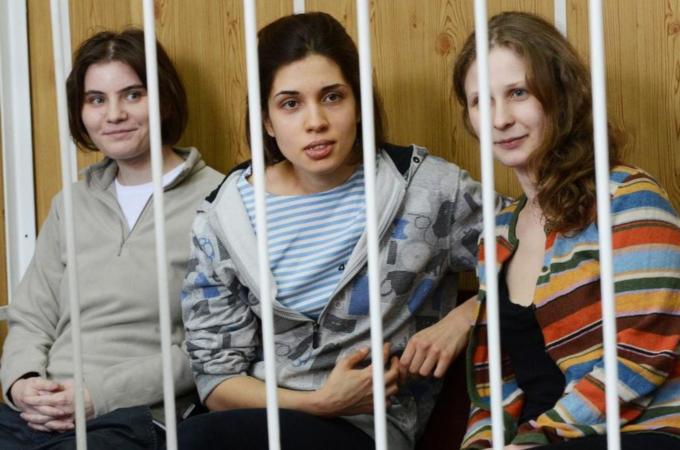
Pussy Riot: Guilty of Crimes of Blasphemy or Being Feminists? By Michele Stopera Freyhauf

In a country that was willing to [sic] its secular court on a “religious” cause, Pussy Riot are true revolutionaries. Nonetheless, it was not until they delivered these closing statements that their supporters—and opponents—heard what these three brave women stand for. Although they are being crushed in the jaws of the system—and know it!—their courage and steadfast sincerity are sufficient cause for (impossible) hope. If not for the Russian state, then at least for the Russian people. —Bela Shayevich

“When religion puts people in jail it’s unjust” – David Gross 

The intermix of religion and politics are familiar, especially after this year’s presidential election.  Many supported Mitt Romney out of concern for religious freedom; a stance that had the potential to marry religion and politics in a dysfunctional union.  We also witnessed a veiled attempt by the Catholic Church to emphasize and sway the faithful to vote for the one true moral candidate; a stance contradicted by Obama’s ability to carry the Catholic vote.  I believe what we see in Russia is a shining example that shows what happens when regulations and laws do not segregate between secular law and church law.  Freedoms do not exist, rather, rules and restrictions are imposed creating an institutional prison.

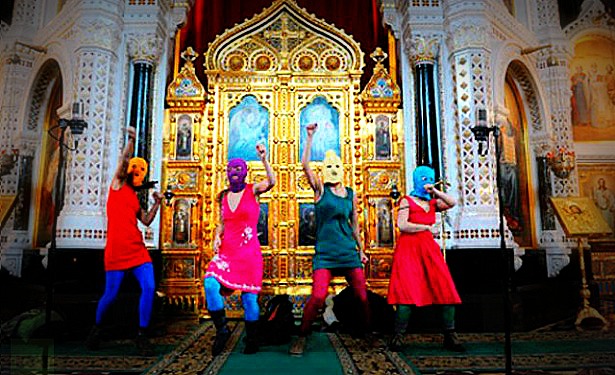
The prosecution of an all girl punk band named Pussy Riot [i]  demonstrates a “complete fusion of the institutions of the state and church,” which devalues “women’s rights and freedom of speech.”Members of Pussy Riot are serving a two year sentence of hard labor for “hooliganism motivated by religious hatred.”  What was their crime?  They went into a Cathedral in Moscow and started singing a punk prayer – “Mother of God, Chase Putin Out!”

(The translated lyrics)

From The Atlantic.com
Frm the Atlantic.com

Virgin birth-giver of God, drive away Putin!

Drive away Putin, drive away Putin!

Black frock, golden epaulettes

Parishioners crawl bowing [toward the priest, during the Eucharist]

Freedom’s ghost [has gone to] heaven

A gay-pride parade [has been] sent to Siberia in shackles

Their chief saint is the head of the KGB

He leads a convoy of protestors to jail

So as not to insult the Holiest One

Woman should bear children and love

Shit, shit, the Lord’s shit!

Shit, shit, the Lord’s shit!

Virgin birth-giver of God, become a feminist!

From AlJazeera.com

Become a feminist, become a feminist!

The Church praises rotten leaders

The march of the cross consists of black limousines

A preacher is on his way to your school

Go to class and give him money!

Patriarch Gundyay believes in Putin

Would be better, the bastard, if he believed in God!

The Virgin’s belt won’t replace political gatherings

The eternal Virgin Mary is with us in our protests!

Virgin birth-Giver of God, drive away Putin!

Drive away Putin, drive away Putin!

Original Video: http://www.youtube.com/watch?v=grEBLskpDWQ&feature=related

Finished Video (music added): http://www.youtube.com/watch?v=NYzlaBPCM6c&feature=related

They danced, kneeled, and crossed themselves in front of the Church’s high altar.   This occurred the day before the re-election of Vladimir Putin.  While I do not support going into a sacred space with relics to make a protest, what I find problematic is their harsh sentence.  However, it should be noted that with the coverage of the trial and the outpouring of support received from many organizations, and musicians, they did manage to bring to the forefront issues surrounding the government and the Church.

Continue reading “Pussy Riot: Guilty of Crimes of Blasphemy or Being Feminists? By Michele Stopera Freyhauf”

Please Excuse Me for Having a Penis: Taking a Back Seat to Privilege and Power by John Erickson

Male feminists must be aware that we not only engage in an ongoing struggle against sexual and gender inequality, but more importantly an ongoing fight with ourselves.

I have often struggled with that little voice, call it my conscience if you will, that speaks to me during times of distress.  Although I consider myself a proud feminist, I still struggle with aspects of what I call, internalized misogyny, or more aptly defined as a male born characteristic trait that imparts the idea that men are not only dominant but also more powerful than the other 50% of the species.

For many reasons, I believe religion is one of the main culprits of this growing evil, one that we all witnessed throughout this last election cycle.  However, instead of placing blame solely on religion and images of the male Godhead we have to begin deconstructing the sociological consequences these subconscious social, sexual, religious, and gendered norms have on men but more importantly men who identify as feminists. Continue reading “Please Excuse Me for Having a Penis: Taking a Back Seat to Privilege and Power by John Erickson”

Validating the Gospel of “Jesus’ Wife” is not Necessary to Prove Female Discipleship by Michele Stopera Freyhauf

The Gospel of “Jesus’ Wife” is certainly at the center of a battle that was last seen when questions of authenticity were raised about the James (Jesus’ brother) ossuary.  In a New York Times article, September 30th, Judith Levitt states that this document adds weight to theological and historical flaws surrounding the issue of the ordination of women.  The Vatican believes that their theology is still sound, calling the document a forgery.

The Gospel of “Jesus’ Wife.” [www.boston.com]
Frankly we do not need this document to validate the existence of female deacons and disciples – we have the biblical text and writings of the early church to validate this position.

Nor do we need this document to show that the standing from the Vatican’s point of view of ordaining women is theologically and historically flawed.

“In 1976, experts of the Pontifical Biblical Commission determined that there were no scriptural reasons preventing women’s ordination. The Congregation for the Doctrine of Faith overturned the commission’s judgment and instead wrote its own statement (Inter Insigniores, 1976) stating that women do not image Jesus who was a man; and therefore only male priests can adequately represent Christ.” – Women’s Ordination Conference

John Ortberg, in the Huffington Post, addressed a bigger issue surrounding female leadership in the Church brilliantly:

“perhaps what matters most in this discussion is the impact Jesus had — not on one woman — but on the status of women as a whole.”

Continue reading “Validating the Gospel of “Jesus’ Wife” is not Necessary to Prove Female Discipleship by Michele Stopera Freyhauf”