
Sexuality and Spirituality: Convergence or Alienation? by Stephanie Arel

stephanie-arelI just finished reading for review The Bloomsbury Reader in Religion, Gender, and Sexualityedited by Donald L. Boisvert and Carly Daniel-Hughes. Targeting an undergraduate audience, the text explores ways that religion, gender, and sexuality intersect and interact in a variety of religious traditions.

The book’s essays traverse a wide sampling of religious inheritance including indigenous traditions, Christianity, Judaism, Islam, and various Asian religions. The topics examined range from the culture of male love in Japanese Buddhism to various themes of love in Haitian Voodoo, from sexual desire in Beguine communities to Gandhi’s experiments in sexual chastity, and from the passion of St. Pelagius to the transgender performance characteristic of the Hijra identity in India. Among other things, the book offers a wide array of interpretations regarding how sexuality emerges in particular traditions and contexts. One is left with a feeling that nearly anything goes depending on which set of rules or religious mores a particular group of people follow. The variations presented in each chapter related to the interpretation of sexuality’s embeddedness in spiritual expression problematize the notion of the “normal” emerging in sexual desire and expression. Continue reading “Sexuality and Spirituality: Convergence or Alienation? by Stephanie Arel”
Sirens, Thunderstorms, and Bowling: The Divine on this Mother’s Day by Ivy Helman

untitledLet’s see if the following course of events makes sense.  A few Wednesdays ago, I was thinking about possible topics for this post considering it would be Mother’s Day.  In the midst of thought, the warning sirens in Prague began.  They were only being tested but, nontheless, I immediately thought of tornados.  You see tornados, as awful and devastating as they are, make me think of thunderstorms and lightning.  I love a good thunderstorm, the louder the better.

A Wisconsin childhood supplies plenty of thunderstorms.  I cannot tell you the number of times as I was growing up that I stood outside watching the sky turn into that distinctive greenish-purple and smelling the storm on the breeze.  Nor could I count the umpteen times we gathered in the basement as the tornado sirens blared and the radio advised its listeners in no uncertain terms to seek shelter.  Nor could I recall how many times I sat with my mom during more recent summers watching the storms come in or the lightning blaze across the sky like a spider’s web.  We’ve been lucky.  Never once did a tornado hit our neighborhood although a house or two has been hit by lightning. Continue reading “Sirens, Thunderstorms, and Bowling: The Divine on this Mother’s Day by Ivy Helman”

Painting the Mother of Exiles by Angela Yarber

angelaLast month, my column focused on the importance of intersectionality within the feminist movement by highlighting the revolutionary work of Sojourner Truth, an escaped slave, abolitionist, and women’s rights activist. I’d like to continue to press the importance of intersectionality, particularly given our current political state. Of late, I’ve received a little criticism that some of my recent Holy Women Icons are too political, particularly with reference to Mothers of Black Lives Matter, Dolores Huerta, and the Midwives of Standing Rock. As a woman artist, and particularly a queer woman artist, the personal is always political. Feminists taught us this decades ago. Since the lives, loves, and bodies of LGBTQs, women, refugees, immigrants, people of color, Muslims, Jews, those who are differently abled, and the poor continue to be legislated, violated, excluded, and oppressed, I’d contend that writing about, painting about, and working for liberation for all of these intersectional identities is paramount, especially for those who profess faith in a homeless refugee liberator from the Middle East (that would be Jesus, of course). Needless to say, I believe these recent works in the Holy Women Icons Project fit in quite nicely with the over seventy revolutionaries—political and otherwise—that I’ve painted and written about in the past.

These critiques combined with the current climate of the United States, new legislation passed, proposed, and promised that attacks the lives of the aforementioned marginalized groups. So, I took to canvas and, for the first time, I did not pen the poetry scrawled across the holy woman’s heart. Instead, I relied on the words of Jewish American poet, Emma Lazarus (1849-1877). Most famous for the portion of her sonnet, “The New Colossus,” that graces the pedestal of the Statue of Liberty, I wanted Lady Liberty and Lazarus’ timely words to become my newest Holy Woman Icon. In its entirety, “The New Colossus” reads: Continue reading “Painting the Mother of Exiles by Angela Yarber”

Painting Lilith, Queering Lilith by Angela Yarber

angelaLilith has been a misunderstood, appropriated, and redeemed woman throughout the ages. Many feminists claim her as an empowering figure in Jewish mythology, her story reclaimed by contemporary artists such as Sarah McLachlan, who created the all-women music tour, “Lilith Fair.” Some queer scholars have surmised that Lilith had a romantic relationship with Eve. Others have claimed that Lilith was a demon who seduced men and strangled children in the night. Quite a disparity, isn’t it?
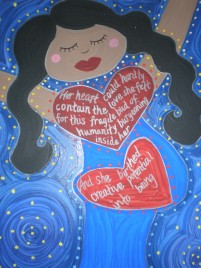
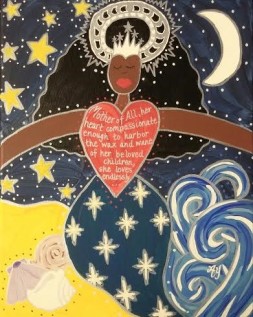

The first time I painted her, I wrote about my subsequent leaving of the church here on Feminism and Religion. Based almost entirely on Judith Plaskow’s beautiful midrash, “The Coming of Lilith,” I’ve painted a second Holy Woman Icon rendition of Lilith. In the Jewish tradition, midrash is akin to climbing inside the story—inside the Torah—and imagining what happened in the places where the text offers no description; it is the space between the letters, the creative imagination within the narrative that makes the story come alive.

According to Plaskow’s midrash, God created Adam and Lilith from the same earth. Tired of Adam demanding that she be subservient to him, Lilith left the Garden of Eden. She was later befriended by Eve and her legacy of empowering women continues today. Adding a queer twist to this feminist midrash, some claim that Lilith and Eve became lovers, as well. Continue reading “Painting Lilith, Queering Lilith by Angela Yarber”

A Letter to Those I’ve Lost by John Erickson

Out of all of these things, the one thing that has kept coming to my mind is G-d. What is he (or she) thinking? I feel like I’m back in one of my Old Testament classes discussing the harsh and cruel G-d that thrust so many horrible things onto their believers. Maybe, the worst part about the election isn’t Donald Trump, but it is the realization that G-d may be dead after all.

Dear [Insert Name Here],

Something died on November 8, 2016, and I do not think I’ll ever be able to get it back. I sat there, walking back to my house, in disbelief and utter shock and scared about the next 4 years of my life.

For weeks leading up to the election, I had found myself praying in the copy room at my work almost daily. I would sit there, silent and alone, having just read some misleading article or alt-right post from a family member that called Hillary Clinton the devil, and wonder: when did everything go so off the rails?

Although we’ll spend years trying to figure the answer to my above question out, for me, it is a question I have been asking myself ever since election night and specifically knowing how certain members of my family would, and ultimately did, vote. Continue reading “A Letter to Those I’ve Lost by John Erickson”

Painting Mary(s), Queering Mary(s) by Angela Yarber

Mary 1
Mary

It’s no secret that the holidays are often a difficult time for queer people. Disproportionately estranged from family, we often must create our own family. While these chosen families can be tremendously life-giving, it’s tough not to long for our families of origin during Christmas time. Many still in relationship with family are forced to retreat to the closet for fear of safety or exclusion this season.

Queer folk who have affirming families of origin still experience the twang of heteronormativity in holiday commercials, family events, and church services throughout December. There’s a reason why many refer to it as “Blue Christmas,” because, well, the holidays can leave us feeling pretty blue when our identities are invalidated, excluded, questioned, or marginalized.

In every nativity scene, we see images of a so-called “holy family” that likely doesn’t look very much like the family’s most queer folk create: a straight, cisgender couple, and a baby. This family is lauded by the Church as the quintessential iteration of what family should look like. When our families don’t look anything like this, it’s easy to see how celebrating the birth of Jesus is fraught with emotional and spiritual hardship.

Mary 5
Virgin de la Regla

There is good news, though. We can subvert this narrative of traditional family by queering the story. So, I’d like to talk a bit about the revolutionary power of queering Mary. Abolitionist and Women’s Rights Activist, Sojourner Truth, said it best at the 1851 Ohio Women’s Convention. Once a slave, Truth questioned the whitewashing done to women of color by white women working only for white women’s right to vote by asking the famed question, “Ain’t I a woman?” In that same speech, she notes that male clergy claim that women “can’t have as much rights as men ‘cause Christ was a man.”

This adage is familiar, not only to women, but also to LGBTQs who have been told that our iterations of family aren’t real or true or right because they don’t reflect the so-called holy family of Joseph, Mary, and Jesus. In an act of theological brilliance and subversion, Sojourner Truth poses this question to the male clergy gathered at the convention: “Where did your Christ come from? Where did your Christ come from? From God and a woman. Man had nothing to do with him!” Continue reading “Painting Mary(s), Queering Mary(s) by Angela Yarber”

Like Birds in the Sky by Oxana Poberejnaia

oxanaI once heard an educated non-feminist say that it would not matter if women came into positions of power. He gave examples of Margaret Thatcher, Indira Gandhi and other women and pointed out that once in power they started wars and engaged in other aggressive tactics, just like men politicians.

 

Firstly, the obvious logical mistake is that not every woman is a feminist, in the same way as not every man is an agent of patriarchy. Secondly, when talking about systems and key positions within these systems, one can see that these posts will play the role that is predetermined by the system.


systemIt would not matter if a head of a patriarchal organisation is a feminist or not. She or he will play a role of a head of a patriarchal system. That is, unless she changes the system altogether and it ceases to be patriarchal.

 

This reminded me of verses from The Dhammapada, a collection of ancient Buddhist verses, which speak about having no home and leaving no trace. By behaving thus, we remain independent of the dominant systems and give our opponents no opportunity to control us.

Continue reading “Like Birds in the Sky by Oxana Poberejnaia”

The God of Abraham, Sarah, and Hagar by Race MoChridhe

race-mochridheThe morning air is hot around the pillars of Jerusalem stone, but the congregation is already tired. The prayers are old, pro forma and remote, drawing power now from the sound of the Hebrew more than from the meaning of the words. “Thank you for mercifully restoring my soul to me…” intones the small group of gathered men, “and for not making me a woman.”

The voices are smooth and practiced, unmixed with the rustling of pages except for a teenager who cannot recite from memory, whose Hebrew is still bad enough that he has to pay attention. This boy tires of waking, and wonders why God did not make him a woman—why he will never be a thing as close to his maker’s image as a woman seems to him to be. Continue reading “The God of Abraham, Sarah, and Hagar by Race MoChridhe”

The End is Nigh by John Erickson

How will the world end? No, it isn’t Lucifer himself coming from hell to bring in the end times, it is someone far worse, and his name is Donald Trump.

John Erickson, sports, coming out.When I was a little boy I was terrified that I would live to experience the end of the world.  Whether it was by an asteroid, Y2K, or a zombie plague, I would make myself sick by picturing these horrible things that could befall me and my family.  Although I was a precocious child, the crippling fear that would lurch its way up my stomach and into my head would sometimes make it impossible to sleep at night.  While I like to think I grew out of that phase, I now sit here feeling that way again.  I’m crippled with fear that the end of the world is at hand and there may be nothing we can do to stop it.   How will the world end? No, it isn’t Lucifer himself coming from hell to bring in the end times, it is someone far worse, and his name is Donald Trump.

By the time you’re reading this post, the first Presidential debate between Hillary Clinton and Donald Trump will have occurred and, no matter where you look, the aftermath will haunt us for weeks to come.  We will either be sitting here, coaxing in the sunlight that Clinton has, in proper fashion, just goaded Trump into revealing to the 100 or so million viewers that will have chimed in to viewing how completely dangerous he truly is, or will we be scurrying to uncover decade old bunkers that were used during the 1950s and the Cold War to take shelter from the fallout to come should, Donald Trump become the next President of the United States. Continue reading “The End is Nigh by John Erickson”

Voting for Hillary & the Real Meaning of Sanctity of Life by Marie Cartier

I just don’t trust Hillary,” a friend said. “Give me one good reason why I should vote for her—other than that, you know, she’s a woman—since I know you teach Women’s Studies.

OK. Here goes.

hillary-and-gunsI recently got a request for support from Gabby Giffords, who was shot on January 8, 2011. This U.S. Representative and eighteen others were shot during a constituent meeting held in a supermarket parking lot in Casas Adobes, Arizona, in the Tucson metropolitan area. Six people died, including federal District Court Chief Judge John Roll; Gabe Zimmerman, one of Rep. Giffords’ staffers; and a nine-year-old girl, Christina-Taylor Green. Giffords was holding the meeting, called “Congress on Your Corner” in the parking lot of a Safeway store when Jared Lee Loughner drew a pistol and shot her in the head before proceeding to fire on other people.

In her recent request for support, Rep. Giffords pondered why she didn’t die and six others had.  There is no answer—save for that, if there is God’s hand in this, she is the one who went on to fight against the all-powerful Gun Lobby who, for years on end continue to use big money to influence Congress.

On November 8th, we, the American people, will decide, for better or worse who is the next leader of the most powerful country in the free world. An important question to ask ourselves as we consider the candidates is: What does it mean to believe in the sanctity of life? Continue reading “Voting for Hillary & the Real Meaning of Sanctity of Life by Marie Cartier”