From the Archives:“Vaginas are Everywhere!”: The Power of the Female Reproductive System by John Erickson

Moderator’s note: This marvelous FAR site has been running for 10 years and has had more than 3,600 posts in that time. There are so many treasures that have been posted in this decade that they tend to get lost in the archives. We are beginning this column so that we can all revisit some of these gems. Today’s blogpost was originally posted June 19, 2012. You can visit it to see the original comments here.

I have a beautiful picture of vagina hanging on my wall.  However, for the longest time it was in the back of my closet, with a plastic bag covering it.  I wasn’t ashamed of it but my ex-boyfriend, like most gay men, refused to have it on the wall where he could see it.  He is now long gone; the vagina is now out and proud.

I bid on the picture one fall during a showing of the Vagina Monologues at Claremont School of Theology.  One of my best friends was in the show and I had always loved its powerful message.  I walked out of the theatre, waiting for my friend, and there it was: the picture of the vagina.  I found myself caught up in its beauty.  Its gaze had mesmerized me.  The outlying layers of red, the contours of its shape, they all began to mold into a figure before my eyes.  While I have never thought of myself as a religious person, I realized that at that moment I was no longer looking the old photo but rather I was staring at the outline of the Virgin Mary.  At that moment, I realized that I had to have the picture.

Continue reading “From the Archives:“Vaginas are Everywhere!”: The Power of the Female Reproductive System by John Erickson”
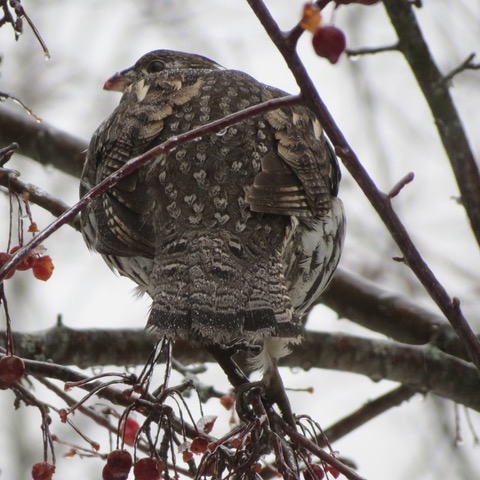
Mama Partridge by Sara Wright

Preface:

I would like to think that there are not many women out there who have had a mother like mine, but I am sure there are more. It is often hard to break the silence of abuse, especially when it is so severe. After I finished this poem I felt guilty – like I had done something wrong… a wonderful aspect of aging is that we begin to see through the ruses and I knew my feelings were temporary.

The Woman Who Birthed Me Was Not My Mother

Dedicated to the Abandoned Child in Myself, a child that suffered what Indigenous peoples call Susto or Soul Loss. This state occurs when abuse is so severe the soul of a baby cannot incarnate in its own body, but hovers around it in a disembodied state. The only way to heal this wound is to be embraced and loved by family…

Continue reading “Mama Partridge by Sara Wright”

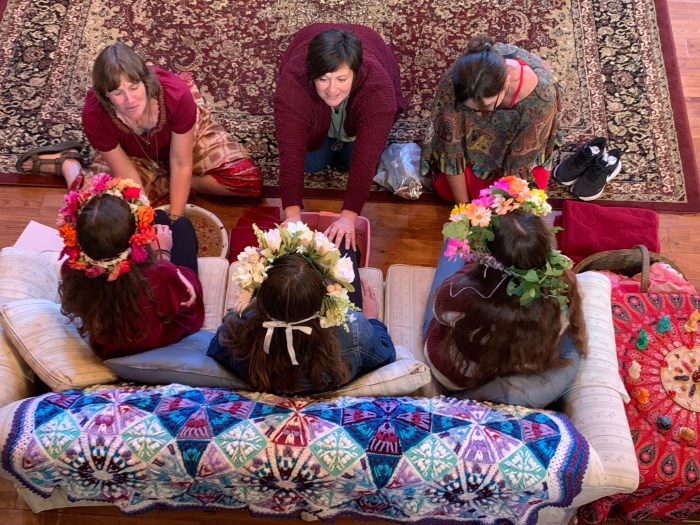
Celebrating Our Girls, by Molly Remer

We gathered roses
and bright zinnias
to crown their heads with flowers,
these shining daughters
who we’ve cradled and fed
and loved with everything
we have
and everything we are.
We knelt before them and sang,
our hands gently washing the feet
that we once carried inside our own bodies
and that now follow
their own paths.
For a moment,
time folded
and we could see them
as babies in our arms,
curly hair and round faces,
at the same time seeing
the girls in front of us,
flowers in their hair,
bright eyed and smiling,
and so too
we see women of the future,
tall and strong boned
kneeling at the feet
of their own girls
as the song goes on and on.
We tried to tell them
what we want them to know,
what we want them to carry
with them as they go on their ways:
You are loved.
We are here.
You are loved.
You are strong.
You are magical.
We treasure who you are.
This love that carried them
forth into the very world
they walk on,
we hope it is enough
to embrace them for a lifetime,
and so we kneel and sing
and anoint and adorn
and hold their hands in ours.
We are here.
You are not alone.
You are wise in the ways.
You belong.
We are not sure if tears can say
what we mean to say,
but they fall anyway
as we try our best to weave
our words and wishes
and songs and stories,
with strength and confidence
into a cloak of power
that will encircle them with magic,
no matter
how far away
from us they journey.

Continue reading “Celebrating Our Girls, by Molly Remer”

Rituals for Our Sons, Part 2, by Molly Remer

Five years ago, I wrote an essay for Feminism and Religion musing about rituals for our sons. I wondered aloud how we welcome sons in manhood, how we create rituals of celebrations and rites of passages for our boys as well as our daughters. I have been steeped in women’s ceremony and ritual since I was a girl myself, watching the women wash my mother’s feet and crown her with flowers at her mother blessing ceremony as she prepared to give birth to my little brother when I was nine years old. Her circle of friends honored us too, crowning their daughters with flowers and loosely binding their wrists with ribbon to their mothers as they crossed the threshold into first menstruation.

At 24, I then helped plan the rite of passage for my youngest sister, then 13, as she and her friends gathered into a wide living room, flowers on their heads and anticipation in their eyes as we spoke to them of women’s wisdom and the strength of, and celebration of, being maiden girls on their way to adulthood. I knew then that I would have a ritual for my own daughter, yet unconceived, one day. I birthed two sons and lost another son in my second trimester. I led a circle of mothers and daughters through a series of nine classes culminating in a flower-becked coming of age ceremony while newly pregnant with the rainbow baby who would become my own daughter.

Continue reading “Rituals for Our Sons, Part 2, by Molly Remer”

Loving Venus, a poem by Marie Cartier

Dedicated to Carol Christ, 1945-2021, who taught so many of us how to love the Goddess


She is called “Nude Woman” and currently lives
in her natural museum house in Vienna.
Nude woman. She is art, but she is not in an art museum.
And there are questions:
why was she originally painted red? Why are her breasts so large?
Why is her stomach so large?
Why does she fit in a human hand?
What was her purpose?
Was it to entice men, or to comfort women?
Historians disagree.
Is her hair woven? Or is it a hat?
Why does she have no eyes? No feet? Why is she there?

Continue reading “Loving Venus, a poem by Marie Cartier”

Becoming the Mother: A Dream Journey to the Sacred Feminine by Jill Hammer

This essay is dedicated to the memory of Carol P. Christ, scholar of the Goddess, who has brought so much wisdom and liberation to our world, and whom I deeply admired. May her memory be a blessing.

The call of the Divine Mother has compelled me for most of my life. I have scoured kabbalistic works for visions of God/dess as Mother, Womb, Protectress, Home of Being. I’ve gone on treasure hunts through museums to find paintings of the Annunciation and statues of birthing goddesses. I’ve written poems to the Mother Goddess of my imagination. Experiencing Deity as creatrix and nurturer moves me. But when I had a daughter of my own, becoming the Mother in an immediate sense proved to be more difficult than revering Her from afar. I couldn’t fully internalize that I had stepped into the sacred role of parent, even after I became one. I know this is true because of my dreams.

Not long after my daughter was born more than a decade ago, I began to have disturbing dreams. In the first of these dreams, I dropped my infant daughter by mistake into water that had flooded the area around my home. She disappeared without a trace into the deep water. I begged for help finding her, but no one would help me. Soon I realized she must be dead. I woke up terrified and sobbing. In another dream, I realized no one was watching my daughter and she must have fallen into the nearby lake. In a third dream, a huge flood came into my house and carried her away.

Continue reading “Becoming the Mother: A Dream Journey to the Sacred Feminine by Jill Hammer”

We Are Not Oppressed Because We Remember pt. 3: Sowing Seeds and Braiding Hair by Chasity Jones

Today, once again, I got to touch the earth!

While planting and constructing my indoor container garden, I thought about how my ancestors put seeds into their children’s hair so that in case they were taken away to live and die in chains, they would at least be able to sustain themselves with a piece of the motherland. Rice, okra, yams, watermelon, and so MANY more crops that would go on to make white slaveholding Americans so rich (passing their wealth to their descendants and zero reparations for the descendants of enslaved Africans), that they were willing to fight a war to sustain their evil practices of owning human beings as chattel (Check out High on the Hog Netflix documentary which was adapted from a book by Dr. Jessica B. Harris). Enslaved Africans brought these foods to the new world, a direct result of slavery.

As I wash my daughter’s hair (which for Black women and girls is a PROCESS!!), as I moisturize her hair, and as I braid my hair, I am thankful that no one has a right to my child and that I do not need to fear her enslavement. Instead, I manifest her revolutionary future to carry the torch of our ancestors. A Torch and a commitment to elevate our community and move the community forward. I leave it up to her to choose how she will carry that torch forward!

Continue reading “We Are Not Oppressed Because We Remember pt. 3: Sowing Seeds and Braiding Hair by Chasity Jones”

Mother-Love: A Review of Rosemary Daniell’s THE MURDEROUS SKY: POEMS OF MADNESS AND MERCY by Joyce Zonana

She’s been called a “national treasure” by Bruce Feiler and lauded by Erica Jong as “one of the women by whom our age will be known in times to come” … And yet Rosemary Daniell is not as well-known as she deserves to be–perhaps because she is a fiercely feminist Southern woman.

joyce-zonana

She’s been called a “national treasure” by Bruce Feiler and lauded by Erica Jong as “one of the women by whom our age will be known in times to come.” The author of three books of poetry, a novel, several memoirs, and several books of nonfiction, she is the founder of the revolutionary “Zona Rosa” writing workshops and retreats that have helped hundreds of participants—mostly women—become published authors.  For many years she led writing workshops in women’s prisons in Georgia and Wyoming, and served as program director for Georgia’s Poetry in the Schools. Her work has been featured in numerous magazines and newspapers. And yet Rosemary Daniell is not as well-known as she deserves to be—perhaps because she is a fiercely feminist Southern woman who unabashedly celebrates her own sexuality while also bringing her formidable intellect, wit, charm, and compassion to bear on her approach to writing.

Continue reading “Mother-Love: A Review of Rosemary Daniell’s THE MURDEROUS SKY: POEMS OF MADNESS AND MERCY by Joyce Zonana”

Grown Little Girl, Grow Little Girl by Chasity Jones Selenga


I have newly found myself a wife and in the throes of motherhood. In many feminist circles, I have encountered anti-family and anti-wifehood sentiments. The understanding is that to be a wife, and, to be a wife that chooses to start a family, is an oppressive position to occupy as well as the antithesis of the feminist movement. Though I am not typically a fan of tough physical, emotional, soulful labor, these two positions have been the highlights of my life so far.

My daughter embodies both my husband and me, physically. However, she is and will become her own person-soul. She is so young, but her soul is eternal, and has experienced eternity. I am here to help her navigate remembering who she is. She inhabits the intersection of Blackness, divinity, femininity, and infinity. Motherhood has greatly increased my capacity of appreciation for women and what women are capable of doing. Especially from the intersection of Blackness and woman-ness. From the capacity to create, labor, and deliver life to the task of raising Black children in a country that would have them annihilated, emotionally traumatized, and made to accept they are inferior.

Continue reading “Grown Little Girl, Grow Little Girl by Chasity Jones Selenga”

God’s Womb by Joyce Zonana

The first time I came across the phrase, I thought I must be making a mistake. “Que Dieu l’enveloppe dans sa matrice,” the passage read in French, “May God’s womb enfold her.” or possibly, “May God enfold her in His womb.” His womb?

Joyce Zonana
The first time I came across the phrase, I thought I must be making a mistake. “Que Dieu l’enveloppe dans sa matrice,” the passage read in French, “May God’s womb enfold her,” or possibly, “May God enfold her in His womb.” His womb?

I’d just started translating Ce pays qui te ressemble [A Land Like You], Tobie Nathan’s remarkable novel of Egypt’s Jews in the first half of the twentieth-century, and I couldn’t be sure I was correct in thinking that “womb” was the proper rendering for “matrice.” But a quick search confirmed my hunch. Matrice (from the Latin matrix < mater) might be translated as “matrix” or “mould,” but that made no sense here. “Uterus or womb” was the anatomical meaning, and it was the first meaning listed in my French dictionary.

The phrase, or something very like it, kept turning up, always after a dead person was named:  

Que Dieu accueille son âme en sa matrice.

Que Dieu l’enveloppe dans sa matrice.

Que Dieu la berce dans sa matrice. 

May God’s womb welcome his soul.

May God’s womb enfold him.

May God’s womb cradle her.

In all, “God’s womb” is mentioned seven times in this novel set in Cairo’s ancient Jewish quarter, Haret al-Yahud. Each time, it’s part of a ritual prayer, a formulaic wish for the wellbeing of a departed soul. But what extraordinary wellbeing is wished for here, what a remarkable envisioning of God as the possessor of a welcoming, warm womb. Continue reading “God’s Womb by Joyce Zonana”