Looking for a Mouth to Tell the Story by Esther Nelson

In Chinua Achebe’s novel, THINGS FALL APART, Okonkwo, a proud, hard-working, albeit quick-tempered tribesman living in the village of Umuofia, fires a gun at Ekwefi, one of his three wives, almost killing her.  Chielo, a widow with two children, who also serves as the priestess of Agbala, Oracle of the Hills and Caves, asks Ekwefi, “Is it true that Okonkwo nearly killed you with his gun?”

Ekwefi replies, “It is true indeed, my dear friend.  I cannot yet find a mouth with which to tell the story.”

I love Ekwefi’s turn of phrase as she responds to Chielo.  Shaken, distraught, and outraged over being shot at by her fiery husband, she “cannot yet find a mouth with which to tell the story.”  That’s exactly how I feel these days.

Continue reading “Looking for a Mouth to Tell the Story by Esther Nelson”

How Do We Heal Rape Culture? Part 2: How to Help Men Become Safer by Trelawney Grenfell-Muir

In Part 1, I presented a spectrum of male behaviors and attitudes, from violently misogynistic to safe ally. Next it is time to think about how we – as women, male allies, and society – can help men move up that scale to become increasingly safer for women. The strategies will differ depending on where a man starts out. However, using current research about change theory, we can find some concrete strategies to help us start to make progress.

The Research

Social scientists have conducted many studies about persuasion and social change, and I encourage everyone to follow these research trends. For this piece, I will focus on a few simple ideas about what works. I’m gearing this advice mainly toward men who want to become safer and to help other men become safer, but some of it applies to women as well. It also applies to religious communities – if they prioritize this issue, the men who attend will learn to be safer.

Continue reading “How Do We Heal Rape Culture? Part 2: How to Help Men Become Safer by Trelawney Grenfell-Muir”

“Queen Sugar:” Must-See Ecowomanist TV by Elise M. Edwards

elise-edwardsHave you been watching “Queen Sugar”?  It is a thoughtful, compelling, and gorgeous TV show that evokes ecowomanist sensibilities.

“Queen Sugar” is a television drama in its second season on OWN, Oprah Winfrey’s network. It was created by celebrated filmmaker Ava DuVernay, who is also the show’s executive producer.  The show has an all-female directing team and an inclusive crew.  Like many of the original series on OWN, “Queen Sugar” features a predominately African-American cast, and like many other programs on the network, it delivers content intended to stir the viewer’s soul.  But notably, “Queen Sugar”’s soulful messages are not mediated by the cadre of life coaches and inspirational leaders often seen on Oprah’s network.  Instead, it is the fictional Bordelon family who invites us to reflect on their world and ours. The series’ three main characters, Nova, Charley, and Ralph Angel, are siblings who take over their father’s sugar cane farm in Louisiana after his death. Their narrative and the lush cinematography that captures it offers viewers the opportunity to consider the complexity, joy, and hardship of African-American characters who are rarely depicted on screen.  The show’s themes and aesthetics are expressive of ecowomanist spirituality.

Continue reading ““Queen Sugar:” Must-See Ecowomanist TV by Elise M. Edwards”

Empowering Toys and the Problem of Class Divisions by Katie M. Deaver

I recently noticed that I’ve been spending a lot of time thinking about financial security, the way class systems work in the United States context, and how these types of realities inform my feminism.  Part of this is no doubt due to the fact that for the first time in my life I am not a student with multiple part time jobs, but rather am a “real” adult working full time at a job that offers retirement and medical benefits.

As I’ve written about before, I grew up in a poor family in rural Wisconsin and as a result I am often hyper vigilant about my finances.  While I likely go a bit overboard when organizing my budgeting, balancing, saving, and spending this type of organizing is something I can control.  The simple act of paying a bill, or determining how much I can spend on groceries this week gives me a profound sense of safety because for the first time there really is enough coming in to support my basic needs.

Continue reading “Empowering Toys and the Problem of Class Divisions by Katie M. Deaver”

The Internet and the Divine? by Ivy Helman

studyWhen my dad was in town for the wedding, he asked me a question about Prague.  I didn’t know the answer.  So, I said, “let me look on my all-knowing phone.”  I googled the question, found a reliable website and told him what it said.

I used to only mention the qualifier all-knowing, or omniscient, in relation to theology, often in discussions of theodicy: who is the divine in the midst of evil and suffering?  If we presume that G-d is all-knowing, does that mean that the divine has competition?  Perhaps that is a crass remark, but I also think there is a measure of truth to the idea.  In reality, the phone is not a divine competitor, but the internet might be.  And, maybe, then the phone is our intermediary or our way to access the divine.  Computers belong to this distinction as well.

This concept of technology taking the place of the divine is not new.  The television set has been accused of being an altar.  That is clearly not a compliment.  Continue reading “The Internet and the Divine? by Ivy Helman”

Reclaiming My Time: A Meditation about Mindfulness and Faithfulness to One’s Purpose by Elise M. Edwards

elise-edwardsYou may have seen the viral video of Congressional Representative Maxine Waters’ demands for “Reclaiming my time!”  Video was taken during a proceeding in which Representative Waters is questioning Treasury Secretary Steven Mnuchin, who responds with long-winded answers and indirect statements.  Ms. Waters appears annoyed, and she is not interested in flattery.  She wants a direct response to her question.  When she does not get it, she appeals to protocol, which allows her to “reclaim” the time allotted to her (intentionally) wasted by a man who wants to dodge her questions.

The video was very popular on my social media feeds.  I know of preachers who used “Reclaiming my Time” in their sermons the following Sunday.  There were memes, of course.  There was even another viral video of Mykal Kilgore singing his gospel composition of Waters’ words.  He and Waters appeared on a TV show soon after.

It’s fairly obvious why this video–and the sentiment behind it–struck such a chord with so many people.  We wish we could reclaim our time in situations where we are moving forward with a purpose, only to be met with delays and roadblocks from those who want to deter us.  Sometimes, these delays are unintentional.  But too often, they are strategic attempts to wear us down, distract us, and redirect our energy away from our goal.  Ms. Waters wasn’t having it.  She called out the delay tactics and held firm to what was rightfully hers.  Her time.

Continue reading “Reclaiming My Time: A Meditation about Mindfulness and Faithfulness to One’s Purpose by Elise M. Edwards”

No Offense by Esther Nelson

What a pleasant surprise to become acquainted with Samar Habib when she appeared on my newsfeed the other day.  According to her biography, she “is a writer, researcher and scholar” as well as “[a] tireless advocate of human rights.” She is also “an expert of international standing on Gender and Sexuality in the Arab world, with unparalleled publications on same-sex love and desire among women and the juncture of Islam and homosexuality.”  The Ted Talk I stumbled upon, titled “Let the Scholar Speak, Even if it Scares You,” explores the modern university’s difficulty navigating that murky space between academic freedom (based on scholarship and inquiry) and giving offense (based on fear of decimating a student’s belief system).

Samar is Palestinian, raised in a secular, but nominally Christian, household.  Initially, her research focused on the study of sex and gender in the Arab world and gradually incorporated the more specific topic of homosexuality in Islam.  At 27 years old, she began teaching her research, showing how the emergence of homophobia in the Arab/Muslim world starkly contrasts with the acceptance of gender and sexual diversity enjoyed in 9th century Baghdad, a vibrant center of scholarship, commerce, and the arts.. Continue reading “No Offense by Esther Nelson”

Mulling over Movies: Moana, Pt. 2 by Elise M. Edwards

elise-edwardsEvery summer in the US, movie theatres show their newest big budget films, hoping to draw in large audiences. While I appreciate an air-conditioned theatre on a hot day, I love the opportunity to go to an outdoor movie screening.  These screenings are usually community-oriented opportunities for social gathering.  In my previous post, I talked about Moana, a Disney film I saw at an outdoor screening earlier this summer.  I enjoyed watching this movie with my friends and their families and I was delighted by the story itself.  It has several religious and spiritual themes and strong female characters. Previously, I spoke of the significance of myths in this movie.  Today, I’m focused on depictions of nature in Moana and their remarkable beauty.

Many feminist and womanist theologians and religion scholars have raised concerns about the interrelated dominations of women and nature, as well as the disproportionate hardships women and children are exposed to with increasing climate change and environmental degradation.  Our changing environment affects all life on the planet, but it is the people who are most vulnerable (physically, economically, politically) who at most at risk.  Obviously, animals and plants are endangered, too. Ethicists like me are interested in finding ways to address these concerns because we are committed the preservation of life.  As feminists, there’s more to it, though.  We recognize the way nature itself is often feminized (“Mother Nature”), which makes it even more troubling when it is cultivated without respect for the wellbeing of existing ecosystems and the life forces dependent upon them.

Continue reading “Mulling over Movies: Moana, Pt. 2 by Elise M. Edwards”

Making America What Again? Reflections for the 4th of July by Sara Frykenberg

I find myself asking (again), when the religious right, evangelicals, and Christian fundamentalists hear Trump say, “Make America Great Again,” do they really hear him saying, “Make America Christian Again?” How can the really hear him saying that in light of what this man has actually said and actually done? The answer: because of the same mythical purity that erases the violence, slaughter, and atrocity attached to this “Christian nation’s” founding.

Sara FrykenbergMy mother sometimes likes to watch the movie “Independence Day,” on the 4th of July—you know, the one where Will Smith, the gutsy and heroic Marine pilot, Jeff Goldblum, scientist, and Bill Pulman, president, save the Earth from extraterrestrial invasion? It’s an action film loaded with implicit myth and exceptionalism, extolling “mankind’s” common humanness in the face of annihilating, “alien” difference. The heroes ultimately unify the globe with fly-by-the-seat-of-your-pants “American” ingenuity, luck, and bravery. Continue reading “Making America What Again? Reflections for the 4th of July by Sara Frykenberg”

Pride by John Erickson

When we come together, we are the Divine.  I didn’t think I could experience that twice in one year; clearly, I was wrong. 

If you’re anything like me you not only hate opening up your Twitter feed each morning but also feel compelled to in order to make sure you didn’t miss whatever new atrocity to come out of 1600 Pennsylvania Ave. After the Women’s March, I felt charged. I felt that whatever this administration threw at the proverbial “us,” I knew we could and would overcome it. Although that charge kept me going for a few months, there came a time where I just couldn’t go on anymore and that I was completely drained; then walked in a man named Brian Pendleton.

After the Women’s March on January 21, I didn’t know what to expect. The event was truly so successful that many of the organizers and coordinators were on an activist high as a result of what was a truly magical and divine moment. A few months came and went and the 45th President of the United States continued (much to our surprise) to be as awful as we all knew and expected. However, while I am able to exist in a world, no matter how oppressive, as a cisgendered white male and the full on privilege and power that comes along with that territory, many of the individuals and communities being attacked did not have those same freedoms; and like with the Women’s March and how that all took shape, in walked Brian Pendleton to my life to talk to me about the #ResistMarch.
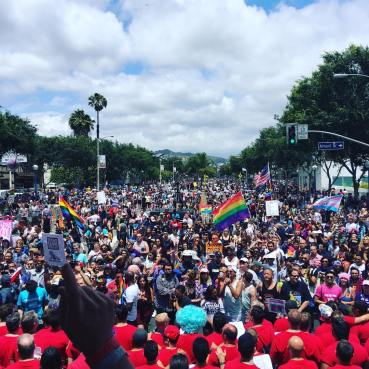
Cover PhotoAlthough my involvement during the 120 days or more that led up to the #ResistMarch happened in a flash, one thing is for certain: miracles exist not because of divine intervention but because G-d places people on this Earth to make positive impacts. The beauty of the #ResistMarch was not just the passion of the organizers but the beauty of the rainbow that came out in full force on June 11

The strength shown by our community was one that, for all intensive purposes, proves that love does conquer all. RuPaul couldn’t have expressed the common and conquering theme better than when he said: “It’s all about love; giving love and being able to receive love. That’s our secret weapon; that’s the one thing they don’t have: our love and our music. That is our activism. That is what we use and what we always use to fight the ugliness.”

That is the one experience that I took most out of the #ResistMarch: the power of love and friendship; the beauty in the unexpected conversation that leads to changing the world, again.  Thank you, Brian. Thank you, for bringing us all together to resist, recharge, and love.
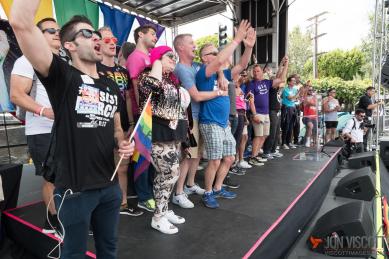
19055531_10158898620590385_6920780108892374453_o

When we come together, we are the Divine.  I didn’t think I could experience that twice in one year; clearly, I was wrong.

John Erickson is the President of the Hollywood Chapter of the National Organization for Women. John is a Ph.D. Candidate in American Religious History at Claremont Graduate University where he is finishing up his dissertation tentatively titled “Step Sons and Step Daughter”: Chosen Communities, Religion, and LGBT Liberation.” John holds a MA in Women’s Studies in Religion; an MA in Applied Women’s Studies; and a BA in English and Women’s Studies. He is the Founding and Past President of the University of Wisconsin Oshkosh’s LGBTQA+ Alumni Association and currently serves as the Chair of the Legislative Committee for the Stonewall Democratic Club, a Diversity and Inclusion Fellow at Claremont Graduate University. He is a permanent contributor to the blog Feminism and Religion, a Co-Founder of the blog The Engaged Gaze, and the Co-Chair of the Queer Studies in Religion Section of the American Academy of Religion’s Western Region, the only regional section of the American Academy of Religion that is dedicated to the exploration of queer studies in religion and other relevant fields in the nation. In April 2017, he was the first openly gay athlete to be inducted into the Wisconsin Volleyball Conference Hall of Fame. Most recently, John was one of the coordinators of the Women’s March Los Angeles, which brought together 750,000 people in downtown Los Angeles on January 21, 2017, and a Committee Member for the #ResistMarch, which brought together 100,000 people from Hollywood to West Hollywood in honor of LA Pride on June 11, 2017.