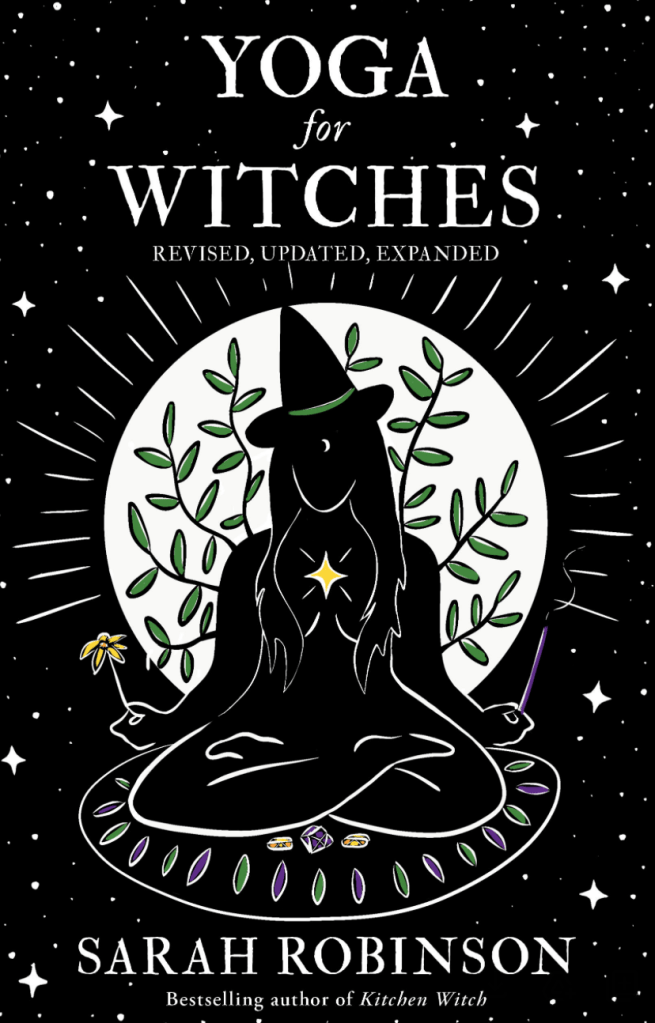
In this post, I review Yoga for Witches by Sarah Robinson, a practical book that weaves together two ancient practices with surprising similarities, yoga from the East, and witchcraft as practiced in Northwestern Europe.
I start with what I loved, and how Robinson describes the similarities and differences between those two traditions. That weaves into some personal and deeper reflections on the theoretical background and yoga sequences. At the end you’ll find a specific recommendation so you’ll know if this is the book for you!
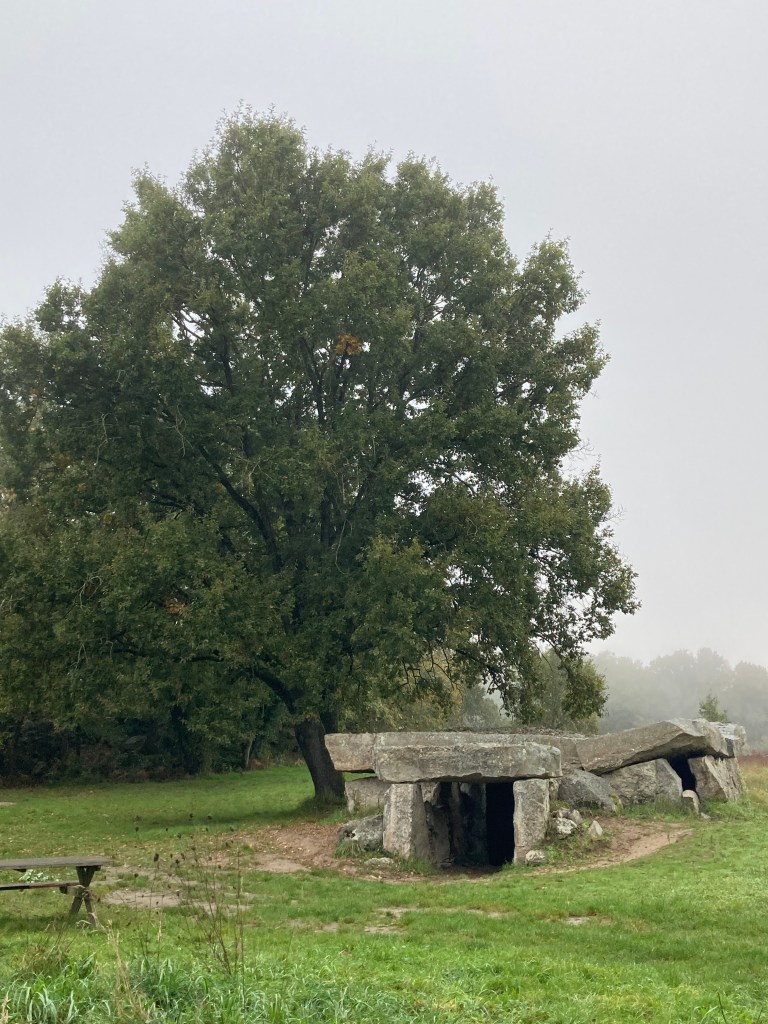
In preparation for my hysterectomy, I decided to spend a night in a dolmen at Samhain last year, to seek guidance and healing. I chose Dolmen de Bajouilière in Saint-Rémy-la-Varenne, in Northern France, a site I had discovered by chance the previous year on my local explorations.
This well-preserved structure, with its spacious square divided into two rooms, felt inviting and safe for an overnight ritual. Though I am accustomed to spending nights in neolithic monuments, mostly in the UK, I felt some hesitation, partly due to my intermediate French and unfamiliarity with the local spirits.
Nevertheless, I recognized this resistance as part of the ego’s fear of the unknown, and I gave myself permission to retreat if needed. If I would feel too vulnerable, it wouldn’t serve my body and spirit ahead of the surgery. Please join me on my overnight Samhain Ceremony full of deep imagery and transformation as I shed my womb three times…
Grief is the experiencing . . . Mourning is the process, when we take the grief we have on the inside and express it outside ourselves – writing, planting, burying, burning, rising up ceremony, ritual, community[i]
A glimpse of our cottage as I drove away.
“As long as I stayed there, I could keep you with me. . . .” Those words kept repeating in my mind throughout my long drive home from my sister, Jeannie’s, “Celebration of Life” service. I’d stopped midway on my thousand-mile journey at the cabin our family has shared for sixty years. There I could still feel her presence — on the hillside where we so often sat with our morning cups of tea, or watching the sunset, or chatting away the afternoon; on the dock where we’d lie in the sun or sit late at night and watch the stars come out, or cuddle up in blankets on windy, fall days; in the circle of couches and chairs where we played telephone Pictionary, charades, and CatchPhrase; in the kitchen where we’d cooked and eaten and played card games together; in the bedroom we often shared with a dog between our beds; the road where we’d go for family walks – eight, ten, twelve of us all together, and always two, three, or four dogs; even the driveway where we’d greet and hold each other with great gladness after months of separation, and where we’d hug and say goodbye, and then hug once more because in the back of our minds we’d be wondering if this was the last time. . . .
This week’s Torah portion is Naso (Numbers 4:21-7:89). The portion discusses who, among the Israelites, carries the components of the Miskan (Tenting of Meeting) while wandering through the desert. It also entails a census of the tribe of Levi, describes various offerings that were brought to the Tent of Meeting in general and for its twelve days of dedication, decrees keeping the ill and ‘contaminated’ out of Israelite settlements, details the Nazirite vow, gives us the priestly blessing, and proscribes the process through which women are acquitted or found guilty of affairs. There are many components of this parshah that offer food for thought when it comes to a feminist analysis, but for today, I am going to focus on where there is equality between men and women within the text and where there isn’t.
When you hear the word ‘soul’, what is your first association?
Soul is a complex and much-debated word, that often brings up strong feelings. Without going into religious or philosophical discourse, it is often associated with the breath, and with that mysterious spark of life force that animates the body. I discussed soul in a previous post Untangling the Triad of Life Force, Spirit and Soul. Today I write about soul as a fluid concept, an essence that can get dispersed and also retrieved, and propose a light self-retrieval through dance as remedy that you can do by yourself.
Moderator’s Note: This was originally posted on Rosh Hashanah Sept 10, 2015. Rosh Hashanah this year begins on Sept. 15th but FAR will be taking a 16 day hiatus at that time so we are posting today.
When I was growing up in the 1950s in my Egyptian Jewish immigrant
My father, an Orthodox man who prayed each morning and went regularly to the local Sephardic synagogue in Brooklyn, privately followed the tenets of his faith. But it was my mother, unconsciously devout, who brought the public rituals of our religion to life. As a child, I longed to be at prayer with my father and was envious of the men and boys who studied and recited the sonorous ancient Hebrew; I did not want to be confined to polishing the silver and setting the table. But today, as an adult, I am grateful for the silent teachings bequeathed to me by my mother.
In Part 1 of this post, published yesterday, I described the first steps of my personal journey of soul recovery, including my first encounter with Green Snake, in statues, dreams and hypnotherapy. Those experiences led to choosing to tattoo Green Snake on my left arm. Read more about finding my Medicine and embracing my Golden Shadow as I stepped into an ancient lineage of Snake Healers.
Sometimes we encounter really sweet, or funny gems on the road of individuation… Let’s start with one like that!
Sweet Intermezzo (6 years ago…)
In the film The Matrix, Neo receives a message to “follow the White Rabbit.” Just before I met my partner, he encountered a live Green Snake slithering across a forest trail in Thailand, followed by a Neo-like dream to “follow the Green Snake.”
This post describes some of the steps on my personal journey of soul recovery across many, many years. It can be traced back to when I was 3 or 4 years old. Each header reflects a significant moment towards finding my Medicine and embracing my Golden Shadow of stepping into an ancient lineage of Snake Healers.
Although many of the steps created an immediate shift in my consciousness, this kind of individuation usually doesn’t happen overnight. I’m sharing it to honour the unfolding trails across time, and to encourage people to surrender to their journey, while letting go of a specific outcome. Part 2 will be published tomorrow.
This post is a follow-up, in a way, to the post I published here on September 11, 2016, entitled “Continuing Pre-Christian Traditions in the Czech Republic,” and will be a combination photo essay* and elaboration on one of the rituals mentioned in that first post. On April 30th, I was in the small village where my partner’s family has their summer house. Yes, that same village that has inspired posts like this. There, we celebrated Čarodějnice, or Witches. This holiday seems to be related to what is called May Day or Beltane in other countries. What is unique about this tradition isn’t necessarily the májka (May Pole) although it is different than other places May Pole, but the burning of the witch.
Throughout the day, everything is gendered. The women and girls have certain tasks; the men and boys have too. The women and girls create and decorate. First, they create a witch to be burned on a large bonfire; the construction and shape of both can vary. After creating the witch, the women and girls (although it should be virgins – but no one really follows that tradition) decorate the top of a cut-down, very tall pine tree with strips of brightly colored fabric and crepe paper, tying them on to create what will become vertical streamers blowing in the wind, thus creating what is called a májka.





 Feminism and Religion