In 2012, shortly after I finished my priestess ordination process and I’d been facilitating women’s retreats for two years, I got a wild idea to go to a goddess festival of some kind. I did a google search and found one that sounded great—Gaea Goddess Gathering–and it was happening in just two weeks. Imagine my surprise to then look at the bottom of the screen and see that it was located only a five-hour drive from me, just over the border into Kansas. I decided it was “meant to be.” My mom and a friend signed up with me (and my then 18 month old daughter) and we packed up my van and went! The night before we left on our adventure, I sat down at the kitchen table and felt a knife-like stinging pain on the back of my leg. I’d accidentally sat on a European giant hornet (these are not regular hornets, they are literally giant hornets about two inches long).
Continue reading “Listen to the wise women by Molly Remer”Category: Goddess Spirituality
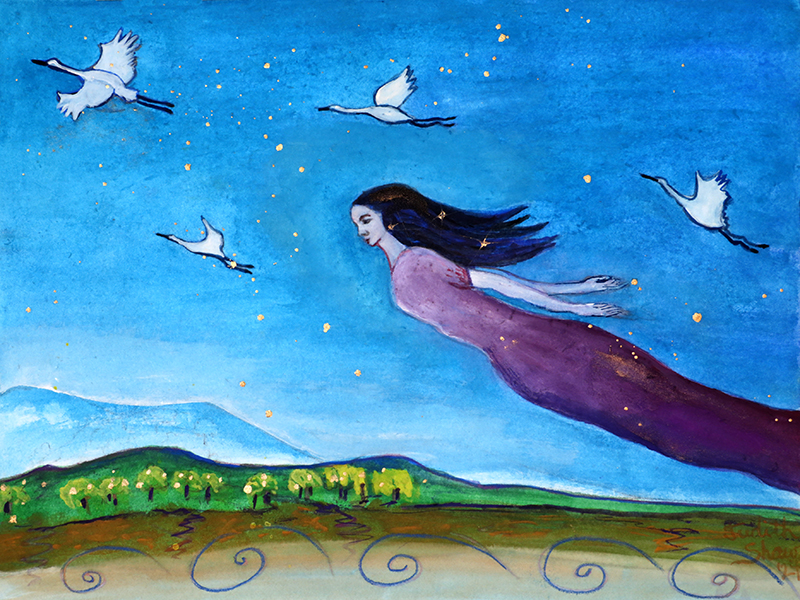
Women Fly Free by Judith Shaw
Artists tend to develop their own visual language over the course of a career, returning again and again to certain motifs. That’s certainly the case for me with trees, women and goddesses, doorways and passages, ancient symbols, flowers, and animals — in particular birds — emerging again and again.

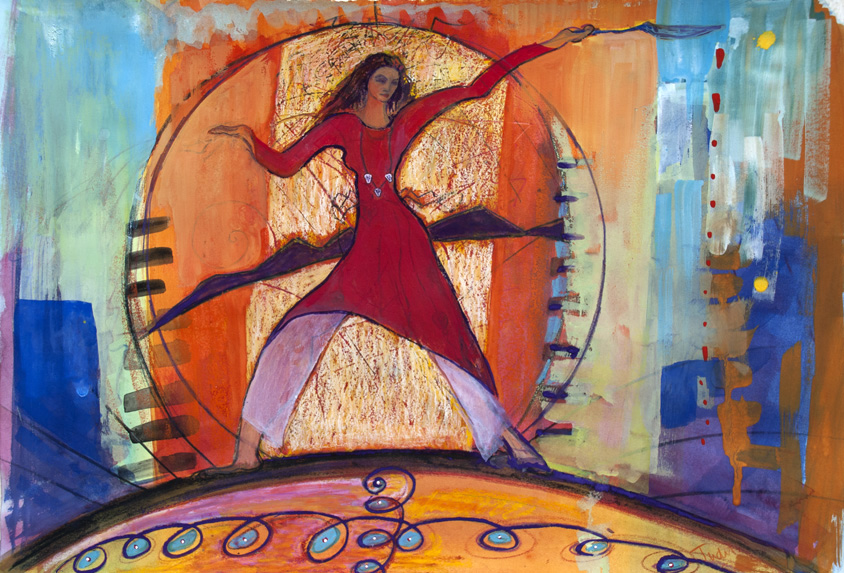
The Impresa of Great Mystery by Janet Maika’i Rudolph
The Fibonacci series has been called the fingerprint of god. That is because they are a sequence of numbers found ubiquitously in nature. I’ve been thinking up new names for it. It is a progression created by adding each number to its previous number after starting with the number one. It looks like this:
1, 1, 2, 3, 5, 8, 13, 21, 34, 55 and so on to infinity.
The Fibonacci Sequence was first described in the 12th century by Leonardo Pisano Bigollo, an Italian mathematician. His nickname was Fibonacci, which translates to “son of Bonacci.” He has been called the Leonardo of Pisa, the city of his birth. The series is unique. When you take the ratio of any two successive numbers in the series (after the three), the resultant numbers have a pattern. They fall into an increasingly narrow range with the sequence revolving around a ratio called the Golden Mean, the golden ratio, or the golden number. It is 1.618. Below is an example of how the number sequence works:

5 / 3 = 1.666
8 / 5 = 1.600
13 / 8 = 1.625
21 / 13 = 1.615
34 / 21 = 1.619
55 / 34 = 1.617
Margins for Magic, by Molly Remer
My ritual today
is to forgive myself
and to begin again
with what I have….
A rite of renewal:
Step out under the sky
whether it holds thunder or sun.
Rest your hands against your heart.
Say: I am here.
I am grateful.
Open your arms to the sky.
Feel air soothe you
and wind bless you.
Say: I am radiant in my wholeness.
I am loved.
Sweep your arms down
to touch the Earth (or the floor.)
Say: I am connected.
I belong.
Settle your hands against your belly.
Say: I am centered.
I am powerful.
I am strong.
Return your hands to your heart.
Wait.
The sacred will meet you here.
We pause today in the middle of the road to listen to a mockingbird perched in a crabapple tree by an abandoned house. In clear and rapid succession, it runs through its impressive repertoire: Phoebe, cardinal, chickadee, titmouse, laser-gun, a few extra trills and beeps and back again. We stand, heads cocked and silent, to experience the performance before walking on with a smile, pausing again to inhale deeply as we pass the wild plum trees so sweet and fleeting. I have been preoccupied with projects, feeling bright, creative energy burgeon inside me as it does around me, so many things tug at the mind and ask for time, leaving my dreams restless, my eyes wild, and my mind awhirl with both pressure and possibility, a persistent urgency that calls me on and away and out of being where I am. On the way back home, we stop again because there are five red winged blackbirds, conversing by the neighbor’s pond and we circle through the grass to examine white flowers in the pear trees and to check for peach blossoms (none). I love spring in Missouri, it restores and nourishes me. It reminds me I am home. I sit with my tea listening to a distant chainsaw and the wild turkeys in their rites of spring, a light rustle of wind, and the clinking of my flattened spoon wind-chimes from years gone by. A lone crow glides in to alight on an oak tree beneath the sun. It tips back and forth briefly, wings a satin shimmer in the sunbeams and then drifts away like a black kite through the spring sunshine. I have joked that the description of my next book could be: “I sat. I saw these things.” And, this is true, for I did, and this is my news for today.
Continue reading “Margins for Magic, by Molly Remer”Listening to Our Landscapes, by Molly Remer
Today the hawk is back, tail feathers lit gold and black by a bright and welcome sun. It stays only a moment before tilting out of the tree and continuing on its way, but this moment is enough to spark a sense of joy and wonder in my chest, the awake kind of glee that fuels and feeds me, that inspires and holds me. This feels like the Year of the Hawk to me, of clear focus and intentional commitment. I watch it glide away between the trees and take a deep breath of release and freedom. I re-center myself into my body and reconnect to the sacred What Is. I am open to clarity. I am open to trust. I am present with this day’s unfolding.
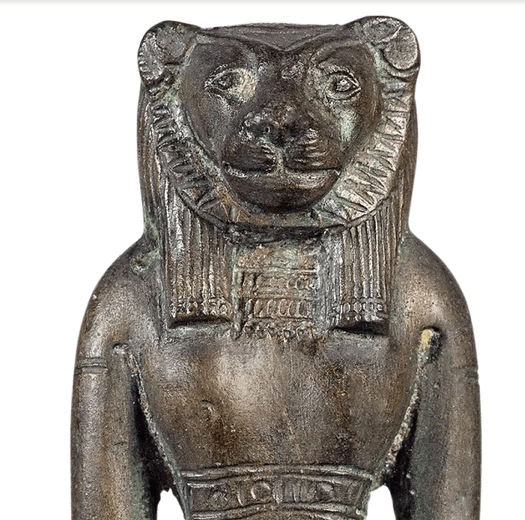
Continue reading “Listening to Our Landscapes, by Molly Remer”Embracing the Dark Goddess – Empowering Paradigm Shifts, Part 1 by Judith Shaw
I always approach the Dark Goddesses with trepidation, preferring to focus on the bright, life affirming aspects of the Goddess. Yet now I find that the difficult break-downs and violent conditions of these days are calling me to explore the terrifying aspects of the ones called “Dark Goddesses.”
But who are the Dark Goddesses and why are they called dark? That question is one of controversy within the Goddess community. Carol Christ has written that the Dark Goddess only exists as a projection of patriarchal values onto the Goddess, turning the Goddess into a force of war and terror, in particular the War Goddesses found in various cultures. Christ views war as an abnormal desire for the Goddess. Whereas others view the Dark Goddess as a part of the one Great Goddess, who encompasses all.

Integrating Snake Medicine Part 1
This post describes some of the steps on my personal journey of soul recovery across many, many years. It can be traced back to when I was 3 or 4 years old. Each header reflects a significant moment towards finding my Medicine and embracing my Golden Shadow of stepping into an ancient lineage of Snake Healers.

Although many of the steps created an immediate shift in my consciousness, this kind of individuation usually doesn’t happen overnight. I’m sharing it to honour the unfolding trails across time, and to encourage people to surrender to their journey, while letting go of a specific outcome. Part 2 will be published tomorrow.
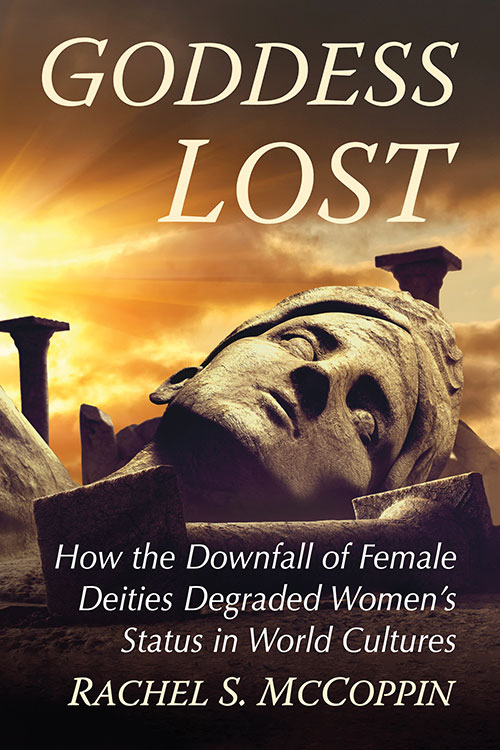
Continue reading “Integrating Snake Medicine Part 1”Goddess Lost: How the Downfall of Female Deities Degraded Women’s Status in World Cultures by Rachel S. McCoppin; book review by Margot Van Sluytman
What then is my repentance?
If not, by rote this repetition?
“Godde is.”
“Godde is.”
“Godde is.”
“Love.”
And my face tastes
The beating heart
Of the sun’s call
For reclamation of
SHE Who Is.
SHE Who Is: knows me.
She, who also, is.
©Margot Van Sluytman

From the moment I saw the title, Goddess Lost: How the Downfall of Female Deities Degraded Women’s Status in World Cultures, by Rachel S. McCoppin, I knew I would have to read it. When it arrived in my mailbox and I saw the cover, I was imbued with inspiration. Then I read two sentences in the Preface, which articulate what for me, and for many, is one of the most vital, powerful, and, as yet, under-addressed, facts.
Continue reading “Goddess Lost: How the Downfall of Female Deities Degraded Women’s Status in World Cultures by Rachel S. McCoppin; book review by Margot Van Sluytman”The Return of the Goddess to Our Human Consciousness by Caryn MacGrandle

Molly Remer of Brigid’s Grove, a fellow contributor here at Feminism and Religion recently wrote on the Mother Well section of the divine feminine app: “I feel like Inanna & Enheduanna are all around in recent months!”
Yes. I do as well.
A year or two ago, I read a book by Lauren Sleeman entitled ‘Behold’. The premise of the book has remained with me: a telling of the Goddesses, in particular Lilith, the Great Mother and Crone of the Cosmos, and Hekate, Goddess of the Dark Moon and the Mysteries of Life, who have been silently watching and waiting these past few thousand years to return to our human consciousness.
Continue reading “The Return of the Goddess to Our Human Consciousness by Caryn MacGrandle”The Vows We Make, by Molly Remer
I make a vow of self-sovereignty,
a declaration of wholeness,
a promise to myself that I will keep:
I vow to listen to my heart,
to claim my power and my voice.
I vow to live my own magic,
to step into the center of my own life
and live from there.
I vow to live a life
that includes space for me,
to stand up for what I need,
to listen to my longings,
to honor my inner call,
to do my own work with trust.
I vow to never abandon myself.
I vow to inhabit my own wholeness
in all ways.
In February, I signed up for a Vow of Faithfulness class with WomanSpirit Reclamation. Guided by Patricia Lynn Reilly (of “Imagine a Woman” and A God Who Looks Like Me fame) and Monette Chilson, the class was based on Patricia’s book, I Promise Myself: making a commitment to yourself and your dreams. Structured as a seven week online women’s circle, the class took us on a deep dive into vow-making, culminating in a vow ceremony in which we made a public (to the class that is) declaration of our own vows to ourselves. As the class unfolded, I found myself reviewing past vows as well as sensing new vows bumping up against my consciousness, whispering to be heard.
Continue reading “The Vows We Make, by Molly Remer”