The Hot Seat by John Erickson

Being a man in feminism isn’t easy and that’s how it is supposed to be.

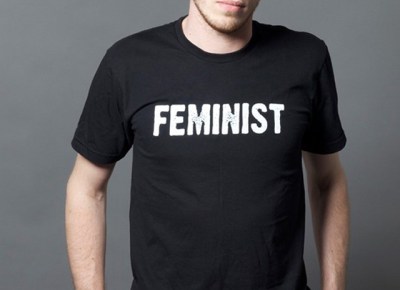
men_feminist_mainI’ve been thinking a lot about what it means to be a male feminist lately.  As the only man to be a permanent blogger on this very site until my colleague and friend Kile Jones came on board, I took my role, as a man in a traditional feminist (online) space very seriously.  Although the ongoing struggle to be a male feminist is one continually wrought with dialogues about power and positionality (amongst a host of many other topics), I am often conflicted when I see male feminists take advantage and destroy the hard work that many, specifically on this site and beyond, worked hard to build and defend.

Not wanting to reopen old wounds or start new online battles, men have been involved in feminism for quite some time.  From James Mott chairing the first women’s rights convention, to radical feminist Andrea Dworkin’s life partner John Stoltenberg, to Michael Kimmel and Michael Kaufman’s life long work to legitimize not only men in feminism but also what it means to be a man who works for gender equality, being a man in feminism isn’t easy and that’s how it is supposed to be. Continue reading “The Hot Seat by John Erickson”

To Have and to Hold: Gay Marriage and the Religion Question

If a conservative religious traditions can’t give their mothers or sisters full equality, how can we expect them to give a GLBT individual the time of day?

John Erickson, sports, coming out.Outrage.  Anger.  Fear.  Hatred.  These are just a few of the words that flashed across my Twitter feed as I woke up on that fateful Wednesday, June 26 morning when the Supreme Court of the United States ruled that the Defense of Marriage Act (or DOMA) was unconstitutional and that supporters of Proposition 8, the hotly contested voter initiative in California that banned same-sex marriage, had no standing.   People were mad.  However, it wasn’t just the typical kind of mad that is associated with hatred, it was a type gay_marriage_81102178_620x350of mad that was met with impossible anguish because what I was reading and feeling was a result of one thing: there was nothing more they could do.

What does all this mean?  Questions from friends and family were filling up my inbox and although I wanted to take a moment to just hit “Reply All,” and input the words: Equality, I had to hold back and start to examine the notion that although equality may now be firmly on the proverbial table, there is still a lot of work to be done, specifically for gay marriage and those wanting to marrying inside the traditional church spaces they grew up in and not just the ones that have come out as open and affirming in recent years towards LGBT individuals. Continue reading “To Have and to Hold: Gay Marriage and the Religion Question”

Genetic Testing: The Ethical Implications of Expanded Newborn Testing – Who Benefits? (Part One) by Michele Stopera Freyhauf

Freyhauf, Feminism, Religion, Durham, Old Testament, Blogger, Bible, Gender, Violence, Ursuline, John CarrollWith Angelina Jolie’s electing to have a double mastectomy because she carried the BRCa Gene, and her mother and aunt died at a very early age of the disease, the issue of genetic testing is in the forefront again.  This is a three-part essay explores genetic testing when it comes to newborn testing (part one and part two) and concludes with exploring personal choices, availability, and psychological ramifications of genetic testing.

BabySeq
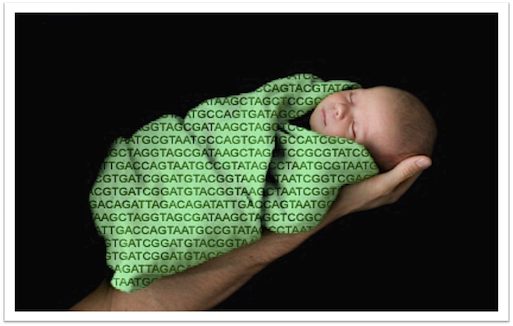
Picture originally found at http://www.ngsleaders.org/blogs.aspx

After nine months of worrying and diligent pre-natal care, the day to meet your unborn child is here.  Labor is long and for hours you lie in the birthing suite riding out contraction after contraction.  The moment finally arrives and you discover you have a son; ten fingers, ten toes and seemingly healthylungs by the cry that you hear.  He is then quickly taken over to the nurse’s station and a drop of blood from his heel is placed into a machine that in seconds will decode his entire genome. Soon your son’s future will be written in stone; he has a life expectancy of 30.2 years and has a 99% chance of dying from heart failure.  In that instance, your son has been labeled as an in-valid and he is now doomed to exist within a lower class of society, one that will prohibit him from pursuing his dreams. Society has discriminated against your new baby boy based solely upon his DNA.  A new form of eugenics is born.

This was the opening scene of the 1997 science-fiction movie called “Gattaca.” Besides pushing the bounds of human imagination, science fiction can serve as a warning about a future caused by the abuses of humankind.  The opening birth scene in this movie is quickly becoming a potential reality.  Now, a person’s entire genome can be decoded and in an instant, a person knows whether he or she will be susceptible to Parkinson’s disease, Alzheimer’s disease, Cancer, or other life threatening conditions.  Proponents of genetic sequencing believe that this is the holy grail of medical care and tout phrases like “personalized medical care” and “significantly reduced costs of healthcare.”  There is a rapid movement towards this goal through the proposed expansion of newborn screening for eighty-four conditions, most of which are not understood or have no known treatment. Continue reading “Genetic Testing: The Ethical Implications of Expanded Newborn Testing – Who Benefits? (Part One) by Michele Stopera Freyhauf”

“Free-Speech or Speech-Free?” by Kile Jones

Kile Jones, atheist[This post is written in response to the chilling effect taking place in the U.K. since the Woolwich Attack.  It is also in response to the uses of the Public Order Act of 1986.]

In any “liberal democracy” that has constitutional protections for “free speech,” there will also be laws against “inciting violence,” “hate speech,” “threats,” “slander,” “libel,” “harassment,” and other “speech codes.”  This is because the government, or those who voted on the passing of such laws, worry about the potential threat un-regulated speech will have on the levels of violence and disharmony in society.  They worry about people being able to yell “fire!” in a theatre, which can cause (which is a key word here for legal reasons) physical harm, not being held liable for such speech.  As much as I understand these worries, I am of the opinion that the potential evils brought about by a lassez-faire approach to speech morally outweigh the evils of blasphemy laws and censorship. Continue reading ““Free-Speech or Speech-Free?” by Kile Jones”

Thanks for Coming (Out): Sexuality, Sports, and Spirituality by John Erickson

I have to be honest, Jason Collins’ admission that he was a homosexual, albeit brave, upset me. While coming out is an completely unique experience to every individual that does it, Jason Collins’ story was just another example of the rampant sexist and heteropatriarachal world that privileges male bodies and sexualities over women’s similar experiences. While I applaud Jason’s story and it’s timing, the first thing I asked to my colleagues was: Where was the hubbub over Sheryl Swoopes or Martina Navratilova?

John Erickson, sports, coming out. Like marking off items on a proverbial checklist, closeted LGBTQ individuals who exist within and outside of the world of professional sports, can recount the numerous things they struggle with in terms of their sexuality.  From fearing of the actual coming out process, dressing in their car or at home to avoid the subtle glances and whispers of individuals in the locker room, to wondering what coming out would mean not only for their game but also for their social and, if they choose, spiritual lives, closeted and out LGBTQ individuals within the multi-billion dollar professional sports industry must grapple with that age old question: what does it mean to be gay and open about it?

The Locker Room

I have to be honest, Jason Collins’ admission that he is a homosexual, albeit brave, upset me.  While I understand that coming out is an completely unique experience to every individual who does it, for me Jason Collins’ story was also an example of the rampant sexist and heteropatriarachal world that privileges male bodies and sexualities over those of women.  While I applaud Jason’s story and the timing, the first thing I asked to my colleagues was: where was the same hubbub over Sheryl Swoopes or Martina Navratilova? Continue reading “Thanks for Coming (Out): Sexuality, Sports, and Spirituality by John Erickson”

(Femen)ism? by Kile Jones

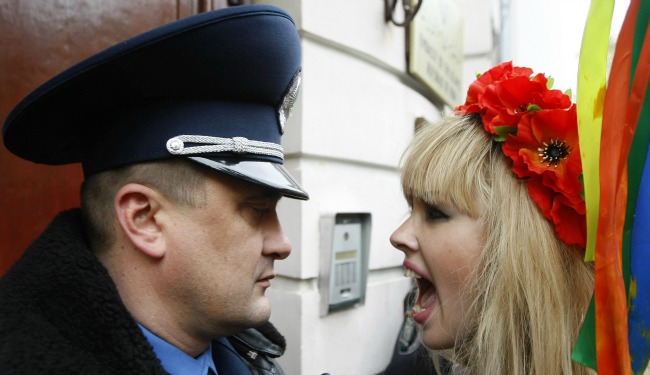
Kile Jones, atheistAs most of us are aware by now, there is a “feminist-sextremist” group from Ukraine called “Femen.”  This group has been very controversial by their public demonstrations of nudity, the words they paint on their bodies, and their explicit condemnations of political structures and organized religions.  They were started by Anna Hutsol in 2008 and have now spread throughout Europe and the Middle East.  The question I pose for this post is: Does Femen harness or hinder the power of the feminist critique?

Image from Konstantin Chernichkin/Reuters

Femen is precisely the kind of movement that pushes us in our understanding of feminism, the means by which it is best expressed, and the issues surrounding moral condemnation and religious sensitivity. Continue reading “(Femen)ism? by Kile Jones”

A Pro-Science, Skeptical Woman Speaks by Kile Jones

Kile Jones, atheistIn my last post, “Feminism and Religion: Where Do I stand?” I talked about how I support an atheistic, secular, and liberal feminism that criticizes organized religion and certain religious beliefs.  After reading the comments and responding to them, I figured that having a brief interview with a woman who holds these sorts of views would be a good way to introduce them to this blog.  I met Anondah Saide at a course at Claremont Graduate University titled, “Evolution, Economics, and the Brain,” taught by the Executive Director of the Skeptics Society and Founding Publisher of Skeptic Magazine, Dr. Michael Shermer.  Anondah was the TA for the course, and I found her comments in class to promote science, reason, and skepticism towards religious and spiritual claims of all kinds.  So without further ado, here is the interview: Continue reading “A Pro-Science, Skeptical Woman Speaks by Kile Jones”

Bringing African American Churches into Reproductive Justice by Mariam Williams

Mariam WilliamsI don’t expect to hear anything in church about the 40th anniversary of Roe v. Wade during the month of January,  the month marking 40 years since the U.S. Supreme Court made the decision to legalize abortion in this country. This is for a number of reasons: 1) it’s January, and at my church the pastor always starts off the year with a series of sermons that illustrate the church’s mission statement, and women’s choice may be off the subject; 2) Martin Luther King Jr. Day is this month, and if a black church is going to honor something or someone besides Jesus in the month of January, it should probably be MLK; and 3) I haven’t heard anything about abortion from the pulpit in a long time.

A local pro-choice movement leader asked me recently about how black churchgoers feel about abortion. I didn’t know what to say. The last time I heard it mentioned was in a Sunday School class in which a woman said that she almost aborted her daughter. It wasn’t a big confessional moment, just part of a longer testimony as to why she was happy her daughter was around, and it wasn’t received with any shock or fanfare. I can remember hearing once from the pulpit of my current church that while abortion might be wrong, the law shouldn’t interfere with what a woman chooses to do with her own body. Many years before that, in the church I grew up in, a preacher said that we would never find a cure for AIDS because the person who would have grown up to discover the cure was aborted. (What made him so sure of that? Who knows.) Continue reading “Bringing African American Churches into Reproductive Justice by Mariam Williams”

Winds of Change in the Roman Catholic Church by Michele Stopera Freyhauf

Michele FreyhaufIn 2007, I had a conversation with a professor who felt that change was in the air for the Roman Catholic Church. The basis of this opinion was based on language. The words and the context used in writings that emerged from the Vatican were changing and somehow different – a difference that went beyond personal writing styles of Pope John Paul II and Pope Benedict XVI. This professor was hopeful that positive change for women could be coming. He was right about change in the Church, however, the changes surrounding women that emerged have not been positive.

As I continue to reflect on these words, I ponder the issue of language; specifically the impact words have and the way they are used to facilitate subtle changes in thinking, opinion, and beliefs. The method of persuasion that seems to be employed is the Aristotelian Rhetorical Theory that utilizes the five canons of rhetoric: invention, organization, style, delivery, and memory.

An example of this can be seen clearly in the changes in the liturgy that occurred last year. First, the teaching comes out with the rationale as to why the liturgy needs to change. From there a discussion, especially through the media, addressing the upcoming modifications are followed by subtle changes in the liturgy beginning with the call – response and the language in the creed. Next, the language of the celebrant began to change. Finally, the full implementation of changes is made with the addition of new gestures or movements. When I discussed the mass changes with a family member, there was an admittance that the changes no longer affect them – the changes were no longer noticeable. Their memory was impacted because the routine is now second nature.

In order to come to grips with the issue of language and the observation of my professor, I wanted to do a cursory review of the writings issued by the Vatican during this period. Admittedly, with a blog post, there is a limitation as to the depth and breadth of information that can be disseminated. It is my hope to eventually complete a thorough review of the modification of language used during Pope Benedict XVI’s papacy. For now, I want to address a few observations.

Continue reading “Winds of Change in the Roman Catholic Church by Michele Stopera Freyhauf”

Don’t Worry, I Won’t Marry Your Girlfriend: Sexuality, Identity, and the Easy Laugh

No longer having to deconstruct the larger cultural and sexual narratives, heterosexuals who do not support marriage equality or feel threatened by homosexuals return to their one source of power that reinforces the ideology that they are on the right path: the Bible. “Marriage is between a man a woman,” or “A man shall not lie with another man as he would a woman,” becomes the newly reinforced heterosexual rallying cry and the progressive progress that occurred in the past becomes nothing more than a joke.

johnI must say, I will be the first to admit that the recent outbreak of videos promulgating the idea that gay men will marry a straight guy’s girlfriend or lesbians will marry a straight girl’s boyfriend all for the sake of marriage equality left me stifling my laughter as I attempted to pay attention in class.

However, after the calamity died down I took a moment to reflect upon the intrinsically embedded aspects of misdirected norms of sexuality, gender, and misogyny latent within the laugh lines and the guffaws throughout each video. Continue reading “Don’t Worry, I Won’t Marry Your Girlfriend: Sexuality, Identity, and the Easy Laugh”