A Goose Tale by Sara Wright

Coalie and the Goose

It’s the last day of November and small groups Canadian geese are still drifting around on patches of open water. I saw two small groups on North Pond. Although many skeins have flown south along the Atlantic flyway – they can migrate south as far as Mexico and South America -some geese spend the winter along coastal areas in Maine if food resources are available. It’s hard to know whether these groups are migrators from Canada who have stopped over to rest or a few that winter over nearby on the Kennebec or elsewhere along the southern coast of Maine. With warming temperatures Canadian Geese migratory patterns are changing.

Soon after their arrival the female disappears to lay 8 – 10 eggs in her nest that is securely hidden in the reeds while her mate stands watch. When the goslings are born both parents escort them through the water, one parent in front, the other behind. If threatened the male becomes aggressive, a totally appropriate behavior from my point of view. When the little ones are big enough these birds join other families for the rest of the summer and some will probably migrate together. These are such community oriented birds. They make it a habit to get along. Geese are omnivores that will eat almost anything and they mate for life, returning to their designated ‘home’ places to breed year after year. Even before the chicks arrive geese are drawn to some of the 400 million lawns in this country (especially those that are close to water) much to the dismay of some.

Continue reading “A Goose Tale by Sara Wright”

The Legacy of Carol P. Christ: THE REFUGEE CRISIS IN GREECE: A TEST OF OUR COMMON HUMANITY by Michael Bakas, translated by Carol P. Christ

This was originally posted on June 22, 2105

Note from Carol Christ: I returned home from the Goddess Pilgrimage to Crete a week ago to find my island, Lesbos, and my village, Molivos, overwhelmed with a refugee crisis of enormous proportions. We are a town of about 1000 permanent residents, and I would estimate that 10,000 or more refugees from the wars in Syria and Afghanistan have passed through our village in recent months. Local authorities and volunteers are exhausted, and there is an urgent need for help from the European Union. This week instead of my own blog, I am offering my translation of a moving plea for help from my dear friend and colleague in the Green Party, Michael Bakas, who by the way is himself a feminist.

Refugees in Mytiline 1914-1918There is nothing new about refugees fleeing from war. At the beginning of World War I, more than 50,000 people arrived in Lesbos from the nearby shores of what is now Turkey. At the end of the war many of these refugees returned to Asia Minor, but after the Greek army invaded and was driven back, the Asia Minor Catastrophe of 1922 sent nearly a million refugees to Greece.

Continue reading “The Legacy of Carol P. Christ: THE REFUGEE CRISIS IN GREECE: A TEST OF OUR COMMON HUMANITY by Michael Bakas, translated by Carol P. Christ”

Anne Brontë’s Agnes Grey: Lifting the Veil on Cruelty, part 2 by Maria Dintino

Part 1 was posted yesterday.

Here the reader further witnesses how young Tom treats his little sisters which is consistently cruel-hearted. Tom continues to describe how he will harm the helpless birds while Agnes desperately works to persuade him otherwise:

“But you shall see me fettle ’em off. My word, but I will wallop ’em? See if I don’t now. By gum! but there’s rare sport for me in that nest.”

“But, Tom,” said I, “I shall not allow you to torture those birds. They must either be killed at once or carried back to the place you took them from, that the old birds may continue to feed them.”

“But you don’t know where that is, Madam: it’s only me and uncle Robson that knows that.”

“But if you don’t tell me, I shall kill them myself—much as I hate it.”

“You daren’t. You daren’t touch them for your life! because you know papa and mamma, and uncle Robson, would be angry. Ha, ha! I’ve caught you there, Miss!”

“I shall do what I think right in a case of this sort without consulting any one. If your papa and mamma don’t happen to approve of it, I shall be sorry to offend them; but your uncle Robson’s opinions, of course, are nothing to me.”

This young charge of Agnes’s is threatening and manipulating her as he and the other children do often. Tom doesn’t realize he has hit a nerve with Agnes, where the brutal treatment of the most vulnerable is unbearable. This situation is indicative of the overall treatment she receives as a governess, as one less-worthy-than and stripped of power, yet blamed for the misbehavior of her charges.

“So saying—urged by a sense of duty—at the risk of both making myself sick and incurring the wrath of my employers—I got a large flat stone, that had been reared up for a mouse-trap by the gardener; then, having once more vainly endeavoured to persuade the little tyrant to let the birds be carried back, I asked what he intended to do with them. With fiendish glee he commenced a list of torments; and while he was busied in the relation, I dropped the stone upon his intended victims and crushed them flat beneath it. Loud were the outcries, terrible the execrations, consequent upon this daring outrage; uncle Robson had been coming up the walk with his gun, and was just then pausing to kick his dog.

“Tom flew towards him, vowing he would make him kick me instead of Juno. Mr. Robson leant upon his gun, and laughed excessively at the violence of his nephew’s passion, and the bitter maledictions and opprobrious epithets he heaped upon me. “Well, you are a good ’un!” exclaimed he, at length, taking up his weapon and proceeding towards the house. “Damme, but the lad has some spunk in him, too. Curse me, if ever I saw a nobler little scoundrel than that. He’s beyond petticoat government already: by God! he defies mother, granny, governess, and all! Ha, ha, ha! Never mind, Tom, I’ll get you another brood to-morrow.”

Uncle Robson’s appalling show of support and praise for Tom’s egregious behavior toward his governess underscores a deeply engrained and condoned misogyny. But here our usual grin-and-bear-it Agnes will not back down or be silenced.

“If you do, Mr. Robson, I shall kill them too,” said I.

“Humph!” replied he, and having honoured me with a broad stare—which, contrary to his expectations, I sustained without flinching—he turned away with an air of supreme contempt, and stalked into the house. Tom next went to tell his mamma.”

Agnes has risked her position in defense of her values, but Uncle Robson, who it is noted never pays his nieces any heed, has instilled and upholds his nephew’s cruel ways, no doubt leading him to become a person who will kick his dogs and treat all creatures deemed lesser, including girls and women, with disdain. Little Tom is “beyond petticoat government already,” encouraged and rewarded for not listening to any of the women in his life. Following the example of his father, uncle, and many of the other men in his life, Tom has already learned to disregard what women have to say.

And Tom’s mother, Mrs. Bloomfield, buys into the dysfunction wholeheartedly. The passage continues with an interaction between Agnes and lady of the house, with her defending the violent behavior of her son and blaming Agnes for interfering with his fun and games.

“It was not her [Mrs. Bloomfield’s] way to say much on any subject; but, when she next saw me, her aspect and demeanour were doubly dark and chilled. After some casual remark about the weather, she observed—“I am sorry, Miss Grey, you should think it necessary to interfere with Master Bloomfield’s amusements; he was very much distressed about your destroying the birds.”

“When Master Bloomfield’s amusements consist in injuring sentient creatures,” I answered, “I think it my duty to interfere.”

“You seemed to have forgotten,” said she, calmly, “that the creatures were all created for our convenience.”

I thought that doctrine admitted some doubt, but merely replied—“If they were, we have no right to torment them for our amusement.”

“I think,” said she, “a child’s amusement is scarcely to be weighed against the welfare of a soulless brute.”

“But, for the child’s own sake, it ought not to be encouraged to have such amusements,” answered I, as meekly as I could, to make up for such unusual pertinacity. “‘Blessed are the merciful, for they shall obtain mercy.’”

“Oh! of course; but that refers to our conduct towards each other.”

“‘The merciful man shows mercy to his beast,’” I ventured to add.

“I think you have not shown much mercy,” replied she, with a short, bitter laugh; “killing the poor birds by wholesale in that shocking manner, and putting the dear boy to such misery for a mere whim.”

“I judged it prudent to say no more. This was the nearest approach to a quarrel I ever had with Mrs. Bloomfield; as well as the greatest number of words I ever exchanged with her at one time, since the day of my first arrival.”

Agnes knows her place and if she wants to maintain her position to both assist her family and to prove she can handle the role, she must monitor herself and bite her tongue around her employers and their children. In both Agnes’s positions, the parents are portrayed as overly indulgent and uninvolved, allowing the children to misbehave and manipulate at every turn. The parents consistently take their children’s side and refuse to see any fault in them, lest it cast blame on their parenting. This creates an especially impossible arrangement for the governess to have any influence on the children, let alone get them to care about and complete their lessons.

Anne’s resting place at St. Mary’s Church in the seaside town of Scarborough, North Yorkshire.

At a certain point in the story it becomes quite clear how all will unfold, yet one cannot stop reading!

In the end, Agnes is rewarded with the love of one she has admired for some time. The icing on this happy-ending cake is that she is also reunited with the neglected dog, Snap, that one of the young women in her charge had given away, breaking Agnes’s heart. This delightful reunion takes place on the beach, a setting Anne Brontë herself cherished.

If one cannot bear the truth, don’t read Anne Brontë’s novels. Yet, it’s worth keeping in mind that if the ugly truth is kept undercover, it’s less likely to be addressed.

Anne Brontë is a Nasty Woman Writer.

© Maria Dintino 2024

Works Cited & Resources

Brontë, Anne. Agnes Grey. The Project Gutenberg eBook of Agnes Grey, 4 December 2020. https://www.gutenberg.org/files/767/767-h/767-h.htm

Ellis, Samantha. “Anne Brontë: the sister who got there first.” The Guardian. 6 January 2017.  https://www.theguardian.com/books/2017/jan/06/anne-bronte-agnes-grey-jane-eyre-charlotte

Holland, Nick. “Agnes Grey: Nothing short of genius.” Anne Brontë Blog, 9 April 2017.  https://www.annebronte.org/2017/04/09/agnes-grey-nothing-short-of-genius/

Anne Brontë’s Agnes Grey: Lifting the Veil on Cruelty, part 1 by Maria Dintino

Moderator’s Note: This piece is in co-operation with The Nasty Women Writers Project, a site dedicated to highlighting and amplifying the voices and visions of powerful women. The site was founded by sisters Theresa and Maria Dintino. To quote Theresa, “by doing this work we are expanding our own writer’s web for nourishment and support.” This was originally posted on their site on November 19, 2024. You can see more of their posts here. 

Anne, the youngest of the Brontë sisters, penned two novels in her short life. The first was Agnes Grey (1847), then The Tenant of Wildfell Hall (1848).

A sketch of Anne by her sister Charlotte.

It’s probably safe to say that Agnes Grey is the least read and appreciated of all the Brontë novels, of which there are seven. Emily’s Wuthering Heights and Charlotte’s Jane Eyre garner the most praise and attention. But Anne’s The Tenant of Wildfell Hall is not far behind, and by some accounts leads the pack.

Interestingly, all the sisters’ first novels were released in the same year, under their pen names Currer, Ellis, and Acton Bell. First was Jane Eyre in October 1847 and then Wuthering Heights and Agnes Grey together as a ‘triple decker’ in December 1847, with Wuthering Heights making up the first two parts, and Agnes Grey the third.

Continue reading “Anne Brontë’s Agnes Grey: Lifting the Veil on Cruelty, part 1 by Maria Dintino”

Moving through the Midlife Threshold

Goddess Qi Gong as a New Compass

There is a deep and insidious taboo around ageing that leaves so many of our experiences as women unspoken, as if the physical, emotional, hormonal and mental shifts of growing older should be suffered alone and hidden behind doors.

What if we can turn midlife into a positive initiation that we share together? Would it be possible to learn to read our body and psyche differently? Might practising conscious movement literally help us move through this phase? And what would happen if we re-orient ourselves towards the many faces of the Goddess?

Continue reading “Moving through the Midlife Threshold”

TOXIC POSITIVITY by Esther Nelson

Psychotherapist Whitney Goodman popularized the phrase “toxic positivity” on Instagram—the ideas of which she eventually gathered into a book with that same title (Penguin Random House LLC, 2022).  The term itself may be fairly new, however, being and staying positive “no matter what” goes way back.

Psychological exploration of the “concept of unrealistic optimism” goes back to at least 1980.  [The] “term toxic positivity first appeared in J. Halberstam’s 2011 The Queer Art of Failure, a work that poked ‘holes in the toxic positivity of contemporary life.’” (Wikipedia) 

Many of us remember Stuart Smalley on the TV show “Saturday Night Live” looking at himself in the mirror while giving himself positive, yet cringe-worthy, affirmations.

My yoga classes are full of vapid affirmations and arrogant advice.  “You are a beautiful person—inside and out.” “You are kind.” “You are caring.” “You love fiercely.”  “You can do ANYTHING you set your mind to.” Really?! Sappy shibboleths and saccharine-laced sayings don’t reach me, other than to make me uncomfortable and squirmy.

Continue reading “TOXIC POSITIVITY by Esther Nelson”

Requiem? by Sara Wright

A requiem for the seasons is an act of living remembrance for what is vanishing, be that long-cherished seasonal moments, forms of celebration that once tied us to nature’s cycles, and to more than human species – some that are going extinct.

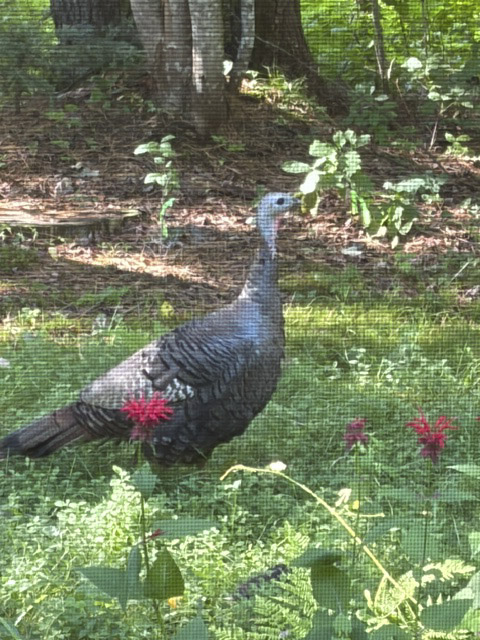
Cheeping twittering birds awakened me at dawn. The first snow of the season cast a spell over the landscape last night and this  generous dusting brought in the wild turkeys… I wished all good morning as I scattered seed under the crabapple. A couple of very friendly individuals followed me back to the door. My little dog Coalie is spellbound. She loves these birds.

I noted turkey hieroglyphics on the doormat as I came in but otherwise took no pleasure from the white shrouded landscape. I used to love snow but because each of the seasons is warming, we are getting mixed precipitation on a regular basis beginning in mid – November. The first snow opens an icy door to winters that are dominated by continuous freeze thaws. Last year I considered myself fortunate to have been able to snowshoe as long as I did.

Continue reading “Requiem? by Sara Wright”

The Legacy of Carol P. Christ: The Refugee Crisis: Through the Eyes of the Children: Review by Carol P. Christ

This was originally posted on Dec 12, 2016

Carol P. Christ by Michael Bakas high resoultionThe Refugee Crisis: Through the Eyes of the Children by Robert and Robin Jones. Santa Barbara, CA: Blue Point Books, 2016. $19.95.  Website: http://www.throughtheeyesofthechildren.com

Arriving in Molivos, Lesbos for a summer break, Robert and Robin Jones quickly became caught up in the refugee crisis engulfing the island that had been their second home for over forty years. Initially Robin and Robert provided water to weary refugees walking along the roads of Lesbos, grateful to have arrived in Europe. Soon, Robin, an artist who holds a certificate in art instruction, began providing marking pens and paper to recently arrived refugee children awaiting transport to processing centers at the other end of the island.

The children’s drawings are the centerpiece of this moving book, while Robin’s photographs and Robert’s words set them in the context of one of the many humanitarian crises of our time. “According to the United Nations High Commissioner for Refugees (UNHCR), 1,000,573 refugees and migrants arrived in Europe from the Middle East and North Africa during 2015. Of these, some 850,000 landed on the Greek islands. Of these, 49 per cent were Syrian, 21 per cent Afghan and eight per cent Iraqi.” 573, 625 arrived in the island of Lesbos between January 2015 and February 2016. Continue reading “The Legacy of Carol P. Christ: The Refugee Crisis: Through the Eyes of the Children: Review by Carol P. Christ”

The Gendered Dimensions of the Water Crisis in Iran: Impacts on Women’s Health, Livelihoods, and Security

Moderator’s Note: This post has been brought to you in cooperation with the NCRI women’s committee. NCRI stands for the National Council of Resistance of Iran. You can learn more information as well as see this original article by clicking this link. A description of their Council can be found at the end of this post.

The water crisis in Iran has moved far beyond a simple environmental issue — it has become a humanitarian, ecological, and economic disaster.

While at first the problem seemed to be the result of drought and declining rainfall, its true causes ran much deeper: entrenched corruption and mismanagement at the heart of the ruling establishment. Until these systemic roots are addressed and removed, Iran’s present — and its future — will only become more precarious.

A significant number of researchers and international observers emphasize that 70 to 80 percent of the current crisis stems from mismanagement, unsustainable policies, lack of transparency, and corruption. As one report notes, “Iran’s water crisis is not a crisis of resources; it is a crisis of decisions—decisions that have made the land thirstier and the future darker. This crisis, alongside the erosion of public trust in governance, is a symptom of structural and managerial failure.” (Newsweek, August 1, 2025; The Times, December 8, 2022; Reuters, April 27, 2021)

Continue reading “The Gendered Dimensions of the Water Crisis in Iran: Impacts on Women’s Health, Livelihoods, and Security”

Holding Our Brokenness by Elizabeth Cunningham

Dear FAR readers, here is a selection from my new collection Holding Our Brokenness, a gathering of poems. I chose these particular poems for their connection to feminism and/or religion. I hope you will enjoy them.

The Old One Speaks 

You must be unmade here
inside my grey cloak
inside my cold womb
here where the ice forms
and breaks
at the river’s edge.

What Kali Tells Me  

It’s all in the rhythm.
Falseness throws you off beat.
Rhythm renews your strength
with every step. That’s how time
becomes timelessness.

Continue reading “Holding Our Brokenness by Elizabeth Cunningham”