

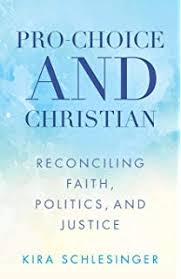
In 2015 Kira Schlesinger wrote piece for Ministry Matters about how her own pro-choice stance on abortion had become more complicated the more she explored the issue of abortion. The article was widely read and shared, as well as hotly debated by many. You can read this article and the many comments here. Out of the response to this article grew Schlesinger’s Pro-Choice and Christian: Reconciling Faith, Politics, and Justice.
The book does a great job of walking the fine line of being both academically engaging and an easy enough read to engage a book or Bible study group as well. Schlesinger uses the first couple of chapters to dig into the history of abortion, listing recorded examples of the process as early as 1300 BCE. From there she briefly walks the reader through the roughly 100 years (Comstock Act in 1873 until Roe v. Wade in 1973) during which abortion was illegal in the United States. Finally, she wraps up this beginning historical section with details about the generations after Roe v. Wade up to our current reality.
 Enter

 One of the projects I am working on these days is an essay on the religion of ancient Crete for a series of books on various aspects of the Minoan site of Gournia.
 The Torah parshah Ki Teitzei, Deutornomy 21:10 to 25:19, contains 74 of the 613 commandments/mitzvot found in the Torah. These mitzvot cover a wide range of topics and concerns. For example, there are mitzvot about how to sow and harvest your fields and others about aiding those in need, including animals. Some of the mitzvot describe how and why divorces can be decreed, to whom can one charge interest, and the punishments for various crimes. There is a mitzvah concerning the requirement to erect a fence on one’s roof to prevent people from falling off, one about not wearing clothes of the opposite gender, one about returning and/or caring for lost property and another detailing from what type of material one’s clothes can be made.


 It’s about every three years when we at Feminism and Religions put out a solicitation for a new intern to join our team. Back in 2013 we had the great privilege of having
 When I began researching years ago, I knew the names of my grandparents and what country in Europe their ancestors were from, but not much more. I have now traced most of my ancestors back to the Old Country, some to the 1600s. But there remained four ancestors with unknown places of origin among my sixteen 2x great-grandparents. A week or so ago, I decided to go back to the online resources, focusing on James Inglis, the Scottish seaman, and his Irish wife, Anne Corliss. This time I was more experienced, and I was determined to find the records.

