

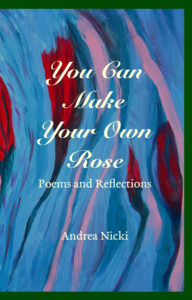
You Can Make Your Own Rose by Andrea Nicki is a collection of poems infused with the spirit of feminist sensibility, social justice and activism. The poems offer more than mere therapeutic comfort while depicting shamanic-inspired healing rituals and magical encounters. They are trauma-free in the sense that Nicki doesn’t ask for our sympathy nor does Nicki simply wish to share traumatic memories. On the contrary, she utilizes somewhat analytical and educational language, interlaced with subtle picturesque and lyrical details alongside a severe social critique, to depict the emotional, intellectual, and social landscape of her reflections on incest and other gender-related forms of abuse.
Continue reading “You Can Make Your Own Rose BOOK REVIEW by Lila Moore”

 Over the summer, I started at a new job, which I’ve decided I can safely describe as a “dream job” – one to which I can bring my full self, and in which I can use all my gifts and strengths. Whereas my old job focused primarily on anti-sexual violence work from an advocate perspective, my new job focuses primarily on sexual violence occurring in the context of human trafficking from an advocate, trainer, and policy perspective. Sex trafficking exists along and as part of the spectrum of gender violence, and yet the history of the modern movements against sexual violence and human trafficking have had very different drives and trajectories.

 At the 2009 meeting of the Parliament of World Religions, former US President Jimmy Carter called the worldwide abuse of girls and women the greatest unaddressed human rights crisis of our time. He stated that this problem is “largely caused by a false interpretation of carefully selected religious texts and a growing tolerance of violence and warfare.” Carter discussed these issues in
 The liturgy of Yom Kippur states: “On Rosh haShanah it is written, on Yom Kippur it is sealed: who will live and who will die, who by fire and who by water…” This prayer refers to a legend mentioned in the Talmud, in which the righteous are written in the book of life while the wicked are written in the book of death (and those of us who fall in-between get our own book of “in between” people.). During the High Holiday season Jews pray again and again to be written in the book of life, but by the end of Yom Kippur the language has changed: we pray to be “sealed” in the book of life. But what is this “sealing”?

