

 I’ve had the privilege of reading for pleasure this summer, a rarity in my world. Nonetheless, the books I tend to reach for are those that also pertain to my research interests and activism. I really can’t say the last time I read a work of fiction (unless you count Trump’s tweets).
Nasty Women: Feminism, Resistance, and Revolution in Trump’s America is one of the books that commanded my attention. Edited by feminist supersheras Samhita Mukhopadhyay and Kate Harding, this anthology offers essays “written at the intersection of feminism” and raises critical points about the issues women face while 45 sits in the oval office. Acknowledging the differences that impact women based on race, gender, religion, culture, sexuality, age, and so on, is an incredible strength of this volume. Packed with essays from fearless feminists who have made great impact on the ways that we think about gender and sexuality in society, Nasty Women is a must read.
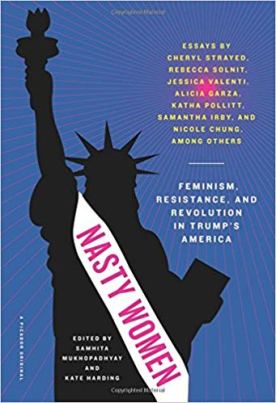 I particularly resonated with Harding’s essay where she declared her atheist beliefs and shared leaving the Catholic tradition behind except for the Communion of Saints. I recognized Harding’s journey and understood why communing with the dead was so important for her. She described adorning herself with momemtos from the women in her family who had gone before her so that they too could be a part of her experience voting for the first woman president of the U.S.; although, as we know, the election didn’t turn out the way many of us expected or hoped.
As a Catholic feminist, I often discuss that it is the women in my family that have journeyed beyond the physical that I pray to. Not God, not Jesus, but my mother, my grandmother, great aunts, cousins, friends, and feminists. It is they who know my story, who have comforted me, give me guidance, and bring me peace. Communing with those women is what gives me strength and keeps me focused on a mission for social justice. But the same is true of the living. Surrounding ourselves with other women, lifting each other up, embracing our shared experiences, and celebrating our diversity is key to creating positive social change and a world worthy of our children.
Another critical issue addressed in this volume, is that we are often far too focused on finding common ground rather than honoring the ways that we are different. In her essay “Why We Need Identity Politics,” Mukhopadhyay reminds us that identity politics is necessary in a nation where white identity is considered the norm. Anything that deviates from this — meaning the experiences of persons of color — is considered abnormal, and thus, deserving little attention. A liberal politics without identity ignores the concerns, fears, and marginalization of a significant population in our nation.
Throughout my read I found myself cheering, crying, and laughing as I recognizing so many of my own experiences, fears, hopes, heartbreaks, and so on. This said, I was also reminded of the many ways I continue to be privileged as a white middle class woman and that challenging “Trump’s America” means much more than wearing pink pussy hats and joining a march.
I admit that I bought two of the pink hats for me and my daughter — and later, two of my students each knitted me a hat for which I am very grateful. I was excited about the Women’s March and encouraged students to attend. I was thrilled to see global participation in the call for respecting women’s human rights. Embarrassingly, I did not give much thought to the many voices that were excluded in the March. Much of the attention was centered on white women’s concerns rather than the concerns of women of color. Like the Suffrage Movement where white women put their right to vote above the voting rights of women of color, the Women’s March failed to highlight critical issues for women of color and transwomen.
So how do we move forward? How can we successfully challenge the alt right movement and bigoted leadership of our country while representing the concern of all — especially those who have been silenced? According to Nasty Women, it is time to activate. We must move away from individualism and recognize our roles as members of a larger community; one that is made up of persons of different cultures, races, religions, genders, and so on. While we may not share the same political positions, as Mukhopadhyay explains, we need coalition politics. We will not be able to move forward until our efforts represent the needs of our diverse population. It is likely our only chance to build a progressive future that honors the needs of all rather than those who make up the misidentified norm.
Nasty Women, brings a wide range of voices together to demonstrate the ways that those who are marginalized continue to be excluded from the conversation. It also offers a well developed argument for identity politics and a map for creating change that matters. I’ll be adopting it in my classroom this fall as I know my students will appreciate these ideas and be able to develop a better understanding of intersectionality and its impact on our current political climate. I took a great deal away from this read, and my students will too. Regardless of where you stand, this book offers an opportunity for a dialogue that we must all be engaged in.
Gina Messina, Ph.D. is an American feminist scholar, Catholic theologian, activist, and mom. She serves as Associate Professor of Religious Studies at Ursuline College and is co-founder of FeminismAndReligion.com. She has written for the Huffington Post and is author or editor of five books including Jesus in the White House: Make Humanity Great Again and Women Religion Revolution. Messina is a widely sought after speaker and has presented across the US at universities, organizations, conferences and on national platforms including appearances on MSNBC, Tavis Smiley, NPR and the TEDx stage. She has also spoken at the Commission on the Status of Women at the United Nations to discuss matters impacting the lives women around the world. Messina is active in movements to end violence against women and explores opportunities for spiritual healing. Connect with her on Twitter @GMessinaPhD, Instagram: @GinaMessinaPhD, Facebook, and her website ginamessina.com.


 This is the first part of a series of reflections on the weekly Torah portions. For those of you unfamiliar with Judaism, we read the Torah in sections. There are 52 parshot (or portions), one parshah (portion) is read each week (most often during Shabbat morning services). It is common for rabbis, prayer leaders or someone of the congregation to offer reflections on the week’s parshah at Shabbat services.


 I touch the earth and offer gratitude

