Earth’s Mystery School by Molly Remer

“Earth is a mystery school complete with initiations and discoveries that you only experience by september-2015-123living with your feelings, touching the earth, and embracing the fullness of your humanity.”

–Queen Guenivere

(awakewoman)

On Samhain morning, I wake early and mist is rising out of the forest and dancing through the field and out of the trees. I have a moment of sheer awe to see it…the veil was literally thin.

Over the weekend, I visit the nearby river to connect in personal ceremony in appreciation before the park closes for the year and also symbolically to those at Standing Rock. This river eventually meets the Missouri River. I run my hands through the water. I anoint my brow, neck, and hands. I whisper my prayers into the ripples. I sing: “I am water. I am water…I am flowing like the water, like the water I am flowing, like the water.”october-2016-065

I am hurrying outside to get some work done. I feel tight and hurried with the length of my to-do list and my superhuman plans for the day. The bright red flame of a bloom on my pineapple sage plant catches my eye and then…the perfection of a bright yellow butterfly alighting on one slender stamen. My breath catches and I stop in wonder. I smell the flower and it smells of pineapple, just as the leaves do. I can hardly believe this treasure and the tightness melts into nothing. The rest of the day is full of joy.

I am once again healed by flowers.

About twenty feet outside my house, there is a small building with a little porch and a peaked roof. Inside, there is red carpet and a purple wall, goddess tapestries draped from floor to ceiling, and goddess sculptures in abundance. march-2016-002In this building I write, work, create, and hold small rituals with a circle of friends. I call it my Tiny Temple and it is the proverbial, “room of one’s own” described by Virginia Woolf in 1929. Having a dedicated work and ceremony space in the midst of a home-based life, which includes a home business shared with my husband, and four homeschooled children, has changed my life profoundly. In the tiny temple, I feel most wholly myself: connected, powerful, free, authentic, and completely alive.

One morning, as I walk to the temple, this beautiful rose makes me drop to my knees with delight. Yes. This right here. This is a beautiful moment. As I kneel beside the rose, the Body Prayer song* wells out of me until I have tears in my eyes.

september-2016-077  “We may need to be cured by flowers. 

We may need to strip naked and let the petals fall on our shoulders, down our bellies, against our thighs. We may need to lie naked in fields of wildflowers. We may need to walk naked through beauty. We may need to walk naked through color. We may need to walk naked through scent. We may need to walk naked through sex and death. We may need to feel beauty on our skin. We may need to walk the pollen path, among the flowers that are everywhere. 

We can still smell our grandmother’s garden. Our grandmother is still alive.”

–Sharman Apt Russell, in Sisters of the Earth

I create personal ritual almost every day in my tiny temple, sometimes simple, sometimes elaborate, sometimes tearful, sometimes joyful, sometimes hurried, sometimes leisurely, sometimes distracted, sometimes astonished at the wonder of it all. The week of my rose worship experience, I smudge the temple with sage I grew in the flowerboxes by my front porch. I ring my bell 13 times. I sing “I Am Fire.” I lay out cards and tiny goddesses and create a mandala out of fallen leaves. I leave an offering of flowers from the herbs and let rose petals drop from my fingers. Ritual captivates all the senses…in this sacred space, I invoke my own senses of smell, touch, sight, sound, and wonder and the result is magic.

“Through ceremony we learn how to give back. When we sing, we give energy through our voice; when we drum, we allow the earth’s heartbeat to join with our own; when we dance, we bring the energy of earth and sky together in our bodies and give it out; when we pray, we give energy through our hearts; when we look upon our relations, we give blessings through our eyes. When we put all these activities together, we have a ceremony, one of the most powerful forms of gift-giving we humans possess.”

–Sun Bear and Wabun Wind

May we each be healed by flowers, time to ourselves to sit on the earth and sing, and the simple, every day beauties and miracles that surround us each day.

october-2016-003

Notes:

august-2016-199

Molly has been “gathering the women” to circle, sing, celebrate, and share since 2008. She plans and facilitates women’s circles, seasonal retreats and rituals, mother-daughter circles, family ceremonies, and red tent circles in rural Missouri and teaches online courses in Red Tent facilitation and Practical Priestessing. She is a priestess who holds MSW, M.Div, and D.Min degrees and finished her dissertation about contemporary priestessing in the U.S. Molly and her husband Mark co-create Story Goddesses, original goddess sculptures, ceremony kits, and jewelry at Brigid’s Grove. Molly is the author of Womanrunes, Earthprayer, and The Red Tent Resource Kit and she writes about thealogy, nature, practical priestessing, and the goddess at Brigid’s Grove

First Time But *Definitely* Not the Last by Vibha Shetiya

vibpicLike many others, I too have been thinking of this election the past month or so. A lot has been said about the repercussions a Trump presidency will have on immigrants, women, the LGBTQ community, non-Whites…the list is endless. But in this post, I would like to talk about personal matters, and what it meant for a first-time voter like me to vote in the US elections. I have been living in the United States for over seventeen years, but only recently – in April this year – did I apply for citizenship.

I’ll be honest. I didn’t know much about Hillary Clinton or American politics. But the good thing that has come out of this cycle is that it has made me want to learn more about governance, elected representatives and what they are doing (or not) for the people they claim to represent. It has made me want to learn about why people hate Hillary so much. I don’t understand the refrain, “She’s a liar”; why she has been singled out for so much hatred when clearly the opposition isn’t exactly a paragon of virtue.

Despite being relatively apolitical prior to this election season, however, there was one thing I was really excited about – the fact that, for the first time in American history, a woman was running for president as a candidate of a major party, that too with a good chance of winning. Now, of course, being from India I was cautious about what this could actually mean for the ordinary American woman. After all, did Prime Minister Indira Gandhi’s rise to power necessarily create a dent in the patriarchal nature of Indian culture and society? Continue reading “First Time But *Definitely* Not the Last by Vibha Shetiya”

The Refugee Crisis: Through the Eyes of the Children: Review by Carol P. Christ

Carol P. Christ by Michael Bakas high resoultionThe Refugee Crisis: Through the Eyes of the Children by Robert and Robin Jones. Santa Barbara, CA: Blue Point Books, 2016. $19.95.  Website: http://www.throughtheeyesofthechildren.com

Arriving in Molivos, Lesbos for a summer break, Robert and Robin Jones quickly became caught up in the refugee crisis engulfing the island that had been their second home for over forty years. Initially Robin and Robert provided water to weary refugees walking along the roads of Lesbos, grateful to have arrived in Europe. Soon, Robin, an artist who holds a certificate in art instruction, began providing marking pens and paper to recently arrived refugee children awaiting transport to processing centers at the other end of the island.

The children’s drawings are the centerpiece of this moving book, while Robin’s photographs and Robert’s words set them in the context of one of the many humanitarian crises of our time. “According to the United Nations High Commissioner for Refugees (UNHCR), 1,000,573 refugees and migrants arrived in Europe from the Middle East and North Africa during 2015. Of these, some 850,000 landed on the Greek islands. Of these, 49 per cent were Syrian, 21 per cent Afghan and eight per cent Iraqi.” 573, 625 arrived in the island of Lesbos between January 2015 and February 2016. Continue reading “The Refugee Crisis: Through the Eyes of the Children: Review by Carol P. Christ”

Reminder: Applications for FAR Project Intern Due 12/15

Art work designed by Jaysen Waller - http://www.jaysenwaller.com/

Interesting in Working with FAR?
Feminism and Religion is seeking a creative, industrious, responsible, and highly-organized feminist, womanist, or mujerista interested in working for our community-oriented collaborative online feminist project.

We seek someone with solid knowledge of the field, excellent writing and editing skills, and the ability to engage WordPress and other forms of social media. Responsibilities include reviewing, editing, and uploading posts, responding to comments, recruiting new contributions, and sharing content.

Although this internship is not monetarily compensated, it is designed to be a learning opportunity. FAR co-weavers will work closely with intern to help provide a positive learning experience. This internship is a 6 month position, with the option to renew, and requires approximately 10 hours per week.

Values and Expectations:
We work to create and maintain a positive, encouraging, and collaborative environment for Feminism and Religion and its broader community. A FAR intern is expected to value:

  • diversity
  • dialogue
  • collaboration
  • community building
  • gender justice

To Apply:
Please e-mail FAR co-directors at (feminismandreligionblog@gmail.com) with:

  • Your resume, including 2 references who can speak to your reliability, diligence, organizational style, and responsibility (these can be professional, academic, or scholastic).
  • A cover letter indicating the reasons you are interested in working with FAR.  Please highlight your interest and background in feminism, religion, gender justice issues, and/or gender/race/sexuality issues in religion.
  • A writing sample between 1000-2500 words – a blog post is ideal.

Applications are due by end of day December 15th, 2016.
Candidates will be contacted for more information and to schedule interviews in January.

For more information, contact Xochitl Alvizo or Gina Messina: feminismandreligionblog@gmail.com

About FAR:
Feminism and Religion (FAR), feminismandreligion.com, is a project that brings together multiple feminist voices from around the world to dialogue about the “f-word” in religion and the intersection between scholarship, activism, and community. It was established in the hope that feminist scholars, activists, and practitioners of religion — and all who are interested in its related topics — would utilize this forum to share their ideas, insights, and experiences, so that the community of thinkers would be nurtured as diverse and new directions are explored. The project has been incredibly successful in offering such a space and continues to act as a medium for feminist community.

Supporting Embodiment: Societal and Jewish Views on Body Modification by Ivy Helman

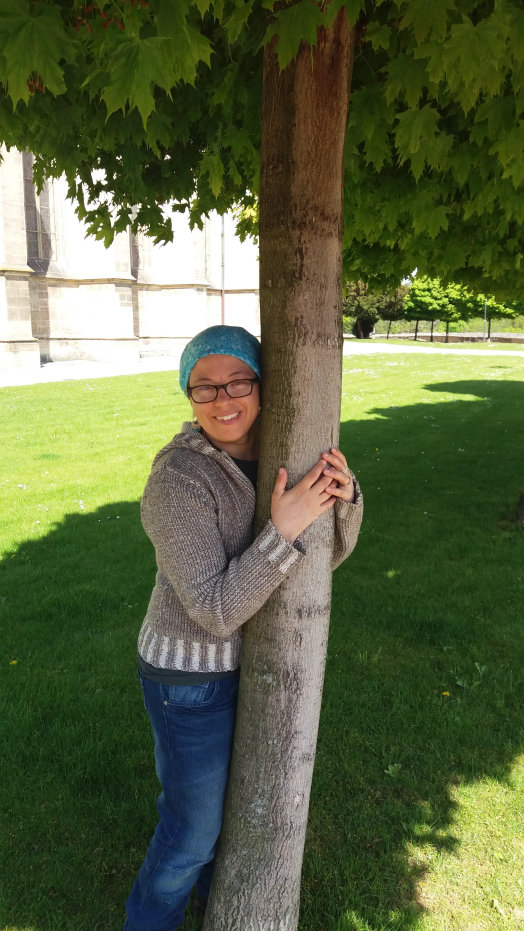
me-hugging-treeEmbodiment is a feminist principle which has, as its basis, two fundamental criteria.  First, humans require their bodies to live.  We must acknowledge that our existence is tied to our bodies.  This fact grounds us in this world.  Here, and not in some other-worldly place, we live out our lives.  We are dependent on our bodies and what the world provides for our survival.  In other words, humans are inseparable and interconnected to this world.  Humans are not above nature as the Western hierarchical dualist mindset would suggest.

Second, embodiment challenges the hierarchical dualistic notion that the mind and body are separable by connecting the mind to the body.  Humans do not exist because they think, as Descartes once said.  Rather, humans exist because of a complex system of interactions between body and mind. Without the body, the mind fails and vice versa.  The link between the mind and the body has led many feminist theorists to reject any sort of existence beyond this physical life.  That is a topic for another time. Continue reading “Supporting Embodiment: Societal and Jewish Views on Body Modification by Ivy Helman”

Painting Mary(s), Queering Mary(s) by Angela Yarber

Mary 1
Mary

It’s no secret that the holidays are often a difficult time for queer people. Disproportionately estranged from family, we often must create our own family. While these chosen families can be tremendously life-giving, it’s tough not to long for our families of origin during Christmas time. Many still in relationship with family are forced to retreat to the closet for fear of safety or exclusion this season.

Queer folk who have affirming families of origin still experience the twang of heteronormativity in holiday commercials, family events, and church services throughout December. There’s a reason why many refer to it as “Blue Christmas,” because, well, the holidays can leave us feeling pretty blue when our identities are invalidated, excluded, questioned, or marginalized.

In every nativity scene, we see images of a so-called “holy family” that likely doesn’t look very much like the family’s most queer folk create: a straight, cisgender couple, and a baby. This family is lauded by the Church as the quintessential iteration of what family should look like. When our families don’t look anything like this, it’s easy to see how celebrating the birth of Jesus is fraught with emotional and spiritual hardship.

Mary 5
Virgin de la Regla

There is good news, though. We can subvert this narrative of traditional family by queering the story. So, I’d like to talk a bit about the revolutionary power of queering Mary. Abolitionist and Women’s Rights Activist, Sojourner Truth, said it best at the 1851 Ohio Women’s Convention. Once a slave, Truth questioned the whitewashing done to women of color by white women working only for white women’s right to vote by asking the famed question, “Ain’t I a woman?” In that same speech, she notes that male clergy claim that women “can’t have as much rights as men ‘cause Christ was a man.”

This adage is familiar, not only to women, but also to LGBTQs who have been told that our iterations of family aren’t real or true or right because they don’t reflect the so-called holy family of Joseph, Mary, and Jesus. In an act of theological brilliance and subversion, Sojourner Truth poses this question to the male clergy gathered at the convention: “Where did your Christ come from? Where did your Christ come from? From God and a woman. Man had nothing to do with him!” Continue reading “Painting Mary(s), Queering Mary(s) by Angela Yarber”

Moving Forward and into a New Season by Elise M. Edwards

elise-edwardsIt’s only been a month and I am still reeling from the US presidential election.  I feel like I’m just beginning to emerge from the sense of loss and futility that has cloaked me.  But I am beginning to move forward.

I don’t feel better.  I’m still confused and discouraged about why people voted for Donald Trump.  I’m very concerned about his cabinet picks and his proposed policies.  But I am actively seeking a path forward and a path of resistance.  I’m finding support in my spiritual practices and communities.

In the Christian calendar, we are in the season of Advent.  Advent carries profound symbolism, and this year it is especially poignant for me.  The word advent bears meanings of arrival, birth, and emergence.  It’s the beginning of the Christian year, which is patterned on the life of Christ, but the year does not begin Jesus’ birth.  That celebration is observed at Christmas, four weeks into the church year.  The weeks preceding Christmas are a time of preparation and reflection on the need for the Incarnation.  The Incarnation of God in the Christ Child may be a distinctly Christian doctrine, but I believe the need for it–even the idea of it–is found in other spiritual and religious teachings.

Continue reading “Moving Forward and into a New Season by Elise M. Edwards”

Be Still by Natalie Weaver

Natalie Weaver editedBe still, and know that I am God.

During this season of Advent, I have found great comfort in one biblical passage, Psalm 46:10, which translates as “Be still, and know that I am God.”  

I take comfort here, when the rest fails me.  I find myself, especially during this season, often unable to pray in the way I think prayer is supposed to be offered.  Even though I know quiet, non-cognitive prayer that thrums like one’s heartbeat is as legitimate as a dozen rosaries or impassioned petitions, I sometimes struggle to affirm myself in this.  Like many academic theologians, I get lost in my mind that knows too many critiques, deconstructions, and rational responses.  I teach on the theology of suffering, and I spend hours every week with spiritual caregivers, healthcare providers, funeral directors, and chaplains, who discuss hospice, childhood cancers, car accidents, and stunning grief.   I teach on pastoral care, spirituality, and addiction, where we explore the complicated nature of hope in the face of largely hopeless circumstances.  I am not sure I ever believed in miracles or lucky rabbit feet.  I am in equal parts terrified and dumbfounded by humanity’s divine pleas that go unanswered. I am, in addition to a dozen other descriptors, depending on the time of day, a critical realist, an empiricist, a stoic, perhaps an epicurean, definitely an existentialist, and, Lord, have mercy, a feminist.   Prayer in both traditional ecclesial and fiery personal senses often struggles in this company. Continue reading “Be Still by Natalie Weaver”

“Tricolor Mary: Encountering Three Faces of the Divine Feminine” by Simone Grace Seol

simone-graceI always felt curiously distant from the figure of Mary. I always sensed that there is so much there and yet, I could never connect to it emotionally.

The foil to Eve, vessel of Love, suffering mother. I wanted to love her, I wanted to feel her, I wanted to feel drawn to the mystery of Marian devotion. But I felt alienated by the vision of the feminine that she seemed to project: the pure, immaculate, virginal, submissive, obedient, quietly suffering.

Most days, I feel like the opposite of every single one of those qualities.

It’s exactly the kind of feminine archetype I don’t really relate to — the kind of person about whom people say, “oh, she’s really nice” as if yielding compliance and non-offensiveness are her primary attributes. The kind of woman who fades into the background, whose worth lies only in her utility to the patriarchal narrative. Continue reading ““Tricolor Mary: Encountering Three Faces of the Divine Feminine” by Simone Grace Seol”

Down on the Farm by Carol P. Christ

iloff-grave-with-carolIn the past week I visited Cherry Ridge, Honesdale, Wayne, Pennsylvania in the Pokonos, where I was welcomed by my third cousin Marcia Perry Gager whose family never left the place where our ancestors settled.  Marcia and I have been corresponding about our family’s history since Ancesty.com connected us about three years ago. During that time, together with another cousin, Debra Ball, we have managed to decipher the complicated history of Henry Iloff, his two wives, and their eighteen children.

My visit to Honesdale began at John’s Evangelical (formerly German) Lutheran Church.  Following a last-minute discovery that the baptism, marriage, and funeral  records of the church were not in the Wayne County Historical Musem archives as I had been led to believe, I made a call to the “emergency number” of Pastor Richard Mowery the day before our scheduled visit, not knowing how he would respond to this “not-really-emergency” invasion of his personal space. Continue reading “Down on the Farm by Carol P. Christ”