The Patriarchal Dilemma by Janet Maika’i Rudolph

I was listening to a newscast when it was reported that the Ukraine sent missiles into Russia. My initial thought was “it’s about time they took it to the Russians.” The next moment I was horrified at myself.  I am a pacifist.  I think the proliferation of weapons is one of humankind’s great evils and here I was cheering on an attack.  One that could escalate an already nasty war, lead to nuclear weapons use and possibly even a world war. And yet when I look at what is happening in Ukraine, my mind simply can’t comprehend what the people are going through. The trauma of the children cuts particularly deeply. And I can see no sane reason behind the strikes other than rank cruelty.

There it is in a nutshell, what I have come to call the patriarchal dilemma. It’s a no-win situation with no right answer. While life might place us in such positions all on its own, the patriarchal form of this is created by design. It is nasty, it is cruel, and loss of human life and ecological destruction are not glitches but features.

Continue reading “The Patriarchal Dilemma by Janet Maika’i Rudolph”

The Motomami Theology: “Segundo chingarte, lo primero Dios.”* Part II

*“God comes first. Fu*king you, a close second.”

In Part 1 of this post, I described my first encounters with Rosalía’s music and visual arts, which are controversial for many, but I find them wonderful. I mentioned how she integrated God, mainly Catholic references and images, into a story of love and suffering in El Mal Querer. But I finished emphasizing my surprise when I listened to the album Motomami, since she managed to combine reggaeton (sexual-indecent music) and her views of God.

So, here is my attempt to describe Rosalía’s theology in Motomami. (Before I start, let me say: yes, I heard every song multiple times collecting references of God or the Christian tradition, so I hope you enjoy it.) Rosalía understands God as someone who controls our destinies amid grief and joy. In Como un G she says “It’s sad when you want something, but God has different plans for you” (“Qué pena cuando quieres algo pero Dios tiene otros planes pa’ ti”.) In Diablo, she says, “What God gives, God takes back” (Si Dios te lo da, te lo quitará), referring to her fans who first loved her but afterward became haters. God also protects us from an evil former partner when she says in Despecha‘ “May God forbid I go back to you” (“Que Dios me libre de Volver a tu la’o). God also is our help and supports our choices. Rosalía brings this concept talking about her identity as a woman, her freedom and autonomy in Saoko: “I know who I am, and I don’t forget where I’m going. I’m driving while God guides me. I am mine and I transform myself” (“Sé quién soy, y a dónde voy nunca se me olvida. Yo manejo, Dios me guía.)

Continue reading “The Motomami Theology: “Segundo chingarte, lo primero Dios.”* Part II”

The Motomami Theology: “Segundo chingarte, lo primero Dios.”* Part I

*“God comes first. Fuc*king you, a close second.”

I went to Rosalía’s promotional concert for the Motomami album in Boston a month ago. I knew some songs from her 2018 album El Mal Querer (Bad Love), a musical masterpiece. That album made Rosalía a visible star in the constellation of musicians and composers in Hispano-American mainstream music. The album has a particular story that Wikipedia explains very well:

The album was written by Rosalía and co-produced with El Guincho on an initial low budget as an independent artist. Presented as experimental and conceptual, revolving around a toxic relationship, the album was inspired by the anonymous 13th-century Occitan novel Flamenca. Therefore, every song on the album is conceived as a chapter of the book. It served as the singer’s baccalaureate project, graduating from Catalonia College of Music with honors. [Read more here]

In El Mal Querer, Rosalía mixed electronics, contemporary dances and rhythms, and traditional flamenco sounds and movements in a beautiful musical and visual collage. Some musically conservative audiences characterized the album as the “profanation” of traditional flamenco music, but there’s no doubt that Rosalía brought the genre back to life and made it mainstream again.

Continue reading “The Motomami Theology: “Segundo chingarte, lo primero Dios.”* Part I”

A Womanist’s Perspective by Sara Wright

Last night I was listening to plant scientist Monica Gagliano who is pushing the boundaries of what we know about plants. She proved that plants respond to the sound of water by moving toward it and cannot be tricked. Bio-acoustics is the study of sound and Monica is researching other ways that plants communicate. We know they use chemical messengers to warn each other above ground and below through the mycelial network thanks to the work of Suzanne Simard who I shall discuss in a moment. We have learned that plants emit electrical impulses. But Monica is studying another way that plants communicate. She says they listen to all the plants around them and learn from each other so that they do not have to re-invent the wheel with each generation. In one amazing memory experiment mimosa plants taught her that plants remember what happened to them previously and don’t repeat their mistakes. The Mind of Plants was her first book. She also studied with Indigenous healers in the Amazon and discusses this mysterious and compelling journey in her latest book Thus Spoke the Plants.

Continue reading “A Womanist’s Perspective by Sara Wright”

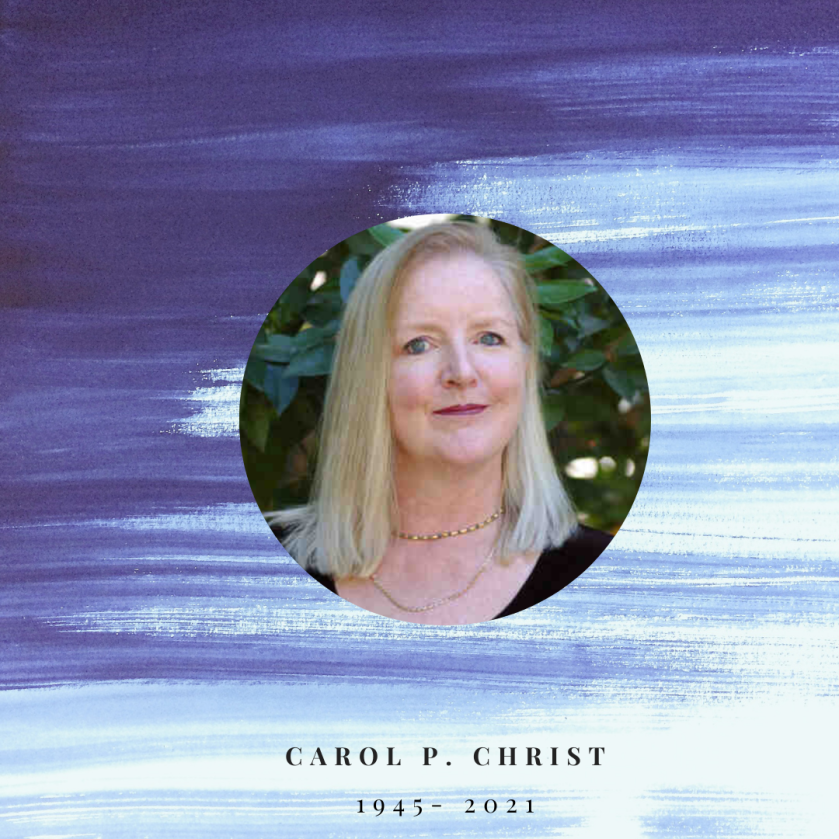
Legacy of Carol P. Christ: Mountain Mother, I Hear You Calling

This was originally posted on July 7, 2014

The mountaintop shrines of Mount Juctas in Archanes, Crete are situated on twin peaks, which may have symbolized breasts. Ancient shrines on the northern peak date from 2200 BCE until at least the end of the Ariadnian (Minoan) period in 1450 BCE. A crevice in the rock was filled with offerings of pottery, clay images of women and men in ritual dress, diseased bodies and body parts, sheep and cattle, and other objects. Excavations to a depth of 13 meters did not reach the bottom layers. Many offerings had been burned, suggesting that the objects were first thrown into fire and then dropped into the crevice. People who climbed the mountain for the festivals would have spilled over both peaks and there may have been shrines as well as fires on both of them.

Continue reading “Legacy of Carol P. Christ: Mountain Mother, I Hear You Calling”

Finding that Feeling and Standing to Heal the Earth by Caryn MacGrandle

Something happened to me while listening to a song yesterday Mycelia by Yaima Music about the Mycelium Network: the largest living organism in the world underneath our feet, connected by synapses, communicating and assisting life. I found that feeling. 

The one where you know you are on Path.

Laney Goodman who just passed, I remembered her singing and drumming.  I remembered being at ALisa Starkweather’s Daughter of the Earth events, meeting the hundreds of Priestesses that ALisa has brought together and trained over the years. Being in awe. Wishing I was a person who could do that.

I remembered that I Am.

“Starting to Hear the Earth
Standing to Heal the Earth”

Continue reading “Finding that Feeling and Standing to Heal the Earth by Caryn MacGrandle”

The Curse of Being Kind

Since earliest childhood, girls have been admonished to be kind and accommodating. To repress our intuition and gut instincts. We’ve been socialized to gaslight our innate sense of right-and-wrong and self-preservation in order to be NICE, to appease. Good Girls never get mad. They never judge or clutch their pearls. They’re not allowed to have boundaries—it’s so unfeminine!

Even now, when we think we’re in a more progressive age, “Be Kind” T-shirts are mercilessly marketed to women and girls who are still expected to be the default support humans, even if it’s not in their best interest.

Continue reading “The Curse of Being Kind”

From the Archives: Storytelling as a Spiritual Practice by Nurete Brenner

This was originally posted on April 10, 2019

“The master’s tools will never dismantle the master’s house.” Audre Lorde

Question: What tools do we have that are powerful enough to dismantle the Master’s house?

Answer: Storytelling.

Storytelling does not belong to the “master.” Storytelling is subversive because it belongs to the collective and not to the individual; it gives agency to the powerless; it is not dependent on time or money, and it makes visible those who are overlooked and ignored in our globalized industrialized system.

We are not seeking to overthrow the patriarchy or “master,” and replace him with a queen. We are seeking something which Riane Eisler (2002) would call a partnership society or a society in which polarities are well balanced, in which the masculine and feminine values which we all hold are given equal weight.  We have become so indoctrinated in the patriarchal master’s way of thinking that we think we need some show of force, some violence, some upheaval to create the more beautiful world. But – truthfully – it won’t look like that. It might actually look like a group of women and men gathering together in a circle, in community, to tell stories. Storytelling is subversive because it belongs to the community; it is a medicine to transmute the toxins of industrialized society; it is a spiritual practice. Storytelling is the antidote to empire.

Continue reading “From the Archives: Storytelling as a Spiritual Practice by Nurete Brenner”

Hawaiian Adventure Shamanism by Janet Maika’i Rudolph

Plumeria, one of the fragrant flowers often used in leis.

While my experience of Hawaiian spirituality isn’t explicitly feminist, I am attracted to it because of its loving and gentle nature. It doesn’t feed the patriarchy. It is a philosophy that doesn’t use dogma but rather principles. It doesn’t work as a top-down power system but rather as an internal power extending to the external world. This is reflected in one of our principles: “all power comes from within.”

I was ordained as an alaka’i (spiritual guide) in October 2016 by Serge Kahili King the founder of Aloha International. He teaches Hawaiian Adventure Shamanism or Huna for short. Huna means secret. It isn’t a secret in the sense of something that can’t be shared but rather something that is esoteric or hard to see. You can think of it like the mists of the sea, hard to distinguish and even harder to hold on to. But all real nevertheless.

Continue reading “Hawaiian Adventure Shamanism by Janet Maika’i Rudolph”

From the Archives: They Really Do Hate Us* by Esther Nelson

This was originally posted on Nov. 20, 2020

A year or so before the November 2020 U.S. presidential election, a private Facebook group now titled “Wives of the Deplorables! Go Vote!” came together because many women were distraught about the political ideological rift between them and their husbands—a rift that became more evident as Election Day 2020 drew nigh.  Women, stunned and disappointed by the Trump-like behavior (angry, petty, and argumentative) of their Trump-supporting husbands or partners, encouraged each other virtually as Biden (now President-elect) moved closer and closer to winning the White House.

From the group’s private Facebook page: “This is a group created after a CNN report about the wives of Trump Supporters. This is not a politically affiliated group….This females only group is created to support each other and help women share their thoughts.”My sister Betty joined the group. Her Trump-supporting husband, she said, had been brainwashed by Fox News. One need not have a Trumpster spouse to be part of the group, but one must be supportive of the members who are upset, even devastated, by having become the target of their partner’s anger and rage when they discover “their women” voted (or planned to vote) for Biden.  Thanks to her invitation to join the group, I have been able to get a glimpse into the lives of these 2,000 or so members who feel demeaned—and yes, even hated, by their spouses. The group remains active post-Election.

Continue reading “From the Archives: They Really Do Hate Us* by Esther Nelson”