Legacy of Carol P. Christ: What Does Mother’s Day Mean in a Patriarchal and Matricidal Culture?

This was originally posted on May 9, 2016

When we seek immortality or spiritual “rebirth,” are we not saying that there is something wrong with the “birth” that was given to us through the body of our mothers? In She Who Changes and in “Reading Plato’s Allegory of the Cave as Matricide and Theacide,” I asserted that our culture is “matricidal” because it is based on the assumption that life in the body in this world “just isn’t good enough.”

What is so wrong with the life that our mothers gave us that we must reject it in the name of a “higher” spiritual life? The answer of course death.

Can we love life without accepting death?

Can we love our mothers if we do not accept a life that ends in death?

Jesus was said to have encouraged his disciples to leave their wives and families in order to follow him.  When he was told that his mother and brothers were outside and waiting to speak to him, he is said to have said:

“Who is my mother, and who are my brothers?” And stretching out his hand toward his disciples, he said, “Here are my mother and my brothers!  For whoever does the will of my Father in heaven is my brother, and sister, and mother. (Matt. 12:48-50)

Continue reading “Legacy of Carol P. Christ: What Does Mother’s Day Mean in a Patriarchal and Matricidal Culture?”

Patriarchy and the Supreme Court by Janet Maika’i Rudolph

I am pissed! I wrote this blogpost the day after Beltane when the leaked draft of the Supreme Court majority opinion regarding Roe v. Wade was leaked to the public. I was up anyway feeling the effects of PTSD. Lessons that Carol P. Christ wrote about and brought to my own consciousness were rattling around my head. The first is her definition of patriarchy: “patriarchy is a system of male domination in which men dominate women through the control of female sexuality with the intent of passing property to male heirs.” This definition was part of a 3-part series she wrote (and we recently re-posed in her legacy posts) beginning here.

They are all well worth reading.

I was raped in 1977 when I was 22 years old. This after being abused by my father. I never got pregnant, but I was suicidal after the rape. Had I been pregnant without recourse to ending it, I would without a doubt have stabbed myself in the stomach or reached for that metal coat hanger. (I was too young to face pregnancy when my father abused me.) Had the result been my own death, that would have been warmly welcomed on my part. To this day, I still self-mutilate at times when stress becomes too much.    

Continue reading “Patriarchy and the Supreme Court by Janet Maika’i Rudolph”

Carol P. Christ’s Legacy: Great Goddess, Mother Goddess, Creatrix, Source of Life

This post was originally posted on February 5, 2018

The symbol of the Goddess is as old as human history. The most ancient images of the Goddesses from the Paleolithic era are neither pregnant nor holding a child. In Neolithic Old Europe the Goddess was most commonly linked with birds or snakes and only rarely portrayed as mother. Yet we tend to equate the Goddess with the Mother Goddess. I suspect that images of the Virgin Mary with Jesus on her lap and prayers to God as Father have fused in our minds, leading us to think that the Goddess must be a Mother Goddess and primarily a Mother.

In a recent blog, Christy Croft reminded us that in our culture, women’s experiences of mothering and motherhood are not always positive:

[The mother] doesn’t always appear in our stories in simple or easy ways. Some of us mother children we did not or could not grow in our bodies; some of us birth babies who are now mothered by others. Some of us are not mothers at all. Some of us had mothers who could not love us unconditionally, or did not have mothers in our lives, or had mothers who brought us more pain and humiliation than comfort, from whose effects we are still recovering, are still healing.

Continue reading “Carol P. Christ’s Legacy: Great Goddess, Mother Goddess, Creatrix, Source of Life”

Carol P. Christ’s Legacy: Was There a “Golden Age” before Patriarchy and War? by Carol P. Christ

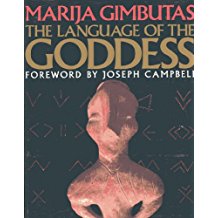
Marija Gimbutas coined the term “Old Europe” c.6500-3500 BCE to describe peaceful, sedentary, artistic, matrifocal, matrilineal and probably matrilocal agricultural societies that worshipped the Goddess as the power of birth, death, and regeneration in all of life. Gimbutas argued that Old Europe was overthrown by Indo-European speaking invaders who began to enter Europe from the steppes north of the Black Sea beginning about 4400 BCE.  The Indo-Europeans were patrilineal and patriarchal, mobile and warlike, having domesticated the horse, were not highly artistic and worshiped the shining Gods of the sky reflected in their bronze weapons.

In the fields of classics and archaeology, Gimbutas’s work is often dismissed as nothing more than a fantasy of a “golden age.” In contrast, scholars of Indo-European languages, Gimbutas’s original specialty, are much more likely to accept the general outlines of her hypothesis. The German linguist and cultural scientist Harald Haarmann is one of them.

Continue reading “Carol P. Christ’s Legacy: Was There a “Golden Age” before Patriarchy and War? by Carol P. Christ”

Carol P. Christ’s Legacy: Kassiani: Placing a Woman at the Center of the Easter Drama

This blog was originally posted on April 13, 2015. You can read the original comments here.

For many years I been told of the beautiful Hymn of Kassiani, sung only on Easter Tuesday night, but I had never heard it until this week. For many this song is the high point of Easter week.

Kassiani, also known as St. Kassia, was a Greek woman born into a wealthy family in Constantinople (now Istanbul) about 805 to 810 AD. According to three historians of the time, she was intelligent and beautiful and selected as a potential bride for the Emperor Theophilos. The chroniclers state that the Theophilos approached her and said: “Through woman, the worst,” referring to the sin of Eve. Clever Kassiani responded, “Through woman, the best,” referring to the birth of the Savior through Mary.

Apparently unable to accept being put in his place by a woman, Theophilos chose another bride. Kassiani founded a monastery in Constantinople becoming its first abbess. She was an outspoken theological advocate of icons during the iconoclastic crisis (for which she was flogged). One of only two women to publish under her own name during the Byzantine Middle Ages, Kassiani wrote both poetry and hymns. Up to 50 of her hymns are known today, with 23 of them being part of the Greek Orthodox liturgy

.

Continue reading “Carol P. Christ’s Legacy: Kassiani: Placing a Woman at the Center of the Easter Drama”

Carol P. Christ’s Legacy: Please Keep It in Your Pants by Carol P. Christ

This blog was originally posted on November 6. 2017. You can read the original comments here.

Trigger warning: this post describes sexual abuse

Last week while responding to a comment on my blog, I suddenly remembered a series of incidents in which men I did not know exposed themselves to me in public places. The first time occurred at a park around dusk during an outing with a group of girls. I was about 11, I may have wandered away from the group, or I may have been with others. What I remember is seeing a man with his pants down sitting on a park bench, possibly the first time I ever saw an adult man’s penis. I told or we told, but the man was not reported by the adults. Fast forward to the beautiful gardens of the Palace Schoenbrunn in Vienna where I was confronted by a penis while lost in thought when I was 19. I ran, but said nothing. In my 20s at the early showing of movies in New York City men would sit next to me and jerk off into paper bags. I learned to move whenever a man was near me in the theater, but I never told the ticket seller. A few years later, I crossed paths with a man who had his penis out on my favorite walk in the hills of Alum Rock Park in San Jose. I never walked carefree in that park again. When I was looking for the cave of the Furies on the Acropolis Hill in Athens, a man followed me waving his penis. I told the guard, but when the police came, he was gone. I arrived home in distress. My boyfriend said I was over-reacting. I learned to stay clear of men in cars on the streets of Athens at night after seeing things I did not want to see more than once in their hands. I coded this behavior as part of the background of my life. There was a man who from the basement apartment a few doors up from the Cycladic Museum pressed his erect penis against the window. I told the guard at the museum who said, “We have called the police more than once, but he always cries, and they let him go.” On a trail I had walked many times with my dogs near Lafionas in Lesbos, coming around a bend, I encountered a young farmer, who as soon as he saw me, pulled out his penis and urinated against a fence. That was the last time I walked the trail. We are supposed to learn to consider this behavior as well, if not normal, anyway, not such a big deal. After all, I wasn’t hurt, or was I?

Continue reading “Carol P. Christ’s Legacy: Please Keep It in Your Pants by Carol P. Christ”

Carol P. Christ’s Legacy: “THE OLD RELIGION” OR A “NEW CREATIVE SYNTHESIS”?

Moderator’s Note: Carol Christ died from cancer in July, 2021. Her work continues through her non-profit foundation, the Ariadne Institute for the Study of Myth and Ritual and the Goddess Pilgrimage to Crete. This blog was originally posted June 30, 2014. You can read its original comments here.

Is Goddess feminism an old religion or a new creative synthesis? Can it be both?  Goddess feminism draws on the feminist affirmation of women’s experiences, women’s bodies, and women’s connection to nature; the feminist critique of transcendent male monotheism as the symbolic expression of male domination of women and nature; and 19th and early 20th century discussions of Goddesses and matriarchy.

Most Goddess and other spiritual feminists have experienced Wiccan rituals, which are often simply called Goddess rituals.  For many of us, elements of Wiccan practice strike a chord of knowing, while other aspects seem odd or strange or even just plain weird.  What are the roots of Wiccan ritual?

Continue reading “Carol P. Christ’s Legacy: “THE OLD RELIGION” OR A “NEW CREATIVE SYNTHESIS”?”

Carol P. Christ’s Legacy: THE LABRYS: A RIVER OF BIRDS IN MIGRATION

Moderator’s Note: Carol Christ died from cancer in July, 2021. Her work continues through her non-profit foundation, the Ariadne Institute for the Study of Myth and Ritual and the Goddess Pilgrimage to CreteThis blog was originally posted July 29, 2013. You can its original comments here.

labrys seal ring

“There’s a river of birds in migration, a nation of women with wings.” Goddess chant, Libana

On the Goddess Pilgrimage to Crete, I explain that many of the names given to “Minoan” (c. 3000-1450 BCE) Cretan artifacts and architecture are products of patriarchal and Eurocentric imaginations, and as such, are misleading.  For example the name “Minoan” was given to the culture of Bronze Age Crete in honor of “King Minos,” who was said to have ruled in Crete a few generations before the Trojan War–several hundred years after the end of the culture to which his name was attached.  In fact, despite his eagerness to find evidence that King Minos ruled at Knossos, the excavator Sir Arthur Evans finally had to concede that the best he could do was to produce a fresco of a “Prince of the Lilies” which he identifed as the image of the male ruler of the culture he called “Minoan.”  Evans’ Prince had white skin, a fact that Evans conveniently overlooked–because according to his own interpretation of “Minoan” iconography, white skin would mark the figure as female.  Mark Cameron, who reviewed Evans’ reconstruction of the fresco, suggested that the Prince is more likely to be a young woman who is perhaps leading a bull to take part in the bull-leaping games.  He also stated that the “crown” belonged to another fresco altogether.

Continue reading “Carol P. Christ’s Legacy: THE LABRYS: A RIVER OF BIRDS IN MIGRATION”

Carol P Christ’s Legacy: Gratitude and Sharing: Two Fundamental Principles of Goddess Spirituality

Moderator’s Note: Carol Christ died from cancer in July, 2021. Her work continues through her non-profit foundation, the Ariadne Institute for the Study of Myth and Ritual and the Goddess Pilgrimage to Crete. This blog was originally posted February 4 2013. You can read it along with its original comments here.

The more I practice the spirituality of the Goddess, the more I understand that earth-based spiritualities are rooted in two fundamental principles:  gratitude and sharing.  We give thanks to the earth for the gift of life. As we recognize our interdependence and interconnection in the web of life, we are moved to share what has been given to us with others. *

When I first began to lead Goddess Pilgrimages in Crete, I was inspired by a line in Homer to begin a pilgrimage tradition of pouring libations of milk, honey, water, and wine on ancient stones. At first I knew the form, but not its deeper meaning.  It gradually dawned on me as I thought about the large number of pouring vessels in the museums, the altar stones, and the Procession Fresco from Knossos, that an important part of Minoan rituals involved processions in which people offered first fruits back to the Mother whose body had produced them, and poured libations on altars.

Continue reading “Carol P Christ’s Legacy: Gratitude and Sharing: Two Fundamental Principles of Goddess Spirituality”

From the Archives: Genderqueering by John Erickson

Moderator’s note: Today’s blogpost was originally posted March 24, 2015. You can visit the original post here to see the comments.

This post is a response to a recent blog entry titled “Who is Gender Queer?” on this site from Carol Christ. It was posted yesterday. I want to thank my friend, advocate, and upcoming scholar Martha Ovadia for reasons only she knows!  Stay brave, speak up, be heard!

Leelah Alcorn, Ash Haffner, Aniya Knee Parker, Yaz’min Shancez

It is terrifying to know that something is wrong but not be able to speak truth to power.

Continue reading “From the Archives: Genderqueering by John Erickson”