Stopping to Smell the Flowers by Marie Cartier

Photo by: Kimberly Esslinger

There is a saying, “Take time to smell the flowers.” Attributed to many different sources, it means among other things–  take time and be grateful. Take time and relax. Take time.


Photo by: Kimberly Esslinger

In that spirit I am sending along pictures from the amazing “super bloom” California is experiencing this spring. It is the most magnificent we have ever had, I think. It happens once a decade, but we are lucky to have had a super bloom in 2017 and now this year as well.  California had an extreme drought last year and then extreme rain this past winter. And now we have flowers…and flowers. Poppies are the state flower of California and they are being celebrated—all over. And people dropping in by helicopter and influencers ruining some of the poppy beds by laying in them for Instagram pics. Yes, it’s been crazy. But, when we were there (my wife and I) on a past Sunday, it felt so magical that so much of Los Angeles it seemed was out to smell the flowers. You can see a picture of folks lined up (my wife at the end in the picture below) photographing the flowers. Flowers suddenly are the new super star!

Continue reading “Stopping to Smell the Flowers by Marie Cartier”

Marianne Williamson. . . I’m Sacredly Smitten by Elisabeth Schilling

I caution myself to be critical and nuanced. I’m sorry, folks. I just haven’t had such dazzling hope or remote interest in politics since. . . well, since I was a puppet junior high evangelist for an independent candidate my Dad liked, and I don’t want to try to remember who it was. But I was 13. And I’m 38 now. What hath made this cold, indifferent, anxious millennial’s soul to warm?

I am into mindfulness, contemplative studies, Eckhart Tolle, Don Miguel Ruiz, Nhat Thich Hanh, the kind of comparative religious studies scholar who has eastern spirituality leanings, so when I heard Marianne Williamson was a presidential candidate, I got curious. I’ve not read A Course in Miracles (although I think I’ve avoided it for the same assumptions Williamson says she initially made) or actually any of her books. Williamson is Jewish and has a pluralistic perspective when it comes to noting the basic underlying wisdom of all religious and spiritual beliefs (I realize we have discussed this before when I called them “wisdom traditions” – is any tradition actually wise/can you separate the violence, oppressions, and misogynies of them?).

She speaks in cool, rushing waters and has a platform that still sounds “political”/political (she breaks down what this word actually means in her latest CNN Town Hall) and is spiritual and based in a rhetoric of love. After the complete loss of hope in what [T . .] represents, and the not-yet healed wounds from [B. . .], she sounds like a reasonable adult, much like Obama did during his years. I wonder if they are friends? They should be.

Continue reading “Marianne Williamson. . . I’m Sacredly Smitten by Elisabeth Schilling”

No Hope, No Problem: Reflections on Pesach, Time and Paradox. by Ivy Helman

29662350_10155723099993089_8391051315166448776_oIn “Time Telling in Feminist Theory,” Rita Felski suggests that there are four main ways feminists discuss and use time: redemption, regression, repetition and rupture.  They are aptly named as they behave similar to their labels.  Redemption is the linear march of time, hopefully progressing step by step towards a redeemed, or at least better, future even if sometimes things get momentarily worse.  Regression is the want to go back in time or at least return to idyllic and/or imagined pasts: to matriarchy or to a time before patriarchy’s violent arrival.  Repetition is a focus on the cyclical nature of time in bodies, in daily chores, in seasons and so on. Rupture posits a break in time in a way what was before no longer makes sense or doesn’t exist.   Think utopia or dystopia.
While she speaks of them individually, she also acknowledges that no one is bound to one manner of speaking of time and that, in many ways, they overlap and intertwine.  Most feminist theorists use more than one although she asserts that feminism as a whole, “Unlike Marxism or liberalism… does not fold a temporal vision into its very core” (22).  What she means exactly by this is unclear.  Yet, if she means that feminism doesn’t share one unified vision of time or of the future, then I would agree with her.  If she is suggesting that feminism isn’t really all that concerned with time, then I disagree.  Feminism is all about creating a better world for us and for future generations. Continue reading “No Hope, No Problem: Reflections on Pesach, Time and Paradox. by Ivy Helman”

On Chronic Illness and Justice by Ivy Helman

29662350_10155723099993089_8391051315166448776_oFor almost four years, I’ve been living with the long-term effects of an inner ear lesion.  The lesion is long gone but its side effects are not.  Throughout the day, I feel a combination of unsteadiness and sudden, unpredictable sensations of movement.  On better days, the unsteadiness is almost non-existent and the feelings of movement are minimal.  On worse days, I’m troubled with a type of brain fog that makes it hard to concentrate as well as disrupting unpredictable sensations of being on a boat that can’t pick one direction in which to move.  It’s frustrating, tiring and demoralizing.
Summer is the season of worse days.  There is really nothing I can do to feel better.  Even staying well-hydrated and taking it easy often doesn’t steady the boat.  So, instead, I often continue my life as normal.  Then, I lay in bed at night and hope sleep comes soon. Continue reading “On Chronic Illness and Justice by Ivy Helman”

Implausible, Impossible Hope by Natalie Weaver

With the single exception of a weak moment in my oldest son’s kindergarten year, during which time the grade school manipulated parents into fundraising schemes by dangling socially advantageous perks (such as a reward trip to a water park) for only those children whose parents participated at a high level in the initiatives, I have never subscribed to any magazines.  Nevertheless, I continue to believe, on some core level, that Ed McMahon is even now driving down the street toward me in the white Publisher’s Clearing House van with a check for one million dollars.  The fact that Ed is long deceased seems to have no bearing on my conviction that the great Miracle, complete with balloons and a camera crew, is blazing toward me and just around the corner.  I never play the lottery, and I actually managed to go to Las Vegas once without gambling a single dollar, yet I feel almost daily that some Jackpot Jeep Bonanza Giveaway has my name all over it.

Continue reading “Implausible, Impossible Hope by Natalie Weaver”

Painting Breast Cancer Goddess by Rev. Dr. Angela Yarber

October is Breast Cancer Awareness Month, though I imagine most of us are already relatively aware. One in eight women will have breast cancer. Pink is everywhere. It’s difficult to find a person who hasn’t been impacted by breast cancer on a personal level. In 2003, my mom was diagnosed. Radiation, a lumpectomy, and ten years later she was dubbed cancer free. When I finished my Ph.D. in 2009, I did a stint as a Research Assistant for a fabulous liturgical studies scholar working on a book that examined and created rituals for women with breast cancer. My task was researching everything written on breast cancer that intersected with feminism, womanism, religion, spirituality, and ritual.


Audre Lorde’s Cancer Journals struck me profoundly. The critiques weighed heavy as a movement that began with destigmatizing breast cancer and offering solidarity to patients has transformed into a pinkified commodity. Whether it’s the lack of transparency in major breast cancer foundations, pinkification, the essentializing conversations that equate breasts with womanhood, lack of access to comprehensive health coverage, the role of the meat and dairy industry in increased risks of breast cancer, the talk of “surviving” and “fighting” as though those who don’t survive aren’t fighters, or the complete lack of representation of women of color in any pink marketing (seriously, do a google image search of “breast cancer headwraps” and feast your eyes upon an endless array of young, white women), breast cancer awareness has been commodified so that helping cancer patients is second to profit. Amidst these pink teddy bears delicately embroidered with the word “fighter,” one can only wonder what we can actually do and offer and create to be supportive of those with breast cancer. What rituals might we offer? What sacred spaces might we create? What is a feminist response? A spiritual response?

Continue reading “Painting Breast Cancer Goddess by Rev. Dr. Angela Yarber”

Out of the Darkness by Gina Messina

Gina and SarahToday is Spring Equinox in the Northern Hemisphere, a time to celebrate moving into light and abundance after the darker cold winter. While many of us are lucky enough to have shelter and access to food out of season, this is a time that continues to be a resurrection in countless ways. Not only is it a literal shift from darker days to increasing light, but a symbolic time that allows us to reflect on changes, that while seeming to be hopeless can blossom into new life.
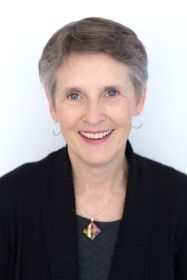
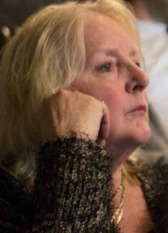
I have been consumed in a time of shifting ground and deep darkness as my sixteen year marriage has come to an end.  Choosing to divorce rather than remain committed to good times and bad is a frightening and soul crushing event. To walk away from what seems to be stability in favor of a questionable future and to defy one’s foundational understanding of family as dictated by society and religion is beyond terrifying.  Continue reading “Out of the Darkness by Gina Messina”

Divine Physics: A Poetic Reflection on Ecclesiastes 3:14 by Lori Stewart

lori-stewart

Ecclesiastes 3:14 – I know that whatever God does endures forever; nothing can be added to it, nor anything taken from it; God has done this, so that all that should stand in awe before him. 

Nothing can be added or
taken away…
… then why does it feel like everything is lost?

You haul away the bodies while
we watch
— linking arms
— standing fast
against the tide of
grief that churns until
we can find
a distraction that makes us believe
life will return to
normal

Nothing can be added or
taken away, you say…
Really?
You take away innocence at
the marketplace
— the prices vary by age
— virgins to the highest bidder
Surely, El-roi, you see
— the pain
— the suffering Continue reading “Divine Physics: A Poetic Reflection on Ecclesiastes 3:14 by Lori Stewart”

The Reason for Hope Is the Creative Process of Life by Carol P. Christ

carol p. christ photo michael bakasIn these these days when many of us are gripped by paralyzing despair as we come to terms with the election as President of a racist, sexist bigot who has created a climate of fear and promises to undo much of the progressive legislation of the past fifty years, I find it appropriate to reiterate an insight that has sustained me through many years of sadness and disappointment about the state of our world.
“Hope is not to be found in optimism so much as in a primal understanding of what matters most.” In other words, the reason for hope is not to be found in the knowledge or rational calculation that our efforts will succeed in saving life on earth but rather in the conviction or inner knowing that it is right to try. Continue reading “The Reason for Hope Is the Creative Process of Life by Carol P. Christ”

Dystopian Fiction Inspiration and Religious Lessons by Ivy Helman

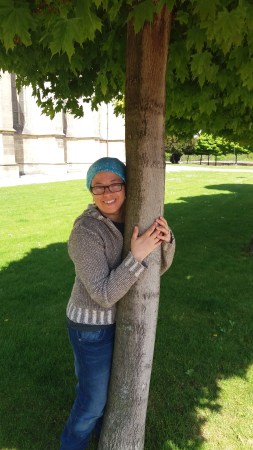
me-hugging-treeWe live in a dystopia.  This world is filled to the brim in dichotomies: poverty and extreme excess, hunger and mountains of food, disease and cutting-edge medicine, materialism and an immense environmental crisis, and hour-long walks for water and hour-long luxurious baths.  There are so many parts of our world that are not just unfair, unequal, broken and undesirable, but violent, traumatic and deadly.  And, sometimes it feels like it is only getting worse, or at least, again teetering on the edge of yet another catastrophe.

Most of the world’s religious traditions agree that this is not the way the world should be.  My own religious tradition, Judaism, traces this separation between the Creator’s utopia, the Garden of Eden, and our current situation all the way back to the beginning of humankind.  The actions of the first two humans resulted in exile from the Garden: enter the world diametrically opposed: dystopia.  Nonetheless, the Jewish religious tradition’s call for tikkun olam (repairing the world) suggests that it is possible to lift the veil between the Divine and us and consequently recreate the utopian Eden once again.  One could say it is why we are here.

That being said, while the dystopian genre has been around for many decades, I have noticed a recent rise in the popularity of dystopian fiction.  While I have always had a keen interest in science fiction, from Star Trek to FireFly and beyond, I myself have, as of late, become an avid reader of dystopian novels.  I blasted through the Divergent series by Veronica Roth, have reread The Fifth Sacred Thing by Starhawk more times than I can count and just began my dip (25 pages) into The Mandibles by Lionel Shriver – not so action-packed as the others.  I’ve also been, one could say, addicted to dystopian films (yes many were books first) like The Hunger Games, Maze Runner, Gattaca, The Fifth Element and Serenity to name just a few.

Continue reading “Dystopian Fiction Inspiration and Religious Lessons by Ivy Helman”