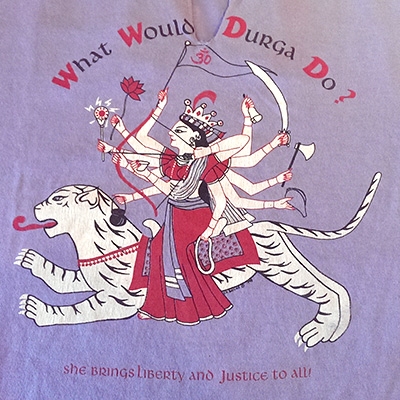
 It’s one of my favorite T-shirts. Every time I wear it, people who know who Durga is comment. So do some people who don’t know who the Hindu goddess is.
“What would Durga do?” is of course an echo of the question What would Jesus Do?
I’ve just done a bit of research and learned that this phrase may come from the Middle Ages, that it was famously used in a sermon in about 1891, and that it became very popular among evangelical Christians during the 1990s. What would Jesus do? I think he’d remind us to pay closer attention to the Sermon on the Mount (Matthew 5, 6, 7), especially the Beatitudes and the Golden Rule: “So whatever you wish that others would do to you, do also to them” (Matt.: 7:12). The Golden Rule is of course given in the other major religions, too. WWJD has also been turned into WWBD—“What would Buddha do?” I think the Buddha would tell us to live more mindfully.
But who, you may be asking, is Durga? Why does she have all those arms? Why is she carrying all those weapons? Why is she riding on a tiger? I’ll answer with reference to Patricia Monaghan’s New Book of Goddesses and Heroines (Llewellyn, 1997). While all the Hindu goddesses are ultimately one goddess with the collective name Devi (“goddess”), Monaghan writes, the goddess appears in different forms. “One of the fiercest of Devi’s forms is Durga … [who is] also the eldest.” She appeared during the “primordial war between gods and antigods” and is the “first manifestation of goddess energy” (p. 106). Continue reading “What Would Durga Do? by Barbara Ardinger”