 In her book Queer Phenomenology, Sara Ahmed investigates how we orient ourselves in space with respect to tables – the tables around which we sit, at which we eat with friends and families of choice and birth, and at which we write. She describes moving into a new place and arranging the furniture. “After the kitchen, the room I hope to inhabit is always the study. Or the place that I have decided is the place where I will write. There, that will be my desk. Or it could just be the writing table. It is here that I will gather my thoughts. It is here that I will write, and even write about writing. … Making a place feel like home, or becoming at home in a space, is for me about being at my table. I think fondly of Virginia Woolf’s A Room of One’s Own. How important it is, especially for women, to claim that space, to take up that space through what one does with one’s body. And so when I am at my table, I am also claiming that space, I am becoming a writer by taking up that space.” (11) Ahmed goes on to discuss how certain possibilities are opened up, and others foreclosed, by the way we orient ourselves (or find ourselves oriented) to others and to objects. She describes the bodily postures that result from orienting oneself to the writing table – the way one might hunch over one’s computer, or find oneself with ink-stained fingers.
In a very different context, the queer theologian Marcella Althaus-Reid describes a scene from her childhood in Argentina. She kneels in front of a priest for confession. But instead of kneeling to the side, aslant, as she ‘ought’ to have done, being a girl, she kneels directly in front of the priest, as if she were a boy. Kneeling here too is a form of orientation, a form of direction, a bodily habit of becoming. “Kneeling is troublesome and it has a theological referent in the church’s also troubled waters of sexuality and power. A whole symbolic sexual order is obviously manifested in kneelings as positions of subordination and sites of possible homo- and hetero- seductions, because these are theologically distributed around the axis of the priesthood’s male genitalia. The priest’s penis carries the sacred connotations of the phallus as a transcendental signifier of the theological discourses to everyday Christianity, and kneeling is a liturgical positing designed to centralise and highlight this.” (The Queer God, 11) To kneel in the right (gendered) position in relation to the priest is also to kneel in the right relation to God. Continue reading “Orientations: Body, Space, Authority by Linn Marie Tonstad”


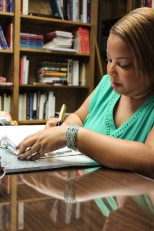 Over the summer, I’ve been writing more than I do during the traditional academic year when other tasks consume the bulk of my workday. I have spent more time experiencing the joy of creative discovery and production, but I’ve also had more time confronting the difficulties of creative work as I’ve wrestled with some of its unique challenges. One of those challenges has been to refine my academic writing voice. I’ve approaches the challenge of developing my voice as both a spiritual and feminist practice and this has helped me find confidence in my work.
 Kavannah is a Jewish concept meaning intention or motivation, perhaps most associated with Hasidism. Hassidism teaches that prayer and the fulfillment of mitzvot connects one more with the Holy One if the right state of mind is cultivated before participating in said activity. While going through the motions (prayer, mitzvot, etc.) is important and still technically fulfills the mitzvot, it is not as spiritually beneficial to the individual as is doing those tasks with kavannah. Praying and fulfilling mitzvot within a certain mental space more fully connects you to the divine. Judaism is not alone regarding this religious insight. Clearly there is something to it.
 The world at large might view artists and writers as free spirits rocking la vie bohème, but creative people know that it’s much more complicated than that, especially if we’re striving to earn even a modest living from our work. As a writer, I often fall into the trap of measuring my success or failure on factors completely beyond my control, such as the ups and downs of a fickle book buying market.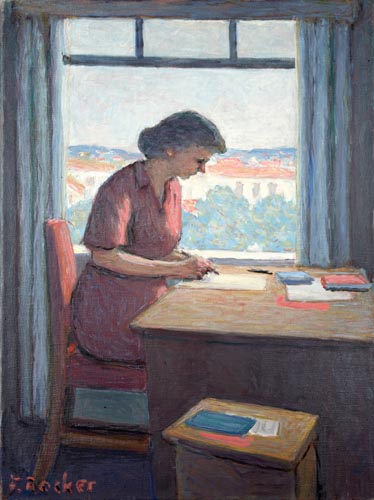


 There are three vicious circles: patriarchy, samsara and wanton destruction of environment. All three lead ultimately to annihilation of life. All three are incredibly difficult to escape. One of the reasons for this difficulty is that there are pay-offs. Someone or something benefits from keeping the cycles going.

 Feminism and Religion