

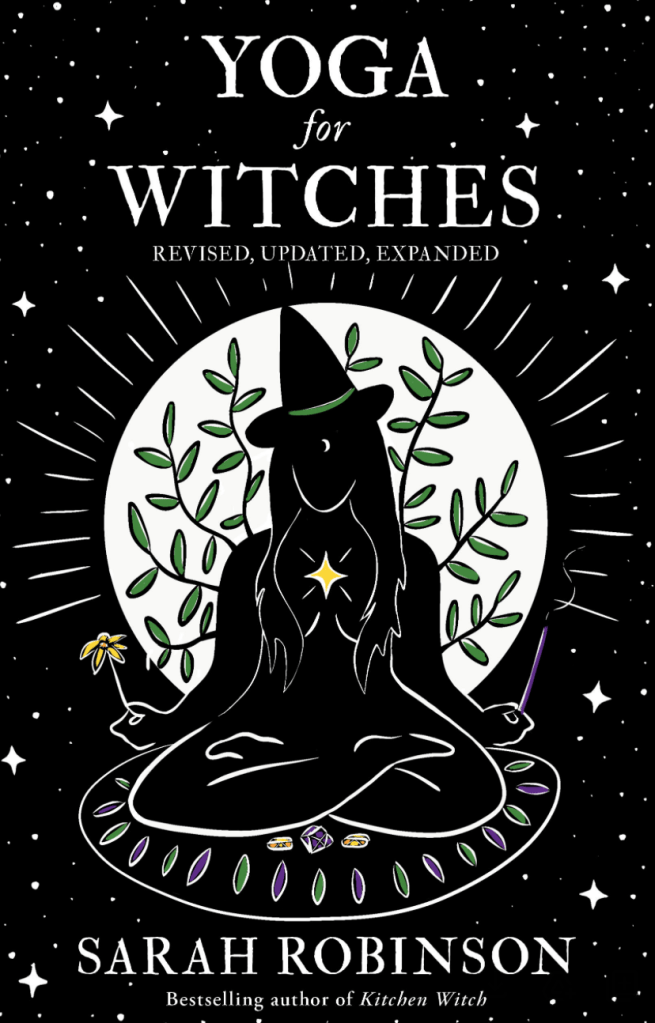
In this post, I review Yoga for Witches by Sarah Robinson, a practical book that weaves together two ancient practices with surprising similarities, yoga from the East, and witchcraft as practiced in Northwestern Europe.
I start with what I loved, and how Robinson describes the similarities and differences between those two traditions. That weaves into some personal and deeper reflections on the theoretical background and yoga sequences. At the end you’ll find a specific recommendation so you’ll know if this is the book for you!
What I loved about it…
Sarah Robinson’s sincerity and love for both yoga and witchcraft shine through every page. She openly shares her journey, weaving together her childhood steeped in British folk traditions with later studies of yoga and paganism. The book exudes warmth and inclusivity, encouraging readers to explore their own practice in a way that feels personal and meaningful.
The subtle illustrations, soft moon motifs, and earthy design of the illustrations adds an inviting atmosphere. The book is peppered with affirmations of inclusivity. Throughout, Robinson affirms that you don’t need permission to call yourself a witch, priestess, yogi or goddess. This sense of encouragement is one of the book’s strongest points. Instead of passively receiving titles assigned by others, she invites readers to consciously craft their own identities—without having to justify yourself to anyone!
Yoga and Witchcraft? Similarities and Differences
Robinson offers a concise historical overview of both practices, highlighting surprising similarities between these traditions. Both focus on intention, energy and transformation to shift consciousness and cultivate personal power. Both traditions also cultivate connection—to self, nature, and unseen forces. Yoga’s breathwork (pranayama) and postures (asana) align energy much like a witch’s rituals and elemental work. Meditation in both fosters deep focus and intuitive insight.
Another parallel is their shared understanding of energy flow. Yoga cultivates prana, or life force, while witchcraft directs energy through spells and ritual. Manifestation also appears in both: yoga through sankalpa and discipline, witchcraft through visualisation and intention. Robinson does a great job in weaving the two practices together.
Where the two diverge is often in language and framing. Yoga tends to focus on internal mastery and surrender, using discipline to clear the mind and achieve stillness, while witchcraft seems to be more overtly expressive, engaging symbols, spells and external tools to shape reality.
Personal Reflections
This difference feeds into my personal discomfort while reading Yoga for Witches. I felt ongoing resistance to the language of manifestation and spellwork, particularly around manipulating reality. While I engage in ritual almost daily, I see it as an alignment with wider forces, a way of flowing with life’s currents rather than imposing my will upon them. Spells, in Robinson’s description, feel more like bending reality to fit a personal desire—my will be done rather than thy will be done. The distinction may seem subtle, but for me, ritual is about co-creation, while spells feel more directive.
That said, some parts of this book joyously affirmed, YES I’m a witch, for which I’m grateful. I loved the role descriptions at the back and resonated most with the kitchen and hedge witch archetypes. Yet other sections alienated me—if this is witchcraft, I don’t know if I want to practice that. However, Sarah gave so much empowerment to following my instinct, that I could put those concerns aside.
Diving a Little Deeper
Maybe it’s my academic curiosity, but I found myself craving more depth. Just as the text begins to touch on something compelling, it quickly shifts to another topic, offering intriguing breadcrumbs rather than deep dives.
Take magic, for example. Robinson describes it as something universal—found in gratitude, love, nature and mindfulness. While this is a lovely sentiment, it glosses over the distinction between an experience of awe and the deliberate practice of magic as a craft. Magic becomes almost interchangeable with “spiritual awareness,” which, while inclusive, dilutes the specificity of magical traditions.
I also wanted more background on topics like the goddesses she references—what do they offer the practitioner beyond their name? How do kundalini and pranayama relate? And where do positive visualisation, psychology, and witchcraft overlap?
Then there’s the yoga theory, of which I know very little and would have loved to learn more. Despite referencing Sanskrit texts, her approach to yogic philosophy feels surface-level. She acknowledges Patanjali’s eight limbs of yoga, but moves past them quickly, offering little explanation of how they intertwine with witchcraft.
The Yoga Sequences
While Robinson offers sequences with evocative names like ‘Yoga for a Broken Heart’ or ‘Warrior Rising,’ they are simply lists of poses, with no clear transitions, meditative guidance, or explanation of why certain poses were chosen. For a non-yogini, they feel arbitrary.
My biggest concern, however, is for beginners or people with physical limitations such as chronic pain or hypermobility. As a Qi Gong teacher and lifelong dancer, I’m acutely aware of how movement affects our anatomy. Many sequences start with poses that strain the hips, knees or ankles, without modifications or preparation guidance. If someone with no yoga experience were to attempt these sequences, they could easily end up with strained joints rather than expanded awareness.
Final Thoughts
I recommend Yoga for Witches to existing Yoga and Qi Gong teachers and seasoned practitioners who can safely modify postures and who want to sprinkle some lighthearted, witchy inspiration and ritual into their practice. Also, if you’re looking for a feel-good, broad-stroke exploration of yoga and magic, then you will probably enjoy this book. But it’s not a step-by-step manual for beginners, nor is it an in-depth exploration to take seasoned practitioners of either yoga or witchcraft a level deeper.
Namaste, witches, yogini’s and other folk, proceed with curiosity and caution.
Today is the birthdate/release date of Yoga for Witches. You can purchase it here.
Invitations
Sealskin Soulskin
Where Women Run with the Wolves meets Conscious Dance! A transformative, in person weekend workshop inspired by Sealskin Soulskin, a story to discover what your own ‘lost skin’ represents. Let the power of story, movement and community guide you home in a safe and sacred women-only space. Birmingham, UK. Read more here.
Story Dance Mentoring
If you have a story you keep ‘living’ that you’d like to heal and transform, this unique 3-session journey blending reflection, movement and ceremony might be for you! Together we will map your unique story, release emotions and retrieve your power and integrate its wisdom gifts. Read more here.
Bio

Eline Kieft danced from a young age, including rigorous classical and contemporary training to become a professional dancer. She then studied anthropology, deepening her fascination with worldwide similarities between indigenous traditions regarding intangible aspects of reality and other ways of knowing, including embodied epistemologies and shamanic techniques.
She completed her PhD in dance anthropology at Roehampton University, trained in depth with the Scandinavian Centre for Shamanic Studies and the School of Movement Medicine. Eline worked at the Centre for Dance Research (C-DaRE) at Coventry University for five years, where she created a Somatics Toolkit for Ethnographers, and pioneered soulful academic pedagogy. Her recent book Dancing in the Muddy Temple: A Moving Spirituality of Land and Body was well received as a unique blend of theory and practice and a medicine for our times.
She is now a full-time change-maker and facilitates deep transformation through coaching and courses both online and in person. Wild Soul Centre offers a set of embodied, creative, and spiritual tools to re-connect with inner strength and navigate life’s challenges with confidence.
Website: https://www.elinekieft.com Also on Facebook | Instagram | Twitter | LinkedIn
Discover more from Feminism and Religion
Subscribe to get the latest posts sent to your email.


“While I engage in ritual almost daily, I see it as an alignment with wider forces, a way of flowing with life’s currents rather than imposing my will upon them.”
YES, exactly. I prefer the word ceremony – ritual seems to smack of something else. A relatively new distinction for me since I began celebrating what I call ritual in an organized way half my life ago – a long time – and I have watched the changes…
I think this idea of manipulating what I call Natural Forces – imposing one’s will on whatever – is more like patriarchy in disguise. Once I too was attracted to witchery until I understood what I was doing – Gosh I still don’t understand why ‘healers’ can’t be used in lieu of the word witches because the latter carries such an ambivalent charge unless it’s because the INTENT is to manipulate or even frighten ….
As you say another crucial distinction is between inner and outer – yoga (which I like) – more of an inner experience working to align self with the rest of nature, while witches lean towards outer manifestation attempting to bend reality and using concrete objects to do … hmmm I am not attempting to bend reality but I do use objects.
My own practice is simple, follows the seasons with eight ceremonies a year and a nod to the moon each month – it is also more fluid – ceremony occurring when the time FEELS right – the entire practice revolves around my relationship to the rest of nature and aligning myself as best I can with natural forces -and each ceremony includes being outdoors with nature whenever possible. I do set intentions, let go, cultivate gratitude and I usually find myself using natural beings as part of my practice although I don’t do this intentionally – it just sort of happens like pussy willow gathering for the equinox…. I guess I have no interest in becoming the “Director” of the process… well this comment has ended up being more about me than the book but this is great because you got me thinking. Thanks so much Eline!…. hope the same happens for others….. especially at a time like this… it’s important to clarify just where one stands in relationship to global chaos.
LikeLike
Thank you for your thoughtful and details comments Sara. I understand ritual and ceremony a little differently than how you describe, but I see your point. Here’s to co-creation WITH life (in both cases!). I wasn’t sure whether to post the review, but I’m glad it offered food for thought!
LikeLiked by 1 person
I am glad you dd!
LikeLike
That’s why I prefer Raja Yoga. Because it’s the Mistress/Master of all Yoga. It is perfect for magical and spiritual development.
LikeLiked by 1 person