

My name is Yalda. I am a woman from the Iranian resistance who, for many years, has fought for women’s equality and worked to amplify the voices of Iranian women around the world. Today, I want to share with you the source of inspiration and motivation that has guided my path.
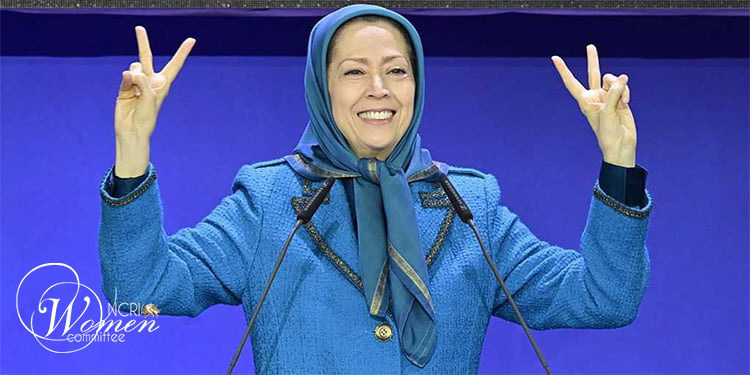
Covering every aspect of Maryam Rajavi’s life and thought in one article is a challenge, so today I will focus only on what has personally influenced me: her perspective on women.
She herself is a woman who has spent decades fighting against two dictatorships—the Shah’s and the misogynistic clerical regime—and believes that women can change the world. A brief overview of her biography: she was born on December 4, 1953, in Tehran and is a metallurgical engineer from Sharif University of Technology in Tehran. From her teenage years, she embarked on the path of struggle, learning from action rather than words.
She was among the student movement leaders affiliated with the Mojahedin1 against the Shah (1973–1978), then became one of the organizers of social protests against oppression and misogyny at the beginning of the clerical rule (1979–1981) and was a parliamentary candidate in 1979 but was removed by the clerics due to widespread electoral fraud. She served as the First Secretary of the Mojahedin Organization (1985–1993) and has been the elected President of the National Council of Resistance of Iran, the parliament-in-exile, since 1993.
However, what impressed me more than any title or position was her view of women and her struggle for equality and against gender oppression. Her speech at the Earls Court in London on June 21, 1996, was particularly illuminating and became a guiding light for my own fight against misogyny. In that speech, she declared: “Today’s oppressed are tomorrow’s victors, and their voices will echo forever.” She then addressed gender oppression as the most enduring form of injustice in history and, using examples of women’s resistance in Iran, offered guidance for women striving for equality and for all freedom-loving people.
She believes that women are the first oppressed in history. Their voices have always been ignored, drowned out by the clanging of chains and the lash of whips. Even in the great tragedies of slavery, there was no space for their cries.
Maryam Rajavi rose against the historical gender oppression, especially under the rule of Iran’s clerics—a regime that considers women eternal slaves and denies their human identity. A regime that holds nine-year-old girls legally accountable while allowing them to be forcibly married from age 13. Women are beaten and imprisoned simply for showing a few strands of hair; female employees, teachers, and workers are dismissed because they are women; young women face torture and rape on the eve of execution.
Against such a monstrous system—one that is not only an enemy of the Iranian people but a foe of humanity—she led the Iranian women’s resistance, elevating women to leadership roles within the resistance and unleashing extraordinary energy for the fight against the misogynistic clerical regime.
Maryam Rajavi asserts that without women’s participation in political power, leadership, and key social and economic decision-making, talking about gender equality is meaningless. She stood up against a monster that has arisen from the depths of centuries, whose survival depends on misogyny and gender apartheid—a monster that is not only an enemy of the Iranian people but has declared war on humanity.
According to her, to overthrow a system of gender-based discrimination and fundamentally transform policies, women must temporarily assume political hegemony. The goal of women’s hegemony is to ensure equality and eradicate gender oppression, not to replace patriarchy with matriarchy. Liberating women’s potential can break the deadlocks of today’s human society and establish a new system of human relations.
This is why, under her leadership in the Iranian resistance, women have held key and leadership roles for years. But reaching this point was not easy; she said, “Sometimes I would ask myself, what must women do for others to believe in them?”
Patriarchal thinking is deeply rooted in social culture, and even the heroism of women and the blood of tens of thousands of women who lost their lives were not enough to gain acceptance for equality. Confronting the ruling misogyny requires cleansing oneself of that mindset and believing in women’s competence to lead society. By assuming tremendous responsibilities in the Iranian resistance, she demonstrated that women could break the chains of historical humiliation and oppression within themselves, believe in themselves, and inspire men not to doubt the competence of women who fight alongside them for freedom in every arena.
She spent years first changing this belief among women within the resistance. That is why, when she was elected the President of the resistance, one of the proposals she introduced concerned women’s rights in a free Iran, recognized in the National Council of Resistance of Iran’s plans:
- Women’s social, political, cultural, and economic rights will be equal to men’s.
- Women will have the right to political and social activity, freedom of movement, and travel without permission.
- Women’s organizations will be recognized and supported.
- Special measures will be taken to eliminate inequality and double oppression against women.
- Women will have the right to choose their careers, hold any position, participate in elections, and engage in artistic and sporting activities.
- Discrimination in employment will end; equal pay for equal work and equal access to insurance and benefits will be guaranteed.
- Freedom of dress, choice of spouse, marriage, divorce, and equal rights in inheritance, guardianship, and child custody will be ensured.
- Sexual exploitation and underage marriage will be prohibited, and polygamy will be abolished.
- Widows, divorcees, and their dependent children will be supported by the social security system.
In that same profoundly inspiring speech, she addressed women: “My sisters, all the women who bore the weight of history’s suffering before you, and all women and men of future centuries, are watching you today. Step into the arena and assume this historic role. You will lead our history into a golden era of equality, peace, democracy, and development.
Footnote 1: The People’s Mojahedin Organization of Iran is a democratic organization founded in 1965, and for about 60 years it has been fighting against both the monarchical dictatorship and the religious dictatorship in Iran. Most of those who have been executed by the Iranian regime have been members of this organization, and most recently six more political prisoners were executed. This organization is a key member of the National Council of Resistance of Iran. Since 1989, it has been led by women, which is considered an indicator of democracy in any organization and society.
Brought to you by the The NCRI Women’s Committee.
Discover more from Feminism and Religion
Subscribe to get the latest posts sent to your email.


Thank you for this piece about this sister. Not sure your opinion of the current US aggression. Trump is about as anti-woman as you can get. The goals for a Gender equal society/government are supported by the Quran (33:35, etc). I pray for actual help for all Iranians.
LikeLiked by 2 people
Dear Jammayali, Thank you very much for your prayers for Iranians. I believe that we women can save society from misogyny. Women’s participation in political leadership is definitely a path to democracy in countries and this is our wish for the future of Iran.
LikeLike
I agree – gender oppression is the most enduring form of injustice in history.. And we must never let this truth slip away from our awareness. However, I have a real problems with this sentence “Today’s oppressed are tomorrow’s victors, and their voices will echo forever.” I see patriarchy written all over it – the victor and the oppressed – always the extremes and opposites – this is patriarchy’s way not the way of women… with that much said I do not see this system disappearing any time soon so maybe the best we can do is work within it without taking on its truths
LikeLiked by 2 people
Dear Sara, thank you for your thoughtful comment.
Our goal is an equal society without gender discrimination. A society where women have equal participation in all matters, including political leadership. The law is the same for all. Women have the rights they should have. Perhaps you have not heard of Iran and the misogyny that is institutionalized in the law of the mullahs. And perhaps this sentence is a reference to the women of Iran.
LikeLiked by 1 person
Oh I have heard of the monstrous mysogyny – it’s beyond the pale – not sure though about the connection to that sentence – maybe it’s just me
LikeLiked by 1 person
So much oppression (all?) in the world springs from patriarchy–a social system anchored in place throughout the world. Unfortunately, the word “patriarchy” comes with a heck of a lot of baggage. Most people, if they think about the word at all, immediately become defensive, thinking if one is critical of patriarchy, one must hate men. The word itself needs to be unpacked–frequently! Carol Christ’s definition of the word is a great starting point: “Patriarchy is a system of male dominance, rooted in the ethos of war which legitimates violence, sanctified by religious symbols, in which men dominate women through the control of female sexuality, with the intent of passing property to male heirs, and in which men who are heroes of war are told to kill men, and are permitted to rape women, to seize land and treasures, to exploit resources, and to own or otherwise dominate conquered people.” Most people aren’t willing to grab hold of the many threads within this definition and follow them, integrating those threads into the creation of new understandings as culture moves forward. “Equal rights” doesn’t do much to dismantle the toxic system of patriarchy. The usual unjust ways of living in the world often seep into “new” policies. It’s exhausting! The concept of domination is at the core of patriarchy. “New” policies can just switch who or what will be dominated.
LikeLiked by 1 person
Dear Esther, Thank you for your very precise comment explaining the concept of patriarchal thinking. In my country, Iran, unfortunately the clerics have used religion as a tool to advance their own goals. They have turned girls and women into instruments for further suppressing society. They have legalized child marriage. Sexual violence against women—especially virgin girls in prisons—is treated as something commonplace, and they even believe it must occur so that these girls are denied entry to heaven. There is documentation of this in the following link: https://wncri.org/2015/11/13/female-prisoners-virgins-raped/
Their laws are entirely designed to suppress women, because they know that women are the primary driving force of society. As seen in all the uprisings in Iran, women have been at the forefront. So you are absolutely right: we do not hate men. We want to change an exploitative system that operates against women.
LikeLike
Esther – gosh I really hope the word feminist is NOT still associated with hating men but your words give me pause. Isn’t that one reason why we are so marginalized? It seems to me that so often these days people are satisfied with stereotypes – from the seventies? yikes – – it’s like thinking is too much of a bother or something. And your remark about new policies that can just switch who or what can be dominated is my reality too. So discouraging and exhausting – all of it. Thanks for commenting – some days I feel like I am the only person who has any opinions at all – and who am I talking to – the VOID? Not a healthy situation when we desperately need women to talk about these issues.
LikeLike
Dear Sarah, all of us women are fighting to express our opinions, to be able to show our thoughts to the world, and we listen to each other and make each other’s voices stronger. Your voice matters because it is the voice of a woman fighting for women’s rights.
LikeLike
These are one of the voices being shooed away by the US. They want to bring the Shah back. So they are intentionally keeping her and the Iranian Resistance out of the public eye. Because they have their candidates for regime change. We must all work together to let the world know about her and the authentic resistance.
LikeLiked by 1 person
Dear MiamiMagus,You have touched the heart of the matter. Thank you for your deep and precise insight into the politics behind the scenes that prevent a woman who wants democracy from speaking out for the future of Iran. Although her ten-point plan is a clear symbol of a democratic Iran, it is ignored and instead the son of the former dictator of Iran is highlighted. But the Iranian resistance movement, led by women, will definitely not back down from this fight.
LikeLiked by 1 person
The Western Powers led mostly by men, wealthy, colonizer men, of the Epstein Class, wish to put Pahlavi back into power. But that will never happen. And the women of Iran are with the Resistance. Please keep fighting on and refuse to be silenced by the Western Colonizers of the Extremist Clerics. You will win.
LikeLiked by 1 person
You are absolutely right. Those who pursue their own interests never want a democratic Iran led by a woman. But we will succeed
LikeLiked by 1 person
Amen Señora Roshan 🙏
LikeLiked by 1 person
Thank you
LikeLiked by 1 person
In Maryam Rajavi’s view, the human being is not a static entity defined within the frameworks of the past, but rather “the source of change.” She believes that any progress in the social and political spheres begins with uncovering the essential nature of a conscious and choosing human being.
In this paradigm, a person is continually redefined by their “choices” at every moment. Human beings are seen as creatures who, in the confrontation between outdated traditions and new values, are constantly making choices.
LikeLike