

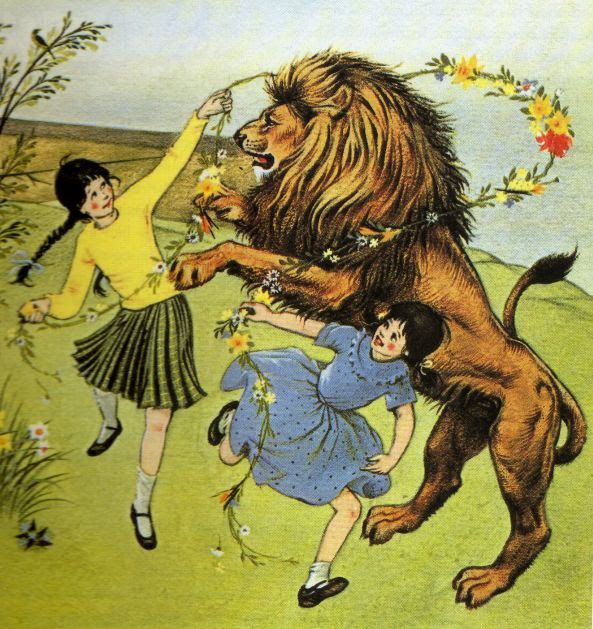
In the landscape of mid-twentieth-century children’s literature, C.S. Lewis’s The Chronicles of Narnia initially appears remarkably progressive. Long before modern fantasy embraced the trope of the fiercely independent heroine, Lewis gives us the Pevensie sisters, Jill Pole, Aravis, and Polly Plummer. These are active, clear-eyed adventurers. Lucy is the spiritual compass of the entire saga, possessing a theological clarity that routinely eludes her brothers. Jill braves subterranean terrors to rescue a captive prince, while Aravis flees an arranged marriage with the sharp wit of a seasoned survivalist. In Narnia, childhood is a meritocracy of spirit, and Lewis grants his young girls immense pluck, agency, and divine grace.
However, from a feminist and theological perspective, this grace comes with a strict expiration date, and a jarring ideological fracture occurs the moment a female character crosses the threshold into adult womanhood. I find that although Lewis champions the plucky girl, he displays narrative anxiety toward the grown woman. Could it be that in the Narnian universe, female maturity is treated as a spiritual fall from grace, an intersection where Christian purity is compromised by adult desire and bodily autonomy?
The most notorious victim of this boundary is Susan Pevensie. As a young queen in Narnia’s Golden Age, she is a skilled archer and a gracious ruler. But upon returning to the real world and hitting her late teens, her transition into womanhood is framed as an apostasy. Condemned for her interest in ‘stockings, lipstick, and invitations’, Susan is barred from salvation at the series’ end. To Lewis, her embrace of adult femininity and sexuality is a vain and shallow capitulation to the world. This reveals a troubling theological thesis: a girl can be a hero of faith, but a woman’s worldly maturity distracts from the divine.
When adult women are granted genuine power and agency in Narnia, Lewis’s theology takes a darker, more patriarchal turn. In my April 2025 analysis for Feminism and Religion, I explored the glass ceiling C.S. Lewis imposes on adult womanhood by examining Narnia’s witches and queens. Upon revisiting the texts, I find that while young girls are granted admiration for their agency and courage, grown women—whether queens like Susan or tyrants like Jadis—are denied that same narrative grace. Tellingly, Lewis’s most famous sovereign adult females are witches: Jadis (The White Witch) and the Lady of the Green Kirtle. They are terrifyingly powerful, but their power is coded as a subversion of divine order, echoing the biblical Eve as a deceptive temptress. They use physical beauty, false magic, tyranny, exploitation, psychological manipulation, and promises of political power to usurp thrones, acting as direct adversaries to the ultimate, explicitly male deity, Aslan.
Although male authorities like Caspian, Peter, and Aslan safely embody benevolent rule, Narnia views mature female sovereignty with deep suspicion, coding adult women like the White Witch as dangerous threats, even while celebrating the innocent childhood coronations of Queens Lucy and Susan. Yet, to view Narnia solely through the lens of its adult anxieties is to miss the profound, magical impact the series has on its youngest readers. As an avid fan who grew up devouring these books during my own girlhood in Istanbul, Türkiye, I find myself drawn back to Narnia with a more nuanced perspective. Defenders of Lewis claim that all characters, regardless of gender, must learn the humility of service; yet I still contend that Narnia delivers a much harsher verdict on adult women. I don’t find it a coincidence that one of the only archetypes left for a fully mature, autonomous woman in Narnia is the villainous Witch; that being said, I don’t dismiss what Narnia offers in terms of girlhood. The conversation gets rather interesting here. Girlhood is often a space of preparation, restriction, or impending expectation. Yet, when Lucy Pevensie steps through the wardrobe, she enters a realm where her youth is her greatest strength, instead of a limitation. Lewis does something extraordinary here for young female readers: he decouples girlhood from passivity.
Lucy, Jill, Aravis, and Polly are allowed to be messy, brave, stubborn, and fiercely independent. They are trusted with kingdoms, weapons, and secrets. To a girl growing up halfway across the world from Lewis’s Oxford, reading about Aravis escaping an arranged marriage across the desert felt electric and liberating. It was a form of conditional feminism that felt incredibly real and necessary to my younger self. As much as Queen Jadis remains my favourite character, Jill Pole is my favourite heroine. She’s a total dark horse. To me, the most compelling people are the ones who start out crying in the dirt, face their fears, and end up standing tall. In more ways than one, despite my criticisms, I won’t deny Lewis affords his young heroines a spiritual and emotional weight that society often denied to young girls.
However, re-reading the series as an adult means wrestling with the knowledge of what awaits these girls. The tragedy of Narnia is that the text forces its readers to view childhood innocence not just as a beautiful phase, but as a mandatory prerequisite for love and salvation. The narrative implicitly tells the young girl turning the pages that her current, plucky self is deeply cherished, but her future, maturing self is more complicated and may not be as readily embraced.
My relationship with Narnia has evolved into a balance of critique and affection. I can still look back at my childhood in Türkiye and feel the exact thrill of discovering Narnia for the first time. Lewis may have failed to extend his grace to the grown woman, but he does undeniably build a magnificent world where a young girl could rule as an equal. Both can be true; however, I still find Lewis’s world operates under strict, conditional terms of service. A feminist reading reveals that Narnia celebrates the untamed, faithful girl. But when that girl grows up, the theological narrative is quick to revoke its favour. Narnia is a paradise for the plucky girl but can remain a hostile territory for the sovereign woman.
To my readers who have pointed out these nuances: a sincere thank you. There are so many fascinating angles from which to approach these stories, whether through an eco-feminist lens or even a critique of labour, and I always appreciate a hearty debate on these themes. There are so many gorgeous analyses out there worth reading. Mine is merely one of the many voices out there; I’m merely one reader revisiting her favourite childhood books.
BIO: Elanur Williams writes from Dublin, Ireland. She holds an MPhil in Children’s Literature and a MS Ed in Literacy Studies. She is a teacher who specializes in reading and writing instruction, as well as a poet whose work has appeared in Eunoia Review, the Ekphrastic Review, Halfway Down the Stairs, and Cosmic Daffodil, among others. Above all, she is inspired daily by her daughter, whose presence imbues her life with joy, magic, and a sense of limitless possibility.
Discover more from Feminism and Religion
Subscribe to get the latest posts sent to your email.
 Feminism and Religion
Elanur,
This was a fascinating article. I think you hit on something, since many children’s books going back in time had powerful girls and teenage girls. I’m also thinking about the Penny Parker mystery series from the 1930s, written by the same author of Nancy Drew mystery stories. Penny Parker drove a car called Leaping Lana, which is the 1930 was truly amazing.
Then this kind of power, freedom and adventure would disappear as the culture suffocated women. CS Lewis is not my favorite guy to be sure, but it is interesting that he couldn’t really write a non-patriarchal script for adult women. I must say, your article was one of the best that has appeared her in quite sometime.
LikeLiked by 2 people
I have to agree – this article is one of the best that has appeared – it addresses the complexity we find ourselves drowning in. BTW how could Lewis write a non patriarchal script living in the context of patriarchy? I don’t think it can be done… in my opinion we have to be situated in a different culture to begin to see – Living in New Mexico with Pueblo peoples helped ground my beliefs – Iw as part of something whole.
LikeLiked by 2 people
How could Lewis write a story outside of the patriarchy of male dominated christianity so all pervasive? He can’t. How do you break free when you are living in this male centric literary world? I liked how you mentioned New Mexico Sara, because being in a different culture is very powerful. You have to go somewhere else, and live somewhere else that is outside your native world. Even being outside the English language opens up ideas– like finding out the difference between being an American and being typically America in addition to finding out your unique individuality. How would you know if you never lived somewhere else?
LikeLiked by 1 person
YES Yes yes! You are correct – how would be know? Side note: We can learn from the rest of nature if we pay attention
LikeLike
Thanks for reading and for adding such a thoughtful layer to the conversation! You make such an excellent point about Penny Parker; indeed, those 1930s series often gave young heroines a level of mobility and autonomy that felt radically ahead of its time (or at least ahead of what followed in the mid-century). Your observation about C.S. Lewis is spot-on, too; it’s fascinating how so many authors could envision freedom for girls, but hit a hard ceiling when it came to adult womanhood. I’m so glad you enjoyed the piece!
Best wishes,
Elanur
LikeLiked by 1 person
I’m glad Elanur that you knew all about Penny Parker mysteries. She was a huge inspiration to me as a girl, and my Mom gave me her books that she read as a teenage girl. How great is that legacy! While Penny Parker stories are very racist looking back in time, they still were a window to other cultures that led me to expand my interests. Penny’s father was a newspaper editor, so journalism was the profession that was powerful and cool. For girls to achieve, and especially girls who are intellectually driven, these stories were so important to me.
LikeLiked by 1 person
How wonderful that those books traveled from your mom to you! I love that Penny Parker was such a spark for your intellect and curiosity. You’ve hit on something so fascinating here; how these 1930s girl detective stories gave girls a vision of professional power and independence, even while carrying the heavy, problematic biases of their era. Honestly, your reflection makes me think this could easily expand into a broader essay on 1930s girlhood stories and the unique, complicated ways they shaped young readers — including your own perspectives. Thanks for adding this to the conversation!
Best wishes,
Elanur
LikeLike
Illuminating, beautifully written article addressing so many important questions about young girls at the turning…I think that female maturity is still treated as a spiritual fall from grace and we are struggling to escape it. I guess this is the root of my problem with witches. Why do we have to associate power with darkness – why not both? Witches were/are healers, diviners, midwives, intimately attached to nature and we turn them into images of dark power. If possible I think women are struggling with this problem more today. Thank you for this inciteful article.
LikeLiked by 1 person
Hi Sara,
Thank you so much for your generous and deeply reflective comment. I love your point about witches. It is so telling that history and folklore so often took women’s grounded, life-giving power, their healing, midwifery, connection to nature, and re-branded it as something dark and fearful. Reclaiming that power as something whole, rather than inherently sinister, is absolutely a struggle that continues today. And yes, it robs us of seeing this wisdom as a force of light. I appreciate what you write about being situated in a different culture to begin to see… I find this is the case for me, too.
Best wishes,
Elanur
LikeLike
I must admit, I find the whole obsession with stereotypical views of women as witches tiresome to say the least. WICKED on Broadway, and that movie everywhere. Woman as evil, ugly, and STILL these stereotypes exist. I agree Sara that women are struggling with this even more today, and the whole porn male takeover of women’s lives is another form of colonization and exploitation. Don’t even get me going on the trans cult, and the forced femininity on young girls that make them believe they are boys just for hating femininity itself — Ellen Paige comes to mind here. We have been in backlash now as a total reaction to a brief moment of freedom, think k.d. lang in the 90s. Keep these ideas coming women! I’ll try to comment more now that I got my password fixed.
LikeLiked by 1 person
Thanks for sharing your reactions to the piece, and I agree that dismantling rigid gender stereotypes and fighting exploitation is crucial. At the same time, I want to gently add that I fully support the trans community, as LGBTQ+ and trans rights and women’s liberation go hand in hand. For me, standing with trans people, including trans men like Elliot Page, is an important part of breaking down those very same rigid gender boxes. I firmly stand with trans people; their struggle for self-determination is deeply connected to broader fight for gender freedom, and out of respect for our readers, I don’t wish to debate this, as their lived experiences are not up for debate. To me, true freedom means we stop policing how people relate to femininity or masculinity altogether, whether they are cis or trans, a view that is also echoed in your comments.
Best wishes,
Elanur
LikeLike
Lesbian actually is a word that means something, and the reason it is always attacked is because it excludes men. It says I will NOT submit to men in any way. This of course has to be destroyed age after age. The latest attack is men claiming to be lesbians, and the absurdity of this reveals just how much straight society “liberals” go along with this erasure. Most lesbians I know are afraid to speak up against this. As women are forced into silence age after age. It’s the patriarchy. LGBTQ is a nonsense woman erasing lesbian erasing term if there ever was one.
LikeLike
I appreciate you taking the time to engage with my work. I approach the LGBTQ+ acronym not as a tool of erasure, but as a framework for building a political and social coalition against the very patriarchy you mentioned. To take an intersectional approach is to recognize that oppression manifests differently according to our overlapping identities, and while we all suffer under patriarchy, I deeply value the diversity of those distinct lived experiences.
I also find literary analysis incredibly useful for illustrating this. If we look closely at Eustace from The Voyage of the Dawn Treader and The Silver Chair, his journey from a repressed bully to a literal dragon reflects the deep alienation caused by oppressive social conditioning. His painful process of ‘undragoning’, shedding layers of false skin to finally become human, perfectly illustrates how agonizing yet liberating it is to claim an authentic identity outside of patriarchal expectations.
I do hope you continue to explore detective stories from the 1930s – you’ve given me a lot to think about there!
LikeLike
YAY!!! And I agree with your ideas around witch power – I find these ideas awfully close to the patriarchy we say we are leaving behind. Please keep commenting!!!
LikeLike
I am another girl who spent her youth in Narnia. I re-read the books into my teen years. What troubled me then was becoming aware of Lewis’s racism in depicting the people and culture of Calormen. Second wave feminism had not quite begun. What happens to girls at puberty continues to be troubling in and out of fiction. Lewis, despite his glorious imagination, was a man of his time and class. As Sara noted, the patriarchy through and through. I believe he was quite affected by his late-life marriage. For anyone who hasn’t read it, I recommend his adult novel Till We Have Faces, a much more complex, if perhaps still problematic, depiction of adult women. CS Lewis has influenced me as a novelist more than any other writer. Sometimes I felt I was called to tell the stories and depict the characters he could not imagine. See The Maeve Chronicles, my best known work, for novels depicting a feisty Celtic Magdalen who is no one’s disciple. Her story is her own, and she lives to old age, her sovereignty intact. In my mystery novel Murder at the Rummage Sale, I also pay tribute to Lucy Pevensie in the character of Lucy Way, an older woman, who is the sleuth and understands mystery in all its meanings. Thanks for a thought-provoking post.
LikeLiked by 1 person
Thank you so much for sharing this! What a wonderful reflection. I love how you phrased that—being called to write the stories and characters he couldn’t imagine. Reclaiming that narrative space to give women like Mary Magdalen or an older Lucy their intact sovereignty is a beautiful response to Lewis’s limitations. I absolutely love that you used those gaps in his imagination as a springboard to create The Maeve Chronicles and give women their full, lifelong sovereignty. Till We Have Faces is such a fascinating, complex recommendation, too. Thanks for adding your voice and your work to this conversation!
Best wishes,
Elanur
LikeLike
Best wishes to you, Elanur. And thank you for this post and all the conversation you have sparked!
LikeLiked by 1 person
I have always hoped that Susan reaches salvation in the end. After all, many people were never in Narnia, so would not have reached salvation following the Last Battle. And Lewis says early on that “Once a king or queen in Narnia, always a king or queen in Narnia”, so I think Susan was just absent, not excluded.
But Lewis really did have a deeply unpleasant attitude to adult women. His short story The Shoddy Lands is really rather sickening. And, despite one or two wonderful passages, That Hideous Strength is almost unreadable because of such attitudes.
LikeLiked by 1 person
Thank you, Daniel, for sharing your thoughts and reflections. You make great points about Susan, and I appreciate your references to Lewis’s other works; they add a necessary dimension to the conversation.
Best wishes,
Elanur
LikeLike