St. Thecla: Transvestite Saint and Woman Apostle by Michele Stopera Freyhauf

Freyhauf, Feminism, Religion, Durham, Old Testament, Blogger, BibleThe story of Thecla is an intriguing one – it is above all a story that demonstrates a woman in active ministry – a story that shows a woman as an Apostle.  The story found is found in the apocryphal literature called Acts of Thecla (sometimes found in “The Acts of St. Paul and Thecla) and seemed to attract the ire of Tertullian and the writers of the Pastoral Epistles.  In fact, some of the names in this story also appear in the New Testament writings. Thecla used to be a Saint in the Catholic Church, and is still a Saint in the Byzantine Rite.  Please note that what I say here is not my original work but a compilation of various interpretations of stories about St. Thecla

St. Paul was travelling in Iconium with his two companions, Demas and Hermogenes.  They were offered hospitality at the house of Onesiphorus.  Paul was giving a sermon praising virginity, stating that eternal reward awaits anyone who lives a chaste life.  Thecla overheard his sermon from her window and became enamoured by his teaching to the point that she was unable to move from her window for three days and three nights. Continue reading “St. Thecla: Transvestite Saint and Woman Apostle by Michele Stopera Freyhauf”

Second Class Rape Victims: Rape Hierarchy and Gender Conflict

Deconstructing masculinity isn’t the key to solving social, sexual, and domestic violence across the world but it is a step worth taking when attempting to engage men in affecting change to stop these violent actions since men, statistically are the perpetrators of such crimes that both cause such outcry as well as perpetual silence.

johnThe most disturbing part of the 2006 documentary Deliver Us from Evil isn’t the fact that Father Oliver O’Grady is rewarded by the Catholic Church with a new congregation in Ireland after his short stint in prison for the rape of dozens of children in the 1970s, but rather the hierarchy of gendered victimization which is often created throughout the various rape cases that are both reported and unreported throughout history.

I am often troubled by the ways in which rape cases are discussed and deconstructed via mediums such as blogs, online communities, social media networks, the news, and popular culture.  No series of events troubled me more than the Jerry Sandusky trial, but more importantly, the ways in which the young boys and adult men who were subjected to Sandusky’s abuse quickly overshadowed the other rape cases that are reported on a daily basis, specifically those involving young girls and women. Continue reading “Second Class Rape Victims: Rape Hierarchy and Gender Conflict”

On Pronouns and Liberation in the Classroom by Ivy Helman

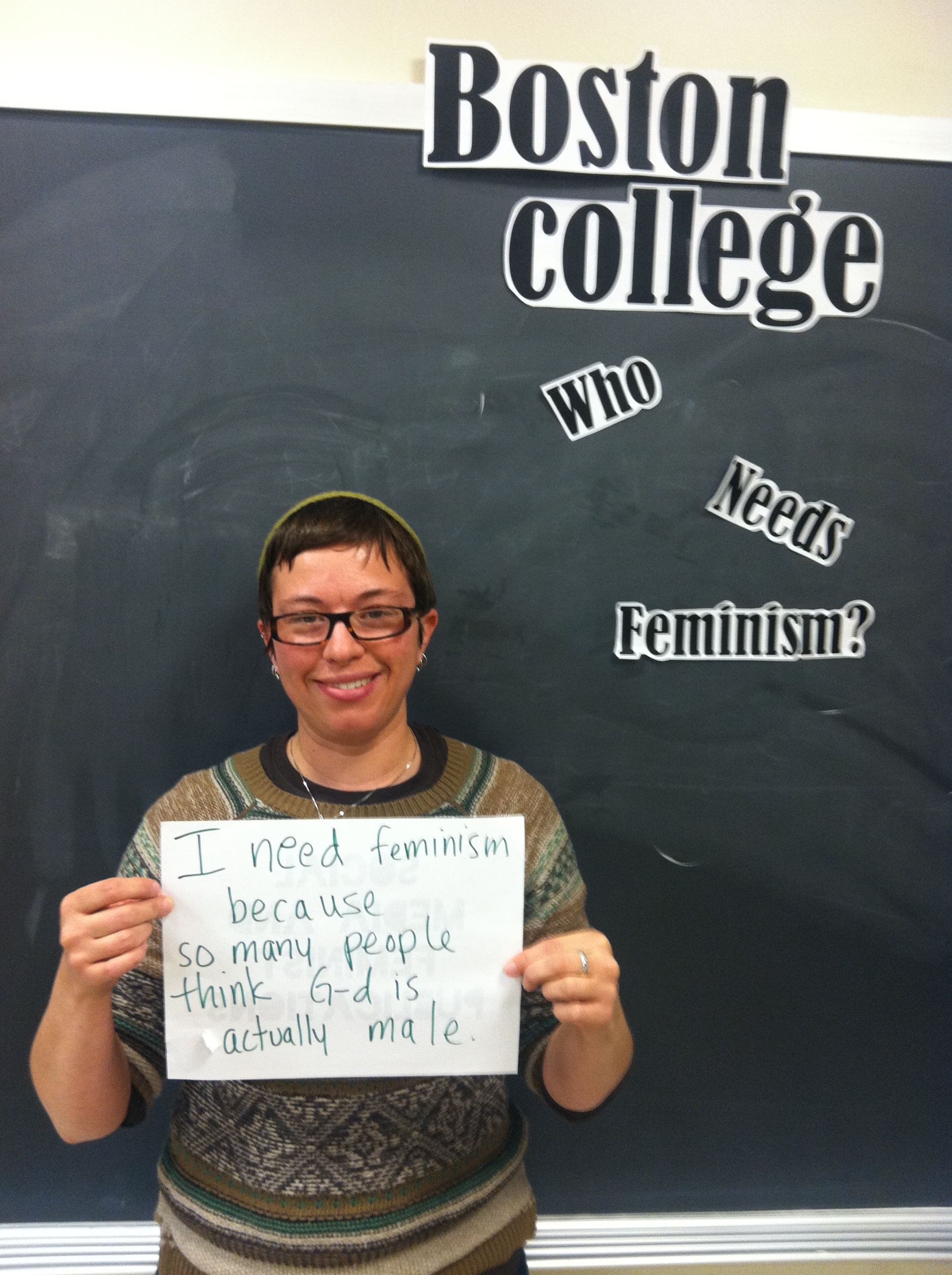
photoIn my introduction to Christianity class, almost every one of my students (who come from diverse religious backgrounds – primarily Roman Catholic, Protestant and Muslim), continues to believe that the best image if not the only appropriate image for G-d is male.  When probed they may speak generically about G-d as genderless, an entity or spiritual presence of some kind, yet conclude by affirming their belief that G-d is male often by adding something along the lines that G-d is best described as Father.  Some go so far in these affirmations that they articulate G-d’s maleness as fact.  It never fails that every semester I struggle with how to address this basic feminist issue within the classroom.

At least as early as 1973, Mary Daly, in Beyond G-d the Father: Towards a Philosophy of Women’s Liberation, articulated the problematic basis of the relationship between gender and divine imagery.  She argues that “If G-d in ‘his’ heaven is a father ruling ‘his’ people, then it is in the ‘nature’ of things and according to divine plan and the order of the universe that society be male-dominated.”  In other words, if maleness is associated with divinity, then the power, domination and running of society by men seems to be divinely ordained. Continue reading “On Pronouns and Liberation in the Classroom by Ivy Helman”

Imagine a Catholic Church that Loved as only a “Woman” Loves by Michele Stopera Freyhauf

Freyhauf, Feminism, Religion, Catholic Church I came across an abhorrent display of ignorance Saturday when reading an article quoting the Pope’s theologian, Dominican priest Wojciech Giertych, on why women cannot be ordained.  This man is in charge of reviewing speeches and texts submitted to the Pope to ensure that they are free of doctrinal error.  Once you read this, I am sure that many of you will have the same thoughts that I do ranging from – that explains a lot — to —  we are in serious trouble!

Giertych touted the common arguments made against ordaining women – Jesus was a man, Jesus chose only male disciples, etc.  However, then he put forth statements about, (1) the theologian’s task, (2) why maleness is essential to the priesthood, and (3) what the vocation of women is and is not.

What is the Theologian’s Task?

According to Giertych, the theologian’s task in determining the definition of priesthood:

 “In theology, we base ourselves not on human expectations, but we base ourselves on the revealed word of God” without the freedom “to invent the priesthood according to our own customs, according to our own expectations.”

According to CTSA (Catholic Theological Society of America), the theological task is described as follows:

Theologians throughout history have promulgated the riches of the Catholic tradition by venturing new ways to imagine and express the mystery of God and the economy of salvation revealed in Scripture and Tradition. This is a Catholic style of theological reflection that very many Catholic theologians continue to practice today. The teaching of the Second Vatican Council in its Pastoral Constitution on the Church in the Modern World (Gaudium et Spes) is especially eloquent on this responsibility” (See Gaudium et Spes #44).

Continue reading “Imagine a Catholic Church that Loved as only a “Woman” Loves by Michele Stopera Freyhauf”

Winds of Change in the Roman Catholic Church by Michele Stopera Freyhauf

Michele FreyhaufIn 2007, I had a conversation with a professor who felt that change was in the air for the Roman Catholic Church. The basis of this opinion was based on language. The words and the context used in writings that emerged from the Vatican were changing and somehow different – a difference that went beyond personal writing styles of Pope John Paul II and Pope Benedict XVI. This professor was hopeful that positive change for women could be coming. He was right about change in the Church, however, the changes surrounding women that emerged have not been positive.

As I continue to reflect on these words, I ponder the issue of language; specifically the impact words have and the way they are used to facilitate subtle changes in thinking, opinion, and beliefs. The method of persuasion that seems to be employed is the Aristotelian Rhetorical Theory that utilizes the five canons of rhetoric: invention, organization, style, delivery, and memory.

An example of this can be seen clearly in the changes in the liturgy that occurred last year. First, the teaching comes out with the rationale as to why the liturgy needs to change. From there a discussion, especially through the media, addressing the upcoming modifications are followed by subtle changes in the liturgy beginning with the call – response and the language in the creed. Next, the language of the celebrant began to change. Finally, the full implementation of changes is made with the addition of new gestures or movements. When I discussed the mass changes with a family member, there was an admittance that the changes no longer affect them – the changes were no longer noticeable. Their memory was impacted because the routine is now second nature.

In order to come to grips with the issue of language and the observation of my professor, I wanted to do a cursory review of the writings issued by the Vatican during this period. Admittedly, with a blog post, there is a limitation as to the depth and breadth of information that can be disseminated. It is my hope to eventually complete a thorough review of the modification of language used during Pope Benedict XVI’s papacy. For now, I want to address a few observations.

Continue reading “Winds of Change in the Roman Catholic Church by Michele Stopera Freyhauf”

The Impact of Excommunication in the 21st Century (Part I) – Spiritual Redemption or Hegemonic Power by Michele Stopera Freyhauf

The Lord loves everyone and died for everyone, and He wants all to be saved…the best lesson that can be learned from everything that has happened is that one finds happiness, joy and satisfaction in obedience to the Church.”Bishop Bruskewitz

One of the most misunderstood concepts in the Catholic Church is excommunication.  Many believe that excommunication is a complete termination or separation from the Catholic Church.  To say this another way, if excommunicated, you are no longer Catholic or part (a member) of the Catholic Church.  None of these statements are true.  By baptism, you are a member of the Catholic Church and no one can take that away.

Much of the misunderstanding stems from the way excommunication was used in the Middle Ages; a means of coercion to control kings and other high ranking officials.  Obedience to the Church meant that you will spend eternal life in heaven.  Disobedience to the Church meant a complete separation from the Church; a ban against  receiving Eucharist, a banishment of your soul to the eternal flames of hell.  Excommunication was the highest form of punishment and the most meaningful (and effective) tools of control.  When a person was excommunicated, there was even a public ceremony –  a bell tolled for the excommunicant, as a bell that would chime for the dead, the Gospels were closed, and a (baptismal) candle would be extinguished.  This ceremony signified eternal darkness and death. Continue reading “The Impact of Excommunication in the 21st Century (Part I) – Spiritual Redemption or Hegemonic Power by Michele Stopera Freyhauf”

BREAKING NEWS: Fr. Roy Bourgeois Excommunicated

It is very disappointing to share that Fr. Roy Bourgeois was excommunicated, dismissed, and laicized by the Vatican as a result of his support for women’s ordination and the eradication of sexism in the Catholic Church.  The following was sent out for immediate release by Maryknoll on November 19, 2012.  Additional information will be shared once released.

FOR IMMEDIATE RELEASE

The Congregation For The Doctrine Of The Faith
Canonically Dismisses Roy Bourgeois

Maryknoll, New York – November 19, 2012 – The Vatican’s Congregation for the Doctrine of the Faith, on October 4, 2012, canonically dismissed Roy Bourgeois from the Catholic Foreign Mission Society of America, also known as the Maryknoll Fathers and Brothers. Continue reading “BREAKING NEWS: Fr. Roy Bourgeois Excommunicated”

Hitting the Trifecta in Women’s Issues by Michele Stopera Freyhauf

One did not have to watch the debate between Barack Obama and Mitt Romney this past Tuesday to know that Romney hit the trifecta in the area of women’s issues.  It was all over social media within minutes of statements being made that marginalized or treated women as “less than.”

The issue of contraception and rape is still a topic of debate.  Church’s post signs to “Vote for Religious Freedom” and hand out voting guides that help you gauge the moral candidate.  Bulletin boards stating that “Obama believes in abortion and gay marriage – do you? vote Republican” appear by the highway.  This issue will not be settled during the election.

If people in power set an example of bullying and/or oppressive behavior, this behavior becomes acceptable.  If women are treated “less than,” then their dignity as well as their humanity is compromised.

An extreme example of this de-humanizing treatment of women in American society appeared October 13th in Cincinnati.com.  A story was published about a flyer found in the men’s restroom of a co-ed freshmen dorm at Miami University.  The title of this flyer – “Top Ten Ways to Get Away With Rape:” Continue reading “Hitting the Trifecta in Women’s Issues by Michele Stopera Freyhauf”

Visions of My Grandmother by John Erickson

“I never told my grandmother I was gay. I’ve often wanted to visit her grave, clench my hands together, and pray that she forgive me for betraying the trust she instilled upon me long ago. However, even today, I cannot bring myself to make that trek, up the hill into the countryside where her ashes lay below the ground.”

I haven’t dreamt of my grandmother since her passing one hot summer July evening.

The night, and the days that followed, continue to be a blur.  However, as my family members continue to see her in their nightly visions, I, go on unabatedly longing to see and hear the voice of a woman who made me feel the presence of the divine with each passing story.

My sister saw her in a dream when she was buying shoes, my mother has seen her multiple times when she would be undergoing a particularly stressful situation, and I, left alone and oftentimes wondering through an abyss of loneliness and disarray, wake up each morning wondering why, I am left all alone. Continue reading “Visions of My Grandmother by John Erickson”

Validating the Gospel of “Jesus’ Wife” is not Necessary to Prove Female Discipleship by Michele Stopera Freyhauf

The Gospel of “Jesus’ Wife” is certainly at the center of a battle that was last seen when questions of authenticity were raised about the James (Jesus’ brother) ossuary.  In a New York Times article, September 30th, Judith Levitt states that this document adds weight to theological and historical flaws surrounding the issue of the ordination of women.  The Vatican believes that their theology is still sound, calling the document a forgery.

The Gospel of “Jesus’ Wife.” [www.boston.com]
Frankly we do not need this document to validate the existence of female deacons and disciples – we have the biblical text and writings of the early church to validate this position.

Nor do we need this document to show that the standing from the Vatican’s point of view of ordaining women is theologically and historically flawed.

“In 1976, experts of the Pontifical Biblical Commission determined that there were no scriptural reasons preventing women’s ordination. The Congregation for the Doctrine of Faith overturned the commission’s judgment and instead wrote its own statement (Inter Insigniores, 1976) stating that women do not image Jesus who was a man; and therefore only male priests can adequately represent Christ.” – Women’s Ordination Conference

John Ortberg, in the Huffington Post, addressed a bigger issue surrounding female leadership in the Church brilliantly:

“perhaps what matters most in this discussion is the impact Jesus had — not on one woman — but on the status of women as a whole.”

Continue reading “Validating the Gospel of “Jesus’ Wife” is not Necessary to Prove Female Discipleship by Michele Stopera Freyhauf”