“These were very simple rituals and yet they were so powerful.”
Jeanette Stokes’ 25 Years in the Garden is on my bedside table. It’s a book I read several years ago with a small group of feminist Christians when I was living in Blacksburg, Virginia. The following passage from one of her essays got me to thinking back to the 2012 PANAAWTM conference (Pacific, Asian, and North American Asian Women in Theology and Ministry) I had attended just two weeks ago:
“Rituals are part of everyday lives: reading the newspaper, checking the weather, waiting for the mail to come, or talking with a family member at the end of the day. Rituals can also mark the extraordinary events in our lives: the birth of a child, the death of a loved one, a birthday, marriage, anniversary, or divorce” (Stokes, 2002, p. 37).
I was raised in a conservative, Republican, military family. I support personal freedom and personal responsibility. I support the military. I support a balanced budget. I support individual rights and the constitution. I support small government. But I find myself increasingly separated from the Republican Party, and this is why:
I cannot align myself with a party that repeatedly acts to restrict the rights of women, to deny women protection from abuse and violence, and to trample the rights of women to make their own medical decisions. I cannot support a party where individual rights and freedoms are only protected for people with a penis (so long as they are not gay).
On February 16, 2012, there was a hearing by the Oversight and Government Reform Committee regarding the Affordable Care Act, which concerned the availability for contraception through insurance provided through religiously-affiliated employers. Out of the ten witnesses called, only two were women. When other representatives asked that other female witnesses be called to testify regarding contraceptives, Chairman Darrell Issa refused their request on the grounds that the scope of the committee was limited to the 1st Amendment implications and not to the matter of contraceptives themselves.
Republicans in Virginia, Oklahoma, Colorado, Wisconsin and Mississippi have advanced “Personhood” acts/bills declaring that a fetus has the full legal rights of a person, beginning at fertilization. Such laws would make in-vitro fertilization, stem-cell research, the morning-after-pill andall abortions (medically necessary or not) illegal. It could also be interpreted to make standard birth control options such as the Nuva ring, the pill, IUDs, and birth control patches illegal. Democrat Vivian Watts in VA attempted to amend the bill in Virginia to specify that contraception would not be banned under the Personhood bill, but Republicans voted 64-34 against adding this amendment. Any abortion or even cases of miscarriage due to negligence could be charged as manslaughter or homicide. Another attempt at amending the bill was proposed by Democrat Jennifer McClellan on Feburary 13, 2012. Continue reading “Grievances Against the GOP from a (former?) Republican Woman by Katie German”
I make a distinction between power and authority. Authority is a personal characteristic based on a relationship of trust between me and a text, a person, or their work. Power, on the other hand, is operative with or without trust.
This past weekend, I had the honor of participating in a workshop on Living Texts: Celebrating Feminist Perspective and Theo/alogy, Authority, and the Sacred in the Academy. The workshop was organized for the Women’s Caucus of WECSOR, a regional association of national organizations who study religion. I was delighted to connect with new friends, mentors and sisters interested in feminism and religion, including some of my co-contributors on this site –Theresa Yugar, Sara Frykenberg, and Corinna Guerrero . There were two panels that shared our reflections about authority from either student perspectives or diverse professional perspectives. I shared my experiences as a student. This workshop was a gathering where women scholars in religion could discuss the challenges and promises of our voices in the academy. Because our dialogue was so inspiring to me, I thought I’d continue the discussion here. Continue reading “My Feminist Perspective of Authority – Part 1 by Elise M. Edwards”
Quite a number of years ago I had a conversation with one of my professors, a feminist theologian, who posed the question “Why do I need a man to purify my baby with the waters of baptism? Is there something wrong or impure about the blood and water from a mother’s womb – my womb?” Before you jump and shout the words Sacrament or removal of original sin, this question bears merit in exploring, especially in today’s world where women are taking a serious beating religiously, politically, and socially. In today’s world, violations and rants are causing women to stand up and say STOP! This is MY Body. This outcry was provoked by chants of ethical slurs against women– Slut! Prostitute! Whore! The cry got even louder when the issue of religion and government was raised in the fight of healthcare coverage of contraception. The cry got even louder with the enactment of the laws in Virginia and Texas (and many other states to follow suit) that forces women to undergo transvaginal ultrasounds in early stage abortions. The mandatory insertion of a wand into a woman’s vagina (mandated by the government, mind you), is a violation and has women crying RAPE!
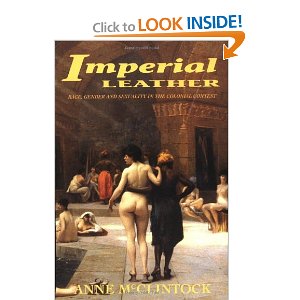
The memory of this conversation did not re-appear by chance, it was prompted by a book I read for my History of Sexuality Class – Imperial Leather: Race, Gender, and Sexuality in the Colonial Context by Anne McClintock who addresses the notion of baptism through origins, property, and power. So many things are currently being taken away from women and reading McClintock’s assertion regarding male baptism is perplexing. She believes that male baptism or baptism by a man takes women’s role in child bearing and diminishes it. These are the same men who historically treated and regarded women as vessels. She further asserts that this act is a proactive removal of creative agency with respect to a woman’s ability to have the power to name. That is, the last name of the child belongs to the husband. A point that supports the notion that patrimony marks the denial of women. Anyone doing genealogy encounters a perplexing struggle to identify mothers because their names are essentially erased from memory and rarely attached to a child’s name. Continue reading “Is Baptism a Male Birthing Ritual? By Michele Stopera Freyhauf”
I knew that I was going to be attending a totally different type of conference than I had ever been to before when I received the following instructions on additional items to pack: (1) my own mug with which to drink coffee or tea (“we will go green in this conference as much as possible”), (2) 3 oz. of water “from a source of nature near your home” to be offered during “opening worship,” and (3) a small, modest, pre-owned, homemade, or inexpensive “earth-honoring gift for exchange.”
“We need to start examining the underlying questions of counter-cultural relationships that view one man marrying many women to be hip because we begin to see that although a polygamist idea of marriage may be sexy from a popular culture standpoint, the thought of legally recognized gay marriage always then gets likened to bestiality.”
… you have to allow polygamy, bestiality, and everything else!” The title for my post this week is a quote from an individual I used to associate with. This individual, haling from a conservative evangelical background, tried to explain to several others and myself the reasons why gay marriage would eventually lead to the repeal of anti-polygamy and bestiality laws across the United States.
The problems that I have with this particular argument are conflating gay marriage with religious freedom. Activists and scholars can draw comparisons to anti-polygamy cases such as the 1878 U.S. Supreme Court case Reynolds v United States and the 1882 Edmunds Act and 1887 Edmunds-Tucker Act that disfranchised and led to the imprisonment of Mormon polygamists. But in the end, gay marriage is not about religious freedom but rather human rights.
I often feel that there is this need both within and outside religious communities to promulgate the idea that LGBTQ individuals want to get married within the sanctified walls of “the church” just as much as heterosexual couples do. Although I do not want to disqualify those who desire to see LGBTQ equality within their faith based communities, buying into a heternormative ideal of what traditional marriage should look like needs to result in LGBTQ individuals asking why marriage should be performed in sacred spaces in the first place The normative traditions that have often defined marriage have also served as shackles keeping LGBTQ couples in the mindset that to achieve fully marriage equality with their heterosexual counterparts is to fully immerse themselves within the same traditions and practices. Continue reading ““If You Allow Gay Marriage…” by John Erickson”
It is our moral responsibility, whether we identify as Christians or not, to pray for not prey on the victims of tragedies.
Over the last month, dare I say years, society has witnessed or been subjected to an all out war from radical Christians across America deploying the wrath of God and reveling in the tragedy of others to perpetuate their apocalyptic message of rhetoric and terror. As I hear the news over the last few months, an old Billy Joel song starts to play in my head “We didn’t start the fire.” Whether we started the fire or not, we should not feed the flames of hatred but figure out a way to extinguish it.
Here is a brief synopsis of current events that reflect this hatred and radicalism perpetuated in the name of God – examples of Christianity terrorizing or preying on victims through their actions.
The Westboro Southern Baptist Church: Preying on Victims at Funerals and Thanking God for their Tragic Deaths
Their web address says it all: www.godhatesfags.com. This group, which one cannot call Christian but rather “hate-mongers,” threatened to burn the Qur’an, was banned from Facebook for spreading hatred against homosexuals, and recently had the audacity to picket funerals of Americans killed in natural disasters, most recently, a teen-age shooting victim, Daniel Parmertor (age 16), from Chardon, Ohio. Thankfully, volunteers across Ohio and a local group of bikers formed a human barricade to keep these people away from the funeral and grieving family and community.
Membership Coordinator of the Women’s Ordination Conference.
Last weekend I had the honor of joining over eighty Women’s Ordination Conference members and supporters in Claremont, California for a screening of “Pink Smoke Over the Vatican” followed by a distinguished panel discussion. WOC board member Miriam Todoroff of Pilgrim Place hosted the event, along with Rev. Kathleen Jess, ECC, with local support from Theresa Yugar. “Pink Smoke Over the Vatican” has recently been made available for purchase, but for the past couple of years the film has starred in women’s ordination movement circles, drawing hundreds to cinemas, churches, universities, and homes for a peek at the controversial and moving film.
Fr. Roy Bourgeois has taken the show on the road, touring and speaking throughout the world (from Rhode Island to Rome) on women’s ordination and the important stories in the film. Fr. Roy’s involvement with women’s ordination is well documented, however, notably, “Pink Smoke Over the Vatican” is specifically mentioned in his First Canonical Warning from his Order, the Maryknoll Fathers and Brothers, insisting that his public support and promotion of the movie was a Holy Offense. More than just good press, this is a testament to the power contained within this film. Continue reading “Pink Smoke Over the Vatican: A Review by Kate Conmy”
In the first part, I posed the question about whether or not the so-called “Curse of Eve” could be interpreted alternatively from the traditional understanding of Genesis 3:16a (the result of Eve’s disobedience being the punishment of painful childbirth for all generations of women). I considered an alternate interpretation of “sorrow” rather than “pain” for the verse, a lens through which the punishment could then be seen as impacting the God-human relationship rather than as a condemnation of pain.
I would like to further examine the consequences of this consideration. What if we were bold enough to interpret both the punishments of Adam and Eve (toiling over the land and pain in childbirth, respectively) as symbolic for all of humankind—and, furthermore, as speaking specifically of the God-human relationship? After all, men certainly aren’t the only ones who have toiled in the fields to bring forth food (I say this specifically thinking of a female farmer who lives down the road from me, and remembering her 10-14 hour days laboring over her harvests). Nor are all women subject to painful childbirth; in fact, the documentary Orgasmic Birth specifically devotes its study to women who find the experience of birth both sensual and ecstatic. If interpreting the Scriptural “curses” as literal and final, these not-so-exceptional exceptions would seem to contradict God’s decree. Yet when interpreting the punishments as indicative of a schism in relationship between God and humankind, the implications can be more clearly understood. Continue reading “The “Curse of Eve”—Is Pain Our Punishment? Part 2 by Stacia Guzzo”
As a teenager, I had very little self-confidence, and I was—and still am—an idealist. My mother, who suffered from diabetes and heart disease, never worked outside the home. She raised four children—one with disabilities—and found a great deal of happiness doing that when we were young. She died at the age of 49, when I was 21. By that point in my life, I had serious questions about my worth as a female member of society. How much of this was due to my family, how much was due to my religion, and how much was due to my middle-class American background? That is hard to answer. But I would probably say that my 21-year-old angst had more to do with witnessing my mother’s health challenges than anything else.
I never pictured my future looking any different than my mother’s and my aunts’, and until the reality began to stare me in the face, I thought I was OK with that. Raised in the Mormon diaspora of the American Mid-West, they all received bachelor’s degrees, married men with advanced degrees, and then settled down into the male-breadwinner model of marriage. Continue reading “The Sovereignty of the Soul by Elizabeth Mott”