This week I bought a pendant that caught my attention. It is Celtic knot work of horses, meant to represent Epona. This triggered my interest in Epona and off I went to learn more.
Epona is a goddess from Gaul. Sadly, any information about her from those early days of worship are lost to us. This is the case of the most ancient deities from that region and time in history. It is thought that she was picked up in Gaul by the conscripted soldiers of the Roman Army who saw a depiction of her upon her horse and they adopted her. Since this army rode across the land on horseback, she was the perfect deity to pay homage to and so, she traveled with them. She soon made it to Rome and is one of only a few deities, not originally Roman, to be worshiped in the Roman Empire.
Part 1 was posted last week. You can read it here.
About ten years ago I began to keep a (public) though never advertised blog to help me keep track of my life. Because I am so severely directionally dyslexic this blog helped me to organize my material. Drafts of published and unpublished papers, poetry, opinions, changing seasons, virtually anything that I was experiencing and writing about ended up on that blog. Without conscious awareness/intention I began to include the more esoteric aspects of my experiences, and this is how stories of Lily b, lizards, various extraordinary encounters with birds, bears etc. ended up on this online journal sort of by ‘accident’. I didn’t even realize what was happening. I wasn’t talking about these experiences, but I was starting to write about them publicly, not just privately. People read what I wrote, I realized vaguely. Frankly this didn’t matter much because that wasn’t why I kept an online journal. Its primary purpose was twofold. It helped me organize my writings but more importantly it distanced me from particulars so that patterns emerged. Enter NPR. Anna had apparently been reading my blog for a couple of years and asked me if I would do an interview on Lily b my telepathic bird. I was astonished, but agreed, although with some trepidation because I had so rarely discussed this subject. The old fear of crazy surfaced.
Sometimes I describe my work and writing as “a love song to the Ozarks.” I am deeply embedded, body and soul, in this land that I come from, my bloodland, the place where I belong. Seven generations of my family have called these wooded hillsides and stony ridgetops home. This is my mystery school, where I explore hundreds of ways to kneel and kiss the earth.
The Earth is my teacher I shall always want I witness her still meadows She leadeth me to green pastures She restoreth my soul On tree covered hills She reminds me I am home and, yea, I walk in her valleys and I fear no suffering She is with me Her mountains and rolling rivers they comfort me joy bubbles through my veins and enlivens my footsteps my cup runneth over truly I stand in mysterious awareness all the days of my life and She holds me in the palm of her hand forever.
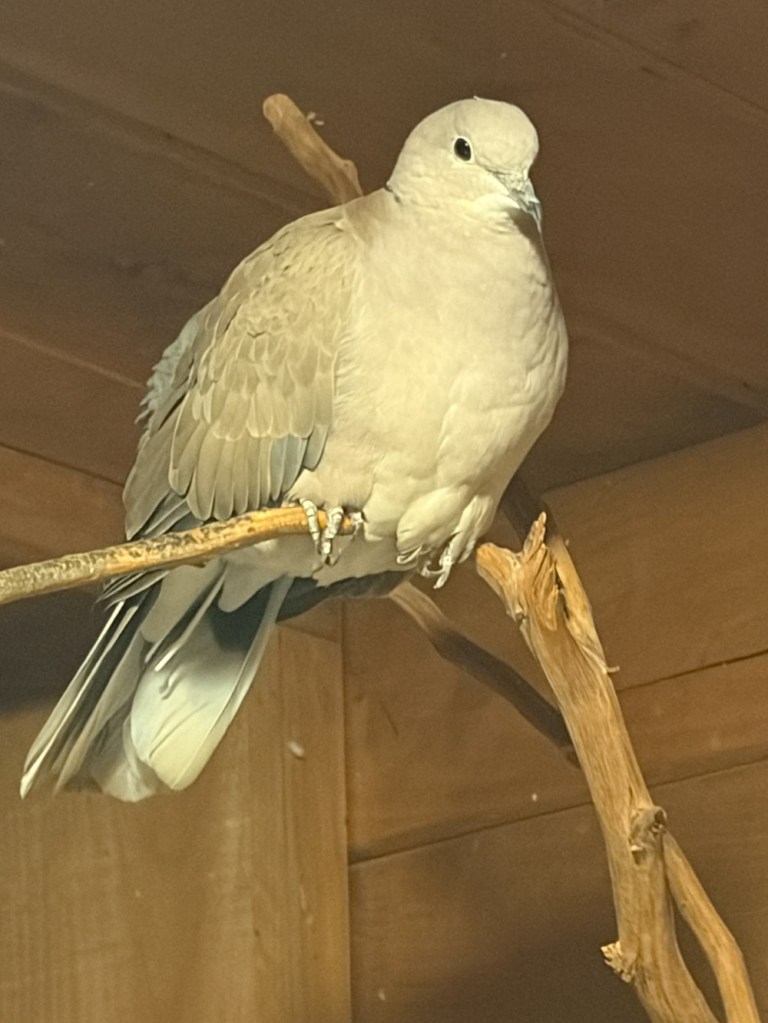
I begin this story with a vignette and an invitation to meet my current family. This morning my four -pound Chihuahua made her usual rounds and ended up in the bathroom where my 3O plus year old African Collared Dove, a free flying house bird has a roost and his very own plant window. Lily b had flown onto the floor and was visiting with Coalie.
The first time I witnessed this exchange between bird and dog I instinctively swept Lily off the floor and deposited him on his perch, feeling relieved no damage had been done, though oddly Lily b was not the least bit agitated. A few days later I discovered him on the kitchen floor as Coalie was backing him into a corner. Or was she? Lily b was initiating these exchanges, so I was baffled.
Every morning Coalie stops by to see if Lily b is perched on his basket. They exchange salutations meeting eye to eye before Coalie moves on unless Lily flies down. It is impossible not to conclude that these two are engaging in some kind of play on days they meet on the floor. If Coalie can’t resist pulling at one of Lily’s feathers, he promptly spreads out a wing using it as a shield to block her. Back off he says and she does! Lily b never flies away.
In late November I first snowshoed our woodland trails to include the little balsam that I lit to honor all evergreens throughout the winter months. Every day when my little dog and I circled the tree I told her I loved her and called her ‘Lightbringer’. This daily encounter never lost its magic. The Goddess Lived during the darkest winter nights!!
The rest speak to the subtle changes that occurred from late winter into spring. My writing naturally follows both seasonal and intraseasonal shifts that might not be noticed unless a person is paying close attention.
(1)Lightbringer
Will she still be there shining after the storm? Moon Bear is on the rise. I peer through white flakes at dawn light pierces her powdery fringed shawl Love lights the darkest Night.
Steadfast Balsam cloaked or not Ever-green, Tree of Life. Heartlines flow crystalline waters pour down deep sleep oh, Daughter of the Night Daughter of The Light, Light -Bringer Life -Bringer The Miracle Is that You Live.
Author’s Note: When my mother died in 2018, I became the custodian of her voluminous files. I found some gems inside them. My mother lived in NJ not too far from a place called Genesis Farms and its founder and proprietress was/is Sister Miriam MacGillis. There was a whole file on the farms.
Included in these files was a binder of cassette tapes from a workshop Miriam MacGillis gave in 1986 called “Education for a Small Planet.” There are 4 double-sided cassettes. When I first saw them, I was afraid to even touch them as 40-year-old cassette tapes are not known for their sturdiness. A friend helped me find an agency that agreed to digitize them. Since then, I have had the great honor of transcribing the tapes. It took me several months, but I have now completed the transcription. (They are a little rough as I added punctuation as I went.) I have been in touch with Miriam about them and she agrees that the message from 1986 is still important, in fact, likely more important now and they should have as wide an audience as possible.
Miriam MacGillis is a modern-day prophet who not only holds a broad understanding of cosmology but brilliantly expresses it. She was an early colleague of Thomas Berry, introducing many people to the Story of the Universe.
I believe these tapes need to be studied and shared and I am happy to make them available to anyone who is interested. Below is a taste of their wisdom. It is from Tape #1A (first tape, first side), lightly edited. This is really just an introduction and it will be in two parts.
Besides being advocates of social justice, the prophets of Israel were advocates of “exclusive monotheism,” exclusively “male monotheism,” “religious othering,” and “religious prejudice.”
Many progressive Jews and Christians find inspiration in prophets because of their insistence that their God cares about the poor and “the widow at the gate.” For progressive Christians, Jesus stands in the prophetic tradition, and the core of his message is “concern for the poor.” For progressive Jews the prophetic tradition is the root of their concern for human rights.
Those who locate their spirituality and concern for social justice in the prophets can point proudly to Martin Luther King and the many priests, ministers, and rabbis, as well as ordinary Christians and Jews who marched with him as exemplars of the prophetic tradition.
But the prophetic tradition also has a nasty underside.
This pretty planet Spinning through space You’re a garden, you’re a harbor You’re a holy place.
Tom Chapin
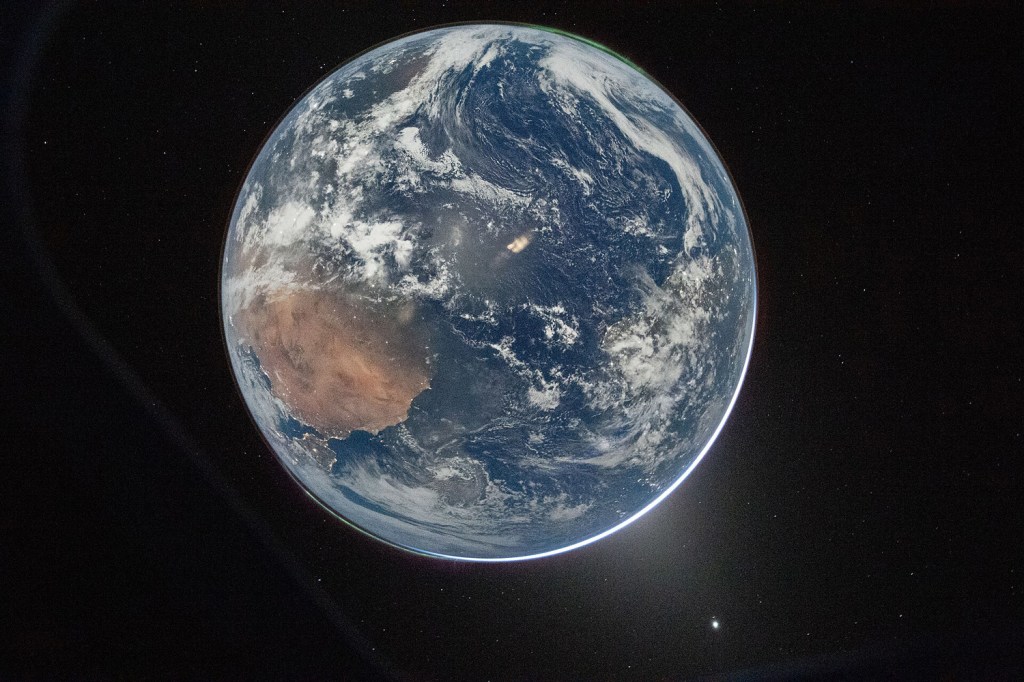
Earth from the perspective of Atemis
A few weeks ago, NASA successfully launched the second in its Artemis series of rockets. Appropriately named for the Greek Goddess of the Hunt and the Moon, the Artemis mission has the moon as its focus. The first rocket in the series, Artemis I, orbited the moon without a crew. The second, Artemis II, carried a crew of four astronauts to the moon and beyond — the farthest from the Earth that humans have ever traveled – so it’s fitting in more ways than one that it is so named since Artemis was known for her ability to rise to a challenge and aim for a distant target with keen accuracy.
In her masterpiece, A Chorus of Stones, ecofeminist Susan Griffin traced our trajectory to the moon through the intimate interweaving of flight and its uses in war — from the delegates to the Second International Peace Conference overturning of the prohibition against dropping projectiles from flying machines that had been adopted previously at the First International Peace Conference to the research and funding for the development of the V-1 and V-2 rockets at the Nazi Peenemünde Army Research Center during WWII and on to ever increasing enhancement of guided missile systems mostly for purposes of war. Those early days of flight generated an enthrallment with technology that continues to this day, and that Griffin found alarming. In the poetry and scientific writings of the early days of flight she found an expressed desire to escape the limitations of the earth and feared our ever-increasing exploration of space beyond the Earth would lead to Earth’s abandonment altogether.[i] Indeed, the ultimate mission of the Artemis program is to establish a colony on the moon, and talk has swirled in popular culture about the need to establish colonies on Mars should Earth become uninhabitable due to climate change or nuclear annihilation.
The Glorians: Visitations from the Holy Ordinary is an astonishing book written by internationally acclaimed writer Terry Tempest Willams that is predicated on the necessity of bearing compassionate witness to all beings during these troubled times. It is a book about family, friends, earth and dreams, the later of which inspired the title. The volume is composed of a series of essays, only one of which I will discuss here.
Terry, who teaches at Harvard Divinity School, writes about the Divinity Tree, a two-hundred-year-old red oak that was removed from the Commons. Listening to this narrative as a ‘Tree Woman’ was/is excruciatingly painful. My stomach roils in misery, but I am compelled to listen, over and over, because this is my story too.
I came to the mountains because I was in love with trees and bears discovering an evergreen paradise or so I thought until the dreams began. In my night stories all the trees were being slaughtered and there was nothing I could do. Since I was surrounded by fragrant forests that stretched from horizon to horizon, I could make no sense of these terrifying warnings and let them be.
the circle repeats tightens with age crushing an aging heart I cannot breathe through these lifetimes of loss instead I relive old pain 4AM lasts an eternity each mourning