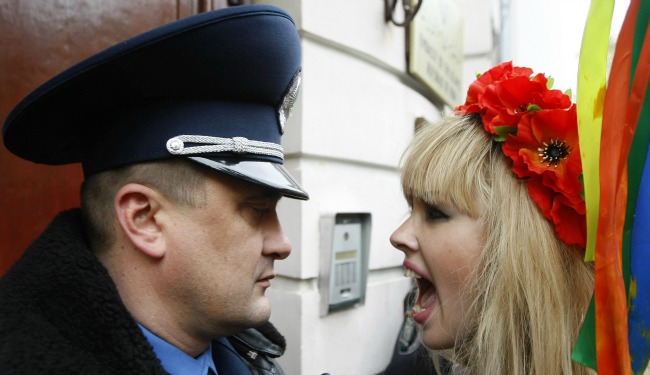
(Femen)ism? by Kile Jones

Kile Jones, atheistAs most of us are aware by now, there is a “feminist-sextremist” group from Ukraine called “Femen.”  This group has been very controversial by their public demonstrations of nudity, the words they paint on their bodies, and their explicit condemnations of political structures and organized religions.  They were started by Anna Hutsol in 2008 and have now spread throughout Europe and the Middle East.  The question I pose for this post is: Does Femen harness or hinder the power of the feminist critique?

Image from Konstantin Chernichkin/Reuters

Femen is precisely the kind of movement that pushes us in our understanding of feminism, the means by which it is best expressed, and the issues surrounding moral condemnation and religious sensitivity. Continue reading “(Femen)ism? by Kile Jones”

Protecting our Families: How the U.S. Falls Short in Protecting New Mothers (and Fathers) by Michele Stopera Freyhauf

Freyhauf, Feminism, Religion, Durham, Old Testament, Blogger, Bible, Gender, Violence, Ursuline, John CarrollLast weekend, I had the privilege of speaking at the National Convention for American Mothers, Inc. about motherhood in the 21st Century.  Because this is such a vital issue for mothers that live in the U.S. (since a large majority of families have two full-time wage earners), I thought it would be appropriate to share my speech here.  With the understanding that this a forum for feminism, I believe that this topic fits this forum because it continues to show how unequal the treatment is between the sexes – whether it is pay, position in employment, healthcare, education, or simply balancing the responsibilities of family/career.  For those that live in the United States, there is often a sense of exceptionalism, and as I clearly demonstrate in this speech, we are certainly a far cry from being role models that when it comes to protecting mothers (whether by birth or adoption) and families.

As a side note:  One topic that was not explored, due to lack of data, is how maternity/paternity leave impacts same sex couples who become new parents – I have to believe that this is a topic to also examine (and I am would encourage any feedback here).  

Recently the United States ranked 25 out of 165 countries for being the best place to live if you are a mother.  This number is up from 31 a year ago and places us between Belarus and the Czech Republic.

You may be asking yourself, Why isn’t the United States in the top five or even in the top ten? The answer to that question becomes evident once we examine how that determination is made. The categories examined are:

  • Mother’s education;
  • Child’s Health;
  • Economic status;
  • The Election of women to government office;
  • Breast feeding programs.  In the United States 75% of mothers breastfeed their babies, 35% continue to breastfeed after six weeks. The number shrinks because mothers usually return to work and find it difficult to to pump at the office;
  • Maternal death rate is another factor, which stunned me when I found out that the US has the highest maternal death rate of any industrialized nation. Approximately 1 in 2,100 women are at risk of dying during child birth;
  • Infant death rates is another category.  Infant deaths are estimated to be 8 per 1000 births – a number that throws us behind 40 other countries;

Feminism and Football By Marcia W. Mount Shoop

Marcia headshot“How did race and privilege affect the NCAA investigation of the football program at University of North Carolina?”

This was the question a student posed to me recently when I gave a Skype lecture to a Sports Ethics class at the University of Washington’s Center for Leadership in Athletics

I am going to take a wild guess (and I may be wrong), and assume that most readers of the FAR blog don’t know much about the NCAA investigation of the UNC football program.   I have outed myself on this blog before—I am more than just a feminist theologian; I am also a football coach’s wife.  Lots of people wonder how I manage to pull that off and still look at myself in the mirror.  That’s a complicated question.  I am finding that the challenges presented by our experience at UNC are creating more and more space for the feminist and the coach’s wife to find a common purpose.  Which brings us back to the question at hand—race and privilege and how it played into the football investigation at UNC.

You may want to investigate the many details of this investigation, but I would like to invite this feminist community to see what you think about this question of privilege in particular.   I will provide just a few factual statements for you all.  You tell me if you can think of ways that race and privilege may have been at work to the detriment of certain groups in this situation.  Continue reading “Feminism and Football By Marcia W. Mount Shoop”

Are Buddhist Women Happy? by Oxana Poberejnaia

0The basic question is the same as in a “A Bit of Fry and Laurie” sketch about a sour-faced champion car racer: “Are you happy?” Are we, Buddhist women, happy with Buddhism? Are Buddhist men happy with the position of Buddhist women? Are we happy with the legacy we are leaving for future generations of Buddhist men and women?

This question can be re-phrased as: Are we happy because we should be happy? Because if we are unhappy it is our failure as women? Or as Buddhist practitioners? Are we happy to keep other people happy?

Do these questions sound familiar? – Are these the same questions that women have to deal with anyway, in this patriarchal society we live in? Continue reading “Are Buddhist Women Happy? by Oxana Poberejnaia”

Speaking Up for Animals by Grace Yia-Hei Kao

I hope that readers will rethink their consumer choices, monies that have long been offered at the expense of nonhuman animals–overwhelmingly female and exploited because of their female biology. We choose where our money goes, and in the process, we choose whether to boycott cruelty and support change, or melt ambiguously back into the masses.”  

Continue reading “Speaking Up for Animals by Grace Yia-Hei Kao”

The Feminist Influence by Elise M. Edwards

Elise Edwards

In these past few months, as I’ve been finishing my dissertation about a theological and ethical perspective on architecture, I’ve had the pleasure of speaking often about my work.  In March, I was invited to give a talk at a symposium titled “On Christ and Architecture” at Judson University.  As they introduced me, the speakers noted that I am a black feminist.  Because of the brevity of my presentation, I didn’t speak about things that most people associate with feminism. So I was especially excited when at the end, one of the organizers complimented me by saying, “I really see the feminist influence in your work and I thank you for bringing that to us.” So exactly what does a feminist perspective bring to a theological study of architecture?

Perhaps first I should explain what my theological study of architecture is.  The purpose of architecture is sometimes understood as aesthetic or functional—to either make buildings that look nice or serve their purposes well (or both).  However, I discuss an ethical approach that expands this common understanding of architecture.  Grounding my research in philosopher Karsten Harries’ The Ethical Function of Architecture and theologian Timothy Gorringe’s A Theology of the Built Environment, I argue that architecture presents interpretations of a community ethos, or way of life, for its specific time and place.  These representations can either promote or inhibit human flourishing, and therefore, are the proper concern of Christian theology and ethics, which is concerned with questions about how Christians and those in the broader society are to live rightly in the world. Continue reading “The Feminist Influence by Elise M. Edwards”

Grief Beyond Belief and Rebecca Hensler by Kile Jones

Kile Jones, atheistIn my last post, “A Pro-Science, Skeptical Woman Speaks” I interviewed a woman with whom I share many views in common.  One of my goals here at Feminism and Religion is to introduce different secular, atheistic, liberal feminists who share many of the same ethical views as regular contributors and readers, but not the same “religious” or “spiritual” ideas.  In this post I examine an online support network for unbelievers, Grief Beyond Belief, and ask a few questions to its founder, Rebecca Hensler.

I met Rebecca in February in San Francisco while on a visit I made to meet with the Unitarian Universalist Association in regards to my ordination.  My girlfriend and I met Rebecca in North Beach, San Francisco for dinner and drinks.  I experienced her as a compassionate, friendly, and genuine person.  Her experiences and insights inspired me to think more about the role of grief and pain among unbelievers.  I mean, atheists cry, agnostics experience loss, skeptics lose family members, and we do it all without a “God” or “spirit” to help us.  And if we were to meet C.S. Lewis, we would make

sure to exclaim, “No…pain is not some megaphone for God to rouse a deaf world.”

R Hensler

Why did you start Grief Beyond Belief?

The original idea was born of my own grief.  After my son died, I found a group in which to share comfort and compassion with other grieving parents: The Compassionate Friends, a mainstream parental grief support organization with a strong online presence.  It was so close to exactly what I needed, but I frequently felt alienated by the religious and spiritual content — not just the offers of comfort that depended on beliefs I do not hold, but the assumption that everyone there held some sort of belief in life after death. And the assumption, so common in mainstream grief support, that even if I am not the same religion as you are, I have a religion, and I believe in some sort of afterlife was equally alienating and hurtful. Continue reading “Grief Beyond Belief and Rebecca Hensler by Kile Jones”

Reflections on Good Friday by Kathryn House

Tomorrow is Good Friday on the western Christian calendar, the day when western Christians remember Jesus’ death on the cross. The day is often memorialized in ways that recall Jesus’ last moments, from his final steps to his final words, with great specificity. For as many traditions to observe the day, there are theologies to interpret just what, if anything, the cross “means.” In the past few years, I have found myself moving further and further away from identifying this day as one that saves. If I am honest, it has been, and continues to be, an exercise and practice in theological freedom. For me it started with the moment in my first year of theology class when my professor spoke about Anselm and Abelard, of transactions, of debt satisfaction. Something about seeing this formula within its feudal context – of seeing it for the first time as a deeply contextual rather than eternal or primordial or absolute theology – struck a chord and disrupted some sediments I considered unshakeable.

This fissure and subsequent reimagining has continued as over the years I’ve engaged the work of womanist and feminist theologians. There was sister FAR contributor Xochitl Alvizo’s post last year disrupting the spectacle of Good Friday, of re-imaging new rituals that do not dwell on death. There is the work of JoAnne Terrell, the books Proverbs of Ashes and Saving Paradise by feminists Rebecca Parker and Rita Nakashima Brock, and my professor Shelly Rambo’s work on spirit and trauma. I suppose if I am anywhere on the topic, I am just no longer sure that Jesus paid a debt he did not owe because I owe a debt I cannot pay. I am unconvinced that suffering redeems, that blood atones, that the death of a son – of anyone’s daughter or son – brings satisfaction. Certainly feminists and womanists hold diverse beliefs, but here is where I can stand, for now.

Continue reading “Reflections on Good Friday by Kathryn House”

Purim and the Value of Courage by Ivy Helman

Ivy HelmanThe Jewish Festival of Purim and the book of Esther offer us an opportunity to reflect on the value of courage from a feminist perspective. The online Webster’s Dictionary defines courage as, “mental or moral strength to venture, persevere, and withstand danger, fear, or difficulty.” In religious discourse, courage is often categorized as a virtue or a moral principle. Aristotle (384BCE – 322BCE), one of the most famous of the virtue ethicists, believed a virtue like courage should be practiced according to the mean or the right amount. Too much courage leaves one rash, possibly too reactionary and hot-headed while too little makes one cowardly and weak, but just the right amount in a given situation leads to moral behavior. Virtuous living leads to happiness, or perhaps is itself happiness, for Aristotle.  Yet, as a feminist, I understand the worth of courage differently.  To me, the value of courage lies not in individualistic gains nor in personal happiness but in its use toward achieving justice and equality in society.

In the book of Esther, we read about Queen Vashti and Esther both of whom demonstrate courage. (There are many feminist commentaries on the inherent sexism of the book of Esther. While I acknowledge the need for such critique, I am not approaching Esther from this perspective as much as I am approaching it from what we can gain from the actions of the women in the story.) As the book opens, King Achashverosh asks Queen Vashti to parade her beauty at a feast for him and his guests. She refuses to be paraded and thus objectified. Men in the king’s royal court react harshly telling the king that if he lets her get away with such disobedience other women will surely follow suit. This is surely problematic for the kingdom as well as their households. Vashti is replaced as punishment. Continue reading “Purim and the Value of Courage by Ivy Helman”

Marriage as a Commodity (Satisfaction Guaranteed) by Michele Stopera Freyhauf

Freyhauf, Feminism, Religion, Durham, Old Testament, Blogger, Bible, Gender, Violence, Ursuline, John CarrollThis Saturday I will be presenting a paper about Cyberbrides at the United Nations Commission on the Status of Women.  While my focus for that paper is the impact on mothers and families, my research also revealed how some Cyberbrides (or Mail-Order Brides) are selected from internet catalogues with “satisfaction guaranteed” and how “International Marriage Broker” may be a cloak hiding the agencies’ involvement with human trafficking.

Cyberbrides are essentially mail-order brides, but like pen pals, they can chat and exchange pictures on the Internet and interact through video or instant chat.  There are almost 2.9 million website matches that turn up when Google-ing “Mail-Order Brides” within 19 seconds of pressing the “return” button. With the low cost of social media, a new venue to market and display this “commodity” is available.  Presently,  about 30 Facebook sites exist that advertise “Mail-OrderBrides. Continue reading “Marriage as a Commodity (Satisfaction Guaranteed) by Michele Stopera Freyhauf”